This Report Provides In-Depth Analysis of the Sodium-Ion Battery Materials Market Report Prepared by P&S Intelligence, Segmented by Material Type (Cathode Materials, Anode Materials, Electrolytes), End-Use (Renewable Energy & Utilities/Energy Storage Systems, Automotive & Transportation, Industrial, Consumer Electronics), and Geographical Outlook for the Period of 2021 to 2032
Explore the market potential with our data-driven report
Sodium-Ion Battery Materials Market Overview
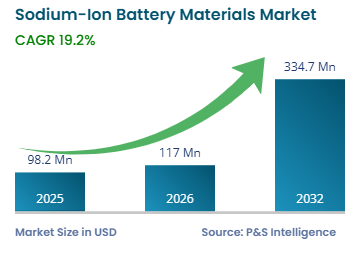
The global sodium-ion battery materials market reached USD 98.2 million in 2025. It is on track to reach USD 117.0 million in 2026 and USD 334.7 million by 2032, a 19.2% CAGR during 2026-2032. Grid-storage integrators and battery cell makers are buying cathode, anode, and electrolyte materials formulated specifically for sodium chemistry instead of adapting lithium-ion inputs, as they qualify sodium-ion cells for stationary storage and low-cost mobility applications. For materials suppliers, that shift opens a line of cell-grade purchase orders separate from the established lithium-ion supply chain.
Demand for these materials tracks growing pressure on lithium supply chains, since cell makers are looking for chemistries that do not compete for the same constrained inputs. The U.S. Geological Survey classifies lithium as a critical mineral and projects a sharp rise in demand through 2040 as electric-vehicle and energy-storage production keep expanding. Sodium-ion cells draw on sodium, iron, and manganese instead of lithium, nickel, and cobalt, feedstocks that are more widely available and less exposed to price swings. That difference is pulling material-qualification programs for sodium-ion batteries into cell factories that once relied solely on lithium-ion inputs.
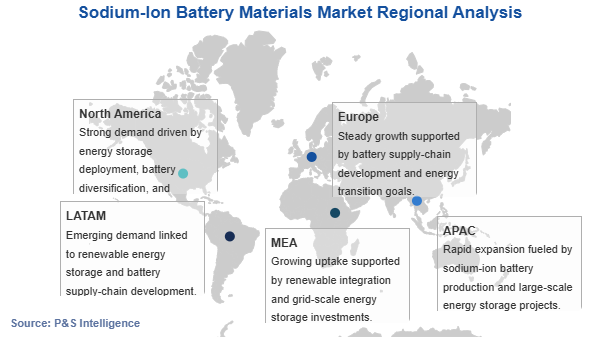
Asia-Pacific accounted for 73% of 2025 revenue, as cell manufacturers already running qualification and pilot lines in China, Japan, and India convert sodium-ion materials into finished cells faster than newer entrants elsewhere. Europe is the fastest-growing region, with its 2026-2032 CAGR reaching 24.4% as materials producers in Germany and the U.K. scale up local sodium-ion cathode and cell lines to cut reliance on Asian supply chains. Suppliers with qualified production in both regions are best placed to capture new sodium-ion battery materials orders as cell output ramps up.
Key market insights
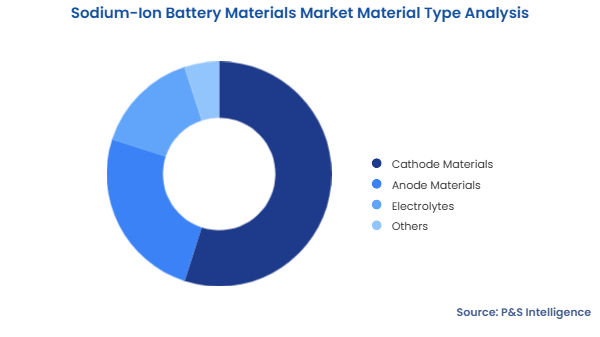
By material type, cathode materials led demand in 2025, while anode materials climbs fastest, at a 22.0% CAGR through 2026-2032.
By end-use, renewable energy & utilities/energy storage systems led demand in 2025, while industrial is set to grow at a 19.6% CAGR during 2026-2032.
By geography, Asia-Pacific held 73% share in 2025, while Europe expands fastest, at a 24.4% CAGR through 2026-2032.
Sodium-Ion Battery Materials Market Trends and Growth Drivers
Grid-storage buildout is accelerating sodium-ion material purchases
China's stationary storage build-out is pulling cathode, anode, and electrolyte orders toward sodium-ion cell lines, since utility-scale battery projects can tolerate the chemistry's lower energy density in exchange for lower material cost. Grid operators buying batteries by the megawatt-hour care more about installed cost per cycle than about extending range, a trade-off that favors sodium-ion cells once a supplier qualifies for a project.
China's Ministry of Industry and Information Technology named sodium-ion batteries a priority category in its Action Plan for Promoting High-Quality Development of the New-Type Energy Storage Manufacturing Industry, issued in February 2025, which sets out to grow several leading sodium-ion producers and widen the chemistry's application fields. A national plan of that kind gives materials suppliers a policy-backed pipeline of qualification opportunities, since provincial procurement and demonstration projects tend to follow the categories the plan singles out. Suppliers that qualify early under such a provincial project typically keep the relationship as procurement scales toward commercial volume.
Critical-mineral substitution is opening a new buyer base in Europe
Battery makers outside China are looking for chemistries that avoid nickel, cobalt, and lithium supply risk, and sodium-ion materials fit that need directly because their cathodes and electrolytes draw on sodium, iron, and manganese inputs that sit outside most countries' critical-minerals watch lists. That gives materials suppliers an opening with buyers that have spent the past two years rationing lithium-ion cell allocations and hedging against single-supplier exposure.
The European Commission selected 60 strategic projects under its Critical Raw Materials Act in 2025, several covering substitution technologies including sodium-ion chemistries, with implementation running through 2030. A materials supplier accepted into that pipeline gains co-funding and a guaranteed buyer relationship with the European cell maker it partners with, a structure that gives early movers a foothold in a region still building its own sodium-ion supply base. That guaranteed buyer relationship matters most to suppliers without an existing European plant, since it removes the need to build capacity before securing a customer.
Automotive-grade qualification is widening sodium-ion material specifications
Sodium-ion cathode and electrolyte formulations are being adapted to meet the same qualification tests that lithium-ion materials already pass for automotive use, a shift that widens the addressable buyer base beyond stationary storage. Cell makers pursuing electric two-wheelers, low-speed vehicles, and entry-level passenger cars need materials proven against the same abuse and cycle-life tests regulators already apply to lithium-ion packs before they can sell into that segment.
Sodium-ion cell products have passed China's GB 38031-2025 national safety standard for electric-vehicle traction batteries, the same standard lithium-ion packs must meet to be sold into China's EV market. Passing that standard lets a materials supplier's cathode and electrolyte formulations move from storage-only qualification files into automotive qualification files without running a separate testing track, letting early movers bid into a wider set of cell contracts. Materials suppliers still working only from storage-qualification files face a longer path into automotive contracts without a second testing track already cleared.
Lower energy density is limiting sodium-ion use in long-range vehicles
Sodium-ion cells still store less energy per kilogram than the lithium chemistries they compete against, and that gap limits which cell programs will buy sodium-ion materials at all. A cell maker building packs for long-range passenger vehicles has less reason to switch material suppliers than one building for stationary storage, light-duty mobility, or industrial equipment, where weight and range matter less than cost and cycle life.
The International Energy Agency notes that current sodium-ion cells reach about 175 watt-hours per kilogram, against up to 205 Wh/kg for the newest lithium iron phosphate cells and 265 Wh/kg for nickel-cobalt-manganese cells. That density shortfall confines near-term materials demand to stationary storage, short-range vehicles, and industrial equipment, and materials suppliers pitching sodium-ion chemistries to automakers still need a credible density roadmap before a long-range vehicle program will requalify around their products. Suppliers focused on stationary storage and light-duty mobility can scale sooner, since those buyers do not need the density gains a long-range program would require first.
Cathode materials led the market in 2025, ahead of anode materials, electrolytes, and other cell-grade inputs. Cathode active material is typically the single most expensive component in a sodium-ion cell, so layered-oxide, polyanionic, and Prussian blue chemistries account for a larger share of cell bill-of-materials cost than anode or electrolyte inputs. Cell makers scaling up production place their largest individual purchase orders with cathode suppliers first, ahead of finishing qualification of anode and electrolyte partners for the same product line. Electrolyte suppliers typically finalize terms only after the cathode chemistry is locked in.
Layered transition metal oxides held 47% of cathode material revenue in 2025, ahead of polyanionic compounds, Prussian blue analogues, and other chemistries. Layered-oxide cathodes use simpler synthesis routes and lower-cost precursors than polyanionic or Prussian blue chemistries, and their manufacturing cost sits well below competing sodium-ion cathode types. The U.S. Department of Energy's Argonne National Laboratory estimates that a cobalt-free sodium layered-oxide cathode costs roughly 40% less to produce than an equivalent lithium iron phosphate cathode, a gap that keeps layered oxide the first chemistry most cell makers qualify at scale. That cost gap keeps layered oxide the default choice.
Polyanionic compounds are projected to grow fastest among cathode types, at a 22.4% CAGR during 2026-2032. Their more stable crystal structure gives polyanionic cathodes better thermal stability and cycle life than layered oxides, qualities that matter more to buyers running high-cycle stationary storage and industrial packs than to cost-sensitive consumer cells. Cathode suppliers that qualify both layered-oxide and polyanionic product lines can serve buyers across the storage-cost and storage-durability trade-off instead of competing on price alone. Prussian blue analogues remain a smaller third category. Suppliers advancing multiple cathode chemistries can match a buyer's shift between cost and durability priorities.
Anode materials will expand faster than any other material category, at a 22.0% CAGR during 2026-2032. Hard carbon anode production is still scaling up from a small base, so even modest additional cell output translates into a large percentage increase in anode material demand. Hard carbon does not depend on the graphite supply chains that lithium-ion anodes need, letting new entrants qualify biomass and synthetic precursor sources instead of competing for existing graphite processing capacity. The International Renewable Energy Agency notes hard-carbon capacity announcements are lagging new sodium-ion cell plants, keeping qualified anode suppliers in a strong bargaining position.
End-Use
Renewable energy and utility-scale energy storage systems accounted for the largest share of sodium-ion battery materials demand in 2025. Utilities and independent power producers pairing battery storage with solar and wind capacity favor sodium-ion cells for stationary applications, where footprint and weight matter less than installed cost per cycle, letting them absorb the chemistry's lower energy density in exchange for cheaper materials. That trade-off does not hold for mobile applications, which keeps stationary storage the largest buyer of sodium-ion cathode, anode, and electrolyte materials. The U.S. Energy Information Administration recorded 15 gigawatts of new utility-scale storage capacity added in 2025.
Industrial applications are set to grow fastest, at a 19.6% CAGR during 2026-2032. Forklifts, warehouse robotics, and backup power systems run frequent charge-discharge cycles that wear out lithium-ion cells faster than sodium-ion cells tolerate, and industrial buyers value cycle life and low fire risk over compact size. As industrial equipment makers requalify their battery packs around sodium-ion chemistries, materials suppliers gain a second high-volume buyer category alongside grid storage. Materials suppliers that already meet industrial abuse-tolerance testing can enter this category without redesigning their qualification files, giving them a faster path to a second buyer base.
This report is categorized into the following segments:
Material Type
Cathode Materials
Layered Transition Metal Oxides
Polyanionic Compounds
Prussian Blue Analogues
Others
Anode Materials
Electrolytes
Others
End-Use
Renewable Energy & Utilities/Energy Storage Systems
Automotive & Transportation
Industrial
Consumer Electronics
Others
Drive strategic growth with comprehensive market analysis
Asia-Pacific Sodium-Ion Battery Materials Market outlook
Asia-Pacific generated 73% of global materials revenue in 2025, ahead of every other region. China, Japan, and India host most of the world's operating sodium-ion cell production lines, giving materials suppliers established local buyers rather than export-only relationships. Battery makers in the region already run mass lithium-ion cell manufacturing, and their qualification teams, testing equipment, and supplier relationships transferred directly into sodium-ion material sourcing, shortening the time between a new cathode or anode formulation and its first commercial order.
China, the region's largest sodium-ion materials market, hosts most of the cell-manufacturing capacity that pulls regional cathode and anode orders. The China Energy Storage Alliance reports that the country's new-type energy storage fleet reached about 144.7 gigawatts of installed capacity by the end of 2025, a buildout that is opening qualification slots for sodium-ion cell and material suppliers alongside the lithium iron phosphate systems that still dominate installed capacity.
Asia-Pacific's share is likely to stay elevated through 2032, since new cell capacity being commissioned in the region continues to specify sodium-ion materials from qualified local suppliers instead of importing them. Materials producers with plants already sited near China's, Japan's, and India's cell-manufacturing clusters keep a logistics and lead-time advantage over suppliers shipping in from other regions.
Europe is set to expand faster than any other region, with revenue climbing at a 24.4% CAGR during 2026-2032. European cell makers are building local sodium-ion capacity specifically to reduce exposure to Asian lithium-ion supply chains, and national governments are backing that shift with direct funding for domestic material and cell production rather than leaving it to private capital alone.
Germany, the region's fastest-growing sodium-ion materials market, is home to several of the cathode and cell projects driving this expansion. Germany's federal government launched a EUR 14 million program in 2025 to support domestic sodium-ion battery production, funding that is helping materials producers and cell makers there move formulations from pilot lines into qualified commercial output faster than they could on private financing alone.
Europe's growth is likely to keep outpacing the global average through 2032 as more of the region's planned cathode and cell capacity reaches commercial qualification. Materials suppliers that secure a position in Germany's and the U.K.'s early project pipelines stand to gain the most durable customer relationships as regional cell output scales up.
North America contributes a smaller share of global materials revenue, concentrated in the United States, where federal research funding still drives most current demand, ahead of commercial-scale cell manufacturing. Materials producers there are working from smaller, government-backed pilot programs instead of the gigawatt-hour production lines already running in Asia-Pacific.
The U.S. Department of Energy's Advanced Materials and Manufacturing Technologies Office issued a funding opportunity of USD 15.7 million to advance domestic manufacturing of next-generation batteries, including work aimed at improving the manufacturability and scalability of sodium-ion cells. That funding gives U.S. cathode and electrolyte developers a path to scale beyond laboratory production without waiting for a foreign cell maker to place the first large order. North America's position should strengthen gradually as these pilot-scale projects reach commercial qualification, giving domestic materials suppliers their first steady buyers.
Latin America's contribution to the global market remains small for now, with early demand concentrated in grid-storage projects ahead of automotive or consumer applications. Utilities in the region are only beginning to open standalone battery-storage procurement to new chemistries, which limits how quickly sodium-ion materials suppliers can secure contracts outside pilot deployments.
Brazil's national congress enacted Law No. 15,269/2025, the country's first comprehensive legal framework for energy storage, and the national electricity regulator is now translating that framework into technical rules covering grid-connected battery projects. As Brazilian utilities open standalone storage auctions under this new framework, sodium-ion materials suppliers gain a defined procurement channel that did not previously exist in the region, and suppliers already working with utility-scale
The Middle East and Africa hold a small but growing piece of the global market, led by grid-storage buildout in the Gulf Cooperation Council countries. Utilities there are deploying battery storage at a scale that creates room for new cell chemistries once local qualification testing is complete, though most current capacity still runs on established lithium-ion systems.
Saudi Arabia's state-owned Saudi Electricity Company connected a 7.8-gigawatt-hour battery storage development to the national grid in December 2025 under the country's National Renewable Energy Program, which targets 48 gigawatt-hours of storage capacity by 2030. Storage buildout at that scale gives materials suppliers a growing pool of future tenders to qualify sodium-ion chemistries against, and suppliers that can demonstrate qualification against Gulf utilities' testing requirements are positioned to capture a share of the region's expanding pipeline as utilities diversify beyond their current lithium-ion base.
This report is categorized into the following geographies.
The Sodium-Ion Battery Materials Market is moderately fragmented, with no single supplier holding a dominant position across cathode, anode, and electrolyte categories. Material qualification is chemistry-specific and often tied to a single cell maker's formulation, which keeps the field open to specialists even as larger diversified chemical companies enter. Capital intensity is lower than in lithium-ion materials, since several sodium-ion chemistries use simpler synthesis routes and more widely available precursors, letting newer entrants reach commercial qualification without the scale investment lithium-ion cathode plants require.
Large Chinese cell makers, including Contemporary Amperex Technology Co., Limited, BYD Company Limited, and EVE Energy Co. Ltd., compete by integrating material production alongside their own cell lines, an approach that gives them scale and speed advantages when qualifying new cathode and anode chemistries. Specialist developers such as HiNa Battery Technology Co. Ltd. and Faradion Limited compete instead on proprietary cathode and cell chemistry, targeting buyers that want a qualified material supplier without building in-house cathode capacity themselves.
European specialists Altris AB and Tiamat Energy SAS compete on that same proprietary-chemistry basis, pairing cathode or cell technology with regional manufacturing partners to scale output. Diversified industrial and chemical suppliers, including BASF SE and NGK Insulators Ltd., bring existing precursor sourcing, hard-carbon feedstock, or manufacturing infrastructure from adjacent businesses into sodium-ion material supply, giving them a cost or logistics edge over cell-focused specialists in specific material categories.
Switching a cell line to a new material supplier requires re-running safety and performance qualification, which raises the cost of changing suppliers once a formulation is locked into a production line. That qualification barrier favors suppliers that win early design-in relationships with cell makers building new sodium-ion capacity, since a supplier already qualified on one production line has an advantage bidding for that same cell maker's next facility.
Leading Companies in the Sodium-Ion Battery Materials Market:
Contemporary Amperex Technology Co. Limited
HiNa Battery Technology Co. Ltd.
Faradion Limited
Altris AB
Tiamat Energy SAS
BYD Company Limited
BASF SE
NGK Insulators Ltd.
Stora Enso Oyj
Reliance Industries Limited
EVE Energy Co. Ltd.
Xiamen Hithium Energy Storage Technology Co. Ltd.
Gotion High-Tech Co. Ltd.
Sodium-Ion Battery Materials Market Developments
In September 2026, HiNa Battery Technology Co. Ltd. signed a five-year agreement to supply 10 GWh of sodium-ion batteries to South Korea's Volta. The deal extends HiNa's sodium-ion cell technology into an export market outside China, giving its material suppliers a new multi-year order base.
In September 2026, Xiamen Hithium Energy Storage Technology Co., Ltd. launched a 4 MWh integrated sodium-ion energy storage system built around a new 785 Ah cell, with full-scale production planned for 2027. The launch moves Hithium's sodium-ion line from utility pilots toward a defined commercial product timeline.
In July 2026, Contemporary Amperex Technology Co., Limited partnered with Alfen to deploy 5 GWh of sodium-ion battery storage systems across Europe. The agreement gives CATL's sodium-ion cells their first large-scale European deployment channel outside direct exports from China.
In May 2026, Gotion High-Tech Co., Ltd. launched its "Gnascent" sodium-ion battery brand, backed by gigawatt-hour-scale production lines already running in Tangshan and Hefei, with an energy density of up to 261 Wh/kg. Mass production is targeted for the fourth quarter of 2026, positioning Gotion among the first suppliers to move sodium-ion cells from pilot to volume output.
In January 2026, Altris AB formed a cathode-material manufacturing partnership with Czech chemicals producer Draslovka to scale production of its Prussian white cathode material. The partnership gives Altris an established industrial-chemicals partner for scaling cathode output after losing its previous cell-manufacturing partner to bankruptcy in 2025.
In December 2025, EVE Energy Co. Ltd. broke ground on a sodium-ion battery production campus in Huizhou, China, backed by a RMB 1 billion (about USD 140 million) investment and targeting 2 GWh of annual capacity. The campus consolidates EVE's sodium-ion research, pilot production, and manufacturing in one site aimed at data-center and energy-storage customers.
Frequently Asked Questions About This Report
What is the projected market size of sodium-ion battery materials?+
It is on track to reach USD 117.0 million in 2026 and USD 334.7 million by 2032, a 19.2% CAGR during 2026-2032.
What materials do sodium-ion cells use compared to lithium-ion?+
Sodium-ion cells draw on sodium, iron, and manganese instead of lithium, nickel, and cobalt, feedstocks that are more widely available and less exposed to price swings.
Which region is growing fastest for sodium-ion battery materials?+
Europe is the fastest-growing region, with its 2026-2032 CAGR reaching 24.4% as materials producers in Germany and the U.K. scale up local sodium-ion cathode and cell lines to cut reliance on Asian supply chains.
Why are battery makers outside China interested in sodium-ion materials?+
That gives materials suppliers an opening with buyers that have spent the past two years rationing lithium-ion cell allocations and hedging against single-supplier exposure.
What role do cathode materials play in sodium-ion cell costs?+
Cathode active material is typically the single most expensive component in a sodium-ion cell, so layered-oxide, polyanionic, and Prussian blue chemistries account for a larger share of cell bill-of-materials cost than anode or electrolyte inputs.
Which applications favor sodium-ion cells over lithium-ion?+
Forklifts, warehouse robotics, and backup power systems run frequent charge-discharge cycles that wear out lithium-ion cells faster than sodium-ion cells tolerate, and industrial buyers value cycle life and low fire risk over compact size.
Why are layered-oxide cathodes the most common sodium-ion cathode type?+
Layered-oxide cathodes use simpler synthesis routes and lower-cost precursors than polyanionic or Prussian blue chemistries, and their manufacturing cost sits well below competing sodium-ion cathode types.
Want a report tailored exactly to your business need?
Leading companies across industries trust us to deliver data-driven insights and innovative solutions for their most critical decisions. From data-driven strategies to actionable insights, we empower the decision-makers who shape industries and define the future. From Fortune 500 companies to innovative startups, we are proud to partner with organisations that drive progress in their industries.
Client Testimonials
Working with P&S Intelligence and their team was an absolute pleasure – their awareness of timelines and commitment to value greatly contributed to our project's success. Eagerly anticipating future collaborations.
McKinsey & Company
India
Unmatched Standards
Our insights into the minutest levels of the markets, including the latest trends and competitive landscape, give you all the answers you need to take your business to new heights
Complete Data Security
We take a cautious approach to protecting your personal and confidential information. Trust is the strongest bond that connects us and our clients, and trust we build by complying with all international and domestic data protection and privacy laws