This Report Provides In-Depth Analysis of the Smart Packaging Market Report Prepared by P&S Intelligence, Segmented by Technology (Active Packaging, Intelligent Packaging, Modified Atmosphere Packaging (MAP)), End Use (Food & Beverages, Pharmaceuticals & Healthcare, Personal Care & Cosmetics, Electronics, Automotive, Logistics & E-commerce), Packaging Format (Labels & Tags, Films & Wraps, Bottles & Containers, Boxes & Cartons, Blister & Strip Packs), and Geographical Outlook for the Period of 2022 to 2033
Explore the market potential with our data-driven report
Smart Packaging Market Overview
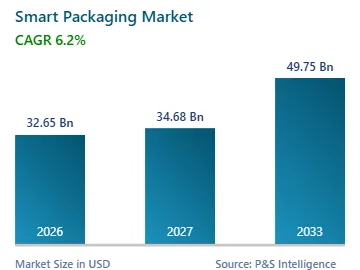
The global smart packaging market size is estimated at USD 32.65 billion in 2026 and is expected to rise to USD 34.68 billion in 2027. Revenue is projected to reach USD 49.75 billion by 2033, advancing at a 6.2% CAGR during 2027-2033. Meat processors, grocers, and drug makers are the main buyers, paying for oxygen absorbers, modified atmospheres, freshness indicators, and RFID labels that keep perishable goods saleable for longer and show where a pack has been. For converters, each added function lifts the value of a pack that would otherwise be bought on unit price alone.
Grocers and meat processors carry the cost of spoiled stock themselves, which is why they pay for packaging that adds saleable days. According to the UN Environment Programme, 1.05 billion tonnes of food were wasted in 2022, and retail accounted for 12% of that total. The figure covers waste across the food system and does not measure packaging purchases, but it explains why a retailer will pay extra for an absorber, a gas-flushed tray, or an indicator. Suppliers that can document longer shelf life for a specific product line have a stronger case in price talks with food buyers.
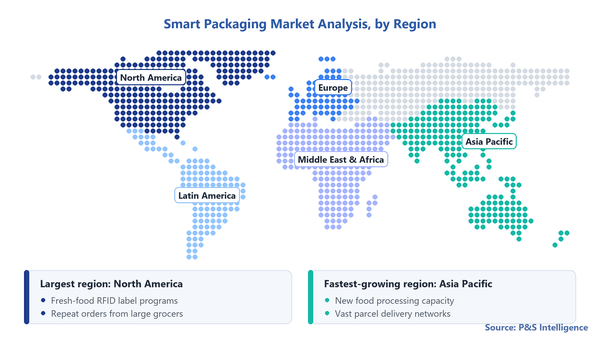
North America accounts for 40% of revenue in 2026, supported by grocery, meat, and pharmaceutical supply chains in the U.S. and Canada that already buy smart functions as routine line items. Asia-Pacific is set to grow fastest, at an 8.6% CAGR during 2027-2033, as food processors and parcel networks in China and India add capacity that can carry smart features from the start. North American spending grows mostly through upgrades to existing packs, while new lines and first-time buyers in Asia account for a rising part of smart packaging market growth.
Key market insights
By technology, active packaging represents 47% of revenue in 2026, while intelligent packaging is forecast to expand at an 8.0% CAGR during 2027-2033.
By end use, food & beverages accounts for 46% of 2026 revenue, and pharmaceuticals & healthcare is set to expand at a 7.5% CAGR during 2027-2033.
By geography, North America contributes 40% of revenue in 2026, while Asia-Pacific is expected to advance at an 8.6% CAGR during 2027-2033.
Smart Packaging Market Drivers & Opportunities
Perishable losses before retail are driving spend on shelf-life packaging
Meat packers, produce shippers, and dairy processors lose product between the farm and the store shelf, and every spoiled pallet is margin they cannot recover. Active packaging and modified atmospheres lengthen the selling window, which lets a processor weigh the cost of an absorber or a gas-flushed tray against the value of stock it no longer writes off. Purchases tend to start in the fastest-spoiling categories, because that is where the payback is easiest to prove to a finance team.
The Food and Agriculture Organization estimates that 13.3% of food was lost after harvest and before retail in 2023, with losses for fruits and vegetables reaching 25.4%. These shares size the problem, not packaging purchases, and much of the loss occurs on farms or in storage where a better pack is not the remedy. Where packaging does change the outcome, the case is strongest in fresh produce and meat. Suppliers holding shelf-life trial data for those categories can sell on the value of each extra day on shelf instead of the price per pack.
Package-level drug tracing is redefining what pharmaceutical packs carry
Drug manufacturers and wholesalers now treat the individual pack, instead of the pallet or case, as the unit they must identify and follow through distribution. That shift moves product data from shipping documents onto the pack itself, so carton and label specifications for prescription drugs include a serialized code that must print or encode reliably at line speed. For packaging suppliers, a pharmaceutical carton has become a data carrier as well as a container, which raises the technical bar for printing and inspection on every line.
As per the US Food and Drug Administration, the Drug Supply Chain Security Act sets out steps toward an interoperable, electronic way to identify and trace certain prescription drugs at the package level. The law does not require RFID tags, sensors, or any specific smart component, and a printed code can satisfy its identifier requirement. Its commercial effect is to make package-level data routine, which can make it easier for drug makers to add temperature indicators or NFC tags to the same pack later. Converters already printing serialized codes are better positioned to offer those additions.
Two-dimensional codes at checkout are opening a route to connected packs
Brand owners in grocery and personal care have long printed a linear barcode for checkout and, on some packs, a separate QR code for marketing. Retail systems that read a two-dimensional code at the till let one symbol carry batch, expiry, and a web link, which turns a compliance-driven artwork change into a chance to add consumer and traceability content. Once that code is on the pack, the extra cost of a connected feature falls, and the brand can test digital content without buying a new label format.
Per GS1 US, its Sunrise 2027 initiative supports retailers in readying point-of-sale systems to read 2D barcodes such as QR codes, and it advises brands to update existing QR codes to the GS1 Digital Link standard. GS1 describes 2027 as a transition milestone that brands and retailers can approach in stages. A code used only at checkout remains a standard barcode, so the gain for smart packaging comes when brands use the same code for connected content. Label printers able to manage variable data across many products could pick up repeat work as brands convert.
Recyclability requirements are constraining embedded components in packs
Brand owners selling into Europe face a goal that their packaging be recyclable by 2030, and an RFID inlay with a metal antenna, a plastic absorber sachet, or a printed sensor can complicate sorting and fiber or plastic recovery. Each added component becomes a design question for the packaging engineer, and some buyers may hold back a connected or active feature until they know it will not lower a pack's recyclability rating. The risk is greatest for small inserts that combine metal, chips, and plastic in one piece.
The European Commission confirms that the Packaging and Packaging Waste Regulation, in force since February 11, 2025 and applicable from August 12, 2026, aims to make all packaging recyclable in an economically viable way by 2030. The regulation has no rule specific to smart components, so each added part counts toward the whole pack's recyclability. Tageos launched a paper-based NFC inlay on April 15, 2026 that it said improves paper recyclability, with prototype samples first and volume orders expected from the third quarter of 2026. If such designs qualify at scale, the restraint would ease first for fiber packs.
Segmentation Analysis
Technology
Active packaging represents 47% of smart packaging market revenue in 2026. Its lead comes from consumables placed in or on every pack, including oxygen absorbers, moisture-control packets, and ethylene scavengers. Mitsubishi Gas Chemical's AGELESS absorbers, used in foods and in drug products such as prefilled syringes and tablets, show how one component can serve both large end uses. Because these inserts fit inside an existing pack design, buyers can add them without changing filling lines, which tends to keep reorder volumes steady. Each absorber is used only once, so revenue in this category rises with the number of packs filled.
Intelligent packaging is expected to grow fastest of the three technologies, at an 8.0% CAGR during 2027-2033. Retailers and cold-chain operators want proof of a product's condition and location at the level of the single pack, and indicators and data carriers supply it. Zebra Technologies sells Fresh-Check food indicators that change color after heat exposure that can speed spoilage, letting a store worker or inspector read a pack's temperature history at a glance. Grocers' item-level RFID programs for fresh food widen the range of products where such labels pay back, which favors label converters already approved by large grocery chains.
End Use
Food & beverages accounts for 46% of revenue in 2026 because meat, dairy, bakery, and fresh produce lose value by the day and are sold through retailers that write off expired stock. Processors in these categories use modified atmospheres, absorbers, and freshness indicators to stretch the selling window, and some large grocers now add RFID labels to fresh items to manage stock rotation and markdowns. Food buyers bring large order volume, so suppliers compete on cost per pack as well as on shelf-life performance. Thin margins on everyday items lead food buyers to keep indicators and tags for higher-value lines.
Pharmaceuticals & healthcare is set to outpace other end uses, at a 7.5% CAGR during 2027-2033. Vaccines, biologics, and other temperature-sensitive drugs need evidence that a pack stayed within its range, and serialized codes already printed on drug packs give manufacturers a base for adding further functions. Drug makers judge packaging against the cost of a failed or recalled batch, which supports spending on indicators and absorbers that would be hard to justify on a low-value food item. That spending favors suppliers with pharmaceutical-grade quality systems, since drug makers qualify packaging vendors against their own quality standards for each product.
Packaging Format
Labels & tags carry many of the intelligent functions, since indicators, RFID inlays, and NFC chips can be applied directly to an existing bottle, carton, or film without redesigning the pack. That makes labels the easiest entry point for a brand testing freshness or connected features, and it ties the format's sales to label converters' order cycles. Films & wraps and bottles & containers hold more of the active and modified atmosphere functions, where barrier film or tray gas does the work. Linde, which supplies gases and not packs, sells product-specific MAP programs under its MAPAX name to food processors.
Boxes & cartons and blister & strip packs serve the shipping and pharmaceutical channels, and each format counts here only when the pack carries an active, intelligent, or modified atmosphere function. Fiber cartons are where paper-based RFID and NFC inlays are being trialed, since a tag that adds no plastic or metal is less likely to complicate fiber recycling. Blister & strip packs hold unit-dose medicines, which ties this format to pharmaceutical demand. Format choice also decides which supplier in the chain captures the value of the smart function, whether the label converter, the film maker, or the carton plant.
The following segments are analyzed in this report:
Technology
Active Packaging
Intelligent Packaging
Modified Atmosphere Packaging (MAP)
End Use
Food & Beverages
Pharmaceuticals & Healthcare
Personal Care & Cosmetics
Electronics
Automotive
Logistics & E-commerce
Others
Packaging Format
Labels & Tags
Films & Wraps
Bottles & Containers
Boxes & Cartons
Blister & Strip Packs
Geographical Analysis
North America smart packaging market outlook
North America holds 40% of global revenue in 2026, the largest regional share. Grocery chains, meat packers, and drug distributors in the U.S. and Canada already buy absorbers, modified atmosphere trays, and temperature indicators as routine line items, so most spending comes from repeat orders and upgrades within existing accounts. Retailer RFID programs for fresh food add a newer layer of demand, because one chain's label specification can then apply to every store and supplier it serves.
The U.S. is the region's largest market. U.S. Census Bureau data show that e-commerce made up 17.1% of total retail sales in the second quarter of 2026, a figure that sizes the parcel channel where shipment indicators and tracking labels are used, not the adoption of those labels. Growth here depends more on higher value per pack than on new packaging lines. North America is likely to keep the largest share, though its lead could narrow as Asian capacity expands, a pattern that tends to favor converters already approved by large retailers and drug makers.
Asia-Pacific smart packaging market growth
Asia-Pacific is expected to post the fastest growth of any region, an 8.6% CAGR during 2027-2033, and its demand comes more from new capacity than from upgrades. Food processors, cold-chain operators, and parcel carriers in China and India are adding lines and routes, and each new line gives a buyer the chance to specify an absorber, a gas-flushed tray, or a tracking label from the outset. Japan adds a mature base of active packaging users, with oxygen absorbers long used in its food and drug supply.
India is the region's fastest-growing country market, with food processing and pharmaceutical exports adding new packing lines. In China, figures from the State Post Bureau put China's express parcel volume at 199 billion items in 2025, up 13.7% from the year before. That count measures shipments, not smart packaging use, yet it shows the scale of the logistics network into which tracking labels and shipment indicators can be added. Price-sensitive buyers may keep many packs plain, so suppliers with local converting plants are likely to compete more effectively than importers.
Europe market analysis
Europe's demand, across Germany, the United Kingdom, France, and smaller national markets, is shaped as much by packaging law as by food spending. European grocers widely use modified atmosphere trays for chilled meat and ready meals, so much of the region's spending goes into replacing and redesigning existing packs. Recyclability rules mean many of those redesigns now try to keep the shelf-life function while removing layers or materials that block recycling, which shifts orders toward simpler barrier structures.
Eurostat recorded 57.9 million tonnes of food waste in the EU in 2024, with 19% generated in food and beverage manufacturing and 8% in retail and other distribution. Those stages are where processors and retailers absorb the loss directly and have a cost case for shelf-life functions. Suppliers able to offer mono-material barrier films or fiber-based tags that pass recycling assessments are better placed in European retail tenders, while suppliers relying on mixed-material inserts may face more redesign requests from buyers.
Latin America market analysis
Latin America trails the larger regions, with demand anchored in Brazil's meat export industry and Mexico's food processing sector. Exporters shipping chilled beef and poultry over long sea routes rely on vacuum and modified atmosphere packs that hold quality for weeks, which makes shelf-life performance a condition of reaching distant buyers. Each new long-distance market extends the time a pack must protect its contents, so export growth and packaging specification tend to move together in the region.
Copyright P&S Intelligence. Reuse requires attribution under CC BY 4.0.
The Brazilian Association of Meat Exporting Industries puts Brazil's 2025 beef exports at 3.5 million tonnes, shipped to 177 countries. That volume sizes the export base, not packaging purchases, but it shows how much chilled and frozen product depends on packs that perform over long transit times. Mexico adds a second channel through processors that supply U.S. retailers, whose labeling and traceability requirements can flow down to them. Packaging suppliers with plants close to Brazilian meat-processing hubs are better placed to serve this demand than those shipping film from overseas.
Middle East & Africa market analysis
Middle East & Africa contributes a smaller share of global demand, concentrated in the U.A.E. and Saudi Arabia. Both countries bring much of their food in over long, hot supply chains, which raises the value of packaging that limits spoilage and records temperature exposure between port and shelf. Under its National Food Security Strategy 2051, the U.A.E. aims to diversify food import sources, with three to five supply sources for each major food category. Each added origin brings another route and transit time that a pack has to survive.
Much of the smart function in the region is likely to arrive on imported goods, chosen by brand owners and exporters before shipment, which keeps locally purchased volume modest. More domestic food processing in the Gulf would change that by moving more packing, and more packaging decisions, into the region. Pharmaceutical distribution adds a steadier stream, since temperature-sensitive medicines need condition evidence on arrival. Suppliers with warehousing or converting partners in the U.A.E. and Saudi Arabia are better placed to serve that shift than exporters selling from distant plants.
The following geographies are analysed in this report.
North America
U.S.
Canada
Asia-Pacific
China
Japan
India
Australia
South Korea
Rest of Asia-Pacific
Europe
Germany
U.K.
France
Italy
Spain
Rest of Europe
Latin America
Brazil
Mexico
Rest of Latin America
Middle East & Africa
U.A.E.
Saudi Arabia
South Africa
Rest of Middle East & Africa
Smart Packaging Market Competition Analysis
The smart packaging market is moderately fragmented, because the value in a smart pack is split across several supplier layers. Flexible and rigid converters make the pack, label and identification companies supply indicators and RFID inlays, and chemical and gas companies supply barrier resins, absorber chemistry, and modified atmosphere gases. No single company spans all of those layers at scale, and food, pharmaceutical, and logistics buyers each qualify suppliers separately. The structure is evolving as converters combine, but the split between pack makers and function suppliers has held.
Converters such as Amcor, Sealed Air, and Huhtamaki compete on barrier films, trays, and documented shelf-life performance for food and healthcare buyers. Fiber packaging groups including Smurfit Westrock, International Paper, and Stora Enso bring cartons and corrugated packs where paper-based tags can be built in. Label and identification suppliers such as Avery Dennison and Zebra Technologies compete on inlay and indicator performance and on approvals from retailers and drug makers. BASF and Linde sit further upstream, supplying materials and gases that converters and food processors use, so their position depends on how widely those inputs are specified.
Switching costs differ by end use. A drug maker that has validated an indicator or absorber on a pack must revalidate before changing supplier, which tends to keep approved suppliers in place for the life of a product. Food buyers can rebid films and trays more readily, since a change usually calls for shelf-life trials instead of formal revalidation. Recent combinations among converters, including Amcor's merger with Berry Global and International Paper's purchase of DS Smith, have enlarged the biggest pack makers without changing the split between pack makers and function suppliers.
Major Companies in Smart Packaging Market:
Amcor plc
Sealed Air Corporation
3M Company
Avery Dennison Corporation
BASF SE
Ball Corporation
Crown Holdings Inc.
Zebra Technologies Corporation
Huhtamaki Oyj
Stora Enso Oyj
International Paper Company
DuPont de Nemours Inc.
Linde plc
Smurfit Westrock plc
Smart Packaging Market News
In April 2026, Sealed Air Corporation completed its acquisition by funds affiliated with Clayton, Dubilier & Rice at an enterprise value of USD 10.3 billion, with stockholders receiving USD 42.15 in cash per share and the stock delisted from the New York Stock Exchange. The CRYOVAC owner now runs its food and protective packaging businesses under private ownership with a longer investment horizon.
In February 2026, Avery Dennison Corporation launched its AD IdentiFresh RFID inlay series for bakery, meat, deli, and produce, built on Impinj M800 series chips and designed to read reliably on densely stacked items in high-moisture cold cases. The inlays target fresh categories where moisture and dense stacking make item-level RFID tags harder to read, a practical obstacle for grocers digitizing fresh departments.
Last Updated: October 2026
Frequently Asked Questions About This Report
What is the size of the smart packaging market?+
The global smart packaging market size is estimated at USD 32.65 billion in 2026 and is expected to rise to USD 34.68 billion in 2027.
What is driving demand for smart packaging?+
Grocers and meat processors carry the cost of spoiled stock themselves, which is why they pay for packaging that adds saleable days.
Which region dominates the smart packaging market?+
North America accounts for 40% of revenue in 2026, supported by grocery, meat, and pharmaceutical supply chains in the U.S. and Canada that already buy smart functions as routine line items.
Which region is growing fastest in the smart packaging market?+
Asia-Pacific is set to grow fastest, at an 8.6% CAGR during 2027-2033, as food processors and parcel networks in China and India add capacity that can carry smart features from the start.
Which technology leads the smart packaging market?+
Active packaging represents 47% of smart packaging market revenue in 2026. Its lead comes from consumables placed in or on every pack, including oxygen absorbers, moisture-control packets, and ethylene scavengers.
Who are the key players in the smart packaging market?+
Converters such as Amcor, Sealed Air, and Huhtamaki compete on barrier films, trays, and documented shelf-life performance for food and healthcare buyers.
Want a report tailored exactly to your business need?
Leading companies across industries trust us to deliver data-driven insights and innovative solutions for their most critical decisions. From data-driven strategies to actionable insights, we empower the decision-makers who shape industries and define the future. From Fortune 500 companies to innovative startups, we are proud to partner with organisations that drive progress in their industries.
Client Testimonials
Working with P&S Intelligence and their team was an absolute pleasure – their awareness of timelines and commitment to value greatly contributed to our project's success. Eagerly anticipating future collaborations.
McKinsey & Company
India
Unmatched Standards
Our insights into the minutest levels of the markets, including the latest trends and competitive landscape, give you all the answers you need to take your business to new heights
Complete Data Security
We take a cautious approach to protecting your personal and confidential information. Trust is the strongest bond that connects us and our clients, and trust we build by complying with all international and domestic data protection and privacy laws