Smart Indoor Air Quality Sensors Market Size & Share Analysis - Trends, Drivers, Competitive Landscape, and Forecasts (2025 - 2032)
This Report Provides In-Depth Analysis of the Smart Indoor Air Quality Sensors Market Report Prepared by P&S Intelligence, Segmented by Product Type (Fixed Monitors, Portable Monitors), Pollutant Type (Chemical Pollutants, Physical Pollutants, Biological Pollutants), Technology (NDIR Sensors, Electrochemical Sensors, Laser Scattering / Laser-Based Sensors, Metal Oxide Semiconductor (MOS) Sensors, Photoionization Detector (PID) Sensors), Connectivity (Wi-Fi, Bluetooth, Zigbee, Cellular), End-Use (Commercial, Residential, Industrial, Government Buildings), and Geographical Outlook for the Period of 2021 to 2032
Smart Indoor Air Quality Sensors Market Size Estimation
Key Highlights
Study Period
2021 - 2032
Market Size in 2025
USD 2.23 Billion
Market Size in 2026
USD 2.43 Billion
Market Size by 2032
USD 4.12 Billion
Projected CAGR
9.2%
Largest Region
North America
Fastest Growing Region
Asia-Pacific
Market Structure
Moderately Fragmented
Market Size
Explore the market potential with our data-driven report
Smart Indoor Air Quality Sensors Market Overview
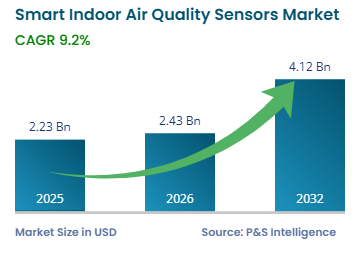
The global smart indoor air quality sensors market stood at USD 2.23 billion in 2025, and the 2026 estimate is USD 2.43 billion. Revenue is projected to reach USD 4.12 billion by 2032, growing at a CAGR of 9.2% during 2026-2032. Facility managers, homebuilders, and school districts are installing connected CO2, particulate, and VOC sensors that send readings to an app or building system, replacing wall-mounted gauges nobody checks. For device makers, that shift turns a one-time HVAC accessory into a recurring line item tied to ventilation compliance and occupant health expectations.
The World Health Organization estimates that household air pollution caused 3.2 million deaths in 2020, mostly from cooking and heating with polluting fuels in low-income homes. That toll falls mainly outside this market's core buyers, but it shows how much harm indoor pollutants can do, and building owners in wealthier regions often measure conditions instead of assuming ventilation is adequate. A monitor that flags elevated CO2 or particulate levels gives a facility team, landlord, or parent a concrete trigger to act, which converts general health awareness into a specific purchase.
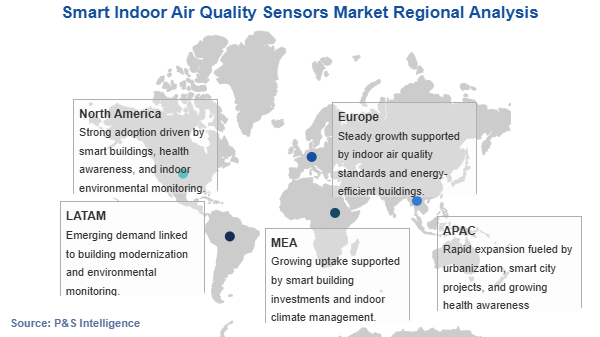
North America accounted for 35% of 2025 revenue, as facility owners in the U.S. and Canada retrofit offices, schools, and multifamily buildings with connected monitors. Asia-Pacific is on track for the fastest growth through 2032, because new residential and commercial construction across China, Japan, and India gives vendors a route to first-time buyers who can specify smart indoor air quality sensors from day one. That contrast, a mature region buying upgrades and a region buying into buildings as they go up, shapes which vendors compete for each order.
Key Market Insights
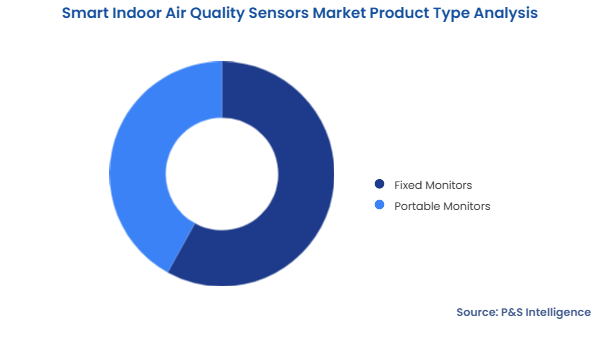
By product type, fixed monitors led with 58% of 2025 revenue, while Portable Monitors lead growth through 2026-2032.
By pollutant type, chemical pollutants led with 50% of 2025 revenue and also lead growth through 2026-2032.
By technology, electrochemical sensors led with 41% of 2025 revenue, while Laser Scattering Sensors lead growth through 2026-2032.
By connectivity, Wi-Fi led with 42% of 2025 revenue and also leads growth through 2026-2032.
By end-use, commercial buyers led with 34% of 2025 revenue, while Residential leads growth through 2026-2032.
By geography, North America contributed 35% of 2025 revenue, while Asia-Pacific is the fastest-growing region during 2026-2032.
Smart Indoor Air Quality Sensors Market Trends and Growth Drivers
School Air-Quality Management Plans Are Reshaping Institutional Buying Cycles
Schools and other public buildings are adopting formal indoor air quality management plans that treat monitoring as a continuing task instead of a one-time inspection. A district that commits to tracking CO2, particulates, and humidity in occupied classrooms needs a device in each room, so a compliance decision becomes a recurring hardware order that repeats as buildings are added and older sensors wear out.
The U.S. Environmental Protection Agency awarded USD 34 million across five grants in 2024 to organizations helping schools in low-income, disadvantaged, and Tribal communities build indoor air quality management capacity. Grantees train district staff to write and carry out plans, and continuous monitoring is a natural part of that work, so grant-funded districts are likely early buyers. Vendors selling into public-building budgets gain a steadier pipeline than one tied to a single mandate, since a plan can generate expansion and replacement orders across several budget cycles.
Demand-Controlled Ventilation Requirements Are Driving Sensor Attachment Rates
Commercial building codes increasingly tie ventilation rates to real-time occupancy signals instead of fixed airflow, and CO2 concentration is the standard proxy for occupancy in densely used spaces such as classrooms, conference rooms, and open offices. Meeting that requirement means installing a CO2 sensor at the space level and wiring it into the building's control system, which turns a code requirement directly into a sensor purchase for every qualifying room.
The 2025 edition of ASHRAE's ventilation and indoor air quality standard, 62.1, added new demand-controlled ventilation sequences along with humidity-control and emergency-ventilation-control requirements that also depend on continuous sensing. Building owners renovating to the latest edition often replace legacy CO2 sensors with connected units that report to a building-management platform, not a stand-alone controller. Suppliers whose sensors work with common building-automation protocols are better placed to win these code-driven replacement orders than suppliers selling isolated hardware.
Wellness Building Certification Is Opening a Recurring Verification Market
Building owners pursuing health and wellness certification for office and residential properties must show air quality performance over time, not just at handover. That creates demand for monitoring hardware that stays in service for the life of the certification, and it favors continuous connected sensors over portable test kits used once. A wellness-certified building becomes a standing customer for calibration, data logging, and replacement sensors.
The International WELL Building Institute reported that more than 6 billion square feet of real estate across nearly 100,000 locations in 137 countries was engaged with its standard as of mid-2025. Recertification cycles give owners a reason to keep monitoring equipment installed and calibrated once a plaque is awarded. Sensor vendors that can supply recertification-ready hardware and data logging stand to capture repeat orders as more properties pursue or renew certification, and they can sell the same package to each new building in a portfolio.
Wireless Certification Requirements Are Limiting Smaller Vendor Entry
Every connected sensor that transmits over Wi-Fi, Bluetooth, Zigbee, or cellular must clear radio-frequency equipment authorization before it can be sold, and that process adds cost and lead time to product launches. Smaller manufacturers building a single new sensor model absorb a fixed compliance cost that larger vendors spread across many product lines, which slows the pace at which new entrants can bring connected monitors to market.
The U.S. Federal Communications Commission requires devices with intentional radio transmitters to be tested by accredited laboratories and authorized before they are marketed in the U.S.. That step delays revenue recognition for a new sensor model and raises the working capital a startup needs before its first shipment, months before any sales revenue arrives. A vendor that launches five single-purpose devices pays that cost five times. Because the cost applies per radio design, vendors with fewer, reusable hardware platforms absorb it more easily than manufacturers launching many single-purpose devices.
Smart Indoor Air Quality Sensors Market Segmentation Analysis
Product Type
Fixed monitors accounted for 58% of 2025 revenue. Building owners install fixed units in HVAC ducts, ceilings, or wall panels to give a permanent, room-by-room read of CO2, particulates, and VOCs that ties directly into the building's control system, an integration a portable unit cannot offer. Facility teams managing dozens of rooms also standardize on fixed hardware because it removes the risk of a unit being moved, unplugged, or left in a drawer, keeping every zone under continuous coverage.
Portable monitors are set to post the fastest growth over 2026-2032. Falling prices for compact, battery-powered units let renters, homeowners, and small offices buy one device to check air quality room by room without a wired installation. Portable units also suit landlords and inspectors who need to spot-check several properties with one instrument, extending demand to buyers who would otherwise skip monitoring altogether.
Pollutant Type
Chemical pollutants, including VOCs and formaldehyde, accounted for 50% of 2025 revenue. These gases come off paint, adhesives, furnishings, and cleaning products used continuously indoors, giving building operators an ongoing source to track instead of an occasional event. Multi-gas modules that detect several chemical pollutants at once are increasingly common in both fixed and portable devices, which suits buyers who want one instrument to cover a whole room.
Chemical pollutants are also set to grow fastest over 2026-2032. Off-gassing from new furnishings, adhesives, and finishing materials can continue well after a building or renovation is complete, so buyers are likely to keep adding VOC-capable modules as interiors are refreshed. Sensor makers are packaging VOC and formaldehyde detection alongside particulate and CO2 sensing in single modules, which raises the average selling price of devices sold into this category.
Technology
Electrochemical sensors accounted for 41% of 2025 revenue. These sensors detect specific gases, such as carbon monoxide and formaldehyde, with a low-power electrochemical cell, so device makers can use them in both plug-in and battery-powered monitors. A laboratory evaluation of a low-cost electrochemical formaldehyde sensor, hosted in the U.S. National Institutes of Health's PubMed Central repository, reported a detection limit of roughly 11 parts per billion, a sensitivity that helps explain why manufacturers use the technology in mid-market fixed and portable products.
Laser scattering Sensors are set to grow fastest over 2026-2032. These sensors count particles optically, giving finer size resolution than cheaper LED-based optical counters, which matters as buyers ask to separate PM2.5 from PM10 instead of seeing one combined figure. Premium fixed monitors and commercial-building systems are likely to adopt laser-based modules first, since the added cost is easier to absorb across a facility-wide installation than in a single consumer device.
Connectivity
Wi-Fi-enabled devices accounted for 42% of 2025 revenue. Most homes and offices already run a Wi-Fi network, so a Wi-Fi sensor connects to existing infrastructure without a separate hub or gateway purchase, which keeps installation simple for both consumers and facility teams. Manufacturers also favor Wi-Fi because it lets a device push data directly to a cloud dashboard or mobile app without an intermediary bridge, a feature homeowners and single-site businesses value most.
Wi-Fi is also set to grow fastest through 2026-2032, as more monitors add native smart-home protocol support on top of it. The Matter interoperability standard can run over Wi-Fi as well as Thread, and Wi-Fi's installed base makes it an easy default for vendors building multi-brand compatibility into new models. Vendors that ship Wi-Fi-first hardware can list on more smart-home platforms at launch than those relying on a proprietary hub.
End-Use
Commercial buyers accounted for 34% of 2025 revenue. Office landlords, retail operators, and hospitality groups manage the largest floor area per buyer, so a single sale often covers dozens of sensors across one property instead of a single unit sold to a household. Property managers who want to show tenants healthy occupancy conditions have a reason to instrument every leased floor, which supports repeat orders as leases turn over.
Residential demand is set to grow fastest over 2026-2032. Consumer awareness of indoor pollutants, combined with falling prices for smart-home-compatible monitors, is pulling in first-time buyers who previously owned no monitoring device at all. Retailers and smart-home platforms are bundling air-quality sensors with other connected home devices, turning what was once a specialist purchase into an add-on bought alongside thermostats and smart plugs.
The complete segmentation hierarchy is as follows:
Product Type
Fixed Monitors
Portable Monitors
Pollutant Type
Chemical Pollutants
Physical Pollutants
Biological Pollutants
Technology
NDIR Sensors
Electrochemical Sensors
Laser Scattering / Laser-Based Sensors
Metal Oxide Semiconductor (MOS) Sensors
Photoionization Detector (PID) Sensors
Connectivity
Wi-Fi
Bluetooth
Zigbee
Cellular
Others
End-Use
Commercial
Residential
Industrial
Government Buildings
Drive strategic growth with comprehensive market analysis
Smart Indoor Air Quality Sensors Market Geographical Analysis
North America Smart Indoor Air Quality Sensors Market Outlook
North America held 35% of the Smart Indoor Air Quality Sensors Market in 2025, the largest share of any region. Offices, multifamily housing, and school districts across the U.S. and Canada already run building-management systems, which gives a connected sensor existing wiring and software to plug into without a new control layer. HVAC contractors who already serve these buildings can also shorten the time between a purchase decision and an installed device, which keeps repeat and replacement orders concentrated in the region.
The U.S., the biggest single country market in the region, holds most of this installed base, including the offices and school districts most likely to reorder. Health Canada's residential indoor air quality guideline sets a long-term carbon dioxide exposure limit of 1,000 ppm averaged over 24 hours, a threshold that gives homeowners and landlords a specific number to test against. That kind of numeric guideline supports steady replacement demand for CO2-capable monitors even in a region with limited new-construction growth.
North America's share should hold as spending shifts from first-time installations toward replacing aging sensors and adding units to buildings that skipped monitoring during construction. Vendors with established service relationships in the region are best placed to capture this replacement cycle, since a facility team swapping out a failed sensor usually reorders from the supplier it already uses.
Asia-Pacific is projected to outgrow every other region through 2032. Building standards across the region are bringing indoor environment requirements into new construction, and rapid urban residential and commercial building gives vendors a much larger pool of first-time buyers than mature markets can offer. A sensor specified at the design stage is bought with the project, so vendors that win architects and developers early lock in the order before the building opens.
China illustrates the shift most clearly. China's Ministry of Housing and Urban-Rural Development issued new national standards for residential buildings, effective May 1, 2025, that cover indoor environment and building equipment as core sections alongside structure and safety. Developers building to the standard must address indoor conditions at the design stage, which is likely to pull sensor specification earlier into the construction cycle than in markets where retrofit is the norm.
Growth should stay ahead of other regions as more of the region's new housing and office stock is built to codes that address indoor environments from the start. Sensor makers with manufacturing or assembly capacity inside the region can price closer to local developers' budgets than importers shipping finished units from elsewhere, an edge as this construction-linked demand scales.
Europe contributes a smaller share of global demand than North America, supported by a well-established base of commercial and institutional buildings undergoing energy and ventilation upgrades. Building-renovation requirements across Germany, the U.K., France, Italy, and Spain increasingly draw on harmonized European ventilation criteria, which gives one technical specification effect across several national markets and spares sensor vendors a patchwork of local rules.
The European Committee for Standardization approved the 2025 revision of EN 16798-3, the ventilation standard for non-residential buildings, as part of the family of standards that supports the European framework for building energy performance. Because ventilation criteria sit alongside the energy calculations owners already prepare, monitoring can be folded into renovation work already planned. Germany's large commercial and industrial building stock is likely to keep anchoring regional demand as owners upgrade older ventilation systems.
Latin America is a smaller buying region, and Brazil's commercial and institutional buildings are the likeliest early buyers. Rising urban construction and a growing base of internationally certified office towers give building owners in the region's larger cities a reason to specify monitoring equipment that meets criteria buyers elsewhere already expect.
Brazil's standards body, ABNT, published NBR 17037 in 2024, replacing the health agency ANVISA's long-standing Resolution 09 on air-conditioned indoor environments and giving commercial building operators a current technical reference for evaluating indoor air quality. Mexico's export-manufacturing and hospitality sectors are a second, smaller pocket of potential demand as facility operators pursue building-certification goals. Suppliers already active in Brazil's commercial segment have the clearest path into Mexico's smaller pockets as well.
The Middle East and Africa hold a smaller slice of global orders, with commercial and hospitality construction in the Gulf states the likeliest source of orders. Large new-build office and hotel projects in the region often pursue international sustainability certification, which brings indoor air monitoring into the project specification well before occupancy instead of as a later addition.
The GCC Standardization Organization adopted GSO 3000:2025 as the Gulf's unified sustainable-building standard, with indoor environment named among its assessment categories alongside energy and water. Developers targeting certification under the standard have a reason to demonstrate indoor environmental performance, which gives sensor vendors a specification-driven route into Gulf construction projects. South Africa's commercial and mining sectors are a smaller, separate pocket of potential demand as operators pursue similar building-performance goals.
The regions and countries this report covers are listed below.
North America
U.S.
Canada
Asia-Pacific
China
Japan
India
Australia
South Korea
Rest of Asia-Pacific
Europe
Germany
U.K.
France
Italy
Spain
Rest of Europe
Latin America
Brazil
Mexico
Rest of Latin America
Middle East and Africa
South Africa
U.A.E.
Saudi Arabia
Rest of Middle East & Africa
Smart Indoor Air Quality Sensors Market Competitive Landscape
The Smart Indoor Air Quality Sensors Market is moderately fragmented, with no single supplier holding a commanding share. Building an accurate gas or particulate sensor module takes specialized calibration know-how, but wiring that module into a connected device with a battery, app, and cloud pipeline is a separate skill set. That split keeps the field open to established instrument makers and to connected-device specialists, and most new entrants tend to add software and design capability instead of building sensing hardware from scratch.
Three broad clusters compete for orders. Building-automation and industrial conglomerates, including Honeywell International Inc., Siemens AG, and Emerson Electric Co., sell sensors inside larger controls or process-automation contracts, which favors them in commercial and industrial tenders that bundle sensing with service agreements. Environmental and scientific-instrument makers such as Thermo Fisher Scientific Inc., TSI Incorporated, Teledyne Technologies Incorporated, and HORIBA Ltd. compete on measurement accuracy and calibration record, and they win with government, laboratory, and industrial-hygiene buyers that need defensible readings.
Sensirion Holding AG supplies sensor modules that device makers build into finished products, reaching several segments without a branded monitor of its own. Airthings ASA and IQAir AG sell directly to residential and small-office buyers and compete on app design, price, and retail distribution. For buyers, the right supplier depends on the application. A facility team inside a building-management contract has little reason to look past its incumbent, while a household comparing single monitors weighs price and design, so vendors in each cluster seldom meet the same buyer in a tender.
Key Players in the Smart Indoor Air Quality Sensors Market:
Honeywell International Inc.
Siemens AG
Thermo Fisher Scientific Inc.
TSI Incorporated
Teledyne Technologies Incorporated
Emerson Electric Co.
3M Company
Aeroqual Limited
Testo SE & Co. KGaA
HORIBA Ltd.
Sensirion Holding AG
Vaisala Oyj
Airthings ASA
IQAir AG
Awair Inc.
Smart Indoor Air Quality Sensors Market Developments
In May 2026, Airthings ASA partnered with Truemed to make its radon and indoor air quality monitors eligible for purchase with U.S. health savings and flexible spending account funds. The tie-up is the first to make radon monitors eligible for those pre-tax accounts in the U.S., which widens Airthings' buyer base among health-conscious homeowners.
In January 2026, Teledyne Technologies Incorporated acquired DD-Scientific Holdings Limited, a U.K.-based maker of electrochemical gas sensors, for approximately USD 53.0 million in cash, adding lead-free sensor technology used in industrial, medical, and ambient air-quality applications. The deal broadens Teledyne's sensing portfolio into applications adjacent to its existing instrumentation and optical gas-imaging business.
In January 2026, Sensirion Holding AG's SEN63C sensor module became the sensing element in IKEA's newly launched ALPSTUGA smart air quality sensor, which measures CO2, PM2.5, temperature, and humidity and connects through the Matter smart-home standard. The placement puts Sensirion in a mass-retail smart-home line instead of a single specialty brand.
Frequently Asked Questions About This Report
What are the drivers of smart sensor adoption in schools?+
Schools and other public buildings are adopting formal indoor air quality management plans that treat monitoring as a continuing task instead of a one-time inspection.
How do building codes drive sensor sales?+
Meeting that requirement means installing a CO2 sensor at the space level and wiring it into the building's control system, which turns a code requirement directly into a sensor purchase for every qualifying room.
How does wellness certification drive demand?+
Building owners pursuing health and wellness certification for office and residential properties must show air quality performance over time, not just at handover.
What challenges do smaller sensor vendors face?+
Every connected sensor that transmits over Wi-Fi, Bluetooth, Zigbee, or cellular must clear radio-frequency equipment authorization before it can be sold, and that process adds cost and lead time to product launches.
Why is Asia-Pacific growing faster than other regions?+
A sensor specified at the design stage is bought with the project, so vendors that win architects and developers early lock in the order before the building opens.
Why do facility managers prefer fixed monitors?+
Facility teams managing dozens of rooms also standardize on fixed hardware because it removes the risk of a unit being moved, unplugged, or left in a drawer, keeping every zone under continuous coverage.
Why are portable monitors gaining market share?+
Falling prices for compact, battery-powered units let renters, homeowners, and small offices buy one device to check air quality room by room without a wired installation.
What role do chemical pollutants play in market demand?+
These gases come off paint, adhesives, furnishings, and cleaning products used continuously indoors, giving building operators an ongoing source to track instead of an occasional event.
Want a report tailored exactly to your business need?
Leading companies across industries trust us to deliver data-driven insights and innovative solutions for their most critical decisions. From data-driven strategies to actionable insights, we empower the decision-makers who shape industries and define the future. From Fortune 500 companies to innovative startups, we are proud to partner with organisations that drive progress in their industries.
Client Testimonials
Working with P&S Intelligence and their team was an absolute pleasure – their awareness of timelines and commitment to value greatly contributed to our project's success. Eagerly anticipating future collaborations.
McKinsey & Company
India
Unmatched Standards
Our insights into the minutest levels of the markets, including the latest trends and competitive landscape, give you all the answers you need to take your business to new heights
Complete Data Security
We take a cautious approach to protecting your personal and confidential information. Trust is the strongest bond that connects us and our clients, and trust we build by complying with all international and domestic data protection and privacy laws