Small Marine Engines Market Size & Share Analysis - Emerging Trends, Growth Opportunities, Competitive Landscape, and Forecasts (2025 - 2032)
This Report Provides In-Depth Analysis of the Small Marine Engines Market Report Prepared by P&S Intelligence, Segmented by Type (Diesel, Gasoline), Placement (Outboard, Inboard), Displacement (Up to 2 L, 2-4 L, 4-6 L), Application (Recreational Boats, Support Vessels, Coastal Boats, Fishing Boats), and Geographical Outlook for the Period of 2019 to 2032
Explore the market potential with our data-driven report
Small Marine Engines Market Future Outlook
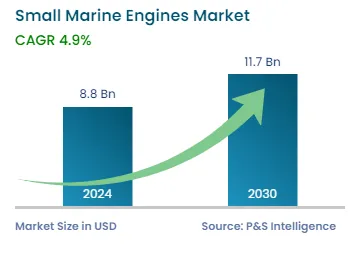
The small marine engine market size was USD 8.8 billion in 2024, and it will grow by 4.9% during 2025–2032, to reach USD 12.8 billion by 2032.
This is attributed to the increasing demand for various types of boats used for recreational and leisure events, and the rising coastal tourism for water activities such as boating, yachting, and fishing. Moreover, the inclination toward water-based tourism has been on the rise due to the augmented spending on water-related activities by a chunk of the population. Also, the sense of improved mental health due to the quality time spent during water-based activities is a key reason for the flourishing boating demand, which, in turn, accelerates the outward and inward-placed engines of marine vessels.
Small marine engines are referred to as motors or engines that are used to power watercraft or maritime vehicles. These engines are placed outboard or inboard the boats, which are mainly used for fishing, transportation, and recreational purposes. The outboard-placed motors are ideally used in small to medium-sized boats used for recreational and leisure purposes. Outboard engines are popular worldwide due to their cost-effectiveness, environmental friendliness, ease of maintenance, and high space efficiency.
The market is also experiencing significant transformation with the integration of advanced technologies such as direct fuel injection systems, electronic controls, and hybrid propulsion solutions. Global tourism has improved significantly since the COVID-19 pandemic. According to the UN Tourism, in 2024, global international tourist arrivals reached 1.4 billion, representing a 99% recovery from the pre-pandemic level, contributing to increased demand for recreational boating experiences and consequently driving the small marine engine market growth.
Small Marine Engines Market Trends & Drivers
Environmental Regulations and Technological Advancements Are Key Trends
The implementation of stringent environmental regulations is a key trend for the market.
From May 2025, the Mediterranean Sea will become a Sulfur Oxides Emission Control Area, requiring ships to use fuel with a maximum sulfur content of 0.10%.
Manufacturers are responding with innovative solutions, including advanced fuel injection systems, electronic engine management, and hybrid propulsion technologies.
Four-stroke engines are known for their fuel efficiency and reduced emissions, making them ideal for larger boats and commercial applications.
The market is witnessing significant technological advancements with the incorporation of artificial intelligence, machine learning, and IoT devices are enhancing engine efficiency, reliability, and safety.
These innovations are enabling predictive maintenance, real-time performance monitoring, and optimized fuel consumption, making small marine engines more attractive to both recreational and commercial users.
The IMO has expanded Emission Control Areas to include the Canadian Arctic and the Norwegian Sea as new Emission Control Areas (ECAs) covering NOx, SO2, and PM.
For the Canadian Arctic, Tier III NOₓ requirements will apply to ships with engines over 130 kW built on or after January 1, 2025, with enforcement beginning March 1, 2026.
For the Norwegian Sea, Tier III NOx rules apply to ships contracted from March 1, 2026, keel-laid from September 1, 2026, or delivered after March 1, 2030, with enforcement starting March 1, 2026.
Rising Recreational Boating Activities and Marine Tourism Are Biggest Drivers
The increasing popularity of recreational boating activities represents a fundamental driver for the small marine engine market.
The surge in participation is not limited to traditional boating enthusiasts but extends to new demographics seeking outdoor recreational experiences.
The expanding tourism industry plays a crucial role in market growth, with coastal destinations and lakeside resorts increasingly offering boating experiences.
For instance, the government of Kerala, India, has established a new boating ecosystem by acquiring pontoons to be installed around its lakes, anticipating increased demand due to growing tourism trends.
In recent years, nautical tourism and leisure activities, such as power boating, yachting, and sailing, have seen a significant increase, due to the rising per capita income of consumers.
Additionally, quick expansion in adventure tourism is supporting water recreational activities.
For instance, the U.S. coasts, including the Gulf of Mexico, Northeast, Hawaii–Pacific Islands, Mid-Southeast, Atlantic, and California, host a multitude of travel, tourism, and recreation activities.
In 2023, a record 57.7 million Americans aged 6 and over engaged in recreational fishing, representing a 6% increase from 2022.
Furthermore, the EU’s coastal and marine tourism is a significant segment of the tourism industry, due to its beauty and cultural richness, which has become a popular vacation spot for many domestic and international travelers.
Also, a significant number of cruise builders are making investments in land-based private islands, which enables cruise companies to extend the onboard experience by providing passengers with exclusive beach time.
According to the Ocean panel, Coastal and marine tourism represents at least 50% of total global tourism.
Small Marine Engines Market Segmentation Analysis
Type Analysis
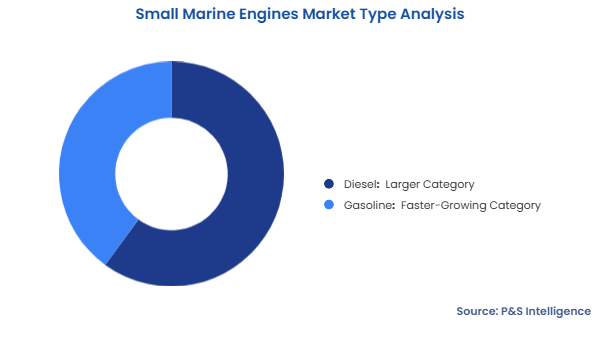
The diesel category held the largest market share, of 60%, in 2024, due to their superior fuel efficiency, durability, and torque characteristics, making them ideal for commercial applications and larger recreational boats. Diesel engines are renowned for their superior torque and durability, making them well-suited for powering larger boats and vessels efficiently. They offer better fuel economy for extended operations and are particularly favoured in commercial fishing vessels, support boats, and coastal patrol vessels where reliability and operational range are critical.
The gasoline category will have the highest CAGR, of 5.2%. Gasoline engines are predominantly used in smaller recreational boats, personal watercraft, and entry-level boating applications due to their lower initial cost, easier maintenance, and quieter operation. The segment benefits from the growing popularity of water sports and recreational activities that typically utilize smaller, more agile vessels powered by gasoline engines.
The types analysed in this report are:
Diesel (Larger Category)
Gasoline (Faster-Growing Category)
Placement Analysis
The outboard category held the larger market share, of 65%, in 2024, and it will have the higher CAGR, of 5.6%, due to technical advances and wide usage to power and steer the boat. The popularity of outboard engines stems from their versatility, ease of maintenance, ability to be tilted out of water when not in use, preventing corrosion and marine growth, lightweight, larger interior, and use of less fuel. The demand for Boaters’ boating experiences is being enhanced by the incorporation of amenities like digital throttle controls, joystick docking control, and automatic trim controls. Furthermore, the outward-placed engines can work with the bow and stern thrusters, providing the boat operator with improved vehicle control.
The placements analysed in this report are:
Outboard (Larger and Faster-Growing Category)
Inboard
Displacement Analysis
The 4–6 l category held the largest market share, of 55%, in 2024, and will grow at the higher CAGR of 5.3% during the forecast period, as these engines are typically found in larger fishing boats, support vessels, and high-performance recreational boats. The segment benefits from the trend toward larger, more capable vessels in both recreational and commercial sectors.
The displacements analysed in this report are:
Up to 2 l
2–4 l
4–6 l (Largest and Fastest-Growing Category)
Application Analysis
The recreational category held the largest market share, of 60%, in 2024, and it will have the highest CAGR, of 5.4%, due to the increasing disposable income, a rising interest in outdoor leisure activities, and an expanding tourism industry. The recreational boating sector benefits from shorter replacement cycles, typically 7–15 years; and a trend of multiple boat ownership. These factors collectively drive higher engine sales volume compared to commercial sectors with longer equipment lifespans. Boating was evidently a popular activity to enjoy with family and friends as an escape from the pandemic stress by enjoying the outdoors safely. Therefore, the accelerated consumer interest in boating activities as an accessible outdoor activity has an influence on leisure activities, sports, and travel. U.S.-based marine manufacturing stands out as an economic resilience sector in the region that supports marine engine production.
The applications analysed in this report are:
Recreational Boats (Largest and Fastest-Growing Category)
Support Vessels
Coastal Boats
Fishing Boats
Drive strategic growth with comprehensive market analysis
Small Marine Engines Market Geographical Analysis
North America Small Marine Engine Market Size
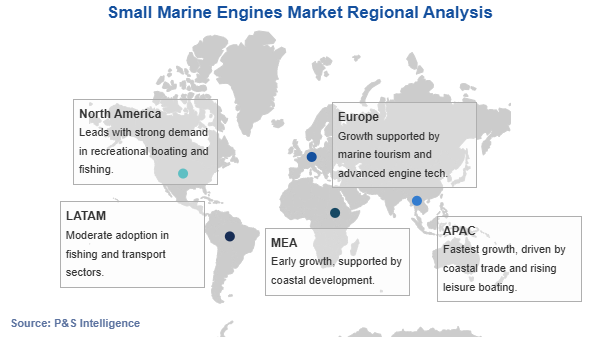
North America held the largest market share, of 45%, in 2024, due to a huge inclination toward water-based activities. Popular recreational boats include runabouts, towboats, fishing boats, sailboats, cabin cruisers, and pontoon boats. The escalation in outdoor activities requires high usage of watercraft, and as an outcome of this, the demand for outward and inward-placed motors is increasing in the region. Canada's market is driven by its extensive coastline and numerous lakes, supporting both recreational boating and commercial fishing activities. The country's focus on sustainable marine practices is driving demand for cleaner, more efficient engine technologies. Furthermore, government support for the fishing industry and maritime tourism further strengthens market growth in the region.
U.S. Small Marine Engine Market Size
The U.S. market benefits from a strong marine infrastructure, including numerous marinas, boat manufacturers, and service facilities. The Great Lakes region, coastal areas, and numerous inland lakes create diverse boating environments requiring various types of small marine engines. The Environmental Protection Agency has established regulations to control emissions from marine vessels. These standards apply to both gasoline and diesel engines. For instance, 40 CFR Part 1042 outlines exhaust emission standards for new marine compression-ignition engines, while 40 CFR Part 1045 addresses regulations for spark-ignition engines. These regulations aim to reduce pollutants like nitrogen oxides and particulate matter from marine engines.
Asia-Pacific Small Marine Engine Market Size
Asia-Pacific will have the highest CAGR, of 5.9%, driven by rapidly expanding economies, increasing disposable incomes, and growing interest in recreational boating activities. The region's fishing industry represents a significant demand driver. Countries like Indonesia, Thailand, and Vietnam have extensive artisanal fishing fleets that rely heavily on small marine engines for their operations. Thailand has adopted Euro 4 standards for light-duty vehicles and Euro III standards for heavy-duty vehicles.
China Small Marine Engine Market Size
China's marine leisure market is experiencing unprecedented growth, supported by government initiatives promoting maritime tourism and the development of inland waterways. The country's vast network of rivers, lakes, and coastal areas provides ample opportunities for both recreational and commercial marine activities. Additionally, China's position as a global manufacturing hub enables competitive pricing and technological innovation in marine engine production.
The geographical breakdown of the market is as follows:
North America (Largest Regional Market)
U.S. (Largest and Fastest-Growing Country)
Canada
Europe
Germany (Largest Country)
U.K. (Fastest-Growing Country)
France
Italy
Spain
Rest of Europe
Asia-Pacific (Fastest-Growing Regional Market)
China (Largest Country)
India (Fastest-Growing Country)
Japan
South Korea
Australia
Rest of APAC
Latin America
Brazil (Largest Country)
Mexico (Fastest-Growing Country)
Rest of LATAM
Middle East and Africa
Saudi Arabia
South Africa (Largest Country)
U.A.E. (Fastest-Growing Country)
Rest of MEA
Small Marine Engines Market Competitive Landscape
The market is moderately fragmented due to the presence of numerous global and regional players competing across various segments. Companies such as Yamaha Motor Co., Mercury Marine, Honda Motor Co., Suzuki Motor Corporation, and Volvo Penta dominate specific areas like outboard and inboard engines. New players such as Torqeedo GmbH are advancing in electric propulsion and providing customized solutions based on regional demands, making the market highly competitive.
Top Small Marine Engine Manufacturers:
Yamaha Motor Co., Ltd.
Suzuki Motor Corporation
Honda Motor Co., Ltd.
Brunswick Corporation (Mercury Marine)
Volvo Penta
Yanmar Marine International B.V.
Tohatsu Corporation
Torqeedo GmbH (Deutz AG subsidiary)
Cox Marine
Hidea Power Machinery Co., Ltd.
Selva Marine
Parsun Power Machine Co., Ltd.
Small Marine Engines Market News
In February 2024, Garden Reach Shipbuilders & Engineers Limited and Rolls-Royce plc entered into a partnership to locally manufacture MTU IMO Tier-II-compliant Series 4000 marine engines in India. This partnership will cater to fast patrol vessels, interceptor boats, and fast attack craft for the Indian Navy and the Indian Coast Guard.
In February 2024, Caterpillar Inc. announced it has entered into a memorandum of understanding with Solstad Offshore ASA and Cat dealer Pon Power AS to identify and evaluate solutions that will increase the fuel efficiency of Solstad’s offshore vessels and reduce their greenhouse gas emissions.
In December 2023, MAN Energy Solutions (now Everllence SE) made an agreement with Alfa Laval AB, a Swedish industrial company; to develop a solution for methanol supply for MAN four-stroke engines and injection technology, highlighting the industry's move toward alternative fuels.
Want a report tailored exactly to your business need?
Leading companies across industries trust us to deliver data-driven insights and innovative solutions for their most critical decisions. From data-driven strategies to actionable insights, we empower the decision-makers who shape industries and define the future. From Fortune 500 companies to innovative startups, we are proud to partner with organisations that drive progress in their industries.
Client Testimonials
Working with P&S Intelligence and their team was an absolute pleasure – their awareness of timelines and commitment to value greatly contributed to our project's success. Eagerly anticipating future collaborations.
McKinsey & Company
India
Unmatched Standards
Our insights into the minutest levels of the markets, including the latest trends and competitive landscape, give you all the answers you need to take your business to new heights
Complete Data Security
We take a cautious approach to protecting your personal and confidential information. Trust is the strongest bond that connects us and our clients, and trust we build by complying with all international and domestic data protection and privacy laws