Small Drones Market Size & Share Analysis - Trends, Drivers, Competitive Landscape, and Forecasts (2026 - 2032)
This Report Provides In-Depth Analysis of the Small Drones Market Report Prepared by P&S Intelligence, Segmented by Component (Hardware, Software, Services), End-User (Defense & Military, Agriculture, Construction & Infrastructure, Energy & Utilities, Logistics & Transportation, Media & Entertainment, Public Safety & Law Enforcement, Environmental Monitoring), Application (Surveillance & Monitoring, Mapping & Surveying, Precision Agriculture, Inspection, Aerial Imaging & Photography, Delivery & Logistics), Public Safety (Search & Rescue Operations, Disaster Management), Type (Fixed-Wing Drones, Rotary-Wing Drones, Hybrid / VTOL Drones), Payload capacity (Less than 2 kg, 2 kg , Above 10 kg), and Geographical Outlook for the Period of 2021 to 2032
Explore the market potential with our data-driven report
Small Drones Market Key Insights
Hardware is the largest component, holding a market share of 60% due to high reliance on sensors, airframes, and propulsion systems.
Agriculture is the fastest-growing end-user registering a CAGR of 11.9%, driven by the rising adoption of drones for crop monitoring and spraying.
Surveillance & Monitoring is the largest application, holding a market share of 30% due to the continuous need for real-time area tracking in defence and infrastructure.
North America holds the largest share of 40% due to strong defence demand and early adoption of advanced drone technologies.
Asia-Pacific is the fastest-growing region, registering a CAGR of 12.5%, driven by expanding agricultural use and growing domestic drone manufacturing capabilities.
Small Drones Market Future Outlook
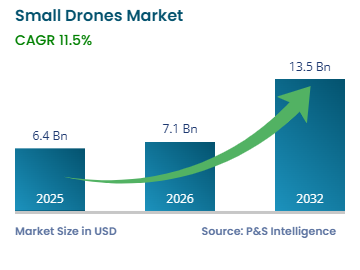
The small drones market size was USD 6.4 billion for 2025, and it will grow by 11.5% during 2026-2032, to reach USD 13.5 billion by 2032.
The market is expanding because small drones are becoming useful tools for industries that need faster site monitoring, safer inspection, and accurate data collection. Companies in construction, agriculture, energy, mining, logistics, and public safety are using small drones to inspect assets, map land, monitor crops, check power lines, and survey difficult locations without sending workers into risky areas. This reduces inspection time, lowers labour dependency, and improves the quality of visual and sensor-based data. Better batteries, compact cameras, thermal sensors, and artificial intelligence-based navigation are also making small drones more reliable for repeated commercial use. According to the Federal Aviation Administration, over 1.61 million recreational drone owners were registered by the end of 2024, and the effective active commercial small drone fleet was around 388,000 units.
The market is also gaining support from wider professional use cases and growing operator familiarity. A large recreational user base creates more awareness of drone handling, while commercial users are adopting drones for tasks that earlier required helicopters, ground crews, scaffolding, or manual surveying. This is especially important for infrastructure monitoring, disaster response, precision farming, border surveillance, and defence operations, where quick aerial visibility improves decision making. The Federal Aviation Administration also forecasts the commercial drone fleet to exceed one million units in 2025 and reach 1.118 million by 2029. This expected fleet expansion is encouraging drone manufacturers, software providers, and service companies to develop more specialised small drone systems for industrial and government applications.
Small Drones Market Segmentation Analysis
Component Analysis
Hardware remains the largest category, holding a market share of 60%, as drones depend on core physical systems such as airframes, propulsion units, sensors, batteries and payload modules for reliable operational performance. Demand is further strengthened because advanced imaging, detection and navigation payloads make up a major share of drone system value, leading to higher spending on component upgrades, replacements and performance improvements. According to the World Intellectual Property Organization, global patent applications reached 3.55 million in 2023, with computer technology accounting for 12.4% of total filings. This continued focus on technology development supports innovation in drone components, helping hardware maintain its leading position in the market.
Software is the fastest-growing category, registering a CAGR of 11.7%, as users increasingly rely on intelligent systems to manage drone operations and process collected data. Modern applications need real-time analytics, automation, and AI-based decision-making, which are all driven by software platforms. As drone usage scales, managing fleets and extracting useful insights becomes more important. This is pushing companies to invest more in advanced software capabilities.
The components analysed in this report are:
Hardware (Largest Category)
Airframe
Propulsion systems
Navigation & control systems
Software (Fastest-growing Category)
Flight control & mission planning software
Data processing & analytics platforms
Imaging and mapping software
AI-based navigation and object detection systems
Services
Drone operation services
Maintenance, repair, and overhaul
Training & simulation services
Data processing and analytics services
End-User Analysis
Defence & Military is the largest category, holding a market share of 30%, because small drones are widely used for surveillance, reconnaissance, and tactical missions. Defence agencies require reliable and high-performance systems for border monitoring and threat detection. Continuous investments in security and modernisation programs also support steady demand. Drones provide a safer alternative to manned operations, which makes them a preferred tool in military activities.
Agriculture is the fastest-growing category, as farmers increasingly adopt drones for crop monitoring, spraying, field mapping and soil analysis to improve operational efficiency and reduce labour dependency. This growth is supported by the expansion of precision farming practices across large agricultural landscapes, where automated aerial systems help monitor crop health, optimise input use and manage wide fields more effectively. According to the Food and Agriculture Organisation of the United Nations, global cereal production reached 3,029 million tonnes in 2025, while the global harvested area of primary crops reached 1.5 billion hectares in 2024. These large production volumes and extensive cultivated areas are increasing the need for automated aerial solutions, strengthening drone adoption across the agriculture sector.
The end-user analysed in this report are:
Defence & Military (Largest Category)
Agriculture (Fastest-growing Category)
Construction & Infrastructure
Energy & Utilities
Logistics & Transportation
Media & Entertainment
Public Safety & Law Enforcement
Environmental Monitoring
Others
Application Analysis
Surveillance & Monitoring is the largest category, holding a market share of 30%, as drones enable continuous observation of wide and complex areas across defence, public safety and infrastructure applications. This demand is supported by the need to reduce reliance on manual patrols, improve visibility in difficult terrains and strengthen monitoring efficiency in high-risk or remote locations. According to the United Nations Peacekeeping, over 76,000 peacekeepers were deployed across 11 peacekeeping missions in 2024, supporting conflict resolution, civilian protection and humanitarian stability efforts worldwide. This large-scale requirement for persistent observation is strengthening the adoption of drones for real-time surveillance while reducing operational pressure on personnel.
Delivery & Logistics is the fastest-growing category, as companies are exploring faster ways to transport goods, especially for last-mile delivery. Drones help reduce delivery time and reach remote or congested areas more efficiently. Growing demand for quick and contactless delivery is encouraging businesses to test and expand these services. Regulatory trial programmes and company-led delivery pilots are helping firms test flight safety, route planning, payload handling, and customer delivery models before wider commercial rollout.
The application analysed in this report are:
Surveillance & Monitoring (Largest Category)
Delivery & Logistics (Fastest-growing Category)
Mapping & Surveying
Precision Agriculture
Inspection
Aerial Imaging & Photography
Others
Public Safety Analysis
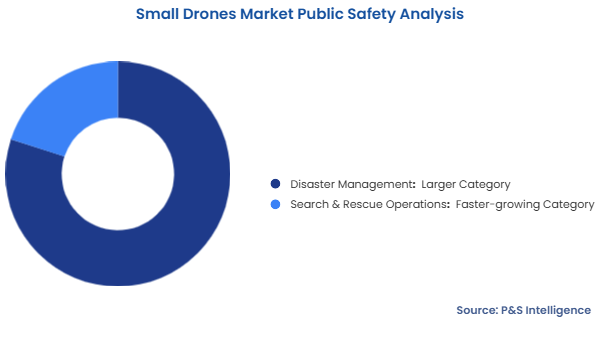
Disaster Management is the larger category, holding a market share of 80%, because drones are heavily used during emergencies to assess damage and plan response actions. They provide quick aerial views of affected areas, helping authorities make faster decisions. Their ability to operate in dangerous conditions without risking human lives makes them highly valuable. Governments and rescue teams rely on drones as a key tool in crisis situations.
Search & Rescue Operations is the fastest-growing category, registering a CAGR of 11.9%, as drones help emergency teams locate missing individuals faster in hazardous, remote, and low-visibility environments. This is driven by the use of thermal cameras, live aerial feeds, and GPS-based tracking, which allow responders to scan large areas without exposing rescue teams to unnecessary risk. DJI Drone Rescue Map recorded 1054 plus people saved through drone-supported rescues across 618 plus rescue incidents in more than 40 countries. Moreover, this direct role in finding people, guiding ground teams, and supporting faster response is increasing demand for small drones in emergency and rescue operations.
Rotary Wing Drones is the largest category, holding a market share of 65%, because their ability to hover, take off vertically, and operate in confined spaces makes them suitable for close range inspection, surveillance, and monitoring tasks. These drones are preferred where operators need stable positioning around buildings, towers, industrial assets, and public safety locations. According to the Federal Aviation Administration, outside FAA Recognized Identification Area recreational operators operated 1.46 quadcopters on average in 2024, compared with 0.47 fixed wing aircraft. This higher use of quadcopter platforms supports the wider adoption of rotary wing drones across inspection, imaging, and monitoring applications.
Fixed-Wing Drones are the fastest-growing category, as they are better suited for long-distance and large-area coverage. They can stay in the air longer and are more efficient for mapping and surveying tasks. Industries that require extended flight time are increasingly adopting them. Their ability to cover wide regions in a single flight is driving their growth.
The type analysed in this report are:
Rotary-Wing Drones (Largest Category)
Fixed-Wing Drones (Fastest-growing Category)
Hybrid / VTOL Drones
Payload Capacity Analysis
Less than 2 kg is the largest category, holding a market share of 65%, because lightweight drones are easier to use and often face fewer regulatory restrictions. They are widely used for basic applications like photography, small inspections, and recreational purposes. Their lower cost and portability make them accessible to a larger user base. This broad usability keeps demand high in this segment.
The 2 kg – 10 kg category is the fastest-growing segment, registering a CAGR of 11.8%, as these drones offer a practical balance between payload capacity, flight stability and operational efficiency for industrial applications. Demand is further supported by their use in inspection, surveying, asset monitoring and logistics tasks that require moderate payload handling without the cost or complexity of heavier drone platforms. According to the International Federation of Robotics, factories installed 542,000 industrial robots in 2024, reflecting the continued expansion of automation across industrial environments. This wider shift towards automated operations is supporting demand for mid-range drones capable of handling specialised inspection, mapping and industrial support functions.
The payload capacity analysed in this report are:
Less than 2 kg (Largest Category)
2 kg – 10 kg (Fastest-growing Category)
Above 10 kg
Drive strategic growth with comprehensive market analysis
Small Drones Market Geographical Analysis
North America Small Drones Market Analysis
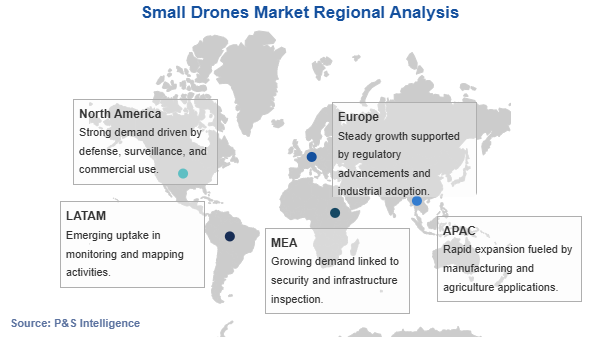
North America holds the largest share, of 40%, because strong defence spending and early adoption of advanced drone technologies have created a stable demand base. The region benefits from well-established drone manufacturers and a mature ecosystem that supports innovation and deployment. Regulatory frameworks, though strict, are more structured, allowing controlled commercial use. Industries such as public safety, infrastructure inspection, and media production actively use drones, which keeps demand steady. Continuous investment in autonomous systems and integration with existing technologies also supports long-term growth in this region.
U.S. Small Drones Market Analysis
The United States market is driven by strong drone adoption across defence, homeland security and commercial sectors, including construction, energy and media production. This demand is supported by the presence of advanced technology providers and continuous innovation in artificial intelligence-based drone systems, which are improving automation, data collection and operational accuracy across industry applications. According to the Federal Aviation Administration, remote pilot certifications in the United States reached approximately 405,682 in 2024, reflecting the continued expansion of commercial drone operations and the growing pool of certified unmanned aircraft system pilots supporting drone-based services. This established regulatory environment and high operational capacity are strengthening drone deployment across multiple industries and supporting sustained market growth.
Canada Small Drones Market Analysis
Canada is witnessing steady drone adoption across mining, forestry and environmental monitoring, supported by its vast land area and remote geographical conditions. This growth is linked to the need for efficient surveying, inspection and emergency-response support in locations that are difficult to access through conventional ground-based methods. According to Public Safety Canada, wildfires burned more than 5.37 million hectares across Canada in 2024, highlighting the need for advanced aerial monitoring systems for environmental management and public safety operations. These conditions are increasing the use of drones for real-time monitoring, damage assessment and remote-area inspection, supporting stronger demand for drone-based solutions in Canada.
Asia-Pacific Small Drones Market Analysis
Asia-Pacific has the highest CAGR, of 12.5%, because rapid industrial expansion and large-scale agricultural activities are increasing the need for efficient monitoring tools. Governments in this region are actively supporting drone usage through pilot programs and relaxed regulations in selected areas. Local manufacturing capabilities also make drones more affordable and accessible. Growing demand from sectors like farming, logistics, and infrastructure development is pushing adoption at a faster pace. The presence of emerging economies further adds to the strong growth momentum.
China Small Drones Market Analysis
China maintains a strong market position due to its large-scale drone manufacturing base and widespread commercial deployment across agriculture, logistics and infrastructure inspection. This strength is supported by domestic companies developing cost-efficient and advanced aerial systems, allowing faster adoption across industrial and commercial applications. According to the Civil Aviation Administration of China, registered civil unmanned aerial vehicles exceeded 2 million units in 2024. This large operational fleet is supporting continuous demand for drone components, replacement parts and system upgrades while reinforcing China’s role as a key global supplier.
India Small Drones Market Analysis
India is witnessing rapid drone adoption driven by expanding applications in precision agriculture, public safety, and infrastructure monitoring. Government initiatives supporting regulatory frameworks, training programmes, and domestic manufacturing are improving the use of drones for public sector and commercial tasks. According to the Ministry of Panchayati Raj, drone surveys were completed in 3.20 lakh villages under the SVAMITVA Scheme in 2025, covering an estimated area of 68,122 square kilometres. This nationwide drone mapping work is creating regular demand for trained drone operators, surveying services, mapping software, and geospatial data processing across India.
Europe Small Drones Market Analysis
Europe continues to see steady development due to its focus on regulatory standardisation and safe drone integration into shared airspace. Countries in this region emphasise privacy, environmental monitoring, and infrastructure maintenance, which shape how drones are used. The market is supported by innovation in industrial inspection and mapping applications. Government-backed initiatives and cross-border collaborations are helping create a unified framework, which encourages adoption while maintaining strict operational guidelines.
The regions and countries analysed in this report are:
North America (Largest Regional Market)
U.S. (Larger Country)
Canada (Faster-Growing Country)
Europe
Germany (Largest Country)
U.K. (Fastest-Growing Country)
France
Italy
Spain
Rest of Europe
Asia-Pacific (Fastest-Growing Regional Market)
China (Largest Country)
India (Fastest-Growing Country)
Japan
South Korea
Australia
Rest of APAC
Latin America
Brazil (Largest Country)
Mexico (Fastest-Growing Country)
Rest of LATAM
Middle East and Africa
Saudi Arabia (Fastest-Growing Country)
U.A.E. (Largest Country)
South Africa
Rest of MEA
Small Drones Market Competitive Landscape
The market is fragmented because it includes a large number of players operating across different regions and use cases. Many small and mid-sized companies focus on specific applications such as agriculture, inspection, or aerial imaging, which increases competition. New startups continue to enter the space with specialised solutions and innovative designs. While a few well-known companies have strong brand presence, they do not fully dominate the market. Different regulatory environments and customer needs also encourage local players to grow. This broad participation keeps competition spread across application areas, with companies differentiating through payload design, flight software, service support, and sector-specific drone solutions.
Key Players in the Small Drones Market:
Shenzhen Da Jiang Innovations Technology Company Limited
AeroVironment Incorporated
Parrot
Teledyne Technologies Incorporated
Skydio Incorporated
Autel Robotics Company Limited
Guangzhou Walkera Technology Company Limited
Yuneec International Company Limited
Elbit Systems Limited
Israel Aerospace Industries Limited
Lockheed Martin Corporation
Northrop Grumman Corporation
The Boeing Company
RTX Corporation
BAE Systems Public Limited Company
Small Drones Market News & Updates
In March 2026, DJI released the Avata 360 drone, introducing a compact aerial system designed for immersive 360-degree video capture with an integrated dual-camera setup and enhanced obstacle sensing capabilities.
In December 2025, Antigravity, an Insta360-incubated drone brand, launched the A1 drone featuring motion-controlled flight, immersive FPV goggles, and an 8K 360-degree camera system that enables post-capture reframing for aerial content creation.
In September 2025, Skydio introduced the R10 drone, a compact indoor UAV designed for confined-space operations, featuring AI-driven navigation cameras, advanced obstacle avoidance, and integrated two-way communication systems for public safety and field applications.
In June 2025, Parrot launched the ANAFI UKR micro-UAV range along with the CHUCK 3.0 AI autopilot module, focusing on compact drone operations with enhanced autonomy and mission control capabilities.
In June 2025, DJI introduced the Matrice 400 drone, a long-endurance platform designed for industrial missions with improved flight stability and extended operational capability in complex environments.
Frequently Asked Questions About This Report
What factors are driving growth in the small drones market?+
Growth is driven by inspection, surveying, agriculture, public safety, defence, and logistics use cases, where drones reduce manual work and improve aerial data collection.
Why are small drones used for industrial inspection applications?+
Small drones help inspect towers, pipelines, buildings, and industrial assets from close range, reducing worker exposure to height, heat, and hazardous locations.
How do regulations affect small drone market adoption?+
Drone rules affect registration, pilot certification, airspace access, and flight permissions, so unclear or strict regulations can slow commercial deployment.
Do commercial drone operators need licences or certifications?+
Commercial drone operators often need approved pilot certification or operational authorisation, depending on country rules, drone weight, and flight risk category.
Why are rotary wing drones widely used commercially?+
Rotary wing drones can hover, take off vertically, and move in tight spaces, making them useful for inspection, monitoring, and public safety operations.
Want a report tailored exactly to your business need?
Leading companies across industries trust us to deliver data-driven insights and innovative solutions for their most critical decisions. From data-driven strategies to actionable insights, we empower the decision-makers who shape industries and define the future. From Fortune 500 companies to innovative startups, we are proud to partner with organisations that drive progress in their industries.
Client Testimonials
Working with P&S Intelligence and their team was an absolute pleasure – their awareness of timelines and commitment to value greatly contributed to our project's success. Eagerly anticipating future collaborations.
McKinsey & Company
India
Unmatched Standards
Our insights into the minutest levels of the markets, including the latest trends and competitive landscape, give you all the answers you need to take your business to new heights
Complete Data Security
We take a cautious approach to protecting your personal and confidential information. Trust is the strongest bond that connects us and our clients, and trust we build by complying with all international and domestic data protection and privacy laws