This Report Provides In-Depth Analysis of the Simulation Software Market Report Prepared by P&S Intelligence, Segmented by Component (Software, Services), Deployment (On-Premises, Cloud), Simulation Type (Finite Element Analysis, Computational Fluid Dynamics, Multibody Dynamics Simulation, Process Simulation, Electromagnetic Simulation), Application (Product Design & Engineering, Digital Twin Lifecycle Management, Manufacturing Process Optimization, Planning, Supply Chain & Logistics, Training & Skill Development, AI Training & Autonomous Systems, Cyber Simulation), End-Use Industry (Automotive, Healthcare & Life Sciences, Aerospace & Defense, Industrial Manufacturing, Electronics & Semiconductor, Energy & Utilities, Construction, Transportation & Logistics), and Geographical Outlook for the Period of 2021 to 2032
Explore the market potential with our data-driven report
Simulation Software Market Overview
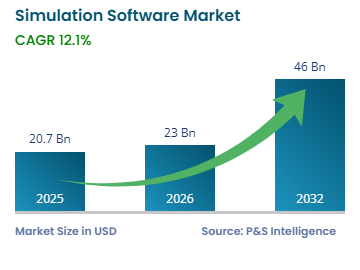
The simulation software market size was USD 20.7 billion for 2025, and it will grow by 12.1% during 2026–2032, to reach USD 46.0 billion by 2032.
This growth is supported by expanding adoption of finite element analysis, computational fluid dynamics, and multibody dynamics tools across product design and engineering workflows, positioning simulation software as a foundational capability for virtual prototyping, digital twin lifecycle management, and manufacturing process validation. Enterprises are increasingly substituting physical prototyping cycles with virtual testing environments. This shift is compressing development timelines and reducing material costs across automotive, aerospace, healthcare, and industrial manufacturing applications. According to the National Institute of Standards and Technology (NIST), inadequate modeling and engineering data cost U.S. manufacturers billions annually, including an estimated USD 8.4 billion in additional engineering effort and USD 3.8 billion in machinist-related documentation and rework costs, underscoring the value of advanced simulation software in improving design accuracy and reducing development inefficiencies.
Additionally, sustained public-sector investment in computational modeling research reinforces demand validation. NIST maintains an active modeling and simulation research program, including open-source discrete-event simulation tools developed to support multistage manufacturing planning and predictive maintenance policy testing. Parallel regulatory momentum is evident in the automotive sector, where the National Highway Traffic Safety Administration continues expanding research and rulemaking activity around automated driving systems. This process increasingly incorporates scenario-based virtual validation alongside closed-track and real-world testing, reinforcing simulation software's role in safety verification and compliance-driven product development.
Key Market Insights
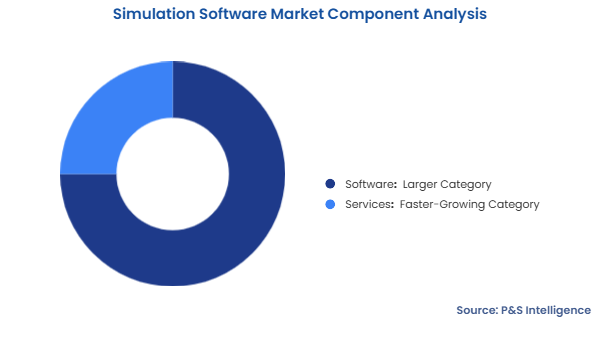
The software category holds the larger market share, of 75%, in 2025, driven by its central role in enabling virtual product development, engineering analysis, and process optimization across industries.
The cloud category will have the higher CAGR, of approximately 12.3%, as small and mid-sized engineering firms adopt cloud-based simulation software to access high-performance computing resources.
The finite element analysis category holds the largest market share, of 35%, in 2025, reflecting its foundational role in structural, thermal, and fatigue analysis across virtually every engineering discipline.
The AI training & autonomous systems category will have the highest CAGR, of approximately 12.6%, driven by rising demand for synthetic data and autonomous system simulation.
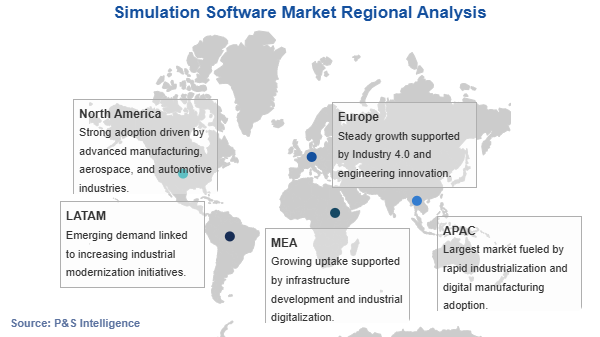
North America holds the largest market share, of 40%, in 2025, anchored by concentrated aerospace, defense, and automotive engineering activity across the U.S. and Canada.
Simulation Software Market Trends and Drivers
Convergence of AI-Enabled Digital Twins with Physics-Based Simulation Is Key Trend
The simulation software market is experiencing a major shift from standalone engineering analysis tools toward AI-enabled digital twin ecosystems that continuously synchronize virtual models with real-world assets. Modern simulation platforms increasingly integrate finite element analysis (FEA), computational fluid dynamics (CFD), multibody dynamics, IoT sensor data, and artificial intelligence. These integrated capabilities enable predictive maintenance and real-time performance optimization, with autonomous decision-making emerging as the next frontier. This convergence is expanding simulation software beyond traditional product design into full lifecycle management, enabling manufacturers to validate designs, optimize production processes, and monitor operational performance through continuously updated digital replicas. As industries accelerate digital engineering initiatives, simulation software is becoming a core technology underpinning Industry 4.0 and software-defined manufacturing.
Growing public-sector investment in digital engineering reinforces this trend. NIST reports that predictive maintenance accounted for 39.9% of digital twin software sales, followed by business optimization at 25.3%, performance monitoring at 17.8%, inventory management at 11.9%, and product design and development at 3.4%. This distribution demonstrates the evolution of simulation software from engineering design tools to enterprise-wide operational platforms. Strategic industry consolidation supports this evolution. In July 2025, Synopsys, Inc. completed its approximately USD 35 billion acquisition of Ansys, Inc., strengthening AI-enabled simulation, digital twin capabilities, and integrated engineering workflows.
Accelerating Digital Engineering and Virtual Prototyping across Manufacturing Industries Are Biggest Drivers
The growing adoption of digital engineering and virtual prototyping is a primary driver of the simulation software market. Manufacturers are increasingly replacing physical design iterations with simulation-based workflows to shorten product development cycles, reduce engineering costs, and improve product performance before production begins. Simulation software enables engineers to evaluate structural integrity, thermal performance, fluid behavior, electromagnetic compatibility, and system dynamics in a virtual environment. This approach reduces the need for expensive physical prototypes and has become essential across automotive, aerospace, electronics, industrial manufacturing, and healthcare industries as products become more complex and development timelines continue to compress.
Government initiatives supporting advanced manufacturing and semiconductor innovation are accelerating demand for simulation software. The European Commission's Chips Act aims to increase the European Union's share of global semiconductor production from approximately 10% to 20% by 2030, while strengthening chip design, prototyping, testing, and manufacturing capabilities. This push creates demand for engineering simulation and virtual validation tools throughout the semiconductor value chain. The European Commission reports that a modern hybrid electric vehicle contains up to 3,500 semiconductor chips, highlighting the growing engineering complexity of next-generation vehicles and the increasing reliance on simulation software for chip, electronics, and system-level design validation.
Shortage of Skilled Simulation Engineers and High Implementation Complexity Are Key Restraints
The shortage of skilled professionals capable of developing, validating, and interpreting complex simulation models remains a restraint for the simulation software market. Advanced simulation platforms require expertise in finite element analysis (FEA), computational fluid dynamics (CFD), multibody dynamics, high-performance computing (HPC), and digital engineering principles. Many organizations, including small and medium-sized enterprises, lack engineers with the specialized knowledge needed to build accurate simulation models and interpret complex results. Businesses often experience prolonged implementation cycles and reduced software utilization. Delayed realization of return on investment limits the broader adoption of simulation solutions.
Enterprise deployment of simulation software introduces complexity that restrains market growth. Modern simulation platforms must integrate seamlessly with CAD, PLM, ERP, MES, IoT, and digital twin systems while ensuring interoperability, data consistency, model accuracy, and cybersecurity. Many organizations need to customize simulation workflows to meet industry-specific engineering requirements, requiring additional technical expertise, training, and consulting services. These implementation challenges increase deployment costs, extend project timelines, and discourage adoption among organizations with limited technical resources, including small and medium-sized manufacturers.
Expansion of Cloud-Based Simulation for Small and Medium-Sized Enterprises Is Biggest Opportunity
The increasing availability of cloud-based simulation platforms presents a growth opportunity for the simulation software market by making advanced engineering capabilities accessible to small and medium-sized enterprises. Traditionally, simulation software required investment in high-performance computing infrastructure, software licenses, and dedicated IT resources, limiting adoption primarily to large enterprises. Cloud-based Simulation-as-a-Service eliminates these barriers by offering scalable, subscription-based access to computational resources. This access enables SMEs to perform finite element analysis, computational fluid dynamics, and other advanced simulations without investing in expensive on-premises infrastructure. Broader accessibility is expected to expand the customer base for simulation software vendors across manufacturing, automotive, electronics, energy, and healthcare industries.
Growing adoption of cloud technologies among businesses strengthens this opportunity. According to Eurostat, 45.2% of EU enterprises purchased cloud computing services in 2023, up from 41.0% in 2021, reflecting the accelerating shift toward cloud-based digital infrastructure. The European Union's Digital Decade policy aims for 75% of businesses to adopt cloud computing, big data, or artificial intelligence by 2030. This target creates a favorable environment for the wider deployment of cloud-native simulation software solutions. As cloud adoption continues to expand, simulation software providers are well positioned to deliver cost-effective, collaborative, and scalable engineering platforms to a much broader base of industrial users.
Simulation Software Market Segmentation Analysis
Component Analysis
The software category holds the larger market share, of 75%, in 2025, driven by its central role in enabling virtual product development, engineering analysis, and process optimization across industries. Simulation software provides advanced capabilities such as finite element analysis (FEA), computational fluid dynamics (CFD), multibody dynamics, and electromagnetic analysis, allowing organizations to evaluate product performance and manufacturing processes before physical production. Growing adoption of digital engineering, virtual prototyping, and digital twin technologies across automotive, aerospace, industrial manufacturing, and electronics sectors continues to strengthen demand for simulation software as a core engineering tool.
The services category will have the higher CAGR, of approximately 12.4%, driven by the increasing demand for consulting, implementation, customization, integration, training, maintenance, and technical support services required to successfully deploy and optimize simulation software platforms. As organizations integrate simulation solutions with CAD, PLM, ERP, MES, IoT, and digital twin ecosystems, they increasingly rely on service providers to ensure seamless implementation, workflow optimization, system interoperability, and user training. Growing adoption of cloud-based simulation platforms, AI-enabled engineering solutions, and digital engineering initiatives is accelerating demand for these services. This shift enables enterprises to reduce deployment complexity, improve simulation accuracy, and maximize return on investment.
The components analyzed in this report are:
Software (Larger Category)
Services (Faster-Growing Category)
Deployment Analysis
The on-premises category holds the larger market share, of 70%, in 2025, supported by stringent regulatory, security, and data-sovereignty requirements across aerospace, defense, automotive, and other engineering-intensive industries. Organizations handling export-controlled or classified engineering data and running computationally intensive simulation workloads prefer locally hosted infrastructure to maintain greater control over sensitive design files, intellectual property, and compliance obligations. This preference is particularly strong among Tier 1 defense and aerospace organizations, where compliance and data residency requirements outweigh the operational flexibility of cloud deployment.
NIST Special Publication 800-171 establishes security requirements for organizations handling Controlled Unclassified Information (CUI) in nonfederal systems, reinforcing the adoption of on-premises infrastructure among defense-adjacent engineering firms.
The cloud category will have the higher CAGR, as small and mid-sized engineering firms increasingly adopt cloud-based simulation software, they gain access to high-performance computing resources without significant capital investment in local infrastructure. Cloud deployment enables scalable simulation workloads, faster collaboration across distributed engineering teams, and quicker software deployment and updates, making advanced simulation capabilities more accessible across industries. Eurostat reported that 52.7% of EU enterprises used paid cloud computing services in 2025, up 7.4 percentage points from 2023, with computing power for enterprise software among the fastest-growing use cases.
The deployments analyzed in this report are:
On-Premises (Larger Category)
Cloud (Faster-Growing Category)
Simulation Type Analysis
The finite element analysis category holds the largest market share, of 35%, in 2025, reflecting its foundational role in structural, thermal, and fatigue analysis across virtually every engineering discipline. Its widespread adoption in automotive, aerospace, industrial equipment, electronics, and energy industries, coupled with its integration into product design and certification workflows, has made FEA the most extensively used simulation type. Regulatory frameworks in aerospace explicitly recognize FEA-based computer modeling as an acceptable method for demonstrating structural compliance, reinforcing its importance in engineering validation rather than treating it solely as a design support tool. The U.S. Federal Aviation Administration (FAA), through Advisory Circular AC 20-146A, recognizes validated computer modeling and simulation techniques as an acceptable means of demonstrating compliance for structural certification under 14 CFR Parts 23, 25, 27, and 29.
The computational fluid dynamics category will have the highest CAGR, driven by increasing demand for advanced fluid flow and heat transfer simulations in electric vehicle battery thermal management, aerospace propulsion systems, renewable energy, semiconductor manufacturing, and data center cooling applications. The growing availability of high-performance computing and cloud-based simulation platforms is further accelerating CFD adoption by enabling faster, more complex simulations with lower infrastructure costs.
The product design & engineering category holds the largest market share in 2025, reflecting its position as the most established and widely adopted application across automotive, aerospace, industrial manufacturing, electronics, and energy sectors. Organizations increasingly rely on simulation software to optimize product performance, validate designs, reduce physical prototyping, and accelerate product development cycles. Continued investment in digital engineering and digital twin technologies has further reinforced the dominance of this application. The U.S. Department of Commerce's National Institute of Standards and Technology (NIST) is providing USD 285 million to establish a Manufacturing USA institute focused on developing, validating, and deploying digital twins for product design and manufacturing applications.
The AI training & autonomous systems category will have the highest CAGR, of approximately 12.6%, driven by expanding demand for synthetic data generation and scenario-based simulation environments used to train autonomous vehicles, robotics, drones, and industrial AI systems while reducing reliance on costly and time-consuming physical testing. Growing advancements in artificial intelligence, autonomous mobility, and digital twin technologies are further accelerating the adoption of simulation software for AI model development and validation. The U.S. National Science Foundation (NSF) announced a USD 100 million investment to support five National Artificial Intelligence Research Institutes, several of which focus on autonomous systems and robotics research requiring simulation-based training environments.
The applications analyzed in this report are:
Product Design & Engineering (Largest Category)
Digital Twin Lifecycle Management
Manufacturing Process Optimization
Planning, Supply Chain & Logistics
Training & Skill Development
AI Training & Autonomous Systems (Fastest-Growing Category)
Cyber Simulation
Others
End-Use Industry Analysis
The automotive category holds the largest market share, of 25%, in 2025, driven by its long-standing adoption of simulation software for crash testing, structural analysis, powertrain development, aerodynamics, battery performance, and vehicle safety validation. Automotive OEMs and Tier 1 suppliers increasingly rely on simulation throughout the product development lifecycle to reduce physical prototyping, accelerate design iterations, and meet stringent regulatory requirements. The widespread integration of digital engineering and virtual validation continues to reinforce the industry's leadership in simulation software adoption. The U.S. Department of Transportation's National Highway Traffic Safety Administration (NHTSA) uses Argonne National Laboratory's Autonomie full-vehicle modeling and simulation system to evaluate the fuel economy impacts of advanced vehicle technologies, supporting regulatory analysis and vehicle certification.
The healthcare & life sciences category will have the highest CAGR, driven by increasing adoption of computational modeling and simulation for medical device development, digital health, personalized medicine, and regulatory submissions. Growing regulatory acceptance of simulation-based evidence is enabling manufacturers to reduce development time, lower testing costs, and improve product validation across the medical device lifecycle.
The end-use industries analyzed in this report are:
Automotive (Largest Category)
Healthcare & Life Sciences (Fastest-Growing Category)
Aerospace & Defense
Industrial Manufacturing
Electronics & Semiconductor
Energy & Utilities
Construction
Transportation & Logistics
Others
Drive strategic growth with comprehensive market analysis
Simulation Software Market Regional Analysis
North America Simulation Software Market Size
North America holds the largest market share, of 40%, in 2025, anchored by concentrated aerospace, defense, and automotive engineering activity across the U.S. and Canada. Dense clusters of engineering talent support this leadership, while finite element analysis and computational fluid dynamics workflows are deeply embedded across Tier 1 automotive and aerospace suppliers, supported by sustained federal research funding directed toward advanced manufacturing and computational modeling that reinforces regional demand. Long-standing relationships between simulation vendors headquartered in the region and defense, aerospace, and semiconductor manufacturers reinforce entrenched on-premises deployment even as cloud migration accelerates elsewhere. Regulatory emphasis on virtual validation for autonomous and safety-critical systems cements regional demand.
According to the National Center for Science and Engineering Statistics (NCSES), U.S. total research and development (R&D) expenditures are estimated to reach USD 993 billion in 2024. This level of investment reflects sustained commitment to advanced engineering, computational modeling, and technology innovation. This commitment supports continued demand for simulation software across research-intensive industries.
U.S. Simulation Software Market Size
The U.S. represents both the largest and fastest-growing country market within North America, driven by its concentration of aerospace primes, automotive OEMs, and semiconductor design houses. Each of these segments relies on high-fidelity simulation for product validation. Federal research infrastructure, including national laboratories and federally funded research and development centers, continues to expand computational modeling capacity available to industry through public-private partnerships. Growing investment in autonomous vehicle development and defense modernization programs accelerates demand for simulation tools capable of scenario-based virtual testing at scale. According to the National Center for Science and Engineering Statistics (NCSES), total R&D expenditures at federally funded research and development centers (FFRDCs) increased from USD 17.7 billion in FY 2014 to USD 31.7 billion in FY 2024, reflecting sustained federal investment in advanced research infrastructure and computational capabilities that support the adoption of simulation software across aerospace, defense, and other engineering-intensive industries.
Asia-Pacific Simulation Software Market Size
Asia-Pacific will have the highest CAGR, of approximately 13.0%, driven by manufacturing digitalization across China, Japan, and South Korea. Large-scale government-backed smart manufacturing initiatives support this growth, while expanding automotive electrification programs require extensive simulation-based validation and growing domestic engineering software capacity reduces reliance on imported tools. Rising investment in software-defined vehicle development across Japan and South Korea is accelerating simulation software adoption within automotive engineering workflows.
According to Japan's Ministry of Economy, Trade and Industry (METI), the updated Mobility DX Strategy targets a 30% global unit sales share for Japanese software-defined vehicles (SDVs) by 2030 and 2035. Achieving this objective requires accelerated adoption of digital engineering, virtual validation, and simulation-based vehicle development, reinforcing demand for simulation software across the automotive sector.
China Simulation Software Market Size
China represents the largest individual country market within Asia-Pacific, underpinned by large-scale state-directed smart manufacturing deployment and an expanding domestic industrial software base. National policy frameworks promoting AI-enabled manufacturing have accelerated adoption of digital twin and simulation technologies across steel, automotive, electronics, and machinery production. Government-led smart factory certification programs continue to expand the base of manufacturers actively deploying simulation-driven process optimization.
According to China's Ministry of Industry and Information Technology (MIIT), reported by Xinhua, China had built more than 35,000 basic-level, over 8,200 advanced-level, and more than 500 excellence-level smart factories by the end of 2025, reinforcing the country's rapid adoption of digital manufacturing technologies and creating strong demand for simulation software used in virtual design, process optimization, and production validation.
The regions and countries analysed in this report are:
North America (Largest Regional Market)
U.S. (Larger and Faster-Growing Country)
Canada
Europe
Germany (Largest Country)
U.K. (Fastest-Growing Country)
France
Italy
Spain
Rest of Europe
Asia-Pacific (Fastest-Growing Regional Market)
China (Largest Country)
India (Fastest-Growing Country)
Japan
South Korea
Australia
Rest of APAC
Latin America
Brazil (Largest and Fastest-Growing Country)
Mexico
Rest of LATAM
Middle East and Africa
Saudi Arabia (Largest Country)
South Africa
U.A.E. (Fastest-Growing Country)
Rest of MEA
Simulation Software Market Competitive Landscape
The market is fragmented due to the presence of numerous global, regional, and niche vendors offering specialized solutions across diverse simulation domains, including finite element analysis, computational fluid dynamics, process simulation, discrete-event simulation, multibody dynamics, and electromagnetic simulation. While established companies such as Dassault Systemes, Siemens Digital Industries Software, Altair Engineering, and Autodesk hold strong positions, they compete with many specialized providers serving specific industries such as automotive, aerospace, healthcare, energy, electronics, and manufacturing. Technological advancements in cloud computing, artificial intelligence, digital twins, and high-performance computing have lowered barriers for innovative software developers to enter niche segments. Many organizations adopt multiple simulation platforms tailored to different engineering workflows rather than relying on a single vendor, creating a highly competitive landscape with no single company dominating the overall global simulation software market.
Top Companies in the Simulation Software Market:
Synopsys, Inc.
Cadence Design Systems, Inc.
Dassault Systemes SE
Siemens AG
Autodesk, Inc.
Altair Engineering Inc.
Bentley Systems, Incorporated
The MathWorks, Inc.
COMSOL AB
PTC Inc.
Rockwell Automation, Inc.
Aspen Technology, Inc.
Simulation Software Market Developments
In March 2026, Synopsys, Inc. launched Ansys 2026 R1, the first integrated release combining Synopsys electronic design automation tools with Ansys multiphysics simulation capabilities, introducing AI-powered solvers and digital twin functionality. The release delivers the initial combined capabilities promised following the companies' USD 35 billion merger, targeting multi-die packaging and thermal-aware design workflows.
In February 2026, Cadence Design Systems, Inc. completed the acquisition of Hexagon AB's Design & Engineering business, significantly expanding its multiphysics simulation, structural analysis, acoustics, and multibody dynamics capabilities. The acquisition strengthens Cadence's Physical AI strategy by integrating Hexagon's engineering simulation portfolio, including MSC Software solutions, into its System Design and Analysis portfolio.
In October 2025, Bentley Systems, Incorporated unveiled AI-powered digital twin tools across its Infrastructure Cloud and OpenSite+ applications at its Year in Infrastructure Conference in Amsterdam. The expansion embeds generative AI directly into civil infrastructure design workflows, enabling automated flood-risk and traffic-flow for large-scale infrastructure projects.
In March 2025, Siemens AG completed the acquisition of Altair Engineering Inc. for an enterprise value of approximately USD 10 billion. The acquisition strengthens Siemens' simulation, high-performance computing (HPC), data science, and industrial AI capabilities while integrating Altair's technologies into the Siemens Xcelerator platform to expand its AI-powered industrial software and digital twin portfolio.
Frequently Asked Questions About This Report
What is driving the growth of the Simulation Software Market?+
Growth is driven by increasing adoption of digital twins, Industry 4.0, AI-enabled simulation, cloud computing, and the need to reduce product development time and cost.
How is AI impacting the Simulation Software Market?+
AI improves simulation accuracy, automates model generation, enables predictive analytics, and reduces computation time for complex engineering problems.
What role do digital twins play in the Simulation Software Market?+
Digital twins use simulation models with real-time operational data to optimize product performance, predictive maintenance, and process efficiency.
What are the major challenges facing the Simulation Software Market?+
High software implementation costs, complex deployment, shortage of skilled simulation engineers, and integration with legacy systems are key challenges.
What opportunities are expected in the Simulation Software Market?+
Growing demand for cloud-based simulation, AI-driven engineering, autonomous vehicles, smart manufacturing, and virtual prototyping will create significant opportunities.
How is cloud computing influencing the Simulation Software Market?+
Leading companies across industries trust us to deliver data-driven insights and innovative solutions for their most critical decisions. From data-driven strategies to actionable insights, we empower the decision-makers who shape industries and define the future. From Fortune 500 companies to innovative startups, we are proud to partner with organisations that drive progress in their industries.
Client Testimonials
Working with P&S Intelligence and their team was an absolute pleasure – their awareness of timelines and commitment to value greatly contributed to our project's success. Eagerly anticipating future collaborations.
McKinsey & Company
India
Unmatched Standards
Our insights into the minutest levels of the markets, including the latest trends and competitive landscape, give you all the answers you need to take your business to new heights
Complete Data Security
We take a cautious approach to protecting your personal and confidential information. Trust is the strongest bond that connects us and our clients, and trust we build by complying with all international and domestic data protection and privacy laws