Silicon Metal Market Size & Share Analysis - Emerging Trends, Growth Opportunities, Competitive Landscape, and Forecasts (2025 - 2032)
This Report Provides In-Depth Analysis of the Silicon Metal Market Report Prepared by P&S Intelligence, Segmented by Grade (Metallurgical, Chemical, Electronic/Solar), Application (Aluminum Alloys, Silicones & Silanes, Solar Panels/Photovoltaics, Semiconductors & Electronics), End-Use Industry (Automotive, Construction, Electronics & Electrical, Energy, Chemical), and Geographical Outlook for the Period of 2019 to 2032
Explore the market potential with our data-driven report
Silicon Metal Market Future Outlook
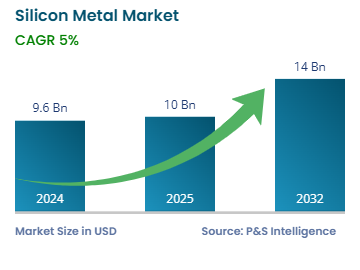
The global silicon metal market size was USD 9.6 billion in 2024, which is predicted to reach USD 14.0 billion by 2032, growing at a CAGR of 5.0% during 2025–2032.
The growth trajectory is primarily driven by escalating demand from the aluminum alloys industry for lightweight automotive components, expansion of solar photovoltaic installations globally, and increasing adoption in semiconductor manufacturing for advanced electronics applications.
Silicon metal continues to witness a robust demand from the automotive sector, particularly with the accelerating transition toward electric vehicles (EVs). By 2030, battery electric light trucks are expected to average 644 pounds of aluminum content, significantly increasing the need for silicon metal as a critical alloying element. The material's role in enhancing aluminum alloy properties, including strength, castability, and corrosion resistance, positions it as indispensable for modern vehicle manufacturing aimed at improving fuel efficiency and reducing emissions.
The renewable energy sector presents another substantial growth avenue for silicon metal demand. By 2030, global installed solar PV capacity is expected to exceed 7 TW, thus driving the requirement for high-purity silicon for photovoltaic cell production. The rapid expansion of solar capacity, particularly in Asia-Pacific and emerging markets, continues to drive demand for solar-grade silicon metal. Additionally, the semiconductor industry's remarkable growth trajectory, with global semiconductor sales hitting USD 627.6 billion in 2024, an increase of 19.1% compared to 2023, as per the Semiconductor Industry Association, reinforces silicon metal's critical position in the global technology supply chain.
Silicon Metal Market Trends & Drivers
Technological Advancements in Production Are Key Trend
Automated technologies are being adopted in silicon metal production to improve furnace operations, reduce downtime, and enhance energy efficiency.
Advanced process control systems and AI-driven monitoring are enabling real-time adjustments to maintain product quality and optimize resource usage.
The U.S. Department of Commerce awarded USD 325 million to Hemlock Semiconductor under the CHIPS Program to build a hyper-pure polysilicon facility in Michigan.
Starting in 2026 and reaching full production by 2028–2029, this project will create about 180 manufacturing and 1,000 construction jobs.
Robotics and automated handling systems are reducing labor-intensive tasks in crushing, packaging, and transporting silicon metal.
Digitalization through the industrial internet of things (IIoT) is allowing for the predictive maintenance of equipment, minimizing unplanned stoppages in smelting plants.
The use of digital twins and simulation models is improving furnace design and process optimization, lowering operational costs.
The CHIPS and Science Act has authorized USD 52.7 billion, including USD 39 billion for manufacturing and USD 13 billion for R&D and workforce, to strengthen U.S. semiconductors and secure materials like polysilicon.
Automated quality inspection systems, including machine vision and spectroscopy, are ensuring consistent purity levels of silicon metal.
The integration of renewable energy sources and smart energy management in automated production systems is reducing carbon footprint and supporting sustainability goals.
India’s Semiconductor Mission has allocated USD 7.17 billion (INR 629 billion) out of a total USD 7.4 billion (INR 650 billion) incentive fund.
By August 2025, ten projects had been approved, including high-volume fabs, compound semiconductors, such as silicon carbide, and advanced packaging facilities.
Smart manufacturing technologies are making silicon metal production more scalable, efficient, and responsive to growing demand from the semiconductors and solar power industries.
The rapid growth of the semiconductor industry is increasing the demand for ultra-high-purity silicon, the foundational material for integrated circuits and microchips.
Advanced electronic devices, such as smartphones, computers, and data centers, rely on semiconductors built from high-quality silicon wafers.
The European Chips Act aims to mobilize USD 46 billion (EUR 43 billion) in public and private funds to boost Europe’s semiconductor ecosystem, supporting R&D, manufacturing, and indirectly increasing demand for high-purity silicon.
As chip designs become smaller and more complex, manufacturers require silicon with extremely low levels of impurities to ensure performance and reliability.
In May 2024, South Korea announced a USD 19 billion (KRW 26 trillion) package to support chip design, contract manufacturing, and materials, boosting its semiconductor industry.
The expansion of 5G networks, artificial intelligence, and cloud computing applications is driving higher semiconductor production, further boosting the need for refined silicon.
Compared to USD 129.1 billion in 2024, studies predict 5G services to bring in USD 782.2 billion to the global economy by 2030, while the demand for cloud services could generate over USD 1.8 trillion in revenue by 2030.
The growing demand for electric vehicles and advanced automotive electronics is contributing to the rising consumption of high-purity silicon-based semiconductors.
Leading semiconductor producers are increasing investments in fabrication facilities, which directly raises the demand for silicon metal processing into polysilicon.
The global supply chain is under pressure to secure consistent sources of high-grade silicon, creating opportunities for silicon metal suppliers.
Japan is investing in advanced semiconductor materials, including high-purity silicon, as part of a broader plan to strengthen its semiconductor industry. The government will provide USD 65 billion (JPY 10 trillion) through 2030 to support chip design, manufacturing, and material production.
The Government support and subsidies for domestic semiconductor manufacturing in the U.S., China, and Europe amplify the requirement for high-purity silicon.
Innovations in chip architecture and next-generation technologies such as quantum computing and IoT devices are expected to further accelerate demand.
Silicon Metal Market Segmentation Analysis
Grade Analysis
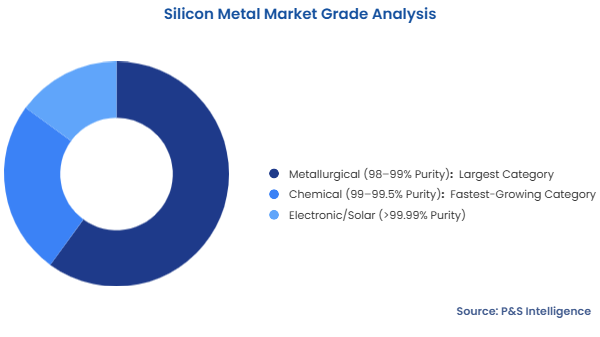
The metallurgical grade dominated the silicon metal market in 2024, accounting for 60% revenue share, primarily driven by its extensive application in aluminum alloy production for automotive and aerospace industries. This grade's significance stems from its optimal balance of purity and cost-effectiveness for alloying applications, where silicon content typically ranges from 98% to 99%. The automotive sector's continuous demand for lightweight materials sustains metallurgical grade consumption, particularly as vehicle manufacturers strive to meet stringent emission standards through weight reduction strategies.
The chemical grade represents the fastest-growing category during 2025–2032, fueled by the burgeoning demand from the silicone industry. This grade undergoes hydrometallurgical processing to achieve the purity levels required for silicone polymer production, serving diverse applications across construction, electronics, personal care, and healthcare sectors. The versatility of silicone products, from sealants and adhesives to medical-grade materials, ensures sustained demand growth for chemical grade silicon metal.
These grades are covered:
Metallurgical (98–99% Purity) (Largest Category)
Chemical (99–99.5% Purity) (Fastest-Growing Category)
Electronic/Solar (>99.99% Purity)
Application Analysis
The aluminum alloys category maintained its dominance in 2024, commanding 40% market share, due to silicon metal's critical role as an alloying element in aluminum production. Silicon enhances aluminum's mechanical properties, improving strength, castability, and wear resistance while reducing density, making aluminum-silicon alloys indispensable for automotive, aerospace, and construction applications. The use of silicon metal for producing aluminum alloys holds the largest share in total silicon metal production.
The automotive industry's transition toward electric vehicles particularly intensifies aluminum alloy demand, as manufacturers seek weight reduction solutions to offset heavy battery systems. The International Aluminium Institute says that the worldwide aluminium demand is projected to rise by nearly 40% by 2030. Furthermore, the aluminium industry will be required to generate an extra 33.3 million tonnes to satisfy the demand increase across all industrial sectors, escalating from 86.2 million tonnes in 2020 to 119.5 million tonnes by 2030.
Solar panels are the fastest-growing category during the forecast period, driven by global renewable energy initiatives and declining solar installation costs. The category benefits from unprecedented government support and private investment in solar infrastructure, with China on track to add 28% more solar capacity than in the previous year. Polysilicon production for photovoltaic cells requires high-purity silicon metal, creating a direct correlation between solar capacity additions and silicon metal consumption. As per the IEA, in 2023, solar PV power generation experienced a remarkable increase of 320 TWh, or 25%, ultimately surpassing 1,600 TWh.
These applications are covered:
Aluminum Alloys (Largest Category)
Silicones & Silanes
Solar Panels/Photovoltaics (Fastest-Growing Category)
Semiconductors & Electronics
Others
End-Use Industry Analysis
The automotive sector represented the largest end use for silicon metal in 2024, accounting for 35% market share, through its extensive use of aluminum-silicon alloys and electronic components. Modern vehicles incorporate silicon-enhanced materials in engine blocks, transmission parts, wheels, and structural components, with electric vehicles further amplifying demand through battery housings and power electronics. Global automotive production reached 85.01 million units in 2022 and, further, 92.5 million units in 2024, sustaining robust silicon metal demand.
The energy sector demonstrates the highest growth potential, during the forecast period, primarily driven by solar photovoltaic installations and energy storage systems. Renewable energy infrastructure development, particularly solar farms and distributed generation projects, creates substantial demand for silicon metal through polysilicon requirements. Additionally, emerging applications in energy storage systems and grid modernization projects contribute to category growth.
These end-use industries are covered:
Automotive (Largest Category)
Construction
Electronics & Electrical
Energy (Fastest-Growing Category)
Chemical
Others
Drive strategic growth with comprehensive market analysis
Silicon Metal Market Geographical Analysis
Asia-Pacific Silicon Metal Market Size
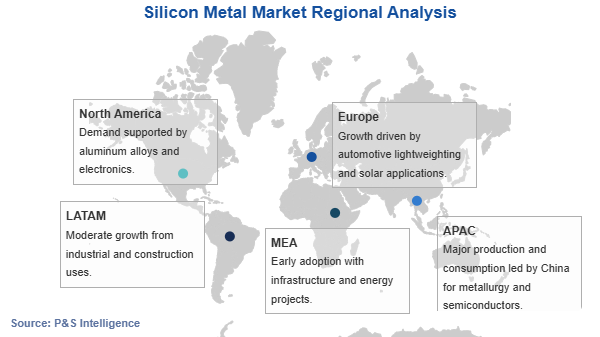
Asia-Pacific commanded the largest market share in 2024, of 40%, driven by the region's dominant position in aluminum production, electronics manufacturing, and solar panel production. China alone represents the epicenter of silicon metal demand, with its massive manufacturing base across automotive, construction, and renewable energy sectors creating unprecedented consumption levels.
China Silicon Metal Market Outlook
China's silicon metal market benefits from integrated supply chains and proximity to key raw materials. China is the world's largest silicon producer, with a production volume estimated at 6.6 million metric tonnes in 2023, providing cost advantages and supply security for downstream industries. Government policies supporting industrial development, particularly in high-technology sectors and renewable energy, continue to drive regional market expansion. Utility-scale solar power capacity in China reached more than 880 Gigawatts (GW) in 2024, with continued capacity additions ensuring sustained silicon metal demand.
China's automotive industry transformation toward electric vehicles creates additional demand momentum for silicon metal. As per OICA, Chinese auto production reached almost 31.3 million units in 2024, marking a 4% increase from 2023, with increasing electrification rates driving aluminum–silicon alloy consumption. The country's ambitious carbon neutrality goals and industrial upgrading initiatives position Asia-Pacific for continued market leadership through 2032.
North America Silicon Metal Market Outlook
North America represents the fastest-growing regional market for silicon metal, projected to expand at approx. 5.5% CAGR during 2025–2032. It is driven by reshoring initiatives in semiconductor manufacturing, electric vehicle production expansion, and infrastructure modernization programs. The region's silicon metal demand benefits from substantial government investments in domestic manufacturing capabilities, particularly in strategic industries requiring silicon-based materials.
Semiconductor manufacturing represents a particularly dynamic growth driver for North American silicon metal demand. The CHIPS Act and related initiatives aim to establish domestic semiconductor production capabilities, requiring substantial high-purity silicon metal supplies. Combined with the automotive industry's electric vehicle investments and solar energy deployment, North America's diversified demand base ensures robust market growth throughout the forecast period.
U.S. Silicon Metal Market Outlook
The U.S. leads regional growth through multiple demand drivers across automotive, semiconductor, and construction sectors. Construction spending in the U.S. reached USD 2,139.1 billion in July 2025, creating a sustained demand for silicon-based construction materials and aluminum alloys. The Infrastructure Investment and Jobs Act continue to support nonresidential construction projects, particularly in transportation and utility infrastructure requiring silicon-enhanced materials.
The regions and countries analyzed in this report are:
North America (Fastest-Growing Regional Market)
U.S. (Larger Country Market)
Canada (Faster-Growing Country Market)
Europe
Germany (Largest Country Market)
U.K. (Fastest-Growing Country Market)
France
Italy
Spain
Rest of Europe
Asia-Pacific (Largest Regional Market)
Japan
China (Largest Country Market)
India (Fastest-Growing Country Market)
South Korea
Australia
Rest of APAC
Latin America
Brazil (Largest Country Market)
Mexico (Fastest-Growing Country Market)
Rest of LATAM
Middle East and Africa
Saudi Arabia (Largest Country Market)
South Africa
U.A.E. (Fastest-Growing Country Market)
Rest of MEA
Silicon Metal Market Share
The global silicon metal market is considered fragmented, meaning that it is made up of many producers rather than being dominated by a few companies. While China accounts for the largest share of production, other regions like Europe, the Americas, and Southeast Asia also have numerous suppliers, preventing any single company from controlling the global market. The demand for silicon metal comes from a variety of industries, including solar energy, aluminum alloys, chemicals, and electronics, which propels the market across different sectors and increases competition among producers. Producing silicon metal requires significant capital investment and strict quality control to achieve high purity, but these requirements are not so restrictive as to create a fully consolidated market.
Overall, the market consists of multiple players with varying production scales, and although certain regions may have higher concentrations of production, no single entity dominates worldwide.
Key Silicon Metal Companies:
Ferroglobe PLC
Elkem ASA
Dow Silicones Corporation
Wacker Chemie AG
United Company RUSAL International Public Joint Stock Company
Rima Industrial S/A
LIASA
Mississippi Silicon LLC
Hoshine Silicon Industry Co., Ltd.
Anyang Huatuo Metallurgy Co., Ltd.
Zhejiang Kaihua Yuantong Silicon Industry Co., Ltd.
PCC SE
Shin-Etsu Chemical Co., Ltd.
Simcoa Operations Pty Ltd
Wynca Group
Silicon Metal Market News
In May 2024, Shin-Etsu Chemical Co. Ltd. announced the launch of Shin-Etsu Silicone (Pinghu) Co. Ltd. in Zhejiang Province, China. The company plans to build a new silicone products plant on a 40,000 m² site with a total investment of around 2.1 billion yen, aiming to meet the growing demand in the Chinese market.
In April 2024, Elkem ASA showcased its latest innovations, PURESIL ESG 01 and MIRASIL N-DML 15, at the NYSCC 2024 Suppliers Day held on May 1–2 in New York City. These products represent significant advancements in sustainable personal care formulations.
In March 2024, Shin-Etsu Chemical Co. Ltd. introduced the KRW-6000 Series of water-based, fast-curing silicone resin that does not require emulsifiers. This innovation marks a significant advancement in environmental sustainability within silicone applications.
In February 2024, Elkem ASA announced it would curtail production at its Norway and Iceland facilities during the first quarter of 2025. The reductions are due to planned maintenance and power-related constraints, as part of the company’s efforts to optimize production efficiency across its global operations.
In September 2023, Wacker Chemie AG announced an expansion of its specialty silicone production line in Zhangjiagang, China, investing approximately USD 158 million. The project aims to strengthen the company’s presence in the growing Asian silicone market, with new production lines for silicone fluids, emulsions, and elastomer gels expected to start operations in the second half of 2025.
Want a report tailored exactly to your business need?
Leading companies across industries trust us to deliver data-driven insights and innovative solutions for their most critical decisions. From data-driven strategies to actionable insights, we empower the decision-makers who shape industries and define the future. From Fortune 500 companies to innovative startups, we are proud to partner with organisations that drive progress in their industries.
Client Testimonials
Working with P&S Intelligence and their team was an absolute pleasure – their awareness of timelines and commitment to value greatly contributed to our project's success. Eagerly anticipating future collaborations.
McKinsey & Company
India
Unmatched Standards
Our insights into the minutest levels of the markets, including the latest trends and competitive landscape, give you all the answers you need to take your business to new heights
Complete Data Security
We take a cautious approach to protecting your personal and confidential information. Trust is the strongest bond that connects us and our clients, and trust we build by complying with all international and domestic data protection and privacy laws