Silicon Carbide-on-Insulator (SiCoI) Film Market Size & Opportunities Analysis - Growth Strategies, Competitiveness, and Forecasts (2025 - 2032)
This Report Provides In-Depth Analysis of the Silicon Carbide-on-Insulator Film Market Report Prepared by P&S Intelligence, Segmented by Substrate Material (Silicon, Silicon Carbide, Sapphire), Wafer Size (100 mm, 150 mm, 200 mm), Technology (Smart Cut, Grinding/Polishing/Bonding), and Geographical Outlook for the Period of 2019 to 2032
Silicon Carbide-on-Insulator Film Market Revenue Scope
Key Highlights
Study Period
2019 - 2032
Market Size in 2024
USD 31.6 Million
Market Size in 2025
USD 57.9 Million
Market Size by 2032
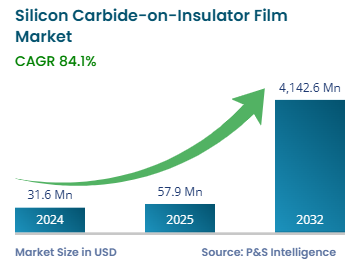
USD 4142.6 Million
Projected CAGR
84.1%
Largest Region
North America
Fastest Growing Region
APAC
Market Structure
Fragmented
Market Size
Major Companies
Important Takeaways
Market Size and Forecast
Industry Trend
Regulatory Landscape
Demand Trend Analysis
Companies Recent Strategical Developments
Key Stakeholders
Voice of Industry Experts/KOLs
Future Opportunity
Explore the market potential with our data-driven report
Silicon Carbide-on-Insulator Film Market Outlook
The global SiC-on-insulator (SiCoI) film market generated an estimated revenue of USD 31.6 million in 2024, which is expected to witness a CAGR of 84.1% during 2025–2032, to reach USD 4142.6 million by 2032. This growth can be attributed to the increasing demand for SiC-based semiconductors for high-performance applications, such as power electronics, automotive, and renewable energy systems. SiCOI films offer superior electrical properties, including high breakdown voltage and thermal conductivity, making them ideal for use in high-power and high-frequency devices.
Furthermore, the growing adoption of electric vehicles (EVs) and the expansion of 5G networks are driving the need for more efficient and reliable semiconductor materials, further fueling the demand for SiCOI films. The continuous advancements in manufacturing techniques and the growing emphasis on sustainability in the electronics sector are also contributing to the market’s positive outlook. As these trends continue to evolve, the SiCOI Film Market is poised for significant growth in the coming years.
Silicon Carbide-on-Insulator Film Market Growth Factors
Rising Demand for High-Power Electronics Is Key Driver
A key driver for the market is the rising demand for high-power electronics, particularly in industries such as automotive, renewable energy, and industrial automation.
SiCOI films are increasingly sought after for their superior electrical properties, including high breakdown voltage, excellent thermal conductivity, and enhanced power handling capabilities.
These characteristics make SiCOI films ideal for use in high-power electronic devices, such as power inverters, motor drives, and electric vehicle (EV) powertrains, which require efficient and reliable performance in demanding conditions.
According to the International Energy Agency’s Global EV Outlook, in 2024, more than 17 million plug-in electric cars (BEVs and PHEVs) were sold worldwide, accounting for over 20% of total global car sales.
Based on figures from the International Federation of Robotics, there were approximately 4.28 million industrial robots in operation worldwide by the end of 2023.
Airbus projects the global commercial aircraft fleet will more than double to roughly 48,230 aircraft by 2043, up from about 24,240 in early 2024.
SiCOI films help improve the efficiency and durability of power electronic devices by enabling higher power densities, faster switching speeds, and lower energy losses.
Additionally, SiCOI films offer better heat management compared to traditional silicon-based semiconductors, making them ideal for applications that generate significant heat.
Advancement in Quantum Technologies Is a Key Opportunity
An emerging market opportunity lies in the advancements in quantum technologies.
Quantum computing, quantum communication, and quantum sensing are rapidly evolving fields that require highly specialized materials to meet their demanding performance and precision needs.
SiCOI films, with their exceptional electrical properties, such as high breakdown voltage, low power loss, and efficient heat dissipation, are gaining attention as potential enablers for quantum devices, particularly in the development of quantum processors and quantum sensors.
SiCOI films provide a stable platform for creating quantum structures that require high-quality insulator layers to isolate specific components or regions of a device.
The material’s ability to handle high frequencies and power densities, combined with its superior insulation characteristics, makes it a promising candidate for the next generation of quantum technologies.
With the growing investment in quantum research and the increasing interest in quantum technologies for various industries, the SiCOI Film Market is positioned to capitalize on this high-potential opportunity, fueling its growth in the coming years.
High Costs Associated with Fabrication Process Poses Challenges
A significant challenge facing the market is the high cost associated with the fabrication process.
The production of SiCOI films involves advanced manufacturing techniques, such as epitaxial growth and ion implantation, which are both complex and expensive.
The process requires high precision and specialized equipment to ensure the quality and performance of the films, especially considering the stringent requirements of industries like power electronics, automotive, and quantum technologies.
This contributes to the overall high production costs of SiCOI films.
Additionally, the need for high-quality substrates and the intricate layering involved in creating the SiC-on-Insulator structure further increases manufacturing expenses.
The specialized materials and technologies required for fabrication are not only costly but also limit scalability, making it difficult to lower production costs significantly.
Silicon Carbide-on-Insulator Film Market Segmentation and Category Analysis
Substrate Material Insights
The silicon carbide (SiC) category is projected to grow at the highest CAGR, of 84.5%, during 2025–2032, after holding the largest market share, of 45%. This is due to its superior performance characteristics and the increasing demand for high-efficiency, high-power devices. SiC is a wide-bandgap material with exceptional thermal conductivity, high breakdown voltage, and the ability to operate at higher frequencies and temperatures compared to traditional silicon.
These properties make SiC ideal for power electronics applications, such as electric vehicles (EVs), renewable energy systems (e.g., solar inverters), and high-performance power supplies. The global shift towards electrification and the growing adoption of renewable energy are driving the demand for more efficient and robust power devices, with SiC semiconductors offering significant advantages in these areas.
SiC-based power devices, such as diodes, MOSFETs, and JFETs, deliver faster switching speeds, greater energy efficiency, and reduced heat dissipation, making them essential for modern power systems.
During the study, we have analyzed the following substrate materials in the report:
Silicon (Si)
Silicon Carbide (SiC) (Largest and Fastest-Growing Category)
Sapphire
Others
Wafer Size Analysis
The 200 mm category holds the largest market share, of 60%, in 2024, due to its optimal balance between performance, cost-efficiency, and scalability. As the semiconductor industry increasingly shifts towards larger wafer sizes, 200 mm wafers have become the standard for manufacturing high-performance SiC-based devices. This size allows for the production of more devices per wafer compared to smaller 100 mm wafers, thereby improving manufacturing yields and reducing per-device costs, making it highly attractive for mass production.
Additionally, 200 mm wafers enable the development of more complex and advanced SiC-based power devices required for applications in electric vehicles (EVs), renewable energy systems, and industrial power control, where high efficiency and robustness are essential. The 200 mm wafer size also facilitates easier transition and integration into existing semiconductor manufacturing infrastructures, as many fabs are already optimized for this size.
The 150 mm category has the highest CAGR, of 85%, as manufacturers seek to scale high-power electronic components for electric vehicles, renewable energy systems, and data centers. The 150 mm format enables greater wafer throughput and improved cost-efficiency compared to smaller diameters, while maintaining the thermal and electrical advantages of SiCOI.
It supports advanced device architectures like vertical transistors and RF power amplifiers, which require high-quality, low-defect substrates. Foundries and integrated device manufacturers prefer this size due to its compatibility with existing silicon fabs, making it a practical step toward commercialization without the complexity of transitioning to 200 mm wafers.
Below is the wafer sizes analyzed:
100 mm
150 mm (Fastest-Growing Category)
200 mm (Largest Category)
Technology Insights
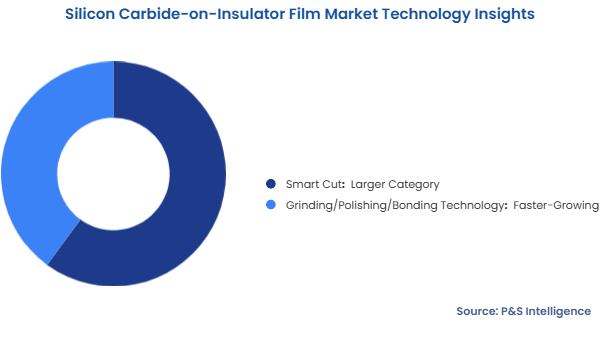
Based on technology, the smart cut technology accounts for the largest share in 2024. This is due to its superior ability to produce high-quality, thin SiC films with excellent surface smoothness and minimal defects. This advanced technology uses ion implantation followed by wafer bonding and detachment to create thin layers of high-quality material, making it highly suitable for applications that require precision and efficiency, such as power electronics and semiconductor devices.
The main advantage of smart cut is its ability to generate high-performance SiC films that are crucial for the manufacturing of power devices like diodes, MOSFETs, and JFETs, which require a high degree of structural integrity and surface uniformity. Moreover, Smart Cut technology enables scalable production with lower material waste and reduced costs, making it highly attractive for mass production of SiC-based components.
Grinding/polishing/bonding is the fastest-growing category, with 85.5% CAGR, due to the growing complexity of SiCoI-based devices. As these films are used in high-power and high-frequency applications, surface uniformity and substrate integrity have become critical. Grinding ensures precise thickness control, while chemical-mechanical polishing (CMP) reduces surface defects and enhances yield in device fabrication. Wafer bonding is essential for integrating SiC layers onto insulating substrates with minimal stress and contamination. These processes directly impact device reliability and performance. As manufacturers scale production and pursue tighter tolerances, high-precision surface engineering tools are becoming indispensable in the SiCoI value chain.
The following technologies are included in the report:
Drive strategic growth with comprehensive market analysis
Silicon Carbide-on-Insulator Film Market Regional Growth Dynamics
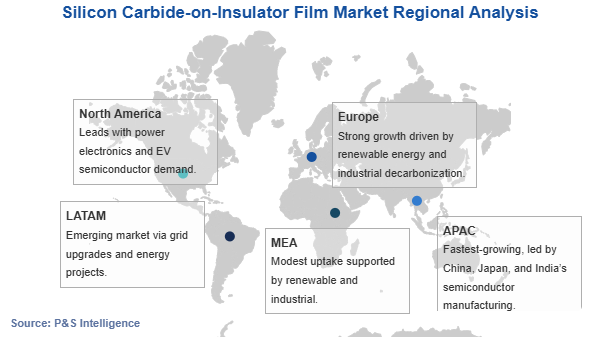
North America holds the largest market share, of 45%, in 2024. This is due to its established leadership in technological innovation, high demand for advanced power electronics, and significant investments in research and development. The region has been at the forefront of adopting Silicon Carbide (SiC) technology, particularly in the automotive, renewable energy, and industrial power sectors. The increasing electrification trend, especially with electric vehicles (EVs), is driving the demand for SiC-based semiconductors, which offer superior performance in high-power and high-efficiency applications.
Furthermore, North America is home to several key players in the semiconductor industry, including major manufacturers and technology companies, which are actively investing in the development and commercialization of SiC-based solutions. Government initiatives, such as funding for green energy projects and EV infrastructure, also contribute to the region's leadership in SiC adoption. Additionally, the U.S. Department of Energy (DOE) has been supporting advancements in wide-bandgap semiconductor technologies, including SiC, to accelerate energy transition goals.
APAC is the fastest-growing market, driven by rapid expansion in electric vehicles, industrial automation, and domestic semiconductor manufacturing. In 2024, China sold approximately 12.87 million plug-in electric vehicles, accounting for nearly 48% of all new car registrations, and now produces over half of the world's EV output. India is also expanding its EV footprint, with Delhi alone consuming more than 40% of the country’s EV charging power, highlighting emerging regional demand.
In industrial automation, Asia reached an average of 182 industrial robots per 10,000 manufacturing workers in 2023, more than double the global density from seven years earlier. South Korea leads globally with 1,012 robots per 10,000 employees, followed by China at 470 and Japan at 419, underscoring the region’s dependence on high-performance power electronics. On the semiconductor front, South Korea controls 17.7% of the global chip market, producing over 70% of DRAM and 17% of total foundry capacity, supported by large-scale government initiatives.
Taiwan continues to dominate logic and advanced packaging, while Japan and India are expanding fabrication and assembly capabilities through national subsidies and foreign partnerships. This broad momentum is fueling consistent demand for SiCoI substrates across power, RF, and high-temperature applications.Bottom of Form
Further, regions and countries analyzed for this report include:
Brazil (Largest and Fastest-Growing Country Market)
Mexico
Rest of LATAM
Middle East and Africa (MEA)
Saudi Arabia (Largest Country Market)
South Africa
U.A.E. (Fastest-Growing Country Market)
Rest of MEA
Silicon Carbide-on-Insulator Film Market Share
The market is fragmented due to the presence of several key players and ongoing technological advancements in the field. While a few large semiconductor companies dominate the market, numerous smaller players and specialized firms also contribute to the market, each focusing on unique aspects of SiC technology, such as wafer size, substrate material, and manufacturing processes. This is further fueled by the evolving nature of SiC technology, with continuous research and development efforts aimed at improving performance and cost-efficiency for power electronics and other high-demand applications.
Additionally, regional players in North America, Europe, and Asia-Pacific are competing and collaborating in joint ventures to enhance production capabilities and address the growing demand for SiC-based devices. With the market’s rapid growth and the continuous push for technological improvements, it remains dynamic and fragmented, fostering competition and innovation across the industry.
Key Silicon Carbide-on-Insulator Film Companies:
SOITEC
Sicoxs Corporation
MTI Corporation
NGK Insulators Ltd.
STMicroelectronics N.V.
Infineon Technologies AG
Semiconductor Components Industries LLC
Toshiba Corporation
Cree Inc.
Mitsubishi Electric Corporation
Sumitomo Electric Industries Ltd.
Texas Instruments Incorporated
Murata Manufacturing Co. Ltd.
Rohm Co. Ltd.
II-VI Incorporated
Silicon Carbide-on-Insulator Film Market News & Updates
In December 2024, X-FAB Silicon Foundries SE introduced the XSICM03 XbloX platform for power MOSFETs, offering a significantly reduced cell pitch. As a result, the new platform enables a higher number of dies per wafer, enhances on-state resistance, and keeps the devices reliable.
In September 2024, Resonac Corporation and Soitec entered into a strategic agreement to develop 200-mm (8-inch) SmartSiC SiC wafers, using substrates and epitaxy processes from Resonac.
In September 2024, STMicroelectronics N.V. launched its fourth-generation STPOWER SiC MOSFET technology, offering higher power density, power efficiency, and robustness. It is designed for the automotive and industrial sectors, especially traction inverters.
Want a report tailored exactly to your business need?
Leading companies across industries trust us to deliver data-driven insights and innovative solutions for their most critical decisions. From data-driven strategies to actionable insights, we empower the decision-makers who shape industries and define the future. From Fortune 500 companies to innovative startups, we are proud to partner with organisations that drive progress in their industries.
Client Testimonials
Working with P&S Intelligence and their team was an absolute pleasure – their awareness of timelines and commitment to value greatly contributed to our project's success. Eagerly anticipating future collaborations.
McKinsey & Company
India
Unmatched Standards
Our insights into the minutest levels of the markets, including the latest trends and competitive landscape, give you all the answers you need to take your business to new heights
Complete Data Security
We take a cautious approach to protecting your personal and confidential information. Trust is the strongest bond that connects us and our clients, and trust we build by complying with all international and domestic data protection and privacy laws