This Report Provides In-Depth Analysis of the Semiconductor IP Market Report Prepared by P&S Intelligence, Segmented by IP Type (Processor IP (CPU, GPU, NPU, DSP), Wired Interface IP (PCIe, CXL, SerDes, DDR, USB, MIPI), Foundation & Physical IP (Standard Cells, Memory Compilers, eNVM), Analog & Mixed-Signal IP (PLL, ADC/DAC, PMIC), Security & Subsystem IP (RoT, Crypto, NoC Interconnect)), Architecture & Sourcing Model (Proprietary Architecture (Arm, ARC, Tensilica, Imagination), Open-Standard / Open-Source Architecture (RISC-V Ecosystem), Semi-Custom & Hybrid IP Collaborations), Delivery Format (Soft IP (Synthesizable RTL), Hard IP (Process-Hardened GDSII Layout), Chiplet & Die-to-Die Subsystem IP), Business Model (Downstream Royalties, Upfront Licensing & Maintenance Fees), End-Use Application (High-Performance Computing (HPC) & AI Data Centers, Mobile & Consumer Electronics, Automotive (ADAS, SDV & Digital Cockpit), Telecom & Wired/Wireless Networking, Industrial Automation, Edge AI & Smart IoT, Aerospace, Defense & Sovereign Silicon), and Geographical Outlook for the Period of 2022 to 2033
Explore the market potential with our data-driven report
Semiconductor IP Market Outlook
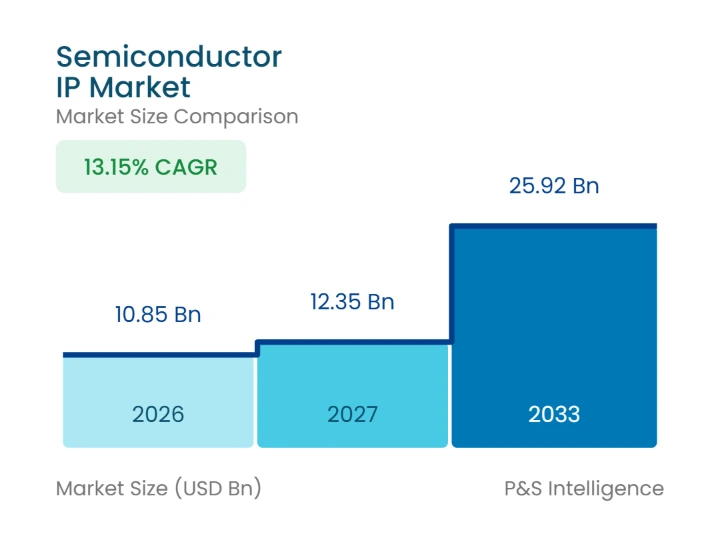
The global semiconductor IP market size is estimated at USD 10.85 Billion in 2026 and is projected to reach USD 12.35 Billion in 2027. Licensor revenue is projected to climb to USD 25.92 Billion by 2033, expanding at a CAGR of 13.15% during 2027-2033. Cloud operators building AI accelerators, handset chipmakers adopting newer processor generations, and carmakers developing software-defined vehicle platforms are behind much of the new licensing activity. Each of these programs buys its non-differentiating blocks from licensors, which pays vendors once at design start and again on every chip shipped.
Fabless chipmakers and cloud operators taping out at 3nm and below are licensing more of each die, because a failed tape-out at those nodes is expensive to repeat, and that design discipline supports steady semiconductor IP market growth. Royalties then scale with the logic silicon those designs ship. The Spring 2026 forecast from World Semiconductor Trade Statistics puts logic sales growth at 27% for 2027, a chip-revenue measure that excludes IP fees yet sizes the base on which per-unit royalties are charged. Design complexity lifts upfront fees, and production volume lifts royalties.
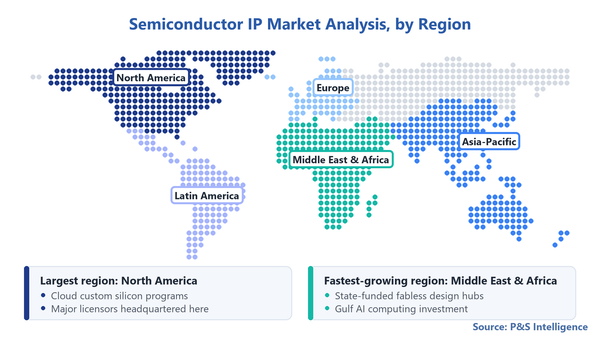
North America accounts for 44.5% of revenue in 2026, led by the United States, where cloud operators running custom-silicon programs and the two largest EDA-and-IP vendors are headquartered. Middle East & Africa is projected to grow fastest, at a 14.8% CAGR during 2027-2033, as Saudi Arabia funds new fabless design companies and the United Arab Emirates builds AI computing capacity. The two regions buy differently, with North American demand renewing large existing design pipelines while Gulf demand comes from first-generation design teams licensing their initial IP portfolios.
Key market insights
By IP type, processor IP (CPU, GPU, NPU, DSP) accounts for 49.0% in 2026, while wired interface IP (PCIe, CXL, SerDes, DDR, USB, MIPI) is projected to post a 16.85% CAGR during 2027-2033.
By architecture and sourcing model, proprietary architecture (Arm, ARC, Tensilica, Imagination) accounts for 73.5% in 2026, while open-standard / open-source architecture (RISC-V Ecosystem) is projected to expand at a 32.5% CAGR during 2027-2033.
By delivery format, soft IP (synthesizable RTL) accounts for 51.0% in 2026, while chiplet & die-to-die subsystem IP is projected to advance at a 27.35% CAGR during 2027-2033.
By business model, downstream royalties account for 56.0% in 2026, while upfront licensing & maintenance fees are projected to grow at a 13.55% CAGR during 2027-2033.
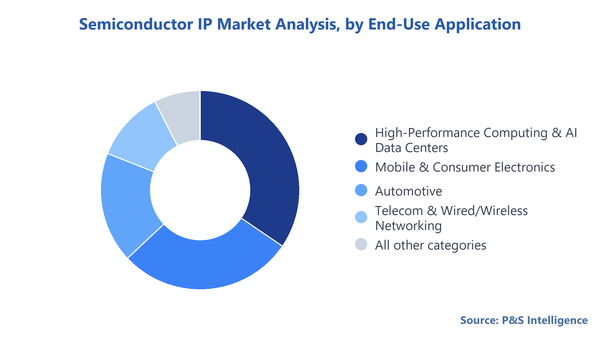
By end-use application, high-performance computing (HPC) & AI data centers account for 34.5% in 2026 and are also projected to grow fastest, at a 17.85% CAGR during 2027-2033.
By geography, North America accounts for 44.5% in 2026, while Middle East & Africa is projected to record a 14.8% CAGR during 2027-2033.
Semiconductor IP Market Growth Drivers & Challenges
Quantum-resistant encryption is reshaping security IP specifications
Chipmakers designing server processors, vehicle gateways, and secure microcontrollers are adding hardware roots of trust and dedicated cryptographic engines to designs that once handled security in software. Post-quantum algorithms use much larger keys and signatures than the RSA and elliptic-curve schemes they replace, and hash-based signatures are especially compute-heavy, so running them on a general-purpose core slows boot and authentication. Design teams therefore license accelerator blocks, and because a chip taped out in 2026 can stay in service for a decade or more, the algorithm choice is being locked in now.
NIST finalized its first three post-quantum standards, FIPS 203, FIPS 204, and FIPS 205, on August 13, 2024, and encouraged system administrators to begin transitioning as soon as possible. The standards specify algorithms and do not require any particular chip design, yet they give security IP licensors a fixed target to implement and validate. Licensors offering validated cores for these algorithms are better positioned in automotive, defense, and cloud programs, where certified implementations shorten customer qualification.
Custom silicon programs at cloud operators are accelerating high-value license deals
Cloud operators designing their own AI accelerators and server CPUs have become a fast-growing group of IP licensees. Their silicon teams typically differentiate on the compute architecture and software stack, then license compute subsystems, HBM controllers, SerDes, and PCIe or CXL interfaces so the chip can reach volume on its first tape-out. Each program buys a bundle of high-speed blocks at once, which raises contract values and makes these designs disproportionately important to interface licensors.
Arm's annual results for the fiscal year ended March 31, 2026, recorded royalty revenue of USD 2.61 billion, up 21%, with the company attributing the rise to higher per-chip rates on Armv9 and its compute subsystems and to wider use of Arm-based chips in data centers. One company's royalty line cannot size industry demand, but it indicates that server silicon now adds recurring income on top of license fees. That shift could favor licensors able to sell complete, pre-verified subsystems.
Multi-die packaging is opening a licensing market for die-to-die links
Chip designers splitting large accelerators and server processors into several chiplets need a link between them, and most would sooner license that link than engineer a proprietary one for each package. A standard die-to-die interface lets a design team combine a compute die built on one node with I/O or memory dies built on another, which reduces the area that must sit on the most expensive wafer. Each die in such a package carries its own interface block, so licensed content per system grows with the die count.
The UCIe Consortium released its 3.0 specification on August 5, 2025, raising data rates to 48 GT/s and 64 GT/s while remaining backward compatible with earlier versions. A common specification lowers the risk that a die built today cannot connect to another vendor's die later, a concern that has slowed multi-vendor designs. Licensors that are first to offer silicon-proven controllers and PHYs at these rates could gain early design wins as the first multi-vendor packages enter design.
Export controls on advanced chip technology are constraining licensor access to Chinese design starts
Western licensors face narrower access to Chinese chip designers working on advanced AI and server parts, a customer group that buys interface and processor IP at leading nodes. When an export license or end-user check is needed, deal cycles lengthen, and some programs move to domestic or open-architecture alternatives that do not rely on US-origin technology. The revenue at risk is concentrated in high-value blocks, because most mature-node consumer and IoT designs sit outside the controls.
According to the US Bureau of Industry and Security, rules announced on December 2, 2024, added controls on 24 types of semiconductor manufacturing equipment and 3 types of software tools for developing or producing semiconductors, along with new restrictions on high-bandwidth memory. The rules target tools, equipment, and memory and do not name licensed IP blocks, yet they narrow the advanced-node programs Chinese licensees can complete. Licensors with a broad Chinese consumer and IoT base keep much of that business, while vendors whose growth depends on leading-edge interface IP face a smaller addressable pool there.
Segmentation Analysis
IP Type
Processor IP (CPU, GPU, NPU, DSP) accounts for 49.0% of the semiconductor IP market in 2026, the largest share of any IP type. Processor cores earn the highest royalty rates per chip because they define the software a device runs, so phone, PC, and server chipmakers tend to stay with one instruction set across many product generations. NPU and GPU cores add further value as AI inference moves onto phones and cars, which raises the processor content licensed into each new design.
Wired interface IP (PCIe, CXL, SerDes, DDR, USB, MIPI) is forecast to rise at a 16.85% CAGR during 2027-2033, the fastest among IP types. PCI-SIG made the PCIe 7.0 specification available to members on June 11, 2025, at 128.0 GT/s, and its president described the group's practice of doubling I/O bandwidth roughly every three years. Each new generation requires chip teams to license fresh PHY and controller IP, since few in-house groups are staffed to redesign mixed-signal links at that cadence. AI clusters compound the effect by multiplying the number of links per accelerator.
Architecture and Sourcing Model
Proprietary architecture (Arm, ARC, Tensilica, Imagination) holds 73.5% of 2026 revenue. Operating systems, compilers, and application code written for these instruction sets represent years of work by handset, PC, and automotive software teams, and switching would mean requalifying that software. Proprietary licensors also deliver cores with physical implementation support and safety documentation, which shortens tape-out schedules for chipmakers without large CPU teams. That combination tends to keep licensees on the same architecture across product generations.
Open-standard / open-source architecture (RISC-V Ecosystem) is expected to expand at a 32.5% CAGR during 2027-2033, the fastest rate on this axis. The instruction set is free to use, so licensors charge for verified core implementations and support rather than for the architecture itself, which lowers the entry cost for microcontroller, storage, and AI-accelerator designers. RISC-V International ratified the RVA23 profile on October 21, 2024, making vector and hypervisor extensions mandatory for compliant application processors, a step that helps software move across vendors' chips. Chipmakers wanting a second processor source can now evaluate RISC-V for application-class roles.
Delivery Format
Soft IP (synthesizable RTL) represents 51.0% of 2026 revenue because processor cores, controllers, and security engines are typically delivered as RTL that a design team can synthesize on any foundry node. That portability lets one license follow a product family across process migrations, and it gives architects room to configure cache sizes, bus widths, and feature sets for each chip. Royalty-bearing processor cores are mostly soft deliverables, so this format also captures most of the recurring income.
Chiplet & die-to-die subsystem IP is projected to post a 27.35% CAGR during 2027-2033, the fastest of the three formats. Accelerator and server-CPU designers are splitting reticle-sized chips into compute, I/O, and memory dies, and every die boundary needs a physical layer and controller on both sides, which most teams license. Vendors are also selling complete subsystems that bundle the link, test logic, and package guidance, which raises the value of each design win. Revenue in this format is therefore closely tied to the number of AI-server programs entering design.
Business Model
Downstream royalties account for 56.0% of 2026 revenue. Royalties are charged on every chip shipped, so cores designed into smartphones, microcontrollers, and vehicles years ago keep paying long after the license fee was booked. This installed base of shipping designs makes royalty income less dependent on any single year's design starts, and per-unit rates rise as licensees move to newer architecture versions. Licensors with deep exposure to high-volume consumer and embedded chips collect the largest royalty streams.
Upfront licensing & maintenance fees are projected to grow at a 13.55% CAGR during 2027-2033, the faster of the two revenue streams. Every new process node needs its own hardened version of interface and foundation blocks, and as of August 2023, TSMC's IP catalog listed more than 60,000 IPs from its alliance members. Advanced-node ports, chiplet subsystems, and multi-year access subscriptions all generate fees before any chip ships. For licensors, this stream turns rising design-start activity into revenue earlier in each program.
End-Use Application
High-performance computing (HPC) & AI data centers account for 34.5% of 2026 revenue, the largest end-use share. Accelerator and server-processor programs license the most expensive blocks in the catalog, including compute subsystems, HBM and DDR controllers, and 224G SerDes, and they do so at the newest nodes where per-block fees are highest. A single AI accelerator also carries many instances of each interface, which multiplies licensed content per chip.
The same category is projected to grow fastest, at a 17.85% CAGR during 2027-2033. JEDEC published its HBM4 standard on April 16, 2025, specifying transfer speeds of up to 8 Gb/s across a 2048-bit interface, and memory-controller IP has to be updated to run at each such generation's speeds. New memory, PCIe, CXL, and die-to-die generations arriving every few years reset the IP bill of materials for the next accelerator. This cadence favors licensors that can deliver silicon-proven controllers early in each standard's life.
Copyright P&S Intelligence. Reuse requires attribution under CC BY 4.0.
The following segments are analysed in this report.
IP Type
Processor IP (CPU, GPU, NPU, DSP)
Wired Interface IP (PCIe, CXL, SerDes, DDR, USB, MIPI)
Foundation & Physical IP (Standard Cells, Memory Compilers, eNVM)
Analog & Mixed-Signal IP (PLL, ADC/DAC, PMIC)
Security & Subsystem IP (RoT, Crypto, NoC Interconnect)
High-Performance Computing (HPC) & AI Data Centers
Mobile & Consumer Electronics
Automotive (ADAS, SDV & Digital Cockpit)
Telecom & Wired/Wireless Networking
Industrial Automation, Edge AI & Smart IoT
Aerospace, Defense & Sovereign Silicon
Regional Analysis
North America semiconductor IP market outlook
North America accounts for 44.5% of global revenue in 2026, the largest regional position. The United States is the region's largest market and hosts the cloud operators running custom accelerator programs, the major fabless processor and networking chipmakers, and the main EDA vendors that also sell interface and foundation IP. These design teams start many of the industry's most advanced-node projects each year, so the region buys a large share of the interface, subsystem, and processor IP that carries the highest upfront fees.
Semiconductor Industry Association data released on July 27, 2026, show that U.S.-headquartered companies generated USD 425 billion in semiconductor sales in 2025, a 53.4% share of the worldwide market. The figure measures chip revenue and excludes IP spending, yet it indicates where design decisions and license contracts are concentrated. Canada adds a smaller pool of design activity. The region's position is likely to stay stable for as long as cloud operators keep funding new accelerator generations, although export rules limit how much of that design output can be sold into China.
Middle East & Africa semiconductor IP market growth
Middle East & Africa is projected to register the fastest regional growth, at a 14.8% CAGR during 2027-2033, starting from a small revenue base. Gulf governments are funding fabless design companies and AI computing capacity, and a new design team typically licenses processor, interface, and foundation IP before its first tape-out. Saudi Arabia is the region's fastest-growing market, while Israel's established design centers provide a steady base of advanced-node licensing.
Saudi Arabia's Research, Development and Innovation Authority launched the National Semiconductor Hub in 2024 with goals of attracting 50 fabless chip-design companies and training and employing 5,000 integrated-circuit design engineers by 2030. Programs of this kind create license demand early, because a new fabless company buys most of its IP instead of writing it. Growth will depend on how many of these firms reach production volumes, since royalties follow shipments while early tape-outs mostly generate upfront fees.
Copyright P&S Intelligence. Reuse requires attribution under CC BY 4.0.
Asia-Pacific market analysis
Asia-Pacific ranks behind North America and holds the densest concentration of smartphone, consumer-electronics, and foundry-linked design activity. Chipmakers in Taiwan, South Korea, and Japan license IP for high-volume handset, memory-interface, and automotive chips, so their unit volumes keep royalty streams large. China adds a deep pool of licensees, and the IC design branch of the China Semiconductor Industry Association estimated 2025 chip-design sales at USD 125.04 billion (CNY 835.73 billion), up 29.4%. Export controls push China's advanced-node programs toward domestic and RISC-V suppliers, while its consumer and IoT designs keep licensing Western cores.
India is adding a newer layer of demand. Figures from the Ministry of Electronics and Information Technology put the number of chip-design projects supported under its Design Linked Incentive scheme at 24 as of January 2026, with 16 tape-outs completed. Start-ups in that program license foundation and processor IP for their first products, which widens the regional customer base beyond the established North Asian chipmakers. Licensors with mature-node ports at Asian foundries are better positioned to serve these first-time design teams.
Europe market analysis
Europe trails the two larger regions, and its demand is concentrated in automotive, industrial, and secure-identity chips. Chipmakers and automotive suppliers in Germany, France, the Netherlands, and Italy design microcontrollers and zonal controllers that must meet ISO 26262 functional-safety requirements, which favors licensed cores delivered with safety documentation. Long vehicle programs give royalties a predictable base, but they also slow the pace at which new IP enters automotive chips.
As per the European Commission, the Chips Act aims to double the EU's global semiconductor market share to 20% in 2030, and its Chips for Europe initiative funds design tools and pilot lines. The Commission followed with a Chips Act 2.0 proposal in June 2026, which would add further support measures if adopted. Public funding of this kind can support start-up and open-architecture design projects, adding licensees that are less tied to the automotive cycle. Growth in Europe is likely to remain below the global average because the region's design base is weighted toward mature nodes and long product lifecycles.
Latin America market analysis
Latin America holds the smallest regional position, with chip design concentrated in Brazil and Mexico. Most licensing comes from design centers of multinational chipmakers and a small number of domestic design houses, which buy mature-node foundation and microcontroller IP. These designs carry modest license fees, and their royalties depend on the volume of the consumer, industrial, and automotive products they serve.
Brazil's Decree No. 13,065, signed on July 15, 2026, regulates the Brasil Semicon program created by Law No. 14,968 of 2024, which supports research, development, and innovation from chip design through to application. Incentives of this kind lower the cost of starting domestic chip programs, each of which needs licensed IP before tape-out. Regional growth is expected to stay below the global rate, because few local programs target the advanced nodes that carry the highest license fees.
The following geographies are analysed in this report.
North America
U.S.
Canada
Middle East & Africa
Saudi Arabia
U.A.E.
South Africa
Rest of Middle East & Africa
Asia-Pacific
China
India
Japan
South Korea
Taiwan
Singapore
Australia
Rest of Asia-Pacific
Europe
Germany
U.K.
France
Italy
Spain
Rest of Europe
Latin America
Brazil
Mexico
Rest of Latin America
Semiconductor IP Market Competition Analysis
Competition in the semiconductor IP market is organized around processor architectures and foundry-ported interface and foundation catalogs, with a broad specialist tier serving narrower needs. Processor licensing depends on operating systems and application software written over decades for a few instruction sets, which makes architecture switching costly for handset, PC, and automotive chipmakers. Interface and foundation IP depend on silicon-proven ports at every foundry node, and each port needs test chips and foundry qualification before a customer will commit, a cost that favors vendors already present on many nodes. Chiplet standards, open instruction sets, and divestitures keep this structure evolving.
Arm, Synopsys, Cadence, Rambus, and SiFive illustrate how differently the main licensors compete for chip-design budgets across processor, interface, memory, and security IP. Arm sells cores and complete compute subsystems to phone, server, and automotive chipmakers on the strength of the software already written for its instruction set. Synopsys and Cadence each pair electronic design automation tools with large interface IP catalogs, so a chip team can buy tools, IP, and design services from one vendor. Rambus concentrates on memory-interface controllers and security IP for data-center customers, and SiFive sells RISC-V cores to chipmakers seeking another instruction set.
For chip designers, this structure keeps negotiations for the most advanced interfaces with a small number of vendors holding silicon-proven ports on each new node. Specialists in embedded memory, on-chip interconnect, wireless connectivity, and RISC-V cores compete on configurability, price, and willingness to customize, and many reach customers through semiconductor foundry partnership programs. New entrants face a long qualification cycle, because a failed advanced-node tape-out can cost a customer more than any license saving.
Major Companies in Semiconductor IP Market:
Arm Holdings plc
Synopsys Inc.
Cadence Design Systems Inc.
Qualcomm Incorporated
Rambus Inc.
Imagination Technologies Ltd.
CEVA Inc.
SiFive Inc.
Arteris Inc.
eMemory Technology Inc.
VeriSilicon Microelectronics (Shanghai) Co. Ltd.
Andes Technology Corporation
Achronix Semiconductor Corporation
Semiconductor IP Market News
In September 2026, Arteris Inc. introduced FlexGen Multi-Die, a non-coherent network-on-chip IP for AI and HPC chiplet designs that carries bidirectional traffic over a single UCIe PHY and cuts PHY area, power, and I/O requirements by up to 50%. The release extends the company's interconnect business from single dies into multi-die packages.
In June 2026, Synopsys Inc. completed the sale of its ARC Processor IP Solutions business, including the ASIP Designer and ASIP Programmer tools and more than 300 IP customers, to GlobalFoundries Inc., which placed it within its MIPS unit. A foundry group now owns a processor IP line, while Synopsys keeps its interface and foundation IP.
In April 2026, SiFive Inc. raised USD 400 million in an oversubscribed Series G round led by Atreides Management, valuing the company at USD 3.65 billion. The funds are earmarked for next-generation data-center solutions and a wider CPU, accelerator, and system IP roadmap, raising RISC-V's profile in server silicon.
In March 2026, Rambus Inc. launched an HBM4E Memory Controller IP supporting up to 16 Gbps per pin and 4.1 TB/s of throughput to each memory device, building on more than 100 HBM design wins. The controller targets AI accelerators whose memory bandwidth needs grow with every model generation.
December 2025, Qualcomm Incorporated completed its acquisition of Alphawave IP Group plc roughly one quarter ahead of schedule, in a deal carrying an implied enterprise value of about USD 2.4 billion when announced. The acquisition adds Alphawave Semi's high-speed connectivity IP to Qualcomm's Oryon CPU and Hexagon NPU portfolio as the chipmaker expands into data centers.
Last Updated: October 2026
Frequently Asked Questions About This Report
How big is the semiconductor IP market?+
The global semiconductor IP market size is estimated at USD 10.85 Billion in 2026 and is projected to reach USD 12.35 Billion in 2027.
What is the growth rate of the semiconductor IP market?+
The revenue is projected to climb to USD 25.92 Billion by 2033, expanding at a CAGR of 13.15% during 2027-2033.
Which region dominates the semiconductor IP market?+
North America accounts for 44.5% of revenue in 2026, led by the United States, where cloud operators running custom-silicon programs and the two largest EDA-and-IP vendors are headquartered.
Which region is growing fastest in the semiconductor IP market?+
Middle East & Africa is projected to register the fastest regional growth, at a 14.8% CAGR during 2027-2033, starting from a small revenue base.
What is the largest segment of the semiconductor IP market?+
Processor IP (CPU, GPU, NPU, DSP) accounts for 49.0% of the semiconductor IP market in 2026, the largest share of any IP type.
Why is RISC-V IP growing so fast?+
The instruction set is free to use, so licensors charge for verified core implementations and support rather than for the architecture itself, which lowers the entry cost for microcontroller, storage, and AI-accelerator designers.
How is AI driving demand for semiconductor IP?+
Accelerator and server-processor programs license the most expensive blocks in the catalog, including compute subsystems, HBM and DDR controllers, and 224G SerDes, and they do so at the newest nodes where per-block fees are highest.
Who are the key players in the semiconductor IP market?+
Arm, Synopsys, Cadence, Rambus, and SiFive illustrate how differently the main licensors compete for chip-design budgets across processor, interface, memory, and security IP.
Want a report tailored exactly to your business need?
Leading companies across industries trust us to deliver data-driven insights and innovative solutions for their most critical decisions. From data-driven strategies to actionable insights, we empower the decision-makers who shape industries and define the future. From Fortune 500 companies to innovative startups, we are proud to partner with organisations that drive progress in their industries.
Client Testimonials
Working with P&S Intelligence and their team was an absolute pleasure – their awareness of timelines and commitment to value greatly contributed to our project's success. Eagerly anticipating future collaborations.
McKinsey & Company
India
Unmatched Standards
Our insights into the minutest levels of the markets, including the latest trends and competitive landscape, give you all the answers you need to take your business to new heights
Complete Data Security
We take a cautious approach to protecting your personal and confidential information. Trust is the strongest bond that connects us and our clients, and trust we build by complying with all international and domestic data protection and privacy laws