This Report Provides In-Depth Analysis of the Semiconductor Foundry Market Report Prepared by P&S Intelligence, Segmented by Technology Node (10/7/5 nm, 16/14 nm, 20 nm, 28 nm, 45/40 nm, 65 nm), Application (Communications, Consumer Electronics, Automotive, Industrial), Type (Pureplay, IDMs), and Geographical Outlook for the Period of 2019 to 2032
Explore the market potential with our data-driven report
Semiconductor Foundry Market Future Outlook
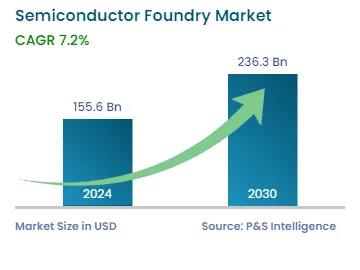
The semiconductor foundry market size was USD 155.6 billion in 2024, and it will grow by CAGR of 5.2% during 2025–2032, to reach USD 268.3 billion by 2032.
The major factors responsible for the growth of the market include the accelerating adoption of artificial intelligence and machine learning applications, rapid deployment of 5G infrastructure globally, and the automotive industry's transition toward electric and autonomous vehicles. As the demand for advanced semiconductor chips continues to surge across multiple industries, foundries are investing heavily in cutting-edge process technologies to meet the evolving requirements of high-performance computing and energy-efficient devices.
The market is experiencing unprecedented growth driven by the proliferation of AI-powered applications that require specialized chips with superior processing capabilities. The rapid expansion of AI adoption across cloud computing, autonomous vehicles, healthcare, and fintech industries has created substantial demand for advanced semiconductor manufacturing capabilities. Furthermore, the global rollout of 5G technology is creating new opportunities for semiconductor foundries, as telecommunications infrastructure requires sophisticated chips capable of handling increased data transmission speeds and network capacity. The automotive sector's shift toward electrification and advanced driver assistance systems (ADAS) has emerged as another significant growth catalyst, with modern vehicles incorporating an increasing number of semiconductor components for battery management, power electronics, and safety systems.
Semiconductor Foundry Market Trends & Drivers
Artificial Intelligence and High-Performance Computing Are Key Trends
The explosive growth of artificial intelligence and machine learning applications represents a key trend in semiconductor manufacturing requirements.
As AI models become more complex and data-intensive, they require increasingly powerful chips, which, in turn, enables the development of even more sophisticated AI applications.
Leading foundries are responding to this demand by developing specialized manufacturing processes optimized for AI chip production, including advanced packaging technologies that enable higher bandwidth memory integration and improved thermal management.
The race to capture the AI semiconductor market has intensified competition among foundries, with companies investing billions in research and development to maintain their technological edge in this rapidly evolving landscape.
Major applications, ranging from cloud data centers to specific industry segments, are expected to undergo upgrades, leading to significant growth in the semiconductor industry.
This transformation is compelling semiconductor foundries to accelerate their investments in leading-edge technologies, particularly in sub-7nm nodes that offer the transistor density and power efficiency required for AI processing.
The proliferation of 5G-enabled devices extends far beyond smartphones to encompass a wide array of IoT applications, industrial automation systems, and smart city infrastructure.
Each of these applications requires specialized semiconductor solutions with varying performance characteristics, creating diverse opportunities for foundries across different technology nodes.
Automotive Electrification and Autonomous Driving Technologies Are Biggest Drivers
A typical modern car today contains 1,400 to 1,500 semiconductor chips, with some models reaching up to 3,000.
Modern vehicles, especially electric vehicles (EVs) and ADAS-equipped vehicles, require advanced semiconductor components such as microcontrollers, power management ICs, sensors, and communication chips.
As per studies, the worldwide spending on ADAS will reach USD 156.4 billion by 2032, while 17 million electric cars were bought in 2024, as per the IEA.
This shift has fundamentally altered the semiconductor content per vehicle, with electric vehicles containing significantly more chips than traditional internal combustion engine vehicles.
The complexity of modern automotive electronics, ranging from battery management systems to advanced driver assistance features, requires semiconductors manufactured across various technology nodes, creating opportunities for foundries with diverse capabilities.
The evolution toward fully autonomous vehicles is accelerating the demand for high-performance computing chips capable of processing vast amounts of sensor data in real-time.
These applications require semiconductors manufactured using advanced nodes to achieve the necessary performance while meeting strict automotive safety and reliability standards.
Additionally, the automotive industry's stringent quality requirements and long product lifecycles present unique challenges and opportunities for foundries, necessitating specialized manufacturing processes and quality control systems.
The convergence of electrification, connectivity, and automation in vehicles is creating a sustained growth trajectory for automotive semiconductors, with foundries investing in dedicated facilities and certifications to serve this expanding market.
The 10/7/5 nm category held the largest market share, of 25%, in 2024, and it will have the highest CAGR, of 5.4%. This dominance is primarily due to the segment's optimal balance between performance capabilities and manufacturing maturity, making it the preferred choice for high-volume production of processors for smartphones, data centers, and AI applications. The widespread adoption of these nodes by leading chip designers, including Apple, Qualcomm, and NVIDIA, has created substantial demand that foundries are scaling their capacity to meet.
The technology nodes analyzed in this report are:
10/7/5 nm (Largest and Fastest-Growing Category)
16/14 nm
20 nm
28 nm
45/40 nm
65 nm
Application Analysis
The communications category held the largest market share, of 45%, in 2024. This is because numerous devices in the market come in different forms for the purpose of communication, such as smartphones, table laptops, Bluetooth devices, and Wi-Fi routers, whose demand is skyrocketing across the world. Today, almost every individual is using a smartphone. There are approximately 4.88 billion smartphone users worldwide, representing about 60.42% of the global population. These devices enable communication through voice calls, texts, video calls, and emails. These also allow to gain access to the internet, as well as various other tools such as cameras, video recorders, and a multitude of apps. Thus, the demand for smartphones is still very high, with millions of devices being sold each year. Smartphone possession is higher across advanced countries. For instance, in the U.S., the penetration rate of these devices is the highest with more than 80% of the total population.
The automotive category will have the highest CAGR, of 5.6%, reflecting the industry's rapid transformation toward electrification and automation. The shift to electric vehicles has dramatically increased the semiconductor content per vehicle, with EVs requiring sophisticated power management systems, battery monitoring circuits, and electric motor controllers. Furthermore, the integration of advanced driver assistance systems and the move toward autonomous driving are boosting the demand for high-performance processors, image sensors, and radar chips. The automotive industry's adoption of over-the-air updates and connected car features is further expanding the range of semiconductors required, from cellular modems to security chips, establishing automotive as a long-term growth driver for the foundry market.
The applications analyzed in this report are:
Communications (Largest Category)
Consumer Electronics
Automotive (Fastest-Growing Category)
Industrial
Type Analysis
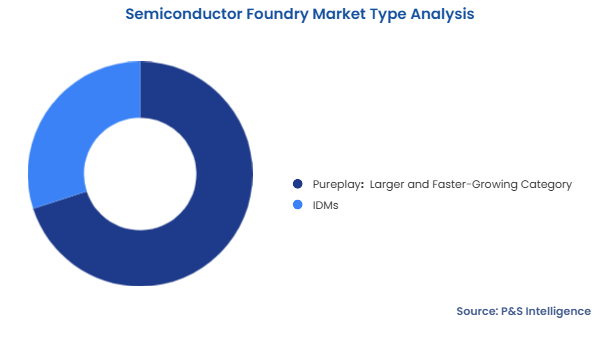
The pureplay category held the larger market share, of 70%, in 2024, and it will have the higher CAGR, of 5.3%, reflecting the industry's continued evolution toward a specialized manufacturing model. Pureplay foundries, led by companies like TSMC, have established themselves as the preferred partners for fabless semiconductor companies due to their technological leadership, manufacturing scale, and customer-focused business model. These foundries benefit from their singular focus on manufacturing excellence, enabling them to invest more aggressively in advanced process technologies and achieve superior yields compared to integrated device manufacturers. The absence of internal product divisions eliminates potential conflicts of interest, making pureplay foundries trusted partners for companies that might otherwise compete with IDMs in end markets.
The types analyzed in this report are:
Pureplay (Larger and Faster-Growing Category)
IDMs
Drive strategic growth with comprehensive market analysis
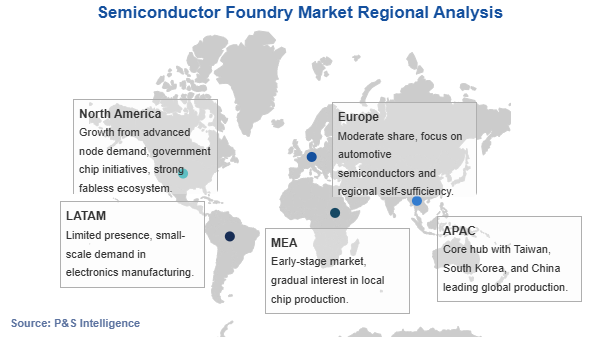
Asia-Pacific held the largest market share, of 45%, in 2024, and it will have the highest CAGR, of 5.9%. This is majorly ascribed to the region's well-established semiconductor manufacturing ecosystem, particularly in Taiwan, South Korea, and China, which host the world's leading foundries and benefit from decades of manufacturing expertise and infrastructure development. The region's dominance is reinforced by its comprehensive supply chain integration, skilled workforce, and supportive government policies that have created an environment conducive to semiconductor manufacturing excellence. Japan has planned to develop its industry policies to regenerate the chipmaking industry, such as a planned focus on equipment, manufacturing, and materials.
China Semiconductor Foundry Market Size
China represents both the largest opportunity and the most dynamic market within the Asia-Pacific region for semiconductor foundries. The country's semiconductor foundry market is experiencing rapid growth driven by strong domestic demand from consumer electronics, telecommunications, and automotive sectors. The growth trajectory reflects China's strategic focus on building domestic semiconductor capabilities while serving its massive internal market.
The Chinese foundry market is characterized by significant investments in mature process technologies, which serve the vast majority of semiconductor applications in consumer and industrial products. Domestic foundries are rapidly expanding capacity and improving their technological capabilities. The growing ecosystem of fabless design companies in China creates natural demand for domestic foundry services, while international trade dynamics are accelerating the trend toward supply chain localization.
Despite facing restrictions on access to the most advanced manufacturing equipment, Chinese foundries are innovating within available technologies and finding success in specialized market segments, positioning China as an increasingly important player in the global foundry landscape. The country has planned a 14th Five-Year Plan and set a goal to achieve "self-sufficiency" in all the segments of semiconductors. China operated 44 semiconductor fabrication plants (fabs) as of 2023. Also, in its K-Belt Semiconductor Strategy, the government has planned tax credits of up to 50% and 16% for R&D and manufacturing, respectively.
India Semiconductor Foundry Market Size
In India, the government has announced to provide a billion dollars for each new fab, which is set up locally, and also planned to support other investments across the value chain of semiconductors. Chips that are manufactured locally are called "trusted sources" and are utilized in products ranging from CCTV cameras to 5G equipment. As of 2025, the Indian government has committed approximately USD 13.1 billion (INR 1.09 lakh crore) to domestic semiconductor manufacturing through initiatives such as the India Semiconductor Mission, fab infrastructure support, modernization of SCL Mohali, and ecosystem development incentives.
North America Semiconductor Foundry Market Size
North America has the second-largest market share, due to the growing electronics and semiconductor sectors, the rising requirement for electronic systems in the automotive industry, and presence of major players. For many years, various corporations are leading in developing processors. Also, the lead of the U.S. in semiconductors is the main reason for the technological expertise and economic dominance of the country. The U.S. semiconductor sector has maintained its strong global position in crucial technologies including quantum computing, Al, and 5G.
Moreover, Canada is in a distinctive place, with financial, economic, and political systems, a well-trained workforce, and a significant reputation globally as a country that is open for businesses and is self-assured to take crucial steps to evolve as a prominent market in the future semiconductor foundry landscape.
Europe Semiconductor Foundry Market Size
The European market value is increasing at a high rate. This is because major countries such as Germany, the U.K., France, and the Netherlands, are adopting advanced technologies, and the rapid growth in the IT, electronics, telecom, manufacturing, health, finance, agriculture, and retail sectors. Strategic investments are driving this expansion, including TSMC’s planned chip design center in Munich, Germany, to support high-performance and energy-efficient chips for automotive, industrial, and AI applications.
The geographical breakdown of the market is as follows:
North America
U.S. (Larger and Faster-Growing Country)
Canada
Europe
Germany (Largest Country)
U.K. (Fastest-Growing Country)
France
Italy
Spain
Rest of Europe
Asia-Pacific (Largest and Fastest-Growing Regional Market)
China (Largest Country)
India (Fastest-Growing Country)
Japan
South Korea
Australia
Rest of APAC
Latin America
Brazil (Largest Country)
Mexico (Fastest-Growing Country)
Rest of LATAM
Middle East and Africa
Saudi Arabia
South Africa (Fastest-Growing Country)
U.A.E. (Largest Country)
Rest of MEA
Semiconductor Foundry Market Share
The market is consolidated due to the massive capital requirements and technological barriers to entry that characterize advanced semiconductor manufacturing. The competitive dynamics of the foundry market are shaped by the continuous race for technological advancement and the ability to achieve high yields on complex manufacturing processes. Moreover, leading foundries invest tens of billions annually in research and development and capital expenditures to maintain their technological edge and expand capacity. The foundry market's competitive landscape is further influenced by geopolitical considerations and supply chain diversification efforts. Government initiatives in various regions to establish domestic semiconductor manufacturing capabilities are reshaping competitive dynamics and creating new opportunities for both established players and regional champions.
Key Semiconductor Foundry Companies:
Taiwan Semiconductor Manufacturing Company Limited
United Microelectronics Corporation
Samsung Electronics Co. Ltd (Samsung Foundry)
Intel Corporation
Powerchip Semiconductor Manufacturing Corporation
GlobalFoundries U.S. Inc.
Semiconductor Manufacturing International Corporation
DB HiTek Co. Ltd.
Hua Hong Semiconductor Limited
STMicroelectronics NV
Tower Semiconductor
X-FAB Silicon Foundries
Semiconductor Foundry Market News
In May 2024, United Microelectronics Corporation launched the industry's first 3D IC solution for RFSOI technology, achieving over 45% die size reduction while enhancing RF performance for 5G applications.
In February 2024, Intel Corporation unveiled the world's first systems foundry designed specifically for the AI era, introducing its Intel Foundry Services with an extended process roadmap to strengthen its competitive position.
In June 2023, GlobalFoundries U.S. Inc. and STMicroelectronics N.V. finalized an agreement to create a new, jointly-operated 300mm semiconductor manufacturing facility in Crolles, France.
In April 2023, Intel Corporation partnered with Arm Limited to expand its IP portfolio, enabling customers to design ARM-based chips using Intel's advanced process technologies.
Want a report tailored exactly to your business need?
Leading companies across industries trust us to deliver data-driven insights and innovative solutions for their most critical decisions. From data-driven strategies to actionable insights, we empower the decision-makers who shape industries and define the future. From Fortune 500 companies to innovative startups, we are proud to partner with organisations that drive progress in their industries.
Client Testimonials
Working with P&S Intelligence and their team was an absolute pleasure – their awareness of timelines and commitment to value greatly contributed to our project's success. Eagerly anticipating future collaborations.
McKinsey & Company
India
Unmatched Standards
Our insights into the minutest levels of the markets, including the latest trends and competitive landscape, give you all the answers you need to take your business to new heights
Complete Data Security
We take a cautious approach to protecting your personal and confidential information. Trust is the strongest bond that connects us and our clients, and trust we build by complying with all international and domestic data protection and privacy laws