This Report Provides In-Depth Analysis of the Security Testing Market Report Prepared by P&S Intelligence, Segmented by Offering (Solutions, Services), Testing Type (Application Security Testing, Cloud Security Testing, Network Security Testing, Endpoint / Device Security Testing, API Security Testing, Wireless Security Testing, Social Engineering Testing, Compliance & Risk-Based Testing), Deployment Mode (Cloud, On-Premises), Organization Size (Large Enterprises, Small and Medium Enterprises), Application (Web Applications, Mobile Applications, Cloud Applications, IoT / Connected Devices, Enterprise Applications), End-User (Banking, Financial Services, and Insurance, Healthcare, IT and Telecommunications, Retail and E-commerce, Government and Defense, Energy and Utilities, Manufacturing, Education), and Geographical Outlook for the Period of 2021 to 2032
Explore the market potential with our data-driven report
Security Testing Market Overview
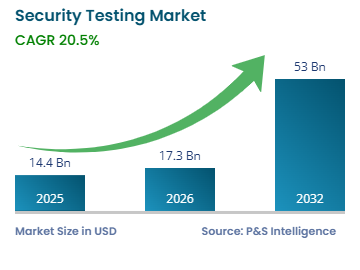
The security testing market size was USD 14.4 billion for 2025, and it will grow by 20.5% during 2026-2032, to reach USD 53.0 billion by 2032.
The market is expanding as organizations increase their focus on identifying and addressing security vulnerabilities across digital environments. This growth is driven by rapid software release cycles, expanding cloud usage, and the rising complexity of connected systems that increase potential attack surfaces. Businesses are deploying applications across hybrid and multi-cloud infrastructures, integrating application programming interfaces, containerized workloads, and third-party software components that require continuous validation throughout the software development lifecycle. Security testing is becoming an essential practice because frequent software updates and evolving cyber threats make periodic assessments insufficient. Additionally, organizations are integrating automated testing into DevSecOps workflows to identify weaknesses earlier, reduce remediation costs, and maintain compliance with internal security policies and external regulatory requirements. The global average cost of a data breach reached $4.88 million in 2024, according to International Business Machines Corporation, reflecting the financial impact of security failures. This cost pressure is encouraging organizations to adopt continuous security testing solutions to reduce risk exposure and operational losses.
Furthermore, enterprises are expanding the use of penetration testing, vulnerability assessment, application security testing, and cloud security testing to strengthen protection across distributed digital environments. Security testing is also becoming more important as organizations adopt artificial intelligence, Internet of Things devices, and remote work environments that introduce additional entry points for attackers. Development teams increasingly rely on automated scanning tools alongside manual testing to detect configuration errors, insecure code, authentication weaknesses, and exposed interfaces before deployment. Moreover, regulated industries such as banking, healthcare, government, and telecommunications are increasing investment in comprehensive testing programs to satisfy security standards and protect sensitive information. These practices help organizations improve software reliability, support faster release cycles with stronger security assurance, reduce disruption from cyber incidents, and strengthen operational resilience across continuously evolving technology environments.
Key Market Insights
Solutions are the larger offering, holding a market share of 75%, due to the rising volume of disclosed software vulnerabilities requiring continuous testing tools.
Cloud Security Testing is the fastest-growing testing type, registering a CAGR of approximately 21.2%, driven by increasing cloud workloads and identity-based attack vectors.
Web Applications is the largest application, holding a market share of 40%, due to widespread internet exposure and handling of sensitive user and transaction data.
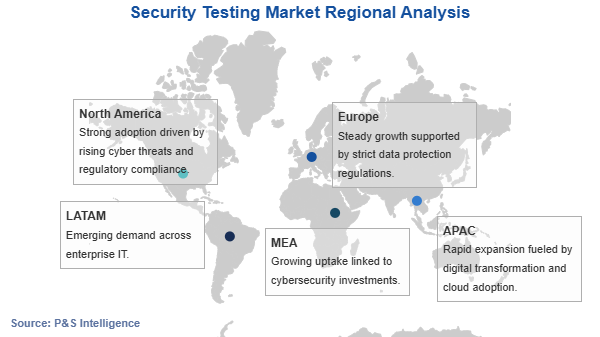
North America is the largest region, holding a market share of 40%, due to high financial losses from cybercrime and strong enterprise security investments.
Asia-Pacific is the fastest-growing region, registering a CAGR of approximately 21.4%, driven by rapid digital adoption and expansion of the internet user base across economies.
Security Testing Market Trends and Drivers
Shift toward Continuous and Automated Security Testing Is a Major Trend
The market is shifting toward integrating security testing directly into software development pipelines instead of performing assessments only during the final stages of application deployment. Organizations are embedding security validation throughout DevSecOps workflows to support continuous code analysis, vulnerability detection, automated compliance checks, and faster software releases across cloud, web, mobile, and enterprise applications. Additionally, automated testing platforms are enabling security teams to identify weaknesses earlier while maintaining development speed across distributed technology environments.
54% of large organizations identified supply chain interdependencies as the greatest barrier to achieving cyber resilience in 2025, according to the World Economic Forum, and 58% of global organizations planned to invest in AI-driven technologies like Generative AI in 2025, according to Cisco Systems, Inc. Furthermore, these developments are encouraging organizations to expand continuous security testing, strengthen automated validation throughout software development, and integrate security more consistently into modern application delivery processes across increasingly connected digital environments.
Rising Cyberattacks and Data Breach Risks Drive Market
The market is expanding due to the rising frequency and sophistication of cyberattacks targeting applications, networks, and user data. Organizations are strengthening security testing throughout the software development lifecycle to identify vulnerabilities before deployment and improve the security of web applications, cloud environments, APIs, endpoints, and enterprise systems. Continuous testing is becoming an essential part of DevSecOps and risk management strategies as businesses accelerate digital transformation and software release cycles.
Destructive cyber campaigns increased by 87% globally in 2025, according to Microsoft Corporation, and threat actors in 2025 increasingly exploited misconfigured network edge devices for initial access, according to Amazon Web Services, Inc. Furthermore, these evolving attack techniques are encouraging organizations to expand continuous security testing, strengthen vulnerability management, and improve resilience across increasingly connected digital infrastructures while supporting more secure software deployment and day-to-day digital operations.
Shortage of Skilled Security Professionals and Complex Testing Environments Limit Adoption
The market faces limitations because advanced security testing requires specialized expertise to manage automated testing platforms, interpret assessment results, and validate vulnerabilities across cloud, application, API, and hybrid technology environments. Organizations also need skilled professionals to integrate testing into DevSecOps workflows and maintain continuous security validation throughout software development. According to the International Telecommunication Union, 123 countries reported having training for cybersecurity professionals in 2024, indicating that cybersecurity capacity development continues to expand across countries. Even with this progress, differences in workforce readiness encourage organizations to rely on managed security testing services and specialized providers for effective implementation across increasingly sophisticated digital environments.
Expansion of Cloud, DevOps, and AI-Based Testing Solutions Creating New Growth Scope
The market presents strong growth opportunities as organizations expand cloud adoption and integrate security testing into modern software development and continuous delivery practices. Growing implementation of DevOps, automation, and artificial intelligence technologies is supporting faster vulnerability identification, continuous code validation, and more efficient security testing throughout development lifecycles. The share of firms adopting artificial intelligence technologies increased to 20.2% in 2025, according to the Organisation for Economic Co-operation and Development, reflecting broader enterprise adoption of AI-enabled capabilities. Furthermore, security testing vendors are incorporating artificial intelligence into testing platforms to improve automation, strengthen analysis, and support scalable security validation across organizations of different sizes.
Security Testing Market Segmentation Analysis
Offering Analysis
Solutions are the larger category, holding a market share of 75%, because organizations prioritize platforms that continuously assess applications, networks, APIs, cloud environments, and endpoints throughout the software development lifecycle. These solutions connect closely with application security testing, cloud security testing, and web application protection, as enterprises need unified tools that support automated vulnerability identification, compliance validation, security policy enforcement, and DevSecOps integration. CVE Program production reached 11,073 CVE Records in 2024, according to the Common Vulnerabilities and Exposures Program, highlighting the expanding volume of publicly disclosed software and system vulnerabilities. This supports wider use of scalable testing solutions across modern enterprise technology environments.
Services are the faster-growing category, registering a CAGR of approximately 20.7%, because organizations are expanding managed, consulting, assessment, and professional security testing services across application, cloud, network, API, and compliance workflows. These services complement solution adoption by providing specialized support for penetration testing, vulnerability assessments, security validation, and secure software development across complex digital environments. Additionally, service providers help large enterprises, small and medium enterprises, healthcare providers, and financial institutions apply advanced testing practices across cloud deployments, mobile applications, and enterprise systems. This broader service adoption supports stronger security programs while improving the practical use of testing tools across industries.
The offerings analysed in this report are:
Solutions (Larger Category)
Static Application Security Testing
Dynamic Application Security Testing
Interactive Application Security Testing
Runtime Application Self-Protection
Software Composition Analysis
Vulnerability Assessment Tools
Penetration Testing Tools
API Security Testing Tools
Network Security Testing Tools
Device Security Testing Tools
Services (Faster-Growing Category)
Professional Services
Managed Services
Consulting Services
Implementation Services
Support Services
Testing Type Analysis
Application Security Testing is the largest category, holding a market share of 25%, because web, mobile, cloud, and enterprise applications are central to digital services across banking, healthcare, retail, government, and technology sectors. This category connects directly with the dominance of solutions, as organizations use automated testing platforms to examine application code, APIs, authentication flows, third-party components, and release pipelines. Frequent software updates and DevSecOps adoption are also increasing the need for testing during development and deployment. Application security testing supports secure digital service delivery by helping organizations validate software quality, maintain compliance, and protect customer-facing platforms across expanding online ecosystems.
Cloud Security Testing is the fastest-growing category, because organizations are rapidly expanding cloud-native applications, software-as-a-service platforms, and hybrid cloud infrastructures across business operations. This category is strongly connected with cloud deployment, small and medium enterprise adoption, and cloud-based security testing solutions, as organizations need continuous validation of cloud configurations, identities, application programming interfaces, workloads, and access controls. Human-operated ransomware-linked encounters increased by 2.75 times in 2024, according to Microsoft Corporation, demonstrating the growing focus on cloud-based environments and identity infrastructure. This is increasing investment in specialized cloud security testing across digital operations.
The testing types analysed in this report are:
Application Security Testing (Largest Category)
Cloud Security Testing (Fastest-Growing Category)
Network Security Testing
Endpoint / Device Security Testing
API Security Testing
Wireless Security Testing
Social Engineering Testing
Compliance & Risk-Based Testing
Others
Deployment Mode Analysis
Cloud is the larger and faster-growing category, holding a market share of 80% and registering a CAGR of approximately 20.9%, because cloud-based testing supports faster deployment, scalable assessment, and continuous validation across distributed applications, APIs, workloads, and enterprise systems. This deployment model connects directly with cloud security testing, small and medium enterprise adoption, and software-as-a-service usage, as organizations prefer flexible testing platforms that align with cloud migration and remote operations. Data centers accounted for around 415 terawatt-hours of electricity consumption globally in 2024, according to the International Energy Agency, reflecting the scale of infrastructure supporting cloud services. This infrastructure growth supports demand for cloud-based testing across digital environments.
The deployment mode analysed in this report are:
Cloud (Larger Category and Faster-growing Category)
On-Premises
Organisation Size Analysis
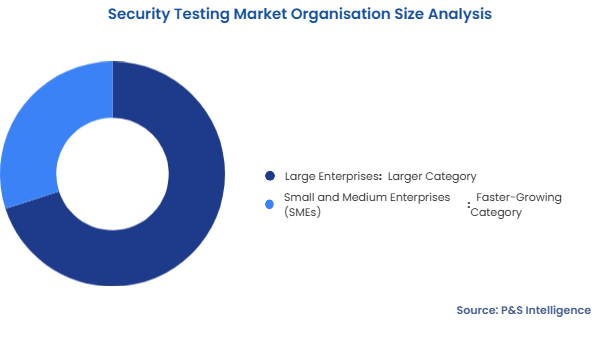
Large Enterprises are the larger category, holding a market share of 70%, because major organizations operate broad application portfolios, hybrid cloud environments, large user bases, and complex internal networks across multiple business units. This category connects strongly with BFSI, healthcare, government, IT, and telecommunications end users, where security testing is integrated into compliance programs, DevSecOps pipelines, cloud migration, and enterprise risk management. Large enterprises also use a mix of solutions and services to test web applications, APIs, endpoints, networks, and cloud workloads at scale. Their structured cybersecurity budgets support regular assessments, automated testing platforms, and managed security validation across business-critical systems.
Small and medium enterprises are the faster-growing category, because businesses are expanding digital operations through cloud platforms, online services, digital payments, and software-as-a-service applications. This category is closely linked with cloud deployment and cloud security testing, as smaller organizations increasingly prefer scalable tools that support application, infrastructure, and cloud validation without heavy internal infrastructure. According to the European Commission Eurostat, 49.3% of small enterprises used paid cloud computing services in 2025, reflecting continued digital technology adoption. This adoption is supporting a stronger demand for accessible security testing solutions across growing digital business operations.
The organisation sizes analysed in this report are:
Large Enterprises (Larger Category)
Small and Medium Enterprises (SMEs) (Faster-Growing Category)
End-User Analysis
Banking, Financial Services, and Insurance is the largest category, holding a market share of 25%, because banks, insurers, payment providers, and financial institutions rely heavily on secure digital banking, mobile payments, trading platforms, customer portals, and transaction processing systems. This category connects strongly with web applications, mobile applications, application security testing, API security testing, and cloud security testing, as financial firms operate highly integrated digital service ecosystems. Regular security testing supports compliance, fraud control, service reliability, and customer trust across digital finance channels. Strong investment in testing solutions and expert services helps financial organizations maintain secure operations across applications, networks, cloud systems, and payment platforms.
Healthcare is the fastest-growing category, because healthcare providers are expanding electronic health records, telehealth platforms, connected medical devices, patient portals, and cloud-based clinical systems across care delivery. This category connects with cloud applications, IoT and connected devices, application security testing, and managed services, as healthcare organizations need continuous validation across sensitive digital healthcare environments. The average cost of a healthcare data breach in the United States reached $7.42 million in 2025, according to HIPAA Journal, highlighting the significant financial value of stronger cybersecurity practices. Security testing adoption is expanding across healthcare applications, networks, medical devices, and cloud environments.
The end-users analysed in this report are:
Banking, Financial Services, and Insurance (BFSI) (Largest Category)
Healthcare (Fastest-Growing Category)
IT and Telecommunications
Retail and E-commerce
Government and Defense
Energy and Utilities
Manufacturing
Education
Others
Application Analysis
Web Applications are the largest category, holding a market share of 40%, because businesses across industries rely on websites, customer portals, online banking platforms, e-commerce systems, and enterprise dashboards to deliver services and manage user interactions. This category connects directly with application security testing, BFSI, retail, healthcare, and government end users, where web platforms support transactions, records, workflows, and digital communication. The number of global internet users reached approximately 6 billion in 2025, according to the International Telecommunication Union, expanding the exposure of internet-facing systems. This broad usage supports continuous testing of web applications across enterprise digital operations.
Mobile applications are the fastest-growing category, because mobile apps are increasingly used for banking, shopping, healthcare access, travel, communication, and workplace productivity. This category links closely with small and medium enterprises, BFSI, healthcare, and cloud deployment, as businesses use mobile platforms to extend services to larger digital user bases. Mobile security testing covers application code, APIs, authentication systems, data storage, payment features, and device-level behavior across rapid release cycles. Growing mobile-first service delivery is increasing demand for testing practices that support secure updates, reliable user experiences, and stronger protection across connected application ecosystems.
The applications analysed in this report are:
Web Applications (Largest Category)
Mobile Applications (Fastest-Growing Category)
Cloud Applications
IoT / Connected Devices
Enterprise Applications
Drive strategic growth with comprehensive market analysis
Security Testing Market Regional Outlook
North America Security Testing Market Analysis
North America holds the largest share of 40% because strong cybersecurity regulations, mature digital infrastructure, and widespread adoption of secure software development practices have made security testing an integral part of enterprise operations. Financial institutions, healthcare providers, government agencies, technology companies, and critical infrastructure operators routinely conduct vulnerability assessments, penetration testing, application security testing, and cloud security validation to strengthen cyber resilience. Additionally, organizations are integrating automated security testing into DevSecOps pipelines to support continuous software delivery without compromising security standards. Furthermore, the region benefits from the presence of leading cybersecurity vendors, managed security service providers, cloud platform providers, and advanced research ecosystems that continuously introduce innovative testing capabilities. High investment in digital transformation, cloud migration, artificial intelligence, and connected enterprise technologies continues to expand demand for comprehensive security testing solutions across diverse industries.
U.S. Security Testing Market Analysis
The United States leads the market because enterprises invest heavily in securing complex digital infrastructures and adopt advanced testing tools early. Frequent cyber incidents and strict regulatory frameworks are increasing the need for continuous security validation across applications and networks. Reported losses from suspected internet crime exceeded $16 billion in 2024, according to the Federal Bureau of Investigation, reflecting the financial scale of cyber threats. This environment is strengthening demand for comprehensive and recurring security testing practices across industries.
Canada Security Testing Market Analysis
Canada is witnessing strong growth because organisations are strengthening cybersecurity frameworks while expanding cloud adoption across business operations. Government-supported initiatives are encouraging enterprises to improve data protection and secure digital services in sectors such as banking and public administration. 19.8% of businesses in Canada planned new or additional cybersecurity actions in 2025, according to Statistics Canada, indicating increasing organisational focus on risk mitigation. This shift is supporting the adoption of structured and continuous security testing solutions.
Asia-Pacific Security Testing Market Analysis
Asia-Pacific has the highest CAGR of approximately 21.4% because rapid digital transformation, expanding cloud adoption, and growing enterprise software development activities are increasing the implementation of security testing across the region. Organizations are strengthening application security, cloud workload protection, API security, and infrastructure testing as they modernize information technology environments and expand digital services. Additionally, governments are introducing stronger cybersecurity strategies and encouraging organizations to implement standardized security practices across public and private sectors. Furthermore, the expansion of financial technology, e-commerce, telecommunications, manufacturing, and healthcare industries is creating sustained demand for automated testing platforms and managed security services. The region's growing technology ecosystem, increasing software development activity, and rising adoption of DevSecOps practices continue to support the broad implementation of security testing solutions across organizations of every size.
China Security Testing Market Analysis
China dominates within Asia-Pacific because of its extensive digital ecosystem and rapid expansion of online platforms handling large volumes of user data. Regulatory pressure is increasing the need for organisations to strengthen system security and adopt testing tools across industries. The number of internet users in China reached 1.125 billion in 2025, according to the Government of China's official statistics, highlighting the scale of digital exposure. This growth is increasing demand for security testing to protect high-volume digital environments.
India Security Testing Market Analysis
India is expanding rapidly because enterprises and startups are accelerating digital transformation through cloud platforms, online applications, digital banking, and connected business services. Growing adoption of software-as-a-service, mobile applications, and digital payment ecosystems is increasing the need for continuous application, cloud, and infrastructure security testing. According to the Press Information Bureau, Government of India, retail digital payment transactions reached 22,167.90 crore by volume during FY 2024–25, reflecting the expanding scale of digital transactions across the country. Additionally, organizations are strengthening security testing throughout software development and deployment to support secure digital services, improve customer confidence, and maintain reliable protection across rapidly expanding digital ecosystems.
Europe Security Testing Market Analysis
Europe shows steady growth in the market because organizations are placing greater emphasis on secure digital operations, regulatory compliance, and continuous protection of enterprise applications and cloud environments. Businesses across banking, manufacturing, healthcare, retail, and public services are integrating security testing into software development and infrastructure management to maintain high security standards throughout the technology lifecycle. Additionally, enterprises are strengthening application security, network security, API protection, and cloud security testing while expanding digital transformation initiatives. Furthermore, organizations are increasing investment in automated testing platforms that integrate with continuous integration and continuous delivery workflows, enabling faster software releases with consistent security validation. Growing adoption of hybrid cloud environments, connected industrial systems, and enterprise digital platforms continues to support stable demand for comprehensive security testing solutions throughout the region.
The regions and countries analysed in this report are:
North America (Largest Regional Market)
U.S. (Larger Country)
Canada (Faster-Growing Country)
Europe
Germany (Largest Country)
U.K. (Fastest-Growing Country)
France
Italy
Spain
Rest of Europe
Asia-Pacific (Fastest-Growing Regional Market)
China (Largest Country)
India (Fastest-Growing Country)
Japan
South Korea
Australia
Rest of APAC
Latin America
Brazil (Largest Country)
Mexico (Fastest-Growing Country)
Rest of LATAM
Middle East and Africa
Saudi Arabia (Largest Country)
South Africa
U.A.E. (Fastest-Growing Country)
Rest of MEA
Security Testing Market Share Analysis
The market is fragmented, with numerous global and regional companies offering a wide range of security testing software, platforms, and professional services across application, cloud, network, API, and infrastructure security. Organizations select vendors based on deployment requirements, compliance objectives, industry-specific security needs, and integration capabilities rather than relying on a single provider. Additionally, established companies continue expanding their portfolios by incorporating automated testing, artificial intelligence, continuous security validation, and DevSecOps capabilities into their platforms. Furthermore, specialized vendors are strengthening the market by delivering advanced solutions for cloud-native applications, container security, software composition analysis, and API protection. This competitive landscape encourages continuous product enhancement, broader technology integration, and service innovation. Companies are differentiating themselves through automation, analytics, real-time reporting, seamless integration with development pipelines, managed security expertise, and scalable deployment models that support organizations across diverse digital transformation initiatives.
Leading Companies in the Security Testing Market:
International Business Machines Corporation
Open Text Corporation
Coforge Limited
Intertek Group plc
Qualitest Group
Synopsys Incorporated
Cisco Systems Incorporated
HCL Technologies Limited
Accenture plc
Rapid7 Incorporated
Veracode Incorporated
Checkmarx Limited
Qualys Incorporated
Tenable Holdings Incorporated
Sophos Limited
Security Testing Market News
In January 2026, BreachLock Inc. expanded its Adversarial Exposure Validation (AEV) solution to web applications, introducing autonomous AI-driven red teaming at the application layer following its earlier network-layer capabilities, enabling validation of injection flaws, business logic weaknesses, OWASP Top 10 risks, and complex exploit paths, with MITRE ATT&CK-aligned reporting and attack path visualisation available through the platform.
In January 2026, Assail, Inc. emerged from stealth and introduced Ares, an autonomous offensive security platform for continuous penetration testing across APIs, web applications, and mobile applications, leveraging AI-driven agents to support application security teams in modern API-first environments.
In December 2025, Black Duck Software, Inc. launched Black Duck Signal, an agentic AI application security product for vulnerability detection and remediation. The product analyzes source code, binaries, software supply chain components, and running applications. It also connects with development tools and Black Duck application security products to support security work during software development.
In July 2025, Invicti Security Corp launched its next-generation Application Security Platform with AI-powered DAST capabilities. The release combined DAST, API security, software composition analysis, and application security posture management. It also added scanning for AI-generated code, API detection, and application risk visibility for teams managing security across web applications and APIs.
In June 2025, StackHawk, Inc. launched Sensitive Data Identification for its API security platform, enabling detection of APIs handling sensitive data across source code repositories, leveraging its API Discovery capability to uncover hidden, shadow, and legacy APIs and prioritise security testing based on data sensitivity and risk exposure.
Frequently Asked Questions About This Report
What is security testing and why do organizations need it?+
Security testing checks applications, networks, and systems for weaknesses, helping organizations reduce breach risk, protect data, and improve overall cyber resilience.
How is penetration testing different from vulnerability assessment methods?+
Vulnerability assessment identifies and prioritizes weaknesses, while penetration testing actively exploits selected vulnerabilities to show real attack paths and business impact.
What types of applications require regular security testing today?+
Web applications, mobile applications, cloud platforms, application programming interfaces, payment systems, and enterprise software require regular testing to reduce exploitable security gaps.
How does automated security testing help development teams work faster?+
Automated testing scans code, applications, and configurations quickly, helping developers find vulnerabilities earlier and fix issues before production release.
Why is security testing important for regulatory compliance requirements?+
Security testing supports compliance by proving that organizations assess risks, validate controls, document findings, and address vulnerabilities across critical systems.
Want a report tailored exactly to your business need?
Leading companies across industries trust us to deliver data-driven insights and innovative solutions for their most critical decisions. From data-driven strategies to actionable insights, we empower the decision-makers who shape industries and define the future. From Fortune 500 companies to innovative startups, we are proud to partner with organisations that drive progress in their industries.
Client Testimonials
Working with P&S Intelligence and their team was an absolute pleasure – their awareness of timelines and commitment to value greatly contributed to our project's success. Eagerly anticipating future collaborations.
McKinsey & Company
India
Unmatched Standards
Our insights into the minutest levels of the markets, including the latest trends and competitive landscape, give you all the answers you need to take your business to new heights
Complete Data Security
We take a cautious approach to protecting your personal and confidential information. Trust is the strongest bond that connects us and our clients, and trust we build by complying with all international and domestic data protection and privacy laws