This Report Provides In-Depth Analysis of the Security Posture Management Market Report Prepared by P&S Intelligence, Segmented by Component (Solutions, Services), Deployment Type (Public Cloud, Multi-Cloud, Private Cloud, Hybrid Cloud), Cloud Service Model (Infrastructure as a Service, Software as a Service, Platform as a Service), Organization Size (Large Enterprises, Small & Medium Enterprises), End User (IT & Telecom, Healthcare & Life Sciences, Banking, Financial Services, and Insurance, Retail & E-commerce, Government & Public Sector, Manufacturing, Energy & Utilities), Use Case (Cloud Risk Management, Identity & Access Risk Management, Compliance & Governance, Threat Detection & Monitoring), and Geographical Outlook for the Period of 2021 to 2032
Explore the market potential with our data-driven report
Security Posture Management Market Future Outlook
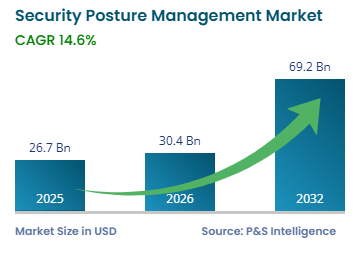
The security posture management market size was USD 26.7 billion for 2025, and it will grow by 14.6% during 2026-2032, to reach USD 69.2 billion by 2032.
The market is expanding because organizations are moving more systems, applications, identities, and sensitive data into cloud and hybrid environments where security settings change frequently. As enterprises use multiple cloud platforms, software tools, and access models, security teams must track exposed assets, misconfigured controls, excessive permissions, and compliance gaps across a much wider digital surface. Manual reviews are becoming less effective because cloud workloads, user roles, and application connections can change faster than traditional audit cycles.
Security posture management solutions help organizations maintain continuous visibility across these environments by identifying risky configurations, weak controls, unmanaged assets, and policy violations before they turn into incidents. According to the International Telecommunication Union, fixed broadband traffic reached 7.3 zettabytes and mobile broadband traffic reached 1.5 zettabytes globally in 2025, showing the scale of data movement across connected infrastructure. This rising digital activity is increasing the need for tools that can monitor security posture across distributed systems, prioritize risk based on business impact, and guide remediation across cloud, identity, data, and application layers. Vendors are also adding automation and analytics features that help security teams reduce alert noise, validate controls, maintain audit-ready security evidence, and close visibility gaps across changing enterprise environments and third-party technology connections.
Key Market Insights
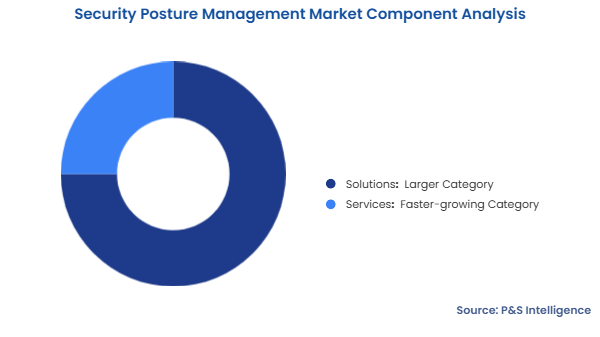
Solutions is the larger segment, holding a market share of 75%, due to demand for integrated platforms enabling continuous risk monitoring across cloud environments.
Multi-cloud is the fastest-growing segment, registering a CAGR of approximately 15.3%, driven by rising complexity in managing security across multiple cloud platforms.
Infrastructure as a Service is the largest segment, holding a market share of 60%, due to its role in hosting core cloud resources with high configuration risks.
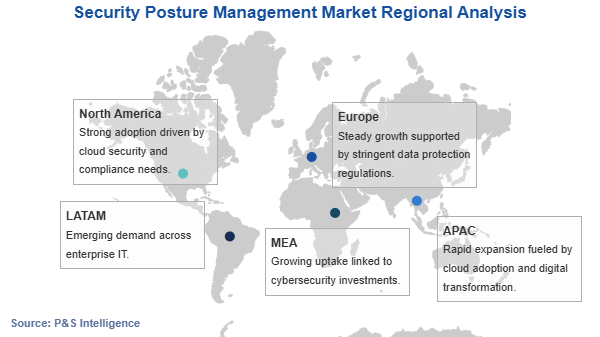
North America holds the largest share of 40%, due to advanced enterprise IT infrastructure and widespread adoption of cloud-based security frameworks.
Asia-Pacific is the fastest-growing region, registering a CAGR of approximately 15.5%, driven by rapid digital transformation and increasing cloud adoption across developing economies.
Security Posture Management Market Dynamics
Shift Toward Unified and AI-Driven Security Posture Platforms Is a Major Trend
The market is witnessing a shift toward unified and AI-driven security posture platforms as organizations seek to reduce operational complexity across fragmented security environments. Enterprises increasingly manage security controls across cloud infrastructure, applications, identities, endpoints, and data assets, creating challenges in maintaining consistent visibility and risk assessment. The need for centralized management is becoming more important as security teams handle growing volumes of alerts and policy requirements across distributed environments. According to Cisco, 86% of organizations reported that multiple point solutions were slowing their ability to detect, respond to, and recover from incidents in 2024, while 55% planned to invest in AI-driven technologies during 2024. These trends are encouraging organizations to consolidate security operations through integrated posture management platforms that improve risk prioritization, strengthen governance processes, and support faster identification of security weaknesses across complex digital ecosystems.
Rising Complexity of Cloud Environments and Misconfiguration Risks Drive Market
The market is growing due to the rising complexity of managing security across multiple cloud environments. Organizations increasingly operate across public cloud, private cloud, and on-premises infrastructure, where different configurations, policies, and security controls create visibility challenges. Security teams must continuously monitor these environments to identify risks that may emerge from configuration drift, access control gaps, and inconsistent security settings. According to IBM, 40% of recorded data breaches globally involved data spread across multiple public cloud, private cloud, and on-premises environments in 2024, while Verizon reported that Errors were involved in 28% of breaches in 2024. These challenges are increasing demand for security posture management solutions that provide centralized visibility, automate risk identification, and support continuous remediation across distributed and rapidly changing digital environments.
Challenges in Integration and Shortage of Skilled Security Teams
The market faces constraints due to integration challenges and a shortage of skilled cybersecurity professionals. Organizations often manage a combination of legacy applications, cloud platforms, security tools, and compliance systems, making posture management deployments more complex. Integrating risk visibility and policy controls across these environments frequently requires specialized expertise and ongoing operational oversight. According to ISC2, the global cybersecurity workforce gap reached 4.8 million professionals in 2024, highlighting the scale of the talent shortage. Limited cybersecurity resources can delay implementation, reduce monitoring effectiveness, and slow remediation activities. These challenges are particularly significant for smaller organizations that have constrained security teams and limited technical capacity.
Expansion into Data and Identity-Centric Security Use Cases
The market presents strong opportunities as organizations expand their focus beyond configuration security to include identity governance, data protection, and access visibility. Enterprises increasingly need to monitor user privileges, sensitive data exposure, and access activity across cloud, hybrid, and multi-platform environments. According to the Federal Trade Commission, identity theft reports increased from 1,036,845 in 2023 to 1,135,270 in 2024, reflecting growth of approximately 9.5%. Rising concerns about unauthorized access, credential misuse, and data exposure are encouraging vendors to enhance posture management platforms with identity and data security capabilities. Organizations are adopting these solutions to strengthen governance, improve risk visibility, and maintain greater control over critical digital assets.
Solutions represent the larger category, holding a market share of 75%, driven by demand for dedicated platforms that manage security posture across cloud environments. Organisations prefer these tools because they provide continuous monitoring, automated remediation, and centralised visibility across data and identity layers. According to the Federal Bureau of Investigation, the Internet Crime Complaint Centre received 859,532 complaints of suspected internet crime in 2024, indicating persistent cyber risk exposure. This sustained threat environment is encouraging enterprises to adopt integrated solutions that reduce manual intervention and strengthen security control across complex infrastructures.
Services are the faster-growing category, registering a CAGR of approximately 15.2%, because many organisations lack the internal skills required to deploy and manage posture management tools effectively. They depend on external experts for setup, monitoring, and ongoing support. This is especially common among mid-sized businesses that want quick implementation without building large in-house teams. As security environments become more complex, demand for managed and advisory services continues to rise.
The components analysed in this report are:
Solutions (Larger Category)
Identity & access-based secure access platforms
Application-level access control systems
Secure remote access frameworks (VPN replacement)
Cloud access security integration
Policy enforcement & trust evaluation engines
Services (Faster-growing Category)
Managed security and monitoring services
Implementation & integration services
Consulting and risk assessment services
Support & maintenance services
Deployment Type Analysis
Public Cloud is the largest category, holding a market share of 45%, because organizations run a significant portion of their applications, databases, and business workloads on public cloud platforms. These environments provide scalability and operational flexibility but also increase exposure to risks such as misconfigurations, excessive permissions, and unmanaged resources. Consequently, enterprises are investing in security posture management tools that continuously assess cloud settings, monitor compliance requirements, and identify vulnerabilities. Furthermore, growing dependence on public cloud services is increasing the need for centralized visibility and automated risk management, supporting strong adoption of posture management solutions across enterprise cloud environments.
Multi-Cloud is the fastest-growing category, as organisations increasingly adopt multiple cloud providers to avoid vendor dependency. This approach introduces operational complexity, with each environment having distinct configurations and security policies. According to Microsoft, the average multicloud estate contained 351 exploitable attack paths leading to critical assets in 2024, highlighting risk exposure. This growing complexity is accelerating demand for security posture management tools that provide centralised visibility and enable continuous risk identification across distributed cloud environments.
The deployment types analysed in this report are:
Public Cloud (Largest Category)
Multi-Cloud (Fastest-growing Category)
Private Cloud
Hybrid Cloud
Cloud Service Model Analysis
Infrastructure as a Service is the largest category, holding a market share of 60%, as it underpins the deployment and management of core cloud resources. Organisations prioritise this layer because misconfigurations in storage, networks, and virtual machines create direct security vulnerabilities. The total number of operational data centres worldwide reached approximately 12,000 facilities in 2025, reflecting the scale of infrastructure supporting cloud services. This expanding infrastructure base is increasing the need for posture management tools that monitor configurations, enforce policies, and maintain security across foundational cloud environments.
Software as a Service (SaaS) is the fastest-growing category, because businesses are rapidly adopting SaaS applications for daily operations. These platforms often involve multiple users, third-party integrations, and shared data, which increases exposure to risks. Companies are now paying more attention to securing user access and data within SaaS environments. This shift is driving higher demand for posture management solutions in this segment.
The cloud service models analysed in this report are:
Infrastructure as a Service (IaaS) (Largest Category)
Software as a Service (SaaS) (Fastest-growing Category)
Platform as a Service (PaaS)
Organisation Size Analysis
Large Enterprises is the larger category, because they operate complex IT environments with multiple cloud platforms, applications, and users. Managing security across such large systems requires advanced posture management tools. These organisations also have the resources to invest in comprehensive solutions. Their focus on compliance, risk management, and operational continuity keeps them as the primary adopters in the market.
Small and medium enterprises are the faster-growing category, registering a CAGR of approximately 14.9%, as they rapidly adopt cloud technologies without established cybersecurity frameworks. These organisations require cost-effective solutions that simplify monitoring and reduce reliance on specialised security teams. According to Global NAPS, approximately 400 million small and medium enterprises operate worldwide, reflecting the scale of this segment. This large and expanding base is increasing demand for scalable security posture management tools that enable SMEs to manage risks efficiently while supporting ongoing digital adoption.
The organization sizes analysed in this report are:
Large Enterprises (Larger Category)
Small & Medium Enterprises (SMEs) (Faster-growing Category)
End User Analysis
IT & telecom is the largest category, holding a market share of 30%, due to its management of extensive digital infrastructure and high data traffic volumes. Companies in this sector depend heavily on cloud and network systems, increasing their exposure to configuration and access risks. According to the International Telecommunication Union, approximately 6 billion people used the internet in 2025, reflecting the scale of global connectivity. This large user base is driving continuous demand for posture management solutions to ensure secure operations and maintain reliability across critical digital networks.
Healthcare & Life Sciences is the fastest-growing category, registering a CAGR of approximately 15.0%, because organisations in this sector are digitising patient records and adopting cloud-based systems. Sensitive data and strict privacy requirements make security a priority. Many healthcare providers are now investing in posture management tools to improve visibility and reduce risks. As digital health systems expand, the need for stronger security controls continues to grow.
The end users analysed in this report are:
IT & Telecom (Largest Category)
Healthcare & Life Sciences (Fastest-growing Category)
Banking, Financial Services, and Insurance (BFSI)
Retail & E-commerce
Government & Public Sector
Manufacturing
Energy & Utilities
Others
Use Case Analysis
Cloud Risk Management is the largest category, because it directly addresses the most common security issues, such as misconfigurations and exposure of cloud assets. Organisations prioritise identifying and fixing these risks to prevent breaches. Continuous monitoring and automated remediation make this use case essential. Since cloud environments form the backbone of digital operations, risk management remains the primary focus.
Identity & access risk management is the fastest-growing category, registering a CAGR of approximately 14.8%, driven by increasing complexity in managing user access across cloud-based systems. Organisations require stronger control over identities, permissions, and authentication processes across multiple environments. According to Microsoft, cybercriminals launched more than 600 million password-based identity attacks per day globally in 2024, indicating significant identity-related threats. This surge in attacks is driving adoption of posture management solutions that continuously monitor access, detect anomalies, and strengthen identity security controls.
North America Security Posture Management Market Analysis
North America holds the largest share, of 40%, because enterprises across the region have widely adopted cloud services, advanced cybersecurity programs, and continuous risk management practices. Organizations operate complex multi-cloud and hybrid environments that require centralized visibility into misconfigurations, security gaps, and compliance risks across digital assets. Regulatory requirements, industry standards, and audit obligations are encouraging businesses to maintain stronger security governance and ongoing posture assessment. In addition, large enterprises are increasing investments in automated security operations to improve risk identification and remediation efficiency. The presence of major cybersecurity vendors, mature IT infrastructure, and strong cybersecurity spending further supports deployment of security posture management platforms that help organizations maintain visibility, strengthen compliance, and manage risk across evolving technology environments.
U.S. Security Posture Management Market Analysis
The U.S. leads the market due to its advanced enterprise IT infrastructure and strong presence of global cloud and cybersecurity providers. Organisations operate complex, distributed environments that require continuous monitoring and integration of security into development and operations processes. According to the U.S. Bureau of Labour Statistics, employment of information security analysts is projected to grow by 29% from 2024 to 2034, reflecting rising demand for cybersecurity capabilities. This increasing focus on security expertise is driving the adoption of posture management solutions to automate risk detection and support compliance across large-scale digital systems.
Canada is experiencing steady growth as organisations modernise their IT infrastructure while maintaining a balance between security and operational efficiency. Businesses are increasingly adopting hybrid environments, which creates demand for improved visibility and control across systems. According to Statistics Canada, 19.8% of businesses planned to implement new or additional cybersecurity measures in 2025, indicating growing awareness of risk management. This rising focus on cybersecurity is encouraging the adoption of posture management solutions that integrate with existing systems and support long-term security strategies without increasing complexity.
Asia-Pacific has the highest CAGR, of approximately 15.5%, because businesses across the region are rapidly expanding cloud adoption, digital services, and connected technology ecosystems. Many organizations are modernizing security programs while managing increasingly complex IT environments that include cloud workloads, software platforms, and distributed operations. Growing digital economies are creating greater demand for tools that provide continuous visibility into security risks and configuration weaknesses. Governments are also strengthening cybersecurity and data protection requirements, encouraging organizations to improve governance and risk management practices. Furthermore, expanding startup ecosystems, digital banking platforms, e-commerce networks, and technology-driven enterprises are increasing the need for scalable security solutions. These factors are driving adoption of security posture management platforms that support continuous monitoring, policy enforcement, and risk reduction across diverse and rapidly evolving digital environments.
China Security Posture Management Market Analysis
China is expanding rapidly due to its large-scale digital ecosystem and strong adoption of cloud and platform-based services. Enterprises operate across extensive digital environments, increasing exposure to configuration and access-related security risks. According to the State Council of the People’s Republic of China, the number of internet users reached 1.125 billion in 2025, with a penetration at 80.1%, reflecting widespread digital usage. This scale of connectivity is driving demand for security posture management solutions that provide centralised visibility and control across complex and highly distributed infrastructure.
India Security Posture Management Market Analysis
India is witnessing strong growth as businesses accelerate the adoption of digital platforms and cloud-based operations across sectors. Many organisations are still building cybersecurity capabilities, which increases demand for simple and scalable posture management tools. According to the Telecom Regulatory Authority of India, internet subscribers reached 971.50 million in 2024, indicating the rapid expansion of digital access. This growing digital base is encouraging enterprises to adopt posture management solutions to strengthen monitoring, improve compliance, and manage risks across expanding cloud and hybrid environments.
Europe Security Posture Management Market Analysis
Europe shows steady growth because organizations operate within a regulatory environment that places strong emphasis on cybersecurity governance, operational resilience, and data protection accountability. Enterprises are increasingly required to monitor cloud assets, software environments, and digital infrastructure to meet evolving compliance obligations and manage cyber risk effectively. Demand is particularly strong among financial institutions, healthcare providers, manufacturers, and public sector organizations that handle sensitive data and critical operations. Companies are focusing on continuous risk assessment, security control validation, and policy enforcement across cross-border business activities. Furthermore, the growing use of cloud platforms and interconnected digital services is increasing the need for centralized visibility into security configurations and compliance status. This environment continues to support adoption of security posture management solutions that improve governance, strengthen oversight, and reduce operational security risks.
The regions and countries analysed in this report are:
North America (Largest Regional Market)
U.S. (Larger Country)
Canada (Faster-Growing Country)
Europe
Germany (Largest Country)
U.K. (Fastest-Growing Country)
France
Italy
Spain
Rest of Europe
Asia-Pacific (Fastest-Growing Regional Market)
China (Largest Country)
India (Fastest-Growing Country)
Japan
South Korea
Australia
Rest of APAC
Latin America
Brazil (Largest Country)
Mexico (Fastest-Growing Country)
Rest of LATAM
Middle East and Africa
Saudi Arabia (Largest Country)
U.A.E. (Fastest-Growing Country)
South Africa
Rest of MEA
Security Posture Management Market Share Analysis
The market is fragmented, with numerous vendors competing across cloud security posture management, data security posture management, identity security posture management, and broader cyber risk monitoring segments. Organizations have diverse security requirements, leading them to adopt specialized solutions for cloud configurations, identity governance, data protection, and compliance management rather than relying on a single platform. Furthermore, rapid innovation in cloud security, artificial intelligence, and automation continues to attract new entrants with focused capabilities. Large cybersecurity providers, cloud-native security firms, and emerging startups are all expanding their offerings to address evolving security challenges. The market also experiences frequent partnerships, acquisitions, and platform integrations as vendors seek to broaden functionality and strengthen competitive positioning. This dynamic environment provides organizations with multiple deployment options while increasing the importance of interoperability, centralized visibility, and effective integration across complex security ecosystems.
Top Companies in the Security Posture Management Market:
Palo Alto Networks Incorporated
Microsoft Corporation
CrowdStrike Holdings Incorporated
Zscaler Incorporated
Check Point Software Technologies Limited
Fortinet Incorporated
Trend Micro Incorporated
Cisco Systems Incorporated
International Business Machines Corporation
Rapid7 Incorporated
Tenable Holdings Incorporated
Qualys Incorporated
SentinelOne Incorporated
Orca Security Limited
Snyk Limited
Security Posture Management Market News
In March 2026, Orca Security introduced AI-driven enhancements to its cloud security platform, including autonomous agents and runtime AI threat detection capabilities, aimed at improving risk identification and accelerating incident investigation across multi-cloud environments.
In February 2026, Tenable released its Cloud and AI Security Risk Report, examining risks associated with cloud adoption and AI integration, with a focus on identity exposure, overprivileged access, vulnerable workloads, and visibility gaps across cloud environments.
Frequently Asked Questions About This Report
What is security posture management in modern enterprise cybersecurity programs today?+
Security posture management helps organizations monitor security controls, cloud settings, identities, assets, and risks so teams can find weaknesses and fix them faster.
Why do companies use security posture management tools across enterprise environments?+
Companies use these tools to gain continuous visibility, reduce manual reviews, detect configuration gaps, and manage security risks across cloud and hybrid systems.
How does security posture management help reduce cloud security risks?+
It checks cloud configurations, permissions, workloads, and compliance settings to identify risky conditions before they expose data or weaken security controls.
Which risks can security posture management platforms identify for teams?+
These platforms can identify misconfigurations, excessive permissions, exposed assets, policy violations, compliance gaps, weak controls, and unmanaged cloud resources.
How is posture management different from vulnerability management in cybersecurity?+
Vulnerability management focuses on software weaknesses, while posture management also covers configurations, identities, cloud settings, compliance controls, and overall security exposure.
Want a report tailored exactly to your business need?
Leading companies across industries trust us to deliver data-driven insights and innovative solutions for their most critical decisions. From data-driven strategies to actionable insights, we empower the decision-makers who shape industries and define the future. From Fortune 500 companies to innovative startups, we are proud to partner with organisations that drive progress in their industries.
Client Testimonials
Working with P&S Intelligence and their team was an absolute pleasure – their awareness of timelines and commitment to value greatly contributed to our project's success. Eagerly anticipating future collaborations.
McKinsey & Company
India
Unmatched Standards
Our insights into the minutest levels of the markets, including the latest trends and competitive landscape, give you all the answers you need to take your business to new heights
Complete Data Security
We take a cautious approach to protecting your personal and confidential information. Trust is the strongest bond that connects us and our clients, and trust we build by complying with all international and domestic data protection and privacy laws