This Report Provides In-Depth Analysis of the Security & Vulnerability Management Market Report Prepared by P&S Intelligence, Segmented by Component (Solutions, Services), Application (Infrastructure protection, Cloud security, Endpoint security, Network security, Application security, Data security), Organization Size (Large Enterprises, Small & Medium Enterprises), Deployment Mode (Cloud, On-premises), End-User (IT & Telecom, Healthcare, BFSI, Government & Defense, Retail, Energy & Utilities), and Geographical Outlook for the Period of 2021 to 2032
Explore the market potential with our data-driven report
Security & Vulnerability Management Market Future Outlook
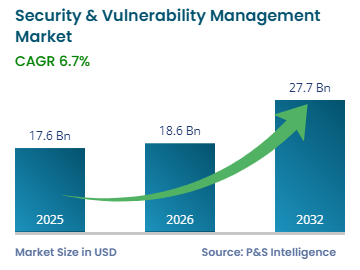
The security & vulnerability management market size was USD 17.6 billion for 2025, and it will grow by 6.7% during 2026-2032, to reach USD 27.7 billion by 2032.
The security and vulnerability management market is expanding as organizations increasingly depend on digital systems to support business operations, customer engagement, and data management. As enterprise environments become more interconnected, maintaining visibility across networks, applications, endpoints, and cloud resources has become a critical requirement. Security teams are placing greater emphasis on identifying and addressing vulnerabilities before they can be exploited, making vulnerability management a core component of cybersecurity strategies. The growing adoption of cloud computing, remote work models, connected devices, and hybrid IT environments is increasing the number of potential entry points for cyber threats. Organizations are managing larger volumes of data and applications across distributed infrastructures, creating challenges in maintaining consistent security controls. Moreover, the rapid pace of software deployment and system updates is making it difficult to identify and remediate vulnerabilities through periodic assessments alone, increasing the need for continuous monitoring capabilities.
According to the European Union Agency for Cybersecurity (ENISA), vulnerability exploitation accounted for 21.3% of initial intrusion vectors between July 2024 and June 2025. This indicates that attackers continue to leverage known security weaknesses to gain unauthorized access to organizational systems. The persistence of vulnerability-based attacks highlights the importance of timely detection, prioritization, and remediation activities across enterprise environments. The increasing frequency of vulnerability exploitation is encouraging organizations to invest in platforms that provide continuous asset visibility, risk-based prioritization, automated scanning, and remediation support. Demand is also rising for solutions that can manage vulnerabilities across cloud, on-premises, and hybrid infrastructures while helping security teams reduce exposure to operational and compliance risks.
Key Market Insights
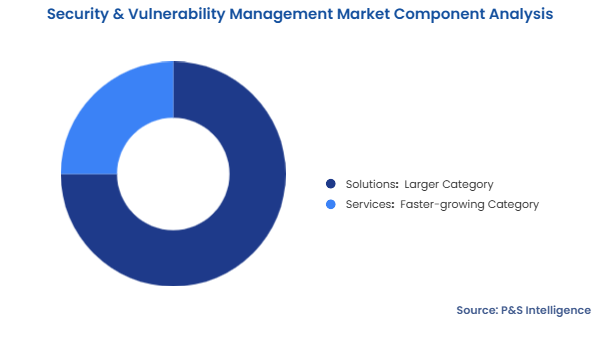
Solutions is the larger component, holding a market share of 75%, due to strong demand for continuous monitoring and automated vulnerability detection across complex IT systems.
Cloud security is the fastest-growing application, registering a CAGR of approximately 7.0%, driven by the rapid shift of business operations to cloud platforms and rising risks in cloud environments.
Large enterprises are the largest organisation size, holding a market share of 75%, due to complex infrastructure, higher cyber risks, and strict compliance requirements.
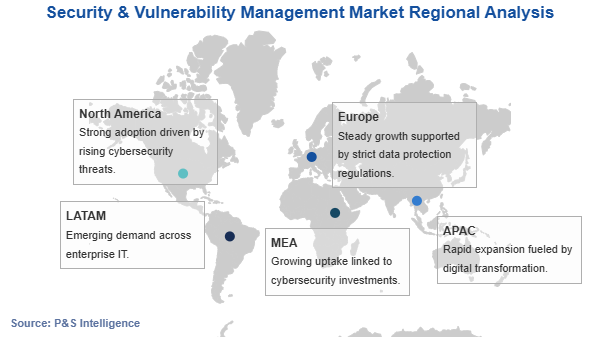
North America holds the largest share of 40%, due to strict cybersecurity regulations, early adoption of advanced tools, and the strong presence of leading security vendors.
Asia-Pacific is the fastest-growing region, registering a CAGR of approximately 7.6%, driven by rapid digital expansion, developing security frameworks, and increasing government cybersecurity initiatives.
Security & Vulnerability Management Market Trends and Drivers
Shift Toward Continuous and Automated Risk Detection Is a Major Trend
The market is shifting toward real-time and automated vulnerability management practices, replacing periodic security assessments that often leave gaps between scans. Organizations are prioritizing platforms that combine continuous monitoring, threat intelligence correlation, and AI-driven risk prioritization to improve visibility across expanding IT environments. This shift is being supported by the growing volume of security alerts, connected assets, and cloud-based workloads that require faster identification of critical vulnerabilities. According to International Business Machines Corporation (IBM), organizations using artificial intelligence and automation reduced the time required to identify and contain breaches by nearly 100 days in 2024. According to the Cisco Cybersecurity Readiness Index 2024, 55% of organizations plan to invest in AI-driven technologies. These investments are increasing demand for platforms that can automate vulnerability discovery, risk assessment, and remediation workflows. Security teams are also adopting integrated solutions to reduce alert fatigue, improve prioritization accuracy, and manage vulnerabilities more efficiently across complex enterprise infrastructures.
Rising Frequency and Impact of Cyberattacks on Business Operations Drive Market
The market is growing due to the increasing frequency and sophistication of cyberattacks that threaten business operations, sensitive data, and digital infrastructure. Organizations are facing a wider range of attack methods, including ransomware, credential theft, and exploitation of unpatched vulnerabilities. This is creating greater pressure to identify security gaps before they can be used to gain unauthorized access. According to the Microsoft Digital Defense Report 2024, Microsoft customers faced more than 600 million cyberattacks daily from cybercriminals and nation-state actors. According to International Business Machines Corporation (IBM), the average cost of a data breach reached USD 4.88 million in 2024. These figures highlight both the scale of cyber threats and the financial consequences associated with successful attacks. Enterprises are increasing investments in vulnerability assessment, continuous monitoring, and remediation platforms to reduce exposure to security incidents. Security teams are also strengthening risk management processes to protect critical assets, maintain operational continuity, and limit potential financial losses across complex IT environments.
Shortage of Skilled Cybersecurity Professionals and Integration Challenges
The market faces constraints due to the shortage of skilled cybersecurity professionals needed to manage and optimize advanced vulnerability management solutions. Organizations often struggle to configure, operate, and integrate these platforms across complex IT environments, reducing their effectiveness and limiting adoption. According to the World Economic Forum Global Cybersecurity Outlook 2025, the global cyber skills gap increased by 8% since 2024, with two out of three organizations reporting moderate-to-critical skills gaps. The shortage of qualified personnel is increasing operational challenges related to vulnerability assessment, remediation, and risk prioritization. Enterprises are also experiencing delays in maximizing platform capabilities, creating barriers to efficient vulnerability management across expanding digital infrastructures.
Growing Demand from Small Businesses and Cloud-Based Security Solutions
The market presents significant growth opportunities driven by increasing digital adoption among small and medium-sized enterprises (SMEs). As these businesses expand their digital operations, they require scalable and cost-effective vulnerability management solutions to protect growing IT environments from cyber threats. According to the World Bank, the share of micro-firms investing in digital solutions increased from 10% in 2020 to 20% in 2022, while the proportion of large firms investing in such technologies rose from 20% to 60% during the same period. This widening adoption of digital tools is creating demand for accessible security platforms that help SMEs identify vulnerabilities, strengthen cyber resilience, and support secure business growth.
Solutions is the larger category, holding a market share of 75%, as organizations prioritize core tools for vulnerability identification, assessment, and remediation. These platforms support automated scanning, patch management, configuration checks, and continuous monitoring across cloud, endpoint, network, and application environments. According to the Australian Signals Directorate, reported common vulnerabilities and exposures increased by 28% during the 2024–2025 financial year. The rising vulnerability volume is increasing reliance on integrated solutions that help large enterprises, IT teams, and regulated users manage attack surfaces with better visibility and faster remediation workflows.
Services are the faster-growing category, registering a CAGR of approximately 6.9%, because organizations increasingly need outside expertise to operate vulnerability management programs effectively. Many SMEs, healthcare providers, and on-premises users lack dedicated security teams to manage assessments, penetration testing, remediation, and compliance requirements. External providers help configure platforms, interpret vulnerability findings, and support incident response when internal resources are limited. This service demand is strengthening adoption among organizations that want managed security support, faster implementation, and practical guidance for using solutions across cloud, infrastructure, and endpoint environments.
The component analysed in this report are:
Solutions (Larger Category)
Vulnerability assessment and management
Security information and event management
Configuration and compliance management
Asset discovery and inventory management
Patch management
Services (Faster-growing Category)
Consulting and deployment
Vulnerability assessment and penetration testing
Incident response and remediation
Managed security services
Support and maintenance
Application Analysis
Infrastructure protection is the largest category, holding a market share of 35%, because organizations continue to prioritize servers, networks, data centers, and core IT assets that support daily operations. These environments remain central for large enterprises, government users, telecom networks, and on-premises deployments, where downtime or unauthorized access can disrupt essential services. Vulnerability management in this segment focuses on asset discovery, configuration control, patch tracking, and exposure reduction. Strong infrastructure protection also supports cloud, endpoint, and application security programs by giving security teams a stable foundation for monitoring risks across connected systems.
Cloud security is the fastest-growing category, due to rising exposure from cloud infrastructure, workload migration, and distributed application environments. Organizations are moving sensitive data, business platforms, and customer-facing services to cloud systems, creating stronger demand for continuous vulnerability assessment and configuration monitoring. According to the World Economic Forum, over 60% of organizations experienced a public cloud-related security incident in 2024, while 83% identified cloud security as a primary concern. This risk profile is increasing demand for cloud-focused solutions, managed services, and security controls across SMEs and large enterprises.
The application analysed in this report are:
Infrastructure protection (Largest Category)
Cloud security (Fastest-growing Category)
Endpoint security
Network security
Application security
Data security
Others
Organisation Size Analysis
Large Enterprises is the larger category, due to broad IT infrastructures, high-value data assets, and strict compliance obligations across industries such as BFSI, IT and telecom, healthcare, and government. These organizations usually operate hybrid environments that combine cloud, on-premises, endpoint, network, and application systems, requiring structured vulnerability management programs. According to the World Economic Forum, only 10% of medium-to-large private-sector organizations reported insufficient cyber resilience in 2024, compared to 38% in the public sector. This higher maturity supports continued investment in advanced solutions, internal security teams, and managed service partnerships.
Small & Medium Enterprises (SMEs) are the faster-growing category, registering a CAGR of approximately 7.2%, because smaller businesses are adopting digital tools while facing limited cybersecurity budgets and skills. As SMEs expand cloud applications, online sales channels, and connected endpoints, their exposure to phishing, ransomware, and unpatched systems increases. Affordable cloud deployment and managed security services are helping these firms access vulnerability scanning, risk prioritization, and remediation support without building large internal teams. This shift is linking SME growth with services, cloud security, and simplified solutions that can scale with changing business needs.
The organization size analysed in this report are:
Large Enterprises (Larger Category)
Small & Medium Enterprises (SMEs) (Faster-growing Category)
Deployment Mode Analysis
Cloud is the larger category, holding a market share of 75%, because organizations prefer deployment models that support scalability, remote access, and faster software updates. Cloud-based vulnerability management platforms are widely used by SMEs, large enterprises, and IT teams that need visibility across distributed assets, cloud workloads, and remote endpoints. These tools reduce infrastructure maintenance and allow security teams to scan dynamic environments more frequently. The shift toward cloud deployment is strengthening demand for subscription-based solutions, managed services, and integrated dashboards that support vulnerability monitoring across infrastructure, applications, and telecom-related digital operations.
On-premises is the faster-growing category, because several regulated industries still require direct control over sensitive systems, data storage, and security configurations. Government and defense, BFSI, healthcare, and critical infrastructure users often prefer on-site deployment for compliance, privacy, and operational control reasons. These environments depend on strong infrastructure protection, patch management, and asset inventory to reduce internal exposure. Demand is increasing where organizations want advanced vulnerability management without moving sensitive workloads to external cloud platforms, especially across legacy systems, private data centers, and high-security network environments.
The deployment mode analysed in this report are:
Cloud (Larger Category)
On-premises (Faster-growing Category)
End-User Analysis
IT & Telecom is the largest category, as the sector manages high volumes of data traffic, connected devices, and complex network infrastructures requiring constant security oversight. The expansion of 5G, cloud-native telecom platforms, and digital communication services is increasing the need for vulnerability identification across distributed environments. According to the Ericsson Mobility Report, total mobile network data traffic is projected to grow by a factor of around 2.5, reaching 515 EB per month by 2031. Rising traffic volumes are increasing demand for scalable monitoring, risk assessment, and remediation solutions.
Healthcare is the fastest-growing category, registering a CAGR of approximately 7.4%, because hospitals, clinics, and care providers are rapidly digitizing patient records, diagnostic systems, and connected medical devices. These digital assets create sensitive attack surfaces, while ransomware and data theft can disrupt care delivery and expose protected health information. Strict privacy requirements also push healthcare organizations to strengthen vulnerability assessment, patch management, and incident response practices. This segment is increasingly connected with cloud security, managed services, and endpoint protection as providers modernize clinical systems while trying to maintain service continuity and patient data security.
The end-user analysed in this report are:
IT & Telecom (Largest Category)
Healthcare (Fastest-growing Category)
BFSI
Government & Defense
Retail
Energy & Utilities
Others
Drive strategic growth with comprehensive market analysis
North America Security & Vulnerability Management Market Analysis
North America holds the largest share, of 40%, because organizations across the region operate under strict cybersecurity requirements and maintain highly complex digital infrastructures. Large enterprises widely use hybrid, multi-cloud, and distributed IT environments, creating a continuous need for vulnerability assessment, monitoring, and remediation. The region also benefits from high cybersecurity spending and strong awareness of operational and regulatory risks associated with data breaches. Security programs are often integrated into broader risk management and compliance strategies rather than being treated as standalone initiatives. In addition, the presence of major cybersecurity vendors, managed service providers, and technology companies supports the rapid deployment of advanced vulnerability management capabilities. Continuous product innovation, frequent software updates, and strong enterprise adoption patterns are helping organizations improve visibility across assets, reduce exposure to emerging threats, and strengthen resilience across increasingly interconnected business environments.
U.S. Security & Vulnerability Management Market Analysis
The U.S. market is driven by high exposure to cyber threats, mature digital infrastructure, and strong cybersecurity enforcement across industries. Organizations are increasingly integrating vulnerability management into DevSecOps workflows and adopting automated tools to secure cloud, on-premises, and hybrid environments. This approach helps security teams identify vulnerabilities earlier in the software lifecycle while improving remediation efficiency across large-scale IT operations. According to the Federal Bureau of Investigation's Internet Crime Complaint Center (IC3), total internet crime complaints reached 1,008,597 in 2025, increasing from 859,532 in 2024. The growing volume of reported incidents is encouraging enterprises to strengthen vulnerability assessment, continuous monitoring, and risk management programs. Demand is also increasing for integrated security platforms that improve visibility across digital assets and support faster responses to evolving cyber threats.
Canada is witnessing steady growth in the vulnerability management market due to expanding cybersecurity initiatives and increasing efforts to strengthen the resilience of critical infrastructure and public-sector systems. Organizations are investing in structured vulnerability assessment, continuous monitoring, and risk mitigation programs to address evolving cyber threats across interconnected digital environments. According to the Communications Security Establishment Canada, the Cyber Centre responded to 1,406 cybersecurity incidents involving Canadian critical infrastructure and 1,155 incidents involving the Government of Canada in 2024–2025. This level of incident activity highlights the operational challenges faced by both public and private organizations. Growing exposure to cyber risks is encouraging wider adoption of vulnerability management platforms that improve visibility into security weaknesses, support faster remediation, and help organizations maintain stronger protection across increasingly complex technology infrastructures.
Asia-Pacific has the highest CAGR, of approximately 7.6%, because organizations across the region are accelerating digital transformation initiatives and expanding cloud, mobile, and connected technology deployments. Many businesses are still developing mature cybersecurity programs, creating substantial demand for vulnerability management solutions that can secure expanding digital environments. Governments across the region are introducing cybersecurity policies, digital economy initiatives, and security awareness programs that encourage stronger protection measures. The market also benefits from a combination of rapidly growing startups, mid-sized businesses, and large enterprises, each requiring scalable security capabilities. As organizations increase investments in digital infrastructure, they are seeking solutions that provide visibility across cloud workloads, endpoints, applications, and network assets. This growing demand is encouraging broader adoption of vulnerability assessment, risk prioritization, and remediation tools that support secure business expansion while helping organizations manage evolving cybersecurity requirements.
China Security & Vulnerability Management Market Analysis
China’s market is shaped by strict cybersecurity regulations and strong domestic technology development across digital ecosystems. Moreover, organisations prioritise locally developed vulnerability management solutions to comply with national data security and sovereignty requirements. According to the China Internet Network Information Centre, the country had 1.125 billion internet users with an 80.1% penetration rate by the end of 2025. Furthermore, this large digital user base is increasing the demand for scalable vulnerability management solutions to secure complex platforms and national infrastructure.
India Security & Vulnerability Management Market Analysis
India is expanding rapidly due to the accelerating digital transformation across banking, telecom, and e-commerce sectors. Moreover, organisations are adopting cost-effective vulnerability management solutions to secure growing online operations and cloud-based systems. According to the Telecom Regulatory Authority of India, internet subscribers reached 969.10 million in 2025, reflecting continued digital expansion. Furthermore, this rising connectivity is increasing exposure to cyber risks, encouraging wider adoption of scalable and affordable security solutions across enterprises.
Europe Security & Vulnerability Management Market Analysis
Europe shows stable growth in the Security & Vulnerability Management market as enterprises work under GDPR, NIS2 Directive, DORA, and sector-specific cybersecurity rules that require stronger data protection, incident readiness, asset visibility, and vulnerability remediation. Organizations are investing in continuous vulnerability assessment, risk-based prioritization, patch orchestration, configuration management, and compliance reporting to reduce exposure across hybrid IT environments. Additionally, banks, healthcare providers, public agencies, and critical infrastructure operators are aligning vulnerability programs with audit, governance, and third-party risk requirements. Furthermore, demand is rising across industrial control systems, OT networks, SCADA assets, and connected manufacturing environments, where unpatched systems can disrupt production, energy supply, transport operations, and citizen services. Similarly, cloud migration and remote access expansion are increasing the need for attack surface management. Moreover, long-term security budgets support steady adoption of vulnerability management platforms across the region.
The regions and countries analysed in this report are:
The market remains fragmented, with vendors competing across vulnerability assessment, exposure management, patch management, asset discovery, configuration monitoring, cloud workload protection, endpoint security, and network scanning. No single provider controls the full market because enterprises usually select tools based on infrastructure type, compliance needs, attack surface size, and integration with SIEM, SOAR, EDR, IAM, and cloud platforms. Additionally, cloud-native security providers are gaining share as organisations move workloads to AWS, Azure, and Google Cloud. Furthermore, established cybersecurity companies continue to strengthen platforms through acquisitions and added modules for risk-based prioritisation and remediation workflows. Similarly, specialist vendors focus on areas such as application security testing, container security, OT vulnerability monitoring, and continuous attack surface management. Moreover, new entrants with AI-driven detection and automated remediation keep competitive pressure high and prevent market consolidation.
Leading Companies in the Security & Vulnerability Management Market:
Microsoft Corporation
International Business Machines Corporation
Cisco Systems Incorporated
Broadcom Incorporated
Palo Alto Networks Incorporated
CrowdStrike Holdings Incorporated
Tenable Holdings Incorporated
Qualys Incorporated
Rapid7 Incorporated
Fortinet Incorporated
Check Point Software Technologies Limited
Trend Micro Incorporated
OpenText Corporation
Fortra Limited Liability Company
Tanium Incorporated
Security & Vulnerability Management Market News
In March 2026, Tufin announced its Agentic Network Security approach, introducing AI-driven security agents built on a dynamic network connectivity graph and automation playbooks to enhance visibility, policy management, compliance, and security posture across complex hybrid environments.
In December 2025, Nucleus Security launched Nucleus 3.0, an advanced exposure management platform featuring unified vulnerability data aggregation and a unified query language, enabling security teams to efficiently manage and prioritise vulnerabilities across enterprise environments.
In November 2025, Cybereason launched a vulnerability management solution integrated into its Endpoint Protection Platform (EPP), enabling continuous identification, assessment, and remediation of software vulnerabilities across enterprise endpoints.
Frequently Asked Questions About This Report
What is security and vulnerability management in modern enterprise cybersecurity programs?+
Security and vulnerability management helps organizations find, prioritize, and fix weaknesses across systems, applications, devices, and cloud environments before attackers exploit them to reduce risk.
Why is vulnerability management important for organizations and security teams today?+
It helps security teams reduce attack exposure, prevent breaches, support compliance, and focus remediation efforts on weaknesses that create the highest business risk.
How does vulnerability management differ from simple vulnerability scanning tools?+
Scanning only identifies weaknesses, while vulnerability management also prioritizes risks, assigns remediation tasks, tracks progress, and supports ongoing security improvement across environments.
What are the main steps in vulnerability management programs?+
Common steps include asset discovery, vulnerability identification, risk assessment, prioritization, remediation, verification, reporting, and continuous monitoring across the organization
Why are enterprises adopting risk based vulnerability management solutions?+
Enterprises use risk based approaches to focus on exploitable vulnerabilities affecting critical assets, instead of treating every discovered weakness with the same urgency.
Want a report tailored exactly to your business need?
Leading companies across industries trust us to deliver data-driven insights and innovative solutions for their most critical decisions. From data-driven strategies to actionable insights, we empower the decision-makers who shape industries and define the future. From Fortune 500 companies to innovative startups, we are proud to partner with organisations that drive progress in their industries.
Client Testimonials
Working with P&S Intelligence and their team was an absolute pleasure – their awareness of timelines and commitment to value greatly contributed to our project's success. Eagerly anticipating future collaborations.
McKinsey & Company
India
Unmatched Standards
Our insights into the minutest levels of the markets, including the latest trends and competitive landscape, give you all the answers you need to take your business to new heights
Complete Data Security
We take a cautious approach to protecting your personal and confidential information. Trust is the strongest bond that connects us and our clients, and trust we build by complying with all international and domestic data protection and privacy laws