Saudi Arabia Wind Energy Market Size & Share Analysis - Trends, Drivers, Competitive Landscape, and Forecasts (2026 - 2032)
This Report Provides In-Depth Analysis of the Saudi Arabia Wind Energy Market Report Prepared by P&S Intelligence, Segmented by Installation (Onshore, Offshore), Component (Turbine, Electrical Infrastructure, Tower, Rotor Blade), Turbine Capacity (Up to 3 MW, 3MW to 6MW, Above 6 MW), Application (Utility, Industrial, Commercial, Residential), and Geographical Outlook for the Period of 2019 to 2032
Explore the market potential with our data-driven report
Saudi Arabia Wind Energy Market Outlook
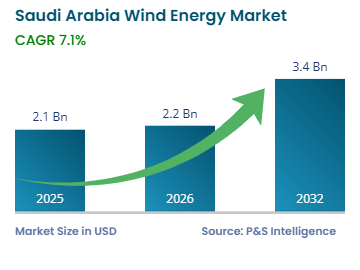
The Saudi Arabian wind energy market size will be an estimated USD 2.1 billion for 2025, and it will grow by 7.1% during 2026–2032, to reach USD 3.4 billion by 2032.
The growth is primarily driven by the implementation of Saudi Vision 2030, which aims to generate 50% of electricity from renewable sources by 2030, with wind power playing a critical role in this energy transition. Vision 2030 targets deploying 40 GW of wind energy capacity by 2030, representing one of the most ambitious renewable energy goals among Gulf Cooperation Council nations.
The abundant wind resources in the northern and coastal regions of Saudi Arabia, particularly in Al Jouf, where average wind speeds range from 3.88 to 4.99 meters per second, provide favorable conditions for wind power development. Saudi Arabia’s Renewable Energy Project Development Office (REPDO) and the Ministry of Energy have outlined a multi-phase wind project pipeline under the National Renewable Energy Program (NREP), with several gigawatt-scale projects currently under planning and tendering.
Saudi Arabia Wind Energy Market Emerging Trends
Strategic Partnerships with International Developers Are Key Trends
International collaborations have emerged as a key trend for Saudi Arabia's wind energy market expansion.
Major global renewable energy companies are partnering with local Saudi entities to develop utility-scale wind projects, bringing advanced technologies, operational expertise, and financing capabilities.
These partnerships facilitate crucial technology transfer and knowledge sharing essential for building local capabilities.
In 2021, Saudi Electric Services Polytechnic partnered with Maersk Training to train over 3,000 trainees over six years, preparing a skilled workforce to support renewable energy projects.
The collaborations also enable access to cutting-edge wind turbine technologies, with the Dumat Al Jandal project utilizing 99 Vestas V150-4.2MW turbines with 130-meter hub heights.
International partnerships extend beyond project development to include engineering, procurement, and construction services, with companies like SEPCO III from China securing EPC contracts.
These collaborations align with Vision 2030's objectives of economic diversification, job creation, and industrial development while accelerating the deployment of wind energy infrastructure across the Kingdom.
Vision 2030 and Government Policy Support Is Biggest Driver
Saudi Arabia's ambitious Vision 2030 initiative serves as the fundamental driver for wind energy expansion in the Kingdom.
The National Renewable Energy Program, launched under Vision 2030, provides a comprehensive framework, including power purchase agreements, streamlined regulatory processes, and financial incentives, to attract both domestic and international investors in wind power projects.
The government's commitment is further demonstrated through substantial budget allocations and land designations.
In 2025, Saudi Arabia allocated 260 square kilometers for wind farm projects as part of its Integrated Energy Strategy.
The Saudi Power Procurement Company has been actively tendering utility-scale projects, with the fourth round of the NREP resulting in contracts for three major wind farms totaling 1,800 MW.
Moreover, the Kingdom aims to reduce 278 million tonnes of carbon dioxide emissions annually by 2030, with renewable energy, particularly wind power, expected to contribute up to 55% of this emissions reduction target.
These policies create a conducive environment for rapid market expansion while ensuring Saudi Arabia's position as a regional leader in renewable energy adoption.
Saudi Arabia Wind Energy Market Segmentation Analysis
Installation Analysis
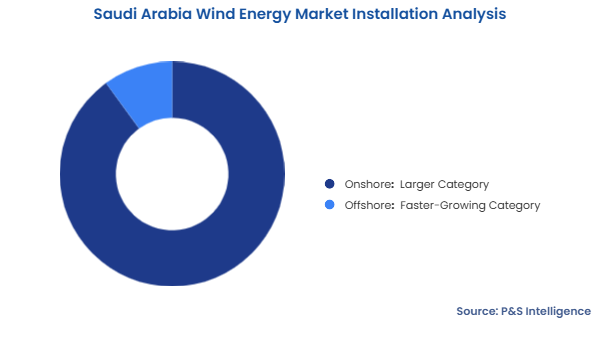
The onshore category holds the larger market share, of 90%, in 2025, due to lower capital expenditure requirements, faster construction timelines, and the availability of vast uninhabited desert and plateau landscapes with favorable wind conditions. The proven success of the 400 MW Dumat Al Jandal project, along with the upcoming 600 MW Al-Ghat and 500 MW Waad Al-Shamal projects, all onshore installations, demonstrates the technical and economic viability of this category in the Saudi context.
The offshore category will have the higher CAGR, of 7.5%, driven by technological advances in floating wind turbine foundations and the Kingdom's extensive Red Sea coastline. Saudi Arabia plans to develop a 500 MW floating offshore wind farm through collaboration between Saipem and Plambeck, with construction expected to commence in 2024 and commercial operations beginning in 2027. Offshore wind installations offer higher capacity factors due to stronger and more consistent wind resources over water bodies.
The installations analyzed in this report are:
Onshore (Larger Category)
Offshore (Faster-Growing Category)
Component Analysis
The turbine category holds the largest market share, of 45%, in 2025, encompassing critical elements, including the nacelle, hub, gearbox, generator, and control systems. Turbine manufacturers like Vestas, Siemens Gamesa, and General Electric are actively participating in Saudi projects, providing advanced equipment designed to withstand the Kingdom's desert climate conditions, including high temperatures, sandstorms, and humidity variations in coastal areas.
The electrical infrastructure category will have the highest CAGR, of 7.3%. As Saudi Arabia expands its wind power capacity, substantial investment in transmission infrastructure, transformers, cables, and control systems becomes essential to evacuate power efficiently and integrate renewable energy into the national grid. Grid modernization initiatives are critical to accommodate the intermittent nature of wind power and maintain system stability. As the Saudi Electricity Company expands transmission and distribution infrastructure to support Vision 2030 renewable energy targets, electrical infrastructure investments are accelerating, driving growth in this segment.
The above 6 MW category holds the largest market share, in 2025, and it will have the highest CAGR, as these large-capacity turbines deliver economies of scale. The trend of larger turbines is evident globally and increasingly adopted in Saudi Arabia as project developers seek to maximize energy generation efficiency. The planned offshore wind projects in Saudi Arabia will likely deploy turbines exceeding 10 MW capacity, leveraging floating foundation technologies that can support these massive structures.
The turbine capacities analyzed in this report are:
Up to 3 MW
3 MW to 6 MW
Above 6 MW (Largest and Fastest-Growing Category)
Application Analysis
The utility category holds the largest market share, of 70%, in 2025. Wind farms, typically exceeding 50 MW capacity, are connected directly to the national transmission grid, supplying electricity to the Saudi Power Procurement Company under long-term power purchase agreements. The Dumat Al Jandal project generates sufficient electricity to power 70,000 Saudi households through a 20-year PPA with SPPC. These large-scale projects benefit from favorable government policies, access to financing from international banks and development institutions, and streamlined regulatory approvals under the National Renewable Energy Program.
The industrial category will have the highest CAGR, of 7.4%, as Saudi industries seek to reduce carbon footprints and operational costs, direct procurement of renewable energy through behind-the-meter wind installations or corporate power purchase agreements becomes increasingly attractive. Energy-intensive sectors, including petrochemicals, mining, desalination, and manufacturing, are exploring wind power solutions to enhance sustainability credentials and hedge against volatile fossil fuel prices.
The applications analyzed in this report are:
Utility (Largest Category)
Industrial (Fastest-Growing Category)
Commercial
Residential
Drive strategic growth with comprehensive market analysis
Saudi Arabia Wind Energy Market Geographical Analysis
Al-Jouf Wind Energy Market Size
Al-Jouf holds the largest market share, of 25%, in 2025, with the 400-MW Dumat Al Jandal wind farm representing the only large-scale operational wind project in the Kingdom. Located approximately 900 kilometers north of Riyadh in northwestern Saudi Arabia, the facility became fully operational in December 2021 and serves as Saudi Arabia's inaugural utility-scale wind power installation. The Dumat Al Jandal project, featuring 99 Vestas V150-4.2MW turbines, displaced approximately one million tonnes of carbon dioxide emissions annually while powering 70,000 households, establishing Al-Jouf as the pioneering hub for wind power development in the Kingdom.
Madinah Wind Energy Market Size
Madinah will have the highest CAGR, of 7.2%, transitioning from zero wind capacity to 700 MW with the Yanbu Wind Farm project. The Yanbu Wind Farm represents the largest single wind project under development in Saudi Arabia, with construction expected to commence in 2024 and commercial operations beginning in 2026. This massive capacity addition in a province previously without wind infrastructure demonstrates exceptional growth momentum. Madinah's strategic location along the Red Sea coast provides access to consistent wind resources and proximity to industrial centers, including petrochemical complexes, enhancing project economics through reduced transmission costs. The 700-MW capacity will play a crucial role in helping Saudi Arabia achieve Vision 2030 targets of generating 50% of electricity from renewable sources by 2030, positioning Madinah as the fastest-growing province in Saudi Arabia's wind energy sector.
The provinces of the market are as follows:
Al-Riyadh
Eastern Province
Makkah
Madinah (Fastest-Growing Province)
Qassim
Asir
Tabuk
Ha'il
Northern Borders
Jazan
Najran
Al-Baha
Al-Jouf (Largest Province)
Saudi Arabia Wind Energy Market Share
The market is consolidated and characterized by the presence of established international renewable energy developers partnering with Saudi entities to execute utility-scale projects under the National Renewable Energy Program framework. Government-owned Saudi Power Procurement Company serves as the principal off-taker, issuing power purchase agreements through competitive bidding processes that attract leading global players. The consolidated nature reflects high barriers to entry, including substantial capital requirements, technical expertise in project development, and established relationships with equipment manufacturers and financing institutions. Leading players pursue strategies focused on achieving record-low tariffs through technological innovation and operational efficiency. Opportunities exist for new entrants in specialized segments, including floating offshore wind technology, advanced energy storage systems to complement wind power intermittency, and localized manufacturing of wind turbine components.
Key Saudi Arabia Wind Energy Companies:
ACWA Power
EDF Renewables
Badeel
Alfanar Energy
Saudi Power Procurement Company
Saudi Electricity Company
Vestas Wind Systems
Siemens Gamesa Renewable Energy
GE Vernova
Envision Energy
Larsen & Toubro Limited
ENGIE
Saudi Arabia Wind Energy Market News
In June 2024, PowerChina was awarded an engineering, procurement, and construction contract for the 500-MW Wa'ad Alshamal Wind Project in Saudi Arabia.
In May 2024, Marubeni Corporation and Ajlan & Bros signed power purchase agreements with Saudi Power Procurement Company for two wind projects totaling 1.1 GW capacity: the 600-MW Al-Ghat and 500-MW Waad Al-Shamal wind farms.
In May 2024, the Al-Ghat wind project achieved a world record-low levelized cost of electricity at 1.56558 cents per kWh while Waad Al-Shamal secured the second-lowest global tariff at USD cents 1.70187 per kWh.
In January 2024, ACWA Power signed a USD 1.5 billion agreement with Egypt to develop a 1.1 GW wind energy project in the Gulf of Suez and Gulf of Zeit, with the initiative expected to reduce annual carbon dioxide emissions by 2.4 million tonnes.
In October 2024, Japan Bank for International Cooperation signed loan agreements providing approximately USD 148 million for Al-Ghat and USD 136 million for Waad Al-Shamal projects, with total co-financing reaching USD 298 million and USD 274 million, respectively, through partnerships with multiple international banks.
Want a report tailored exactly to your business need?
Leading companies across industries trust us to deliver data-driven insights and innovative solutions for their most critical decisions. From data-driven strategies to actionable insights, we empower the decision-makers who shape industries and define the future. From Fortune 500 companies to innovative startups, we are proud to partner with organisations that drive progress in their industries.
Client Testimonials
Working with P&S Intelligence and their team was an absolute pleasure – their awareness of timelines and commitment to value greatly contributed to our project's success. Eagerly anticipating future collaborations.
McKinsey & Company
India
Unmatched Standards
Our insights into the minutest levels of the markets, including the latest trends and competitive landscape, give you all the answers you need to take your business to new heights
Complete Data Security
We take a cautious approach to protecting your personal and confidential information. Trust is the strongest bond that connects us and our clients, and trust we build by complying with all international and domestic data protection and privacy laws