Saudi Arabia Space Launch Market Size & Share Analysis - Trends, Drivers, Competitive Landscape, and Forecasts (2026 - 2032)
This Report Provides In-Depth Analysis of the Saudi Arabia Space Launch Market Report Prepared by P&S Intelligence, Segmented by Payload Type (Satellites, Human Spacecraft, Cargo, Testing Probes), Launch Vehicle (Heavy-Lift, Small-Lift, Medium-Lift), Orbit Type (Low Earth Orbit (LEO), Geosynchronous Orbit (GEO), Medium Earth Orbit (MEO), Polar & Sun-Synchronous Orbit (SSO), Highly Elliptical Orbit (HEO), Beyond Earth Orbit (BEO)), Service Type (Pre-Launch, Post-Launch), End User (Government & Military, Commercial, Research & Academic), and Geographical Outlook for the Period of 2021 to 2032
Explore the market potential with our data-driven report
Saudi Arabia Space Launch Market Overview
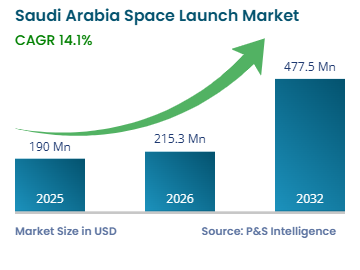
The Saudi Arabian Space Launch market size will be an estimated USD 190.0 million for 2025, and it will grow by 14.1% during 2026–2032, to reach USD 477.5 million by 2032.
The key factors responsible for market growth include the Kingdom's ambitious Vision 2030 space objectives, substantial government investments through the Public Investment Fund, and strategic partnerships with international space technology providers.
Saudi Arabia's broader space economy reached USD 8.7 billion in 2024, encompassing all value-added activities and industries from space technologies and services, according to the Communications, Space, and Technology Commission (CST). The Kingdom's strategic pivot towards space is intrinsically linked to Vision 2030, with space exploration recognized as a pivotal sector for investment in science, technology, and innovation. The Saudi Space Agency (SSA) is spearheading this transformation through comprehensive space programs, including satellite deployment, human spaceflight missions, and the development of domestic space infrastructure.
The establishment of Neo Space Group by PIF in 2024 marked the Kingdom's first major venture into satellite and space industries, signaling a commitment to developing domestic capabilities in space technology. Additionally, the USD 640 million agreement between SpaceBelt KSA and iRocket for up to 30 orbital launches demonstrates Saudi Arabia's determination to build sovereign space infrastructure, reducing dependence on foreign launch services while positioning the Kingdom as a regional space hub.
Saudi Arabia Space Launch Market Dynamics
Growing Demand for Satellite-Based ServicesAre Key Trends
The surge in demand for satellite communications, Earth observation, and broadband connectivity services across the Middle East is a key trend.
Saudi Arabia's strategic location and growing digital economy necessitate dedicated satellite constellations for telecommunications, broadcasting, and secure government communications.
The Middle Eastern satellite services market is experiencing rapid growth, with Saudi Arabia accounting for the largest share.
The Kingdom's ambitious smart city projects, including NEOM and the Red Sea Project, require extensive satellite infrastructure for connectivity, monitoring, and data services, driving demand for regular launch capabilities.
The proliferation of IoT applications across sectors, including oil & gas, agriculture, logistics, and smart cities, is accelerating demand for dedicated small satellite launches.
Saudi Arabia's partnership agreements for LEO satellite services, including the Arabsat-Telesat Lightspeed agreement for multi-gigabit capacity, demonstrate the growing requirement for launch services to deploy next-generation satellite constellations.
Vision 2030 and Strategic Government Investment Is Biggest Driver
The key driver for the Saudi Arabian space launch market is the Kingdom's Vision 2030 initiative, which aims to diversify the economy and establish Saudi Arabia as a global technology leader.
The Saudi Arabian government has allocated USD 2.1 billion for its space program through 2030, demonstrating an unprecedented commitment to space sector development.
The Supreme Space Council formulates comprehensive policies and strategies for all national space programs, ensuring seamless alignment with Vision 2030 objectives.
This high-level oversight has catalyzed multiple initiatives, including the Saudi Space Accelerator Program, which nurtures local entrepreneurs and businesses to advance innovative space solutions.
Strategic partnerships with international space leaders are accelerating technology transfer and capability building.
In May 2025, the SSA and NASA signed an executive agreement to launch Saudi Arabia's first satellite dedicated to studying space weather on the Artemis II mission.
Saudi Arabia Space Launch Market Segmentation Analysis
Payload Type Analysis
The satellites category holds the largest market share, of 60%, in 2025, driven by the Kingdom's extensive satellite deployment programs for communications, Earth observation, and navigation services supporting Vision 2030 objectives. Ongoing investments in sovereign satellite constellations and the replacement of legacy satellites to enhance national connectivity, data security, and space-based service reliability further reinforce this market dominance.
The human spacecraft category will have the highest CAGR, of 14.4%, owing to Saudi Arabia's ambitious astronaut program and planned missions to the Moon and Mars. The successful AX-2 mission in 2023, which included two Saudi astronauts, demonstrated the Kingdom's commitment to human spaceflight, with future missions planned through partnerships with SpaceX and other commercial providers.
The payload types analyzed in this report are:
Satellites (Larger Category)
Cargo
Human Spacecraft (Faster-Growing Category)
Testing Probes
Launch Vehicle Analysis
The heavy-lift launch vehicles category holds the largest market share, of 55%, in 2025, due to Saudi Arabia's reliance on established international launch providers like SpaceX, Arianespace, and others for deploying large communications satellites and multi-satellite missions. The Kingdom's geostationary satellites, including the Saudi Geostationary Satellite series, require heavy-lift capabilities for their deployment.
The small-lift launch vehicles category will have the highest CAGR, of 14.3%, driven by the growing demand for dedicated small satellite launches and the development of indigenous launch capabilities. The iRocket partnership's focus on responsive, reusable launch systems specifically targets this segment, offering rapid turnaround capabilities for small payload deployments.
The launch vehicles analyzed in this report are:
Heavy-Lift (>20,000 kg) (Largest Category)
Medium-Lift (2,000–20,000 kg)
Small-Lift (<2,000 kg) (Fastest-Growing Category)
Orbit Type Analysis
The low earth orbit category holds the largest market share, of 45%, in 2025, driven by the growing deployment of Earth observation satellites, IoT constellations, and broadband communications satellites. Saudi Arabia's partnerships for LEO satellite services, including agreements with OneWeb, Telesat Lightspeed, and planned sovereign constellations, underscore the strategic importance of this orbit type.
The geosynchronous orbit category will have the highest CAGR, continuing to serve the Kingdom's requirements for broadcast, telecommunications, and secure government communications. The established Arabsat fleet and Saudi-owned GEO satellites ensure consistent demand for launches to this orbital regime.
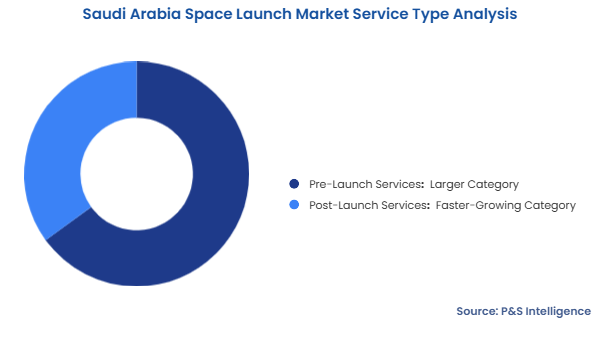
The pre-launch services category holds the larger market share, of 65%, in 2025, encompassing payload integration, mission planning, regulatory approvals, and launch vehicle procurement. The complexity of international launch arrangements and the Kingdom's focus on ensuring mission success through comprehensive pre-launch preparation drive this segment's dominance.
The post-launch services category will have the higher CAGR, of 14.4%, reflecting the increasing sophistication of Saudi satellite operations and the need for ongoing mission support, tracking, and data management services. The establishment of ground stations and mission control facilities within the Kingdom is expanding domestic post-launch service capabilities.
The service types analyzed in this report are:
Pre-Launch Services (Larger Category)
Post-Launch Services (Faster-Growing Category)
End User Analysis
The government & military category holds the largest market share, of 70%, in 2025, reflecting the strategic importance of space assets for national security, secure communications, and sovereignty objectives. Saudi government entities, including the Ministry of Defense, SSA, and various security agencies, constitute the primary demand drivers for launch services.
The commercial category will have the highest CAGR, driven by private sector participation in satellite communications, Earth observation services, and emerging applications like space tourism. The establishment of Neo Space Group and partnerships with commercial operators signal growing commercial demand for launch services. Rising participation from startups and private operators is expected to gradually increase the commercial share of launch demand over the forecast period.
The end users analyzed in this report are:
Government & Military (Largest Category)
Commercial (Fastest-Growing Category)
Research & Academic Institutions
Others
Drive strategic growth with comprehensive market analysis
Saudi Arabia Space Launch Market Geographical Analysis
Al-Riyadh Space Launch Market Size
Al-Riyadh holds the largest market share, of 40%, in 2025. This leadership position is primarily attributed to the concentration of government institutions, including the Saudi Space Agency headquarters, Ministry of Communications and Information Technology, and key decision-making bodies driving space initiatives.
The capital region hosts the Supreme Space Council and serves as the nerve center for Vision 2030 implementation, channeling investments into space infrastructure and programs. The presence of King Abdulaziz City for Science and Technology (KACST), which has successfully developed and launched multiple satellites, further reinforces Riyadh's position as the Kingdom's space technology hub.
Additionally, Riyadh's emergence as a financial and business center is attracting international space companies to establish regional headquarters, facilitating technology transfer and partnership agreements. The planned development of space research facilities and the concentration of aerospace engineering talent in the capital region ensure continued market leadership. This concentration of regulatory, financial, and technical capabilities makes Riyadh the primary coordination hub for national launch-related decision-making.
Eastern Province Space Launch Market Size
Eastern Province will have the highest CAGR, of 14.2%, driven by its strategic importance in Saudi Arabia's industrial diversification and technology development initiatives. The province's established industrial infrastructure, proximity to the Arabian Gulf, and concentration of petrochemical facilities provide unique advantages for developing space industry capabilities.
The region's economic cities and industrial clusters are attracting investments in aerospace manufacturing and satellite technology development. The presence of major Saudi Aramco facilities creates synergies for developing space-based monitoring and communication systems for the energy sector, driving demand for specialized launch services.
Strategic partnerships with international space companies are establishing Eastern Province as a manufacturing and assembly hub for satellite components and ground systems. The region's skilled workforce, developed through decades of oil and gas industry experience, provides a strong foundation for transitioning to high-technology space industry applications.
The provinces analyzed in the market are as follows:
Al-Riyadh (Largest Provincial Market)
Eastern Province (Fastest-Growing Provincial Market)
Makkah
Madinah
Qassim
Asir
Tabuk
Ha’il
Northern Borders
Jazan
Najran
Al-Baha
Al-Jouf
Saudi Arabia Space Launch Market Share
The market is semi-consolidated due to the coexistence of dominant international launch service providers and the gradual entry of emerging domestic participants. The market is characterized by strong dependence on international launch service providers, with established global players currently handling the majority of launch requirements. At the same time, the emergence of Saudi entities and strategic partnerships supported by technology transfer agreements indicates increasing participation from new players. These initiatives, backed by government investment, are expanding the competitive base, while international providers continue to retain leadership, resulting in a semi-consolidated market structure.
Key Saudi Arabia Space Launch Companies:
Space Exploration Technologies Corporation (SpaceX)
Innovative Rocket Technologies Inc.
Lockheed Martin Corporation
Arianespace S.A.
Thales Alenia Space
Blue Origin
Northrop Grumman Corporation
United Launch Alliance, LLC
Rocket Lab USA, Inc.
Airbus Defence and Space (Airbus SE)
Mitsubishi Heavy Industries, Ltd.
Neo Space Group
Saudi Arabia Space Launch Market News
In August 2025, SpaceBelt KSA signed a USD 640 million contract with iRocket Aerospace Technology Co. Ltd. to conduct up to 30 orbital launches over a five-year period, representing Saudi Arabia's most significant commitment to developing indigenous launch capabilities through technology transfer and local operations.
In May 2025, Arab Satellite Communications Organization (Arabsat) finalized agreements with Telesat Corporation to secure multi-gigabit LEO satellite capacity from the Lightspeed constellation, demonstrating growing demand for advanced satellite services requiring regular launch support.
In March 2025, Saudi Arabia launched biological research samples on SpaceX's Fram2 mission, marking the Kingdom's participation in the first crewed polar orbit flight and highlighting its expanding involvement in specialized launch missions.
In July 2024, Saudi Space Agency signed a comprehensive cooperation agreement with NASA to advance civilian space research and exploration, strengthening the Kingdom’s access to advanced space technologies and institutional expertise.
Frequently Asked Questions About This Report
What is the size of the Saudi Arabia space launch market in 2025?+
The market for Saudi Arabian space launch market values USD 190.0 million in 2025.
Which organization is the leading player in the Saudi Arabia space launch industry?+
The Saudi Space Agency leads the Saudi Arabian space launch industry through government programs and international partnerships.
Which is the leading payload type in the Saudi Arabia space launch market?+
Satellites dominate the market for Saudi Arabia space launch.
What are the major drivers for the Saudi Arabia space launch industry?+
The major drivers of the Saudi Arabian space launch industry include Vision 2030 investments, rising demand for satellite launches, and increasing international space collaborations.
What is the nature of competition in the Saudi Arabia space launch industry?+
The Saudi Arabian space launch industry is semi-consolidated.
Want a report tailored exactly to your business need?
Leading companies across industries trust us to deliver data-driven insights and innovative solutions for their most critical decisions. From data-driven strategies to actionable insights, we empower the decision-makers who shape industries and define the future. From Fortune 500 companies to innovative startups, we are proud to partner with organisations that drive progress in their industries.
Client Testimonials
Working with P&S Intelligence and their team was an absolute pleasure – their awareness of timelines and commitment to value greatly contributed to our project's success. Eagerly anticipating future collaborations.
McKinsey & Company
India
Unmatched Standards
Our insights into the minutest levels of the markets, including the latest trends and competitive landscape, give you all the answers you need to take your business to new heights
Complete Data Security
We take a cautious approach to protecting your personal and confidential information. Trust is the strongest bond that connects us and our clients, and trust we build by complying with all international and domestic data protection and privacy laws