Saudi Arabia Smart Cities Market Size & Share Analysis - Trends, Drivers, Competitive Landscape, and Forecasts (2026 - 2032)
This Report Provides In-Depth Analysis of the Saudi Arabia Smart Cities Market Report Prepared by P&S Intelligence, Segmented by Component (Transportation & Mobility, Infrastructure & Environment, People & Society, Governance & Management), Focus Area (Smart Transportation, Smart Utilities, Smart Buildings, Smart Citizen Services), Technology (Internet of Things (IoT), Artificial Intelligence (AI), Cloud Computing, Big Data Analytics, Blockchain, 5G Connectivity), City Size (Large Cities, Medium-Sized Cities, Small Cities), and Geographical Outlook for the Period of 2019 to 2032
Explore the market potential with our data-driven report
Saudi Arabia Smart Cities Market Outlook
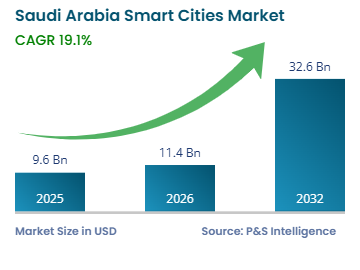
The Saudi Arabian smart cities market size will be an estimated USD 9.6 billion for 2025, and it will grow by 19.1% during 2026–2032, to reach USD 32.6 billion by 2032.
The market growth is primarily driven by Saudi Arabia’s ambitious Vision 2030 agenda, which prioritizes rapid digital transformation and modern urban infrastructure.
Major flagship projects, including NEOM, The Line, and Qiddiya, exemplify Saudi Arabia's commitment to redefining urban living through advanced technologies. The Kingdom's emphasis on integrating Internet of Things, artificial intelligence, and 5G connectivity across urban infrastructure demonstrates its determination to establish itself as a regional leader in smart city innovation.
These initiatives extend beyond the creation of new cities: existing urban centres such as Riyadh and Jeddah are being retrofitted with digital systems that monitor energy use, mobility flows, and public‑safety networks in real time. Public‑private partnerships are being mobilised to deploy data‑centres, edge computing hubs, and smart sensors in residential districts, transport corridors, and entertainment hubs. By positioning technology as the backbone of urban growth, Saudi Arabia is crafting an ecosystem where growth, sustainability, and citizen experience converge.
Saudi Arabia Smart Cities Market Dynamics
Rapid IoT Adoption and Digital Infrastructure Expansion Are Key Trends
The proliferation of internet of things technologies represents a transformative trend reshaping urban management across Saudi Arabia.
The growth reflects increasing adoption across multiple sectors, including transportation, healthcare, energy management, and public safety.
Industrial IoT applications are experiencing particularly robust growth, driven by the Kingdom's focus on manufacturing diversification and operational efficiency improvements.
Manufacturing facilities, oil and gas operations, and logistics centers are increasingly deploying connected sensors, predictive maintenance systems, and automated monitoring solutions.
The expansion of 5G networks serves as a critical enabler for IoT proliferation, providing the high-speed, low-latency connectivity required for real-time data processing and autonomous systems.
The Ministry of Communications and Information Technology is investing heavily in digital infrastructure, smart data centers, and cloud computing hubs to strengthen the foundation for IoT integration.
Vision 2030 and Sustainability Commitments Propel Smart City Investments
Saudi Arabia’s Vision 2030 is the main driver of smart city development, integrating sustainability to address climate and resource challenges.
This comprehensive national strategy prioritizes economic diversification, technological innovation, and sustainable urban development as core objectives for reducing oil dependency.
The scale of investment is unprecedented in the region, with the government channeling resources into infrastructure modernization, digital transformation, and smart technology deployment.
As per reports, the Saudi government invested USD 15 billion to enhance its 5G network infrastructure under Vision 2030 objectives, demonstrating the prioritization of connectivity infrastructure essential for smart city operations.
Public–private partnerships between government entities and international technology providers facilitate knowledge transfer, reduce implementation risks, and ensure access to cutting-edge technologies.
These partnerships enable rapid deployment of smart solutions while building local capacity and expertise for long-term sustainability.
Environmental sustainability has become a core driver for smart city development in Saudi Arabia, reflecting both global climate commitments and local resource management challenges.
The Kingdom has committed to reducing carbon emissions by more than 278 million tons per annum by 2030, positioning smart city technologies as essential tools for achieving these environmental targets.
Smart energy management systems are being deployed across urban areas to optimize consumption, integrate renewable energy sources, and reduce operational costs.
These systems utilize advanced analytics, automated controls, and real-time monitoring to minimize energy waste while maintaining service quality.
Water management represents another critical area where smart technologies address resource scarcity challenges through intelligent distribution systems, leak detection, and consumption optimization.
Waste management transformation through smart technologies enables more efficient collection routes, recycling optimization, and environmental monitoring.
Connected waste bins, automated collection systems, and data-driven logistics reduce operational costs while improving environmental outcomes.
These sustainability initiatives attract international investment and demonstrate Saudi Arabia's commitment to responsible urban development.
Saudi Arabia Smart Cities Market Segmentation Analysis
Component Analysis
The transportation & mobility category holds the largest market share, of 45%, in 2025. This dominance reflects the Kingdom's substantial investments in intelligent transportation infrastructure, including smart traffic management systems, connected public transport networks, and autonomous vehicle preparation. The segment encompasses comprehensive solutions, including traffic optimization systems, smart parking management, public transport integration, and vehicle management platforms.
The infrastructure & environment category will have the highest CAGR, during the forecast period, driven by increasing focus on sustainable urban development, smart energy grid deployment, and environmental monitoring systems. The segment benefits from substantial government investments in renewable energy integration, intelligent utility management, and environmental sustainability initiatives aligned with Vision 2030 objectives.
The smart transportation category holds the largest market share, of 40%, in 2025, due to the Kingdom's urgent need to address urban congestion and mobility challenges across rapidly growing metropolitan areas. Major cities, including Riyadh, Jeddah, and Dammam, are implementing comprehensive intelligent transportation systems encompassing traffic optimization, public transit integration, and connected vehicle infrastructure.
Backed by Vision 2030 funding, smart mobility projects are being rapidly deployed to tackle congestion and enhance urban connectivity. The focus area encompasses autonomous vehicle preparation, smart parking systems, real-time traffic management, and multimodal transport integration. Smart mobility solutions are helping reduce commute times, lower emissions, and enhance the overall commuter experience, addressing critical urban challenges while supporting economic diversification objectives.
The smart utilities category will have the highest CAGR, of 19.3%, driven by increasing emphasis on energy efficiency, renewable energy integration, and resource optimization aligned with Saudi Arabia's sustainability commitments. Smart utility implementations include intelligent energy grids, automated water management systems, and connected waste collection platforms that reduce operational costs while improving service reliability. Smart grid technologies enable efficient integration of renewable energy sources while maintaining grid stability and optimizing energy distribution across urban areas.
The focus areas analyzed in this report are:
Smart Transportation (Largest Category)
Smart Utilities (Fastest-Growing Category)
Smart Buildings
Smart Citizen Services
Technology Analysis
The IoT category holds the largest market share, of 35%, in 2025, reflecting its fundamental role as the connectivity backbone for smart city operations. IoT creates a vast network of sensors, devices, and systems that collect real-time data across urban infrastructure. IoT deployment encompasses everything from environmental monitoring sensors to connected vehicles, smart building systems, and public safety devices. Major smart city projects, including NEOM, integrate IoT extensively, with over 75% of NEOM's infrastructure featuring 5G integration to enable real-time data handling.
The AI category will have the highest CAGR during the forecast period. AI applications in smart cities include predictive analytics for infrastructure maintenance, intelligent traffic optimization, automated public service delivery, and enhanced security monitoring. The Saudi Data and Artificial Intelligence Authority actively promotes AI adoption through policy frameworks and public-private collaboration initiatives.
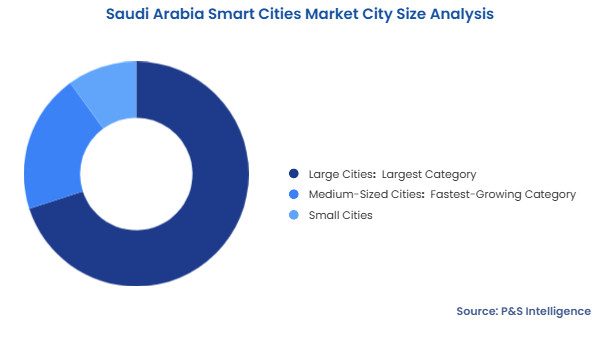
The large cities category holds the largest market share, of 70%, in 2025, driven by substantial government investments in major metropolitan areas, including Riyadh, Jeddah, Makkah, and Dammam. These urban centers serve as pilot locations for comprehensive smart city implementations, benefiting from concentrated populations, established infrastructure, and significant economic activity. Economies of scale in large cities make the deployment of advanced smart city technologies more feasible and cost-efficient. Comprehensive implementations include integrated traffic management, smart energy grids, digital governance platforms, and advanced public safety systems.
The medium-sized cities category will have the highest CAGR, of 19.4%. This growth reflects expanding smart city initiatives beyond major metropolitan areas, as the government extends digital transformation to regional urban centers. Secondary cities benefit from lessons learned in larger implementations while addressing specific local challenges and opportunities.
The city sizes analyzed in this report are:
Large Cities (Largest Category)
Medium-Sized Cities (Fastest-Growing Category)
Small Cities
Drive strategic growth with comprehensive market analysis
Saudi Arabia Smart Cities Market Geographical Analysis
Al-Riyadh Smart Cities Market Size
Al-Riyadh holds the largest market share, of 40%, in 2025. The province benefits from substantial government investments, major corporate headquarters, and flagship smart city projects that serve as national showcases. The capital city's role as the primary hub for Vision 2030 implementation ensures continued prioritization for smart city development initiatives. The province encompasses multiple major smart city projects, including the King Abdullah Financial District expansion, New Murabba development, and various digital transformation initiatives across government agencies.
Riyadh's smart city development encompasses comprehensive transportation management systems, intelligent building management, environmental monitoring, and integrated citizen services. Economic diversification initiatives position Riyadh as a regional technology hub, attracting international investment and expertise.
Tabuk Smart Cities Market Size
Tabuk will have the highest CAGR, of 19.2%, due to hosting NEOM, the world's largest smart city project with a USD 500 billion investment. The project encompasses 26,500 square kilometers, being developed as a completely integrated smart city ecosystem. Tabuk's location in northwestern Saudi Arabia provides unique advantages as a gateway between three continents. The province connects directly to Jordan and Egypt while offering Red Sea access, positioning it as a future hub for international trade and tourism. This strategic location, combined with a relatively mild climate compared to other Saudi regions, makes it ideal for large-scale urban development and international business activities.
Tabuk is set to host the world's first hyper-connected cognitive city integrating advanced technologies, such as 5G, IoT, AI-driven data analytics, immersive reality solutions, smart homes, and autonomous mobility. The province serves as a living laboratory where Saudi Arabia tests and implements the most advanced smart city technologies before broader national deployment.
The provinces of the market are as follows:
Al-Riyadh (Largest Province)
Eastern Province
Makkah
Madinah
Qassim
Asir
Tabuk (Fastest-Growing Province)
Ha'il
Northern Borders
Jazan
Najran
Al-Baha
Al-Jouf
Saudi Arabia Smart Cities Market Share
The market is fragmented due to the involvement of numerous global and regional players offering diverse solutions across multiple domains such as mobility, energy, infrastructure, and citizen services. Each city and mega-project has distinct technological priorities and implementation timelines, leading to varied partnerships and procurement models. Additionally, local regulations, evolving standards, and the need for customized solutions encourage collaboration among multiple specialized firms rather than dominance by a few large companies.
Key Saudi Arabia Smart Cities Companies:
Cisco Systems, Inc.
Saudi Telecom Company (stc)
Elm Company
Huawei Technologies Co., Ltd.
Siemens AG
Schneider Electric SE
Honeywell International Inc.
Ericsson AB
International Business Machines Corporation (IBM)
Nokia Corporation
Zain KSA
Advanced Electronics Company (AEC)
Saudi Arabia Smart Cities Market News
In September 2024, Saudi Telecom Company stc Group partnered with New Murabba to drive advanced ICT adoption in New Murabba, covering comprehensive ICT infrastructure projects while leveraging stc Group's digital solutions and smart city development expertise.
In December 2024, the Holy Makkah Municipality signed an agreement to develop smart city solutions aimed at enhancing disaster resilience, particularly focusing on AI-driven flood management strategies, control room efficiency improvements, and automated decision-making systems.
In March 2024, Amazon Web Services announced plans to establish an AWS infrastructure Region in Saudi Arabia by 2026, representing a USD 5.3 billion investment to provide strategic advantages for developers, enterprises, and various sectors.
In May 2024, Aramco and Qualcomm Technologies Inc. signed an MoU to advance industrial 4G, 5G, and non-terrestrial networks development, focusing on 450MHz cellular technology to enhance industrial IoT capabilities across millions of intelligent edge devices.
In January 2024, NEOM announced Aquellum, an underground digitalized community built within a 450-meter mountain, featuring underwater access points and pioneering architecture that redefines next-generation smart city design.
Want a report tailored exactly to your business need?
Leading companies across industries trust us to deliver data-driven insights and innovative solutions for their most critical decisions. From data-driven strategies to actionable insights, we empower the decision-makers who shape industries and define the future. From Fortune 500 companies to innovative startups, we are proud to partner with organisations that drive progress in their industries.
Client Testimonials
Working with P&S Intelligence and their team was an absolute pleasure – their awareness of timelines and commitment to value greatly contributed to our project's success. Eagerly anticipating future collaborations.
McKinsey & Company
India
Unmatched Standards
Our insights into the minutest levels of the markets, including the latest trends and competitive landscape, give you all the answers you need to take your business to new heights
Complete Data Security
We take a cautious approach to protecting your personal and confidential information. Trust is the strongest bond that connects us and our clients, and trust we build by complying with all international and domestic data protection and privacy laws