Saudi Arabia Renewable Energy Market Size & Share Analysis - Emerging Trends, Growth Opportunities, Competitive Landscape, and Forecasts (2026 - 2032)
This Report Provides In-Depth Analysis of the Saudi Arabia Renewable Energy Market Report Prepared by P&S Intelligence, Segmented by Type (Solar Energy, Wind Energy, Hydropower, Bioenergy, Geothermal Energy), Product Type (Utility, Industrial, Residential, Commercial), and Geographical Outlook for the Period of 2019 to 2032
Saudi Arabia Renewable Energy Market Growth Potential
Key Highlights
Study Period
2019 - 2032
Market Size in 2025
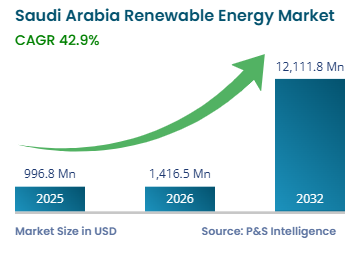
USD 996.8 Million
Market Size in 2026
USD 1416.5 Million
Market Size by 2032
USD 12111.8 Million
Projected CAGR
42.9%
Largest Province
Al-Riyadh
Fastest-Growing Province
Eastern
Market Structure
Semi-consolidated
Market Size
Explore the market potential with our data-driven report
Saudi Arabia Renewable Energy Market Analysis
The Saudi Arabian renewable energy market size will be an estimated USD 996.8 million for 2025, and it will grow by 42.9% during 2026–2032, to reach USD 12,111.8 million by 2032.
The market's explosive growth is driven by the kingdom's ambitious Vision 2030 strategy, massive government investments, and the country's exceptional solar and wind resources. The kingdom's strategic geographical position in the sun belt provides exceptional advantages for renewable energy development. Through the National Renewable Energy Program, the government has accelerated project deployment via transparent tenders, driving record-low electricity costs and substantial private sector investments.
The recent momentum has been extraordinary, with the kingdom securing financing for multiple large-scale projects. Saudi Arabia has awarded renewable energy contracts worth more than USD 2.4 billion (9 billion SAR) amid its push to boost sustainable capacity generation while keeping generation costs low. The market growth trajectory is further supported by the Public Investment Fund's strategic investments in renewable energy localization and manufacturing capabilities, positioning Saudi Arabia as a regional hub for clean energy technology production.
Saudi Arabia Renewable Energy Market Emerging Trends
Public–Private Partnerships Are Key Trends Enhancing Development Capacity
The kingdom's renewable energy sector benefits significantly from robust public-private partnership models that leverage both government support and private sector expertise.
Many internationally renowned companies are participating in the construction of Saudi Arabia's energy storage projects.
In the pre-qualification process for the first battery energy storage system procurement launched by the Saudi Power Procurement Company in November 2024, a total of 33 companies passed the tender qualification review.
Such partnerships introduce cutting-edge technologies, global financing models, and operational expertise to Saudi projects.
The government's approach through the Saudi Power Procurement Company ensures competitive bidding processes that drive down costs while maintaining high technical standards.
International partnerships with leading renewable energy companies from Europe, Asia, and North America provide technology transfer opportunities and enhance local capacity building.
This collaborative approach accelerates project development timelines and ensures access to cutting-edge renewable energy technologies and best practices from global markets.
Vision 2030 Implementation Is Biggest Driver
The cornerstone of Saudi Arabia's renewable energy expansion is Vision 2030, which sets an ambitious target of generating 50% of electricity from renewable sources by 2030, serving as a key driver for large-scale investments, policy reforms, and accelerated project development across the kingdom.
By 2060, Saudi Arabia aims to achieve net zero greenhouse gas (GHG) emissions, targeting 50% renewable energy and reducing 278 million tonnes of CO2 equivalent annually by 2030 under Vision 2030.
This comprehensive strategy encompasses economic diversification, environmental sustainability, and energy security objectives that collectively drive massive investments in renewable infrastructure.
The government has allocated substantial financial resources to support this transformation.
The Saudi Green Initiative, launched in 2021, further reinforces this commitment by establishing environmental targets that complement the energy transition goals.
These policy frameworks provide long-term certainty for investors and developers, creating a stable environment for renewable energy project development across the kingdom.
According to the General Authority for Statistics, Saudi Arabia’s operational renewable energy capacity reached 6,551 MW at the end of 2024, reflecting investments of approximately SAR 19.84 billion into solar and wind projects.
Meanwhile, the latest national target revision sees the renewables target raised to about 130 GW by 2030, underscoring the scale of the infrastructure push.
Grid Integration and Infrastructure Challenges Are Key Restraints
The integration of renewable energy sources into Saudi Arabia's existing power grid infrastructure poses significant technical and operational challenges, which could hinder the country's ambitious renewable energy deployment targets.
The rapid development of renewable infrastructure has posed challenges related to grid integration and energy storage, necessitating significant upgrades to the existing power grid to accommodate variable renewable energy sources.
Saudi Arabia's traditional power grid faces substantial limitations in accommodating the intermittent nature of renewable energy sources, with challenges such as transmission losses, low efficiency, and limited ability to accommodate renewable energy sources.
High implementation costs, the need for skilled labor, and cybersecurity concerns are key hurdles that must be addressed to successfully integrate the Kingdom's planned 130 GW of renewable capacity by 2030.
Saudi Arabia's clean energy goals are constrained by its old grid infrastructure.
The network struggles to integrate intermittent solar and wind power. By the end of 2024, renewable capacity is projected to reach only 6.55 GW.
Grid capacity must increase significantly from its 70.66 GW peak in November 2023).
This requires massive capital, of up to USD 500 billion by 2060 for new lines and substations.
Green Hydrogen Export Leadership and Economic DiversificationAre Biggest Opportunities
Saudi Arabia's strategic position to become a global leader in green hydrogen production and export represents a transformative economic opportunity that aligns with the Kingdom's Vision 2030 diversification goals.
The kingdom is developing the USD 8.4 billion NEOM green hydrogen plant, which will produce up to 600 tonnes of hydrogen per day and utilize around 4 GW of renewable electricity generated from dedicated on-site wind and solar plants.
By 2030, Saudi Arabia aims to produce 1.2 million tonnes of green hydrogen annually, with solar energy powering the electrolysis process.
The hydrogen market is expected to be worth USD 700 billion by 2050, and Saudi Arabia aims to dominate exports.
This opportunity enables Saudi Arabia to leverage its traditional energy sector expertise, while transitioning toward sustainable energy exports.
This will create new revenue streams, industrial clusters, and employment opportunities, ultimately, support long-term economic diversification beyond oil trade.
Saudi Arabia Renewable Energy Market Segmentation Analysis
Type Analysis
The solar energy category holds the largest market share, of 85%, in 2025, due to the kingdom's exceptional solar resources, proven technology reliability, and the government's strategic focus on large-scale solar photovoltaic and concentrated solar power projects. Saudi Arabia plans to deploy around 2.7 GW of concentrated solar power capacity by 2030, reflecting the government’s strong commitment to solar technology diversification.
The wind energy category will have the highest CAGR, of 43.1%, driven by improving wind resource assessments and technological advancement in turbine efficiency. The completion of the 400 MW Dumat Al Jandal wind farm marked a milestone as Saudi Arabia's first utility-scale wind project, proving the commercial viability of wind power generation. Recent project awards, including the 1,500 MW Dawadmi wind project, demonstrate the government's commitment to diversifying renewable energy sources and optimizing resource utilization across different geographical regions.
The types analyzed in this report are:
Solar Energy (Largest Category)
Solar Photovoltaic (PV)
Concentrated Solar Power (CSP)
Wind Energy (Fastest-Growing Category)
Onshore
Offshore
Hydropower
Bioenergy
Geothermal Energy
Others
End Use Analysis
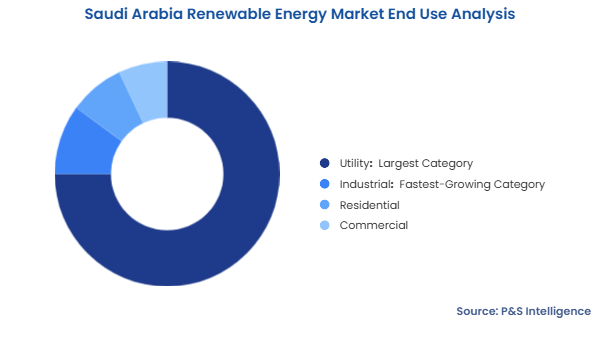
The utility category holds the largest market share, of 75%, in 2025, driven by the National Renewable Energy Program's focus on large-scale grid-connected projects. These utility-scale installations provide bulk power generation to meet the kingdom's growing electricity demand while supporting the grid stability through advanced energy storage systems. Saudi Arabia plans to deploy 48GWh of battery energy storage systems by 2030. The utility segment benefits from economies of scale, competitive procurement processes, and long-term power purchase agreements that ensure project bankability and stable returns for investors.
The industrial category will have the highest CAGR during the forecast period, as energy-intensive industries seek to reduce operational costs and meet sustainability targets. Saudi Arabia's industrial sector, including petrochemicals, mining, and manufacturing, represents significant opportunities for renewable energy adoption through dedicated power supply arrangements. The government's focus on industrial diversification under Vision 2030 creates additional demand for clean energy solutions in new industrial cities and economic zones being developed across the kingdom.
The end uses analyzed in this report are:
Utility (Largest Category)
Industrial (Fastest-Growing Category)
Residential
Commercial
Drive strategic growth with comprehensive market analysis
Saudi Arabia Renewable Energy Market Geographical Analysis
Al-Riyadh Renewable Energy Market Size
Al-Riyadh holds the largest market share, of 30%, in 2025, driven by proximity to major population centers and existing transmission infrastructure. The province hosts several major projects, including the Sudair Solar Park and multiple wind energy developments, that benefit from established grid connectivity and streamlined project approval processes. Riyadh's central location enables efficient power transmission to other regions, making it an optimal hub for large-scale renewable energy development, supporting the kingdom's overall energy security objectives.
The province benefits from excellent solar resources with high direct normal irradiance levels and suitable wind conditions in certain areas, enabling both photovoltaic and wind energy development. Riyadh's established industrial base and growing population create substantial local demand for clean electricity, supporting the commercial viability of renewable energy projects.
Eastern Province Renewable Energy Market Size
Eastern Province will have the highest CAGR, of 43.0%, driven by industrial demand and new economic zone developments. Recent project announcements in the Eastern Province demonstrate the government's commitment to diversifying energy sources across all major economic regions while supporting industrial growth and sustainability objectives.
Ongoing industrial diversification under Vision 2030 is transforming the Eastern Province into a central hub for renewable energy investment and deployment. The province's coastal location provides access to excellent wind resources and enables potential offshore wind development in future phases. The Eastern Province's established infrastructure, including ports, roads, and power transmission networks, facilitates efficient project development and equipment transportation. Additionally, the region's industrial clusters create opportunities for direct power purchase agreements between renewable energy developers and energy-intensive industrial consumers, enhancing project economics and supporting the kingdom's industrial competitiveness.
The provinces analyzed are as follows:
Al-Riyadh (Largest Province)
Eastern Province (Fastest-Growing Province)
Makkah
Madinah
Qassim
Asir
Tabuk
Ha'il
Northern Borders
Jazan
Najran
Al-Baha
Al-Jouf
Saudi Arabia Renewable Energy Market Share
The market is semi-consolidated as a few leading players dominate capacity while numerous firms remain active across smaller projects. Government-led tendering through SPPC favors technically and financially strong developers, creating high entry barriers that result in a balanced structure between competition and concentration. Large-scale projects are primarily awarded to established companies such as ACWA Power, Masdar, and EDF Renewables, which possess strong financial capabilities and proven technical expertise. Their long-term partnerships with entities like the Public Investment Fund and Aramco further reinforce their leadership. However, the government’s localization goals continue to attract new entrants and encourage healthy competition.
Key Saudi Arabia Renewable Energy Companies:
ACWA Power
Masdar
Alfanar Energy
EDF Renewables
ENGIE SA (via Kahrabel)
TotalEnergies Renewables
Nesma Holding Co. Ltd
Siemens Energy AG
Vestas Wind Systems A/S
Enel SpA
SPIC Huanghe Hydropower Development Co.
Saudi Electricity Company (SEC)
Saudi Arabia Renewable Energy Market News
In October 2025, Saudi Arabia awarded five renewable energy projects with a combined capacity of 4,500 MW and total investments exceeding USD 2.4 billion under the sixth round of the National Renewable Energy Program, including record-low costs for wind and solar generation.
In July 2025, ACWA Power Co., Badeel (Water and Electricity Holding Company), and Saudi Aramco Power Company (SAPCO) signed agreements to develop 15,000 MW of renewable energy projects valued at approximately USD 8.3 billion. The plan includes seven plants across multiple provinces, with operations expected to commence between 2027 and 2028.
In June 2025, the Saudi Ministry of Energy began a comprehensive geographic survey to identify optimal sites for renewable projects, deploying 1,200 measurement stations across more than 850,000 square kilometers to assess solar and wind resources.
In August 2024, China Energy Engineering Corporation Ltd. secured a USD 972 million EPC contract for the 2 GW Haden solar PV plant in western Saudi Arabia, demonstrating continued international participation in the kingdom's renewable energy expansion.
In February 2024, ACWA Power Co. obtained a USD 2.30 billion loan for three solar power projects, reflecting strong financial market confidence in the kingdom’s renewable energy trajectory and project bankability.
Want a report tailored exactly to your business need?
Leading companies across industries trust us to deliver data-driven insights and innovative solutions for their most critical decisions. From data-driven strategies to actionable insights, we empower the decision-makers who shape industries and define the future. From Fortune 500 companies to innovative startups, we are proud to partner with organisations that drive progress in their industries.
Client Testimonials
Working with P&S Intelligence and their team was an absolute pleasure – their awareness of timelines and commitment to value greatly contributed to our project's success. Eagerly anticipating future collaborations.
McKinsey & Company
India
Unmatched Standards
Our insights into the minutest levels of the markets, including the latest trends and competitive landscape, give you all the answers you need to take your business to new heights
Complete Data Security
We take a cautious approach to protecting your personal and confidential information. Trust is the strongest bond that connects us and our clients, and trust we build by complying with all international and domestic data protection and privacy laws