Explore the market potential with our data-driven report
Saudi Arabia Online Grocery Market Overview
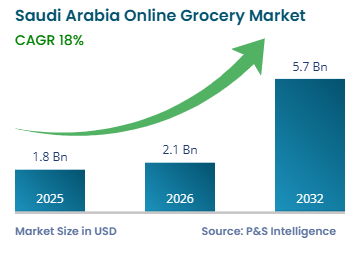
The Saudi Arabian online grocery market size will be an estimated USD 1.8 billion for 2025, and it will grow by 18.0% during 2026–2032, to reach USD 5.7 billion by 2032.
The market’s strong growth is fueled by the kingdom's accelerated digital transformation under Vision 2030, exceptional internet penetration, and the government's ambitious push toward achieving a cashless economy.
Saudi Arabia's demographic profile significantly favors online grocery expansion. With 92.1% of the population living in urban areas and a median age of 29.6 years, the kingdom hosts a young, tech-savvy consumer base increasingly embracing digital-first lifestyles. The substantial working population, comprising 73.2% of the total population, particularly in major cities like Riyadh and Jeddah, demonstrates strong demand for time-saving convenience solutions. The market benefits from Vision 2030's strategic focus on diversifying the economy beyond oil dependency.
Saudi Arabia Online Grocery Market Emerging Trends
Quick Commerce Revolution and Changing Consumer Expectations Are Key Trends
The most significant trend reshaping Saudi Arabia's online grocery market is the rapid adoption of quick commerce, characterized by ultra-fast delivery services within 10–30 minutes.
This trend is fundamentally altering competitive dynamics, operational strategies, and consumer behavior patterns across the kingdom.
This is evidenced by substantial consumer willingness to pay premium fees for speed, with platforms monetizing urgency through 25–40% higher fees, which effectively counterbalances last-mile cost inflation.
This pricing power demonstrates that Saudi consumers value convenience and immediacy over cost savings.
Quick commerce adoption is driving massive investments in dark store networks and logistics infrastructure.
Leading platforms are strategically placing micro-fulfillment centers within dense urban areas to achieve sub-30-minute delivery windows.
HungerStation’s Quick Market now serves nearly 95% of the kingdom with delivery times under an hour, while Nana has launched 30 dark stores in Riyadh and plans to add 20 more facilities soon.
The infrastructure requirements extend beyond physical locations to advanced technology systems.
Quick commerce is reshaping fundamental shopping patterns among Saudi consumers.
The convenience of 10–30-minute delivery is encouraging more frequent, smaller-basket purchases, rather than traditional weekly grocery shopping trips.
This shift is particularly pronounced among working professionals and dual-income households in major cities like Riyadh and Jeddah.
Demand density peaks during evening hours, aligning with post-work consumption patterns, as consumers increasingly use quick commerce for immediate needs rather than planned shopping.
As the kingdom's urban population grows and digital payment adoption accelerates, the demand for instant gratification will likely intensify, making quick commerce capabilities essential for long-term market viability.
The trend's longevity is supported by Saudi Arabia's unique market conditions: high urban density, strong digital infrastructure, a young tech-savvy population, and growing disposable incomes that support premium pricing for convenience services.
Digital Payment Adoption and Urban Lifestyle Shifts Are Biggest Drivers
The rapid advancement of digital payment infrastructure, along with Saudi Arabia’s continued urbanization, serves as a key driver for the online grocery market, creating optimal conditions for seamless digital transactions and expanding consumer demand across urban centers.
MADA card e-commerce sales surged 73.4% year-over-year in March to reach SAR 27.55 billion, indicating strong consumer confidence in digital payment methods.
The kingdom's urban population reached 92.1% in 2025, with major cities experiencing significant population growth.
As per the UN, urbanization is projected to keep rising, potentially reaching 97.6% by 2030, with Riyadh expected to have a population of 8.2 million, 75% of whom will be Saudi nationals.
This urbanization coincides with evolving consumer preferences toward convenience-driven solutions.
The substantial working-age demographic, particularly dual-income households in cities like Riyadh and Jeddah, increasingly prioritizes time-saving services.
As per the Saudi Central Bank (SAMA), electronic payments represented 79% of the total retail payments in 2024, an increase from 70% in 2023, while the volume of electronic non-cash transactions soared to 12.6 billion from 10.8 billion in 2023.
This reflects the growing comfort with digital commerce platforms among urban consumers.
Saudi Arabia Online Grocery Market Segmentation Analysis
Product Type Analysis
The packaged food category holds the largest market share in 2025, driven by the rising consumer demand for convenience products with extended shelf life, including ready-to-eat meals, snacks, and canned goods that appeal particularly to working professionals and busy urban households. The segment benefits from efficient storage and logistics handling, reducing operational costs for delivery platforms.
The fresh produce category will have the highest CAGR during the forecast period. This rapid expansion reflects growing health consciousness among Saudi consumers and improved cold chain infrastructure investments by major platforms. The segment's growth is supported by innovative preservation technologies and strategic partnerships between platforms and local farms, ensuring quality maintenance during quick delivery windows.
The product types analyzed in this report are:
Packaged Food (Largest Category)
Fresh Produce (Fastest-Growing Category)
Dairy & Bakery Products
Staples & Cooking Essentials
Meat & Seafood
Snacks & Beverages
Baby & Personal Care Products
Household Essentials
Others
Platform Analysis
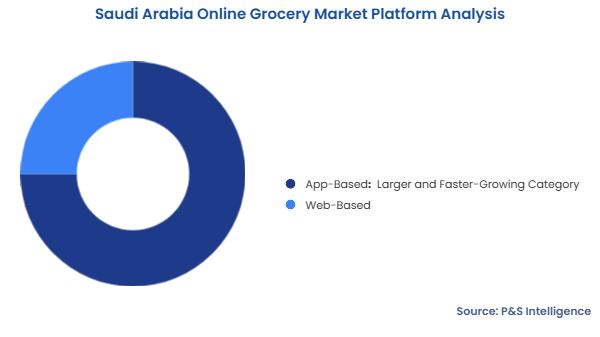
The app-based category holds the largest market share, of 75%, in 2025, and it will have the highest CAGR during the forecast period, aligning with Saudi Arabia's mobile-first digital culture. With mobile phones accounting for 99.4% of internet usage, mobile applications provide the most accessible and convenient shopping channel for Saudi consumers.
The platforms analyzed in this report are:
App-Based (Larger and Faster-Growing Category)
Web-Based
Delivery Speed Analysis
The quick commerce category holds the largest market share, of 60%, in 2025, reflecting strong consumer preference for ultra-fast delivery services within 10-30 minutes. Saudi Arabia's dense urban population and well-developed road infrastructure in major cities support the economic viability of instant delivery models. Platforms achieve this speed through strategic dark store placements and advanced route optimization technologies.
The same-day delivery category will have the highest CAGR, of 18.%, driven by suburban expansion and improved logistics capabilities in secondary cities. This segment serves areas where instant delivery infrastructure remains under development, but consumers still demand same-day convenience. Growing partnerships between logistics providers and regional supermarkets are further enhancing coverage and delivery reliability across emerging urban zones.
The delivery speeds analyzed in this report are:
Quick Commerce (Largest Category)
Same-Day Delivery (Fastest-Growing Category)
Next-Day Delivery
Scheduled Delivery
Delivery Model Analysis
The marketplace aggregators category holds the largest market share, of 55%, in 2025. This model's success stems from its ability to offer extensive product variety by connecting multiple retailers and suppliers through a single platform, providing consumers with a comprehensive grocery selection without requiring platforms to maintain extensive inventory investments. Marketplace aggregators benefit from lower operational costs, faster market entry capabilities, and reduced inventory risk while generating revenue through commission fees and advertising.
The hybrid models category will have the highest CAGR, of 18.3%. This rapid expansion reflects platforms' strategic evolution toward combining marketplace functionality with direct inventory management for high-demand categories. Hybrid models enable platforms to ensure quality control and faster delivery for popular items while maintaining marketplace breadth for specialty products.
The delivery models analyzed in this report are:
Marketplace Aggregators (Largest Category)
Hybrid Models (Fastest-Growing Category)
Direct-to-Consumer (D2C)
Others
Payment Method Analysis
The digital wallets category holds the largest market share, of 45%, in 2025, reflecting Saudi Arabia's aggressive push toward digital payment adoption under Vision 2030. This dominance is supported by the kingdom's remarkable achievement of reaching 70% non-cash transactions two years ahead of the 2025 target, with mobile wallet transactions increasing by 45% year-over-year in 2024. Popular digital wallets like STC Pay, which has grown to over 8 million users as of 2024; and integrated solutions like Apple Pay and Samsung Pay provide seamless checkout experiences for grocery shoppers.
The BNPL category will have the highest CAGR, 18.2%, driven by increasing consumer adoption of flexible payment options for grocery purchases. This segment particularly appeals to younger demographics and households managing monthly budgets, allowing them to spread grocery costs across multiple payments while maintaining purchasing power. The digital payment revolution is further evidenced by MADA card e-commerce sales surging 73.4% year-over-year to reach SAR 27.55 billion in March 2025.
The payment methods analyzed in this report are:
Digital Wallets (Largest Category)
Buy Now, Pay Later (BNPL) (Fastest-Growing Category)
Credit/Debit Cards
Cash on Delivery (COD)
Drive strategic growth with comprehensive market analysis
Saudi Arabia Online Grocery Market Regional Outlook
Al-Riyadh Market Size
Al-Riyadh holds the largest market share, of 40%, in 2025. The capital's lead stems from its massive population base, high concentration of dual-income households, and superior digital infrastructure development. The city benefits from internet penetration of 99.7%, among the highest in the kingdom, supporting widespread digital adoption. Major platforms have established their headquarters and primary distribution centers in Riyadh, creating operational efficiencies that translate to faster delivery times and broader product selection for consumers.
Riyadh’s smart city initiatives under Vision 2030, including the expansion of the Riyadh Metro and integrated logistics hubs, have further strengthened its e-commerce and grocery delivery ecosystem. Additionally, major players, such as Nana, HungerStation, and Jahez, are expanding warehouse automation and AI-driven delivery scheduling in the city to enhance operational efficiency.
Eastern Province Market Size
Eastern Province will have the highest CAGR, of 18.1%, driven by its strong petrochemical industry, which leads to a developed economy with rising disposable incomes. Major cities, including Dammam, Khobar, and Dhahran, demonstrate strong demand for premium grocery categories and subscription-based delivery services. The Eastern Province's economic prosperity, anchored by oil and petrochemical revenues, enables higher average order values and willingness to pay premium delivery fees. This province benefits from strategic proximity to Dammam Port and King Fahd International Airport, facilitating seamless logistics and supplier integration for grocery platforms. Growing digital wallet adoption and higher spending capacity among consumers in Dhahran and Khobar are accelerating platform usage frequency.
The provinces of the market are as follows:
Al-Riyadh (Largest Province)
Eastern Province (Fastest-Growing Province)
Makkah
Madinah
Qassim
Asir
Tabuk
Ha'il
Northern Borders
Jazan
Najran
Al-Baha
Al-Jouf
Saudi Arabia Online Grocery Market Share
The market is semi-consolidated with no single player dominating more than 30% market share. The competitive landscape includes established local players, international entrants, and specialized grocery-focused platforms, each employing distinct strategies to capture market segments. The market's fragmented nature stems from diverse consumer preferences across product categories, delivery speeds, and geographic regions. While some platforms excel in instant delivery of packaged foods, others focus on fresh produce or subscription-based models. Key competitive strategies focus on dark store network expansion, AI-driven inventory management, and strategic partnerships with local retailers. The competitive environment continues evolving rapidly, with price wars, rising marketing expenditures, and shrinking profit margins characterizing the current landscape.
Key Saudi Arabia Online Grocery Companies:
Nana
HungerStation
Danube
BinDawood
Panda
Carrefour
LuLu Hypermarket
Tamimi Markets
Noon
Amazon.sa
Careem Quik
Al Othaim Markets
Rabbit
Keeta
Jahez
Saudi Arabia Online Grocery Market News
In October 2025, Amazon.com Inc. announced that people in certain areas of Saudi Arabia can now access a wide range of grocery and daily products from Al-Othaim Markets. Initially launched in Riyadh and Jeddah, the service provides customers with thousands of new grocery items and essential household products, supplementing those already offered on Amazon.sa. This initiative merges the extensive retail network and competitive pricing of Al-Othaim Markets with Amazon's advanced delivery system, allowing for same-day delivery of fresh groceries directly to the homes of customers.
In April 2025, Rabbit, an Egyptian hyperlocal e-commerce firm, eclared its entry into the Saudi Arabian market, aiming to deliver 20 million items across all major cities by 2026. The company has set up its regional headquarters in Riyadh, supported by an expanding Saudi workforce, and its operations are currently active through a network of 'dark stores' (fulfillment centers) in essential neighborhoods throughout the city.
In December 2024, Meituan's Xiaoxiang Supermarket officially initiated its international expansion, commencing with Saudi Arabia.
In September 2024, Meituan launched its Keeta app in Saudi Arabia, starting in Al-Kharj with expansion plans to Riyadh, marking the Chinese company's international expansion strategy.
In January 2024, HungerStation became the first domestic company to launch food delivery services in Neom, utilizing electric and hybrid vehicles to align with the city's zero-carbon objectives.
Want a report tailored exactly to your business need?
Leading companies across industries trust us to deliver data-driven insights and innovative solutions for their most critical decisions. From data-driven strategies to actionable insights, we empower the decision-makers who shape industries and define the future. From Fortune 500 companies to innovative startups, we are proud to partner with organisations that drive progress in their industries.
Client Testimonials
Working with P&S Intelligence and their team was an absolute pleasure – their awareness of timelines and commitment to value greatly contributed to our project's success. Eagerly anticipating future collaborations.
McKinsey & Company
India
Unmatched Standards
Our insights into the minutest levels of the markets, including the latest trends and competitive landscape, give you all the answers you need to take your business to new heights
Complete Data Security
We take a cautious approach to protecting your personal and confidential information. Trust is the strongest bond that connects us and our clients, and trust we build by complying with all international and domestic data protection and privacy laws