Saudi Arabia Nuclear Power Equipment Market Size & Opportunities Analysis - Growth Strategies, Competitiveness, and Forecasts (2026 - 2032)
This Report Provides In-Depth Analysis of the Saudi Arabia Nuclear Power Equipment Market Report Prepared by P&S Intelligence, Segmented by Equipment Type (Nuclear Island Equipment, Balance of Plant), Type (Nuclear Power Plants, Small Modular Reactors), Capacity (Large (>1000 MW), Medium (500-1000 MW), Small (<500 MW)), End User (Power Generation, Water Desalination, Industrial Process Heat Applications, Research & Development), and Geographical Outlook for the Period of 2021 to 2032
Saudi Arabia Nuclear Power Equipment Market Growth Potential
Key Highlights
Study Period
2021 - 2032
Market Size in 2025
USD 380.0 Million
Market Size in 2026
USD 386.8 Million
Market Size by 2032
USD 453.9 Million
Projected CAGR
2.6%
Largest Province
Eastern Province
Fastest-Growing Province
Al-Riyadh
Market Structure
Semi-Consolidated
Market Size
Explore the market potential with our data-driven report
Saudi Arabia Nuclear Power Equipment Market Outlook
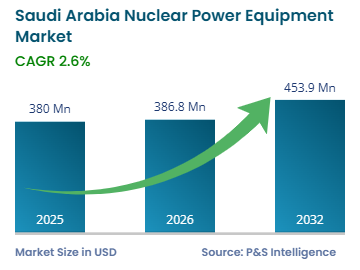
The Saudi Arabian nuclear power equipment market size will be an estimated USD 380.0 million for 2025, and it will grow by 2.6% during 2026–2032, to reach USD 453.9 million by 2032.
The market growth is primarily driven by the Kingdom's ambitious Vision 2030 energy diversification strategy, escalating electricity demand, and the government's commitment to achieving net-zero emissions by 2060 while developing peaceful nuclear energy capabilities for both power generation and water desalination applications. The Kingdom is advancing its National Atomic Energy Project, establishing Duwayhin Nuclear Energy Company (DNEC) as the designated owner–operator for its first nuclear power plant and completing the IAEA Management Systems Advisory Service mission in May 2025.
According to the International Atomic Energy Agency, Saudi Arabia is following the IAEA Milestones Approach for nuclear infrastructure development, systematically building institutional capabilities, regulatory frameworks, and technical expertise required for safe and sustainable nuclear power deployment. The market's expansion is further accelerated by strategic international partnerships, including the ongoing negotiations for a civil nuclear cooperation framework with the United States and collaborations with South Korea on SMART reactor technology.
Saudi Arabia Nuclear Power Equipment Market Growth Factors
Small Modular Reactor Technology Is Key Trend
The adoption of small modular reactors represents a paradigm shift in Saudi Arabia's nuclear strategy, offering enhanced flexibility, reduced capital requirements, and accelerated deployment timelines compared to conventional large-scale reactors.
Saudi Arabia is collaborating with South Korea on the SMART reactor program, a 330-MWt pressurized water reactor specifically designed for electricity generation and desalination applications.
The Kingdom's interest in SMRs aligns with global trends, as these reactors can be deployed incrementally, starting with a single unit and adding modules as demand grows, reducing financial risks and enabling faster returns on investment.
SMR technology offers particular advantages for Saudi Arabia's diverse energy needs, including the ability to provide process heat for industrial applications, support water desalination in remote locations, and integrate with renewable energy systems for grid stability.
The modular construction approach, factory fabrication, and standardized designs of SMRs can significantly reduce construction timelines compared to conventional large reactors, accelerating Saudi Arabia’s nuclear program implementation while maintaining stringent safety standards.
Rising Electricity Demand and Industrial Expansion Are Biggest Drivers
The exponential growth in Saudi Arabia's electricity consumption is creating an urgent need for baseload power generation capacity that nuclear energy can efficiently provide.
Saudi electricity consumption was about 340,430 GWh in 2024, rising by 4.1% from 327,000 GWh in 2023.
Transmitted power also rose by around 5.7% in 2024.
The number of electricity subscribers in KSA increased from 7.62 million in 2014 to 11.34 million in 2024.
According to the Saudi General Authority for Statistics, industrial production expanded by 6.5% year-on-year in July 2025, with manufacturing output rising by 7%, driven by strong gains in petrochemicals and refined products.
This industrial expansion, coupled with rapid urbanization and population growth from 4 million in 1960 to over 35 million in 2024, is straining the existing power infrastructure and necessitating substantial capacity additions through nuclear power deployment.
The Kingdom's manufacturing sector, valued at approximately USD 90 billion in 2024, requires a reliable and cost-competitive electricity supply that nuclear power can provide without the carbon emissions associated with fossil fuels.
The government's target to triple the industrial sector's GDP contribution to SAR 895 billion by 2030, create 2.1 million jobs, and boost industrial exports to SAR 557 billion further underscores the critical role of nuclear power in providing stable, affordable electricity for industrial competitiveness.
Commercial sector electricity use grew ~29.2% from 2021 to 2024, while industrial use rose ~8.1% in the same period.
Saudi Arabia Nuclear Power Equipment Market Segmentation Analysis
Equipment Type Analysis
The nuclear island equipment category holds the largest market share, of 60%, in 2025, driven by the critical importance of reactor core components in establishing Saudi Arabia's nuclear infrastructure and the high capital investment required for reactor pressure vessels, steam generators, and control systems. The segment benefits from Saudi Arabia's focus on proven reactor technologies, particularly pressurized water reactor designs that require sophisticated nuclear island components engineered to withstand extreme temperatures, pressures, and radiation levels over 60-year operational lifespans.
The balance of plant category will have the highest CAGR, driven by the Kingdom's emphasis on localizing manufacturing capabilities for auxiliary systems and the lower technological barriers for domestic production compared to nuclear-grade components. The rapid growth in this segment is fueled by opportunities for Saudi companies to participate in supplying cooling systems, turbine-generators, electrical systems, and water treatment equipment, aligning with Vision 2030's local content requirements mandating minimum domestic sourcing in government procurement. The increasing adoption of digital instrumentation and control systems, advanced monitoring technologies, and cybersecurity solutions for nuclear facilities further accelerates demand for sophisticated balance of plant equipment that enhances operational efficiency and safety.
The equipment types analyzed in this report are:
Nuclear Island Equipment (Larger Category)
Reactor Pressure Vessels
Steam Generators
Pressurizers
Control Rod Drive Mechanisms
Reactor Internals
Balance of Plant (Faster-Growing Category)
Cooling Systems
Turbine-Generator Systems
Condensers & Heat Exchangers
Instrumentation & Control Systems
Emergency Core Cooling Systems
Electrical Systems
Water Treatment & Purification Systems
Radiation Monitoring & Safety Equipment
Type Analysis
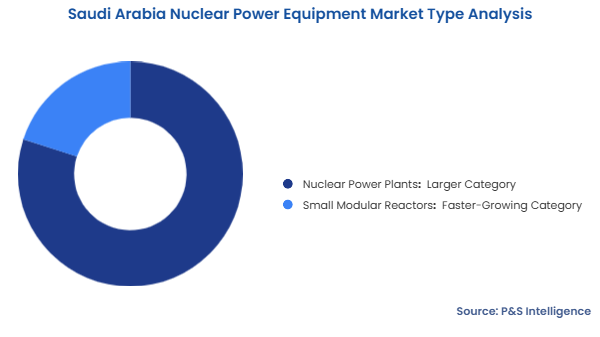
The nuclear power plants category holds the largest market share, of 80%, in 2025, as Saudi Arabia's initial nuclear strategy prioritizes proven, commercially mature reactor designs capable of providing substantial baseload capacity to meet the Kingdom's rapidly growing electricity demand. The preference for large-scale reactors reflects their established operational track record, with over 440 commercial reactors operating worldwide providing extensive performance data, proven safety systems, and well-developed supply chains that reduce project risks for newcomer countries and support foreign direct investment (FDI) decision-making.
The small modular reactors category will have the highest CAGR, of 2.9%, driven by their versatility in addressing Saudi Arabia's diverse energy applications, including remote area electrification, industrial process heat, and integration with desalination facilities. The Kingdom's collaboration with South Korea on SMART reactor development and growing interest in molten salt reactor technology for enhanced safety and efficiency positions SMRs as critical components of Saudi Arabia's long-term nuclear strategy, particularly for deployment in industrial clusters and remote regions where grid connection costs for large plants would be prohibitive.
The types analyzed in this report are:
Nuclear Power Plants (Larger Category)
Small Modular Reactors (Faster-Growing Category)
Capacity Analysis
The large category holds the largest market share, of 75%, in 2025, as Saudi Arabia’s nuclear development strategy is primarily oriented toward baseload electricity generation to support large-scale grid demand from urban centers, energy-intensive industries, and desalination infrastructure. Large reactors offer economies of scale, lower levelized cost of electricity over long operating lifetimes, and proven operational reliability, making them the preferred choice for national grid integration and long-term energy security planning.
The small category will have the highest CAGR, driven by growing interest in Small Modular Reactors. These reactors offer lower upfront capital requirements, modular deployment, shorter construction timelines, and enhanced siting flexibility. In Saudi Arabia, SMRs are particularly attractive for remote regions, industrial clusters, desalination plants, and grid-stabilization applications, enabling phased capacity additions aligned with demand growth.
The capacities analyzed in this report are:
Large (above 1000 MW) (Largest Category)
Medium (500–1000 MW)
Small (less than 500 MW) (Fastest-Growing Category)
End User Analysis
The power generation category holds the largest market share, of 65%, in 2025, as electricity production remains the primary application of nuclear energy in Saudi Arabia. Rapid population growth, expanding industrial output, electrification of infrastructure, and rising cooling demand have significantly increased the need for stable, baseload, low-carbon electricity, positioning nuclear power as a strategic alternative to fossil fuel-based generation.
The water desalination category will have the highest CAGR, of 2.8%, during the forecast period, supported by Saudi Arabia’s acute water scarcity and its status as the world’s largest producer of desalinated water. Nuclear-powered desalination offers a cost-efficient, energy-secure, and low-emission solution, particularly for large-scale cogeneration facilities. Increasing investments in dual-purpose nuclear plants designed for simultaneous electricity and freshwater production are accelerating demand for specialized nuclear equipment tailored to desalination integration.
The end users analyzed in this report are:
Power Generation (Largest Category)
Water Desalination (Fastest-Growing Category)
Industrial Process Heat Applications
Research & Development
Drive strategic growth with comprehensive market analysis
Saudi Arabia Nuclear Power Equipment Market Geographical Analysis
Eastern Province Nuclear Power Equipment Market Size
Eastern Province holds the largest market share, of 40%, in 2025, driven by its strategic importance as the Kingdom's industrial heartland hosting major petrochemical complexes, the world's largest oil processing facilities, and proximity to planned nuclear sites near the UAE border. The province's dominance is reinforced by the proposed Khor Duwaihen nuclear plant location, where Saudi Arabia issued requests for information and pre-qualification engagement for two reactors totaling around 2.8 GWe in capacity, leveraging existing industrial infrastructure and skilled workforce from the energy sector.
The concentration of nuclear development in the Eastern Province benefits from established supply chains, port facilities at Dammam and Jubail capable of handling heavy nuclear components, and the presence of Saudi Aramco's technical expertise in mega-project execution. The region's advanced industrial ecosystem, including the Jubail Industrial City, generating over SAR 100 billion annually, provides immediate demand for nuclear power while offering opportunities for localizing equipment manufacturing and maintenance capabilities. The proximity to Gulf Cooperation Council countries, particularly the UAE's successful Barakah nuclear program, facilitates knowledge transfer and regional cooperation in nuclear technology development, positioning the Eastern Province as Saudi Arabia's nuclear energy hub.
Al-Riyadh Nuclear Power Equipment Market Size
Al-Riyadh will have the highest CAGR, of 2.7%, driven by the capital region's rapid urbanization, concentration of government institutions overseeing the nuclear program, and electricity consumption. The establishment of King Abdullah City for Atomic and Renewable Energy (KA-CARE) headquarters in Riyadh centralizes nuclear program management, research activities, and international partnerships, creating a cluster effect for nuclear technology companies and equipment suppliers.
The presence of leading academic institutions, including King Saud University's nuclear engineering programs, creates a talent pipeline for the nuclear sector while research partnerships with international organizations drive technology transfer. The Saudi Nuclear and Radiological Regulatory Commission's establishment in Riyadh in 2018 ensures robust regulatory oversight while facilitating equipment certification and vendor qualification processes essential for market development.
The provinces of the market are as follows:
Al-Riyadh (Fastest-Growing Province)
Eastern Province (Largest Province)
Makkah
Madinah
Qassim
Asir
Tabuk
Ha'il
Northern Borders
Jazan
Najran
Al-Baha
Al-Jouf
Saudi Arabia Nuclear Power Equipment Market Share
The market is semi-consolidated with international technology providers dominating the landscape while local companies increasingly participate through joint ventures and technology transfer agreements aligned with Vision 2030's localization objectives. This consolidation reflects the high technological barriers, stringent safety requirements, and the limited number of qualified vendors capable of delivering complete nuclear power solutions for newcomer countries.
Market dynamics are evolving as Saudi companies position themselves for participation in the nuclear supply chain, with firms like Zamil Industrial, Al-Rashid Trading & Contracting Company, and Advanced Electronics Company developing capabilities in fabrication, construction, and instrumentation relevant to nuclear projects. The establishment of Duwayhin Nuclear Energy Company as the designated nuclear plant owner-operator creates a central procurement entity that will shape competitive dynamics through vendor selection criteria emphasizing technology maturity, safety records, and localization potential. International vendors are responding by forming strategic alliances with Saudi industrial partners, exemplified by potential collaborations between global nuclear firms and Saudi Aramco, SABIC, and Ma'aden for equipment manufacturing and project execution capabilities.
Key Saudi Arabia Nuclear Power Equipment Companies:
Korea Electric Power Corporation
Korea Hydro & Nuclear Power Co., Ltd.
Rosatom State Atomic Energy Corporation
Westinghouse Electric Company LLC
Hyundai Engineering & Construction Co., Ltd.
China National Nuclear Corporation (CNNC)
Framatome
Orano SA
Doosan Enerbility Co., Ltd.
Assystem SA
AtkinsR
Saudi Arabia Nuclear Power Equipment Market News
In November 2025, the United States and Saudi Arabia announced planned signing of a civil nuclear cooperation framework, establishing a foundation for potential U.S. reactor technology exports and strengthening long-term collaboration in peaceful nuclear energy development.
In May 2025, the International Atomic Energy Agency completed its first Management Systems Advisory Service (IMSAS) mission to Saudi Arabia, reviewing Duwayhin Nuclear Energy Company's management systems and providing recommendations for strengthening organizational capabilities as the designated owner-operator for the Kingdom's first nuclear power plant.
In September 2024, the Saudi Nuclear and Radiological Regulatory Commission announced the implementation of the full IAEA Comprehensive Safeguards Agreement, rescinding the Small Quantities Protocol effective December 31, 2024, signaling readiness for commercial nuclear power deployment.
Want a report tailored exactly to your business need?
Leading companies across industries trust us to deliver data-driven insights and innovative solutions for their most critical decisions. From data-driven strategies to actionable insights, we empower the decision-makers who shape industries and define the future. From Fortune 500 companies to innovative startups, we are proud to partner with organisations that drive progress in their industries.
Client Testimonials
Working with P&S Intelligence and their team was an absolute pleasure – their awareness of timelines and commitment to value greatly contributed to our project's success. Eagerly anticipating future collaborations.
McKinsey & Company
India
Unmatched Standards
Our insights into the minutest levels of the markets, including the latest trends and competitive landscape, give you all the answers you need to take your business to new heights
Complete Data Security
We take a cautious approach to protecting your personal and confidential information. Trust is the strongest bond that connects us and our clients, and trust we build by complying with all international and domestic data protection and privacy laws