Key Highlights
| Study Period | 2020 - 2032 |
| Market Size in 2025 | USD 1901.0 Million |
| Market Size in 2026 | USD 2025.3 Million |
| Market Size by 2032 | USD 2967.0 Million |
| Projected CAGR | 6.6% |
| Largest | NA |
| Fastest-Growing | NA |
| Market Structure | Fragmented |

| Study Period | 2020 - 2032 |
| Market Size in 2025 | USD 1901.0 Million |
| Market Size in 2026 | USD 2025.3 Million |
| Market Size by 2032 | USD 2967.0 Million |
| Projected CAGR | 6.6% |
| Largest | NA |
| Fastest-Growing | NA |
| Market Structure | Fragmented |
Explore the market potential with our data-driven report
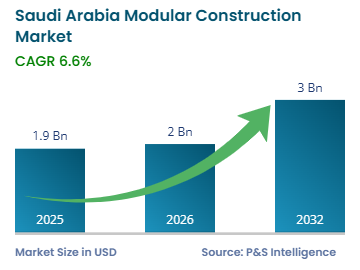
The Saudi Arabia modular construction market size was USD 1901.0 million for 2025, and it will grow by 6.6% during 2026–2032, to reach USD 2967.0 million by 2032.
The market growth is primarily driven by the government's ambitious Vision 2030 initiatives, accelerating demand for rapid construction solutions across megaprojects, and the increasing adoption of sustainable building practices aligned with the Kingdom's environmental goals. According to the Saudi Vision 2030 Housing Program Annual Report 2024, the homeownership rate among Saudi families reached 65.4% by the end of 2024, progressing toward the Kingdom's target of 70% by 2030, creating strong demand for faster and more efficient residential construction solutions.
The Kingdom's focus on large-scale urban developments, including NEOM, Qiddiya, and The Red Sea Project, is accelerating the adoption of prefabricated and modular building systems that offer faster project delivery, improved quality control, and reduced environmental impact compared to traditional on-site construction methods. The surge in infrastructure investment under Vision 2030 is transforming Saudi Arabia's construction landscape. Modular construction enables faster project execution while maintaining high quality standards, making it particularly attractive for the Kingdom's ambitious development pipeline, especially for projects associated with Expo 2030 and the FIFA World Cup 2034.
A structural shift toward off-site and industrialized construction is redefining how projects are planned and executed across the Kingdom. The growing emphasis on faster project delivery, improved construction quality, greater cost efficiency, and digitalization under Vision 2030 is accelerating this transition, making off-site and industrialized construction a defining trend in the Kingdom's construction sector. Government entities and developers are increasingly encouraging the adoption of modular construction and Building Information Modeling to improve project efficiency, quality, and delivery across major developments. Saudi Arabia's National Industrial Development and Logistics Program continues to strengthen domestic manufacturing capabilities by encouraging advanced manufacturing technologies and local production, creating a favorable environment for factory-based modular construction. This transition is further supported by private-sector investment in manufacturing infrastructure, including AMANA Group's opening of a modular construction factory in Rabigh through DuBox in March 2023 to expand off-site manufacturing capacity and strengthen the Kingdom's industrialized construction ecosystem.
During 2024, more than 122,000 families benefited from housing support under the Saudi Vision 2030 Housing Program. Over 49,000 contracts were signed for ready-built housing units and more than 27,000 off-plan housing sales contracts were recorded, indicating sustained residential construction activity and demand for faster, standardized building solutions. This shift toward manufacturing-led delivery is driving investment in automated production lines and digital quality-control systems as contractors expand factory-based manufacturing capabilities for repeatable building types in climate-controlled environments that reduce weather-related disruptions while enhancing construction quality and productivity. As standardized component libraries and digital construction technologies continue to advance, the adoption of industrialized construction methods is expected to accelerate across Saudi Arabia.
The Kingdom's parallel execution of multiple giga-projects is increasing demand for faster and more efficient construction delivery, positioning modular construction as a preferred building approach. As project completion timelines become increasingly important for Vision 2030 developments, developers are adopting modular construction to accelerate project delivery, improve project predictability, and deliver standardized buildings more efficiently than conventional on-site construction methods. According to the Saudi Vision 2030 Annual Report 2024, 85% of the Kingdom's 1,502 active Vision 2030 initiatives were either completed or on track, reflecting the sustained pace of development across strategic sectors and reinforcing the need for efficient construction methods. With large-scale housing, hospitality, healthcare, education, and infrastructure developments progressing under Vision 2030, developers are increasingly shifting construction activities to controlled factory environments where standardized and parallelized production enhances project efficiency, quality, and schedule certainty. For example, in June 2023, NEOM awarded more than SAR 21 billion in contracts to develop workforce residential communities using relocatable modular units for up to 95,000 residents, demonstrating the growing preference for modular construction to support large-scale project delivery.
A peer-reviewed study published in Frontiers in Sustainable Cities (2024) found that the adoption of Modern Methods of Construction (MMC) in Saudi Arabia improves construction productivity and quality while reducing project costs and delivery time, supporting the growing adoption of industrialized construction techniques. The continued expansion of giga-projects, combined with increasing investment in factory-based manufacturing and digital construction technologies, is expected to accelerate modular construction adoption across the Kingdom.
Despite market momentum, logistical complexity remains a key restraint on modular construction deployment across Saudi Arabia. Transporting large volumetric modules requires specialized heavy-haul transportation, route planning, and regulatory approvals, while the size and weight of prefabricated components increase handling complexity and transportation costs, particularly for remote giga-project locations situated far from manufacturing facilities. These additional transportation and logistics requirements can increase overall project costs and reduce some of the time-efficiency advantages associated with modular construction, making adoption less attractive for certain projects. Installation and on-site coordination also require precise alignment with foundation, structural, and utility works to ensure efficient module assembly and project execution, increasing planning requirements for developers and contractors.
Although Saudi Arabia continues to strengthen its logistics infrastructure through initiatives such as the National Transport and Logistics Strategy, transportation and site coordination remain important considerations for modular construction projects, with expanding regional manufacturing capacity and continued logistics investments expected to improve deployment efficiency over the forecast period.
Saudi Arabia's tourism transformation is creating growth opportunities for modular construction across hospitality, residential, and institutional buildings. The Kingdom is targeting 150 million annual visitors by 2030, driving expansion of hotels, resorts, worker accommodation, educational facilities, and healthcare infrastructure. Saudi Arabia welcomed nearly 116 million domestic and international tourists in 2024, sustaining growth in infrastructure demand. Modular construction is well suited to these standardized, high-volume building types, including luxury hospitality developments along the Red Sea coast. The approach enables developers to accelerate project delivery while maintaining consistent quality and efficiency. This enables modular construction providers to expand their presence across multiple high-growth end-use sectors, creating long-term opportunities for manufacturing capacity expansion, product standardization, and technology adoption throughout the Kingdom.
As hospitality, housing, and institutional construction pipelines continue to expand in preparation for Vision 2030 initiatives, Expo 2030, and the FIFA World Cup 2034, modular construction providers are expected to benefit from sustained opportunities across multiple end-use sectors.
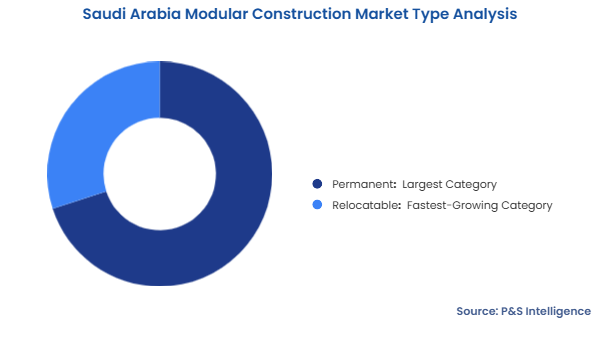
The standalone/prefabricated units category holds the largest market share, of 65%, in 2025, driven by their extensive use for worker accommodation camps, site offices, schools, and single-building deployments across giga-project construction phases, with their dominance stemming from lower per-unit cost, rapid deployment, and suitability for the temporary and semi-permanent facilities that megaproject build-out demands at scale. Their versatility across multiple end-use applications and ease of installation continue to make them the preferred choice for projects requiring standardized building deployment.
The volumetric modular construction category will have the highest CAGR, of 7.8%, driven by increasing adoption of factory-built modules for faster, high-quality construction. Growing domestic manufacturing capacity and the adoption of industrialized construction methods are further supporting market growth across residential, commercial, healthcare, and educational projects. The increasing preference for factory-built permanent structures is expected to increase the deployment of volumetric modular systems across large-scale building projects throughout the Kingdom.
The segments analyzed in this report are:
The low-rise and single-storey structures category holds the largest market share, of 65%, in 2025, and it will have the highest CAGR, of 8.7%, driven by the widespread development of villas, townhouses, schools, healthcare centers, and other low-rise community buildings across the Kingdom, where three-dimensional modules integrate efficiently with ground-level foundations and standardized layouts. The Sedra housing development in Riyadh includes a 200,000-square-meter modular manufacturing plant dedicated to producing standardized housing components, supporting the wider adoption of volumetric modular construction for low-rise residential developments across the Kingdom.
According to the Ministry of Municipalities and Housing, Saudi Arabia plans to deliver more than 660,000 new housing units by 2030, creating sustained demand for standardized low-rise construction formats that can be manufactured and assembled efficiently. Developers are increasingly prioritizing repeatable building designs that enable faster factory production, streamlined transportation, and shorter on-site assembly cycles. These advantages make low-rise modular structures the preferred solution for large-scale residential and community developments. This preference supports their continued dominance within volumetric modular construction.
The structure types analyzed in this report are:
The residential category holds the largest market share, of 40%, in 2025, driven by the Kingdom's need to deliver housing units at unprecedented volume and speed. Projects such as ROSHN's Sedra community, comprising approximately 30,000 residential units across 20 million square meters, demonstrate the growing deployment of modular construction to support large-scale residential development in Saudi Arabia. Moreover, Saudi Arabia's Vision 2030 Housing Program continues to promote large-scale residential development, increasing demand for efficient construction methods capable of supporting standardized housing delivery. Three-dimensional modular units are increasingly being adopted for residential developments because they enable faster project execution, consistent construction quality, and greater factory-based production efficiency.
The institutional category will have the highest CAGR, of 8.7%, driven by increasing government investment in healthcare, education, and public infrastructure under Vision 2030. The rapid delivery offered by volumetric modular construction enables schools, hospitals, clinics, and public service facilities to be completed within shorter timelines while maintaining consistent construction quality. In addition, the expansion of healthcare capacity, the establishment of new educational institutions, and the development of public facilities across emerging cities and giga-projects are accelerating the adoption of factory-built modular solutions.
The applications analyzed in this report are:
The multi-storey category holds the largest market share, of 85%, in 2025, and it has the highest CAGR, of 7.2%, driven by the greatest efficiency that prefabricated bathroom and utility pods deliver in multi-storey hospitality, healthcare, and residential towers, where hundreds of repeated, quality-controlled wet-room units can be manufactured off-site and installed across identical floors. This repeatability drives both current dominance and fastest growth, while the Kingdom's dense pipeline of high-rise hotels and mixed-use towers in urban centers favors pod-based standardization to maintain quality consistency and schedule certainty at scale. The increasing construction of multi-storey developments is also encouraging wider adoption of factory-manufactured wet pods, enabling developers to standardize interior fit-outs while improving installation efficiency across large-scale building projects.
The structure types analyzed in this report are:
The residential category holds the largest market share, of 45%, in 2025, as high-volume housing and apartment developments increasingly integrate prefabricated wet cores to accelerate delivery and improve on-site quality control across large residential schemes. The growing adoption of standardized wet pod systems in residential projects is expected to increase the use of factory-manufactured bathroom modules across the Kingdom's expanding housing developments
The commercial category will have the highest CAGR, of 7.3%, driven by heavy deployment across hotels, offices, and retail developments where standardized washroom and service cores are integral to building programs. The scale of the Kingdom's hospitality and commercial pipeline underpins this leadership, while wet pods align with the repeatable floorplate designs typical of these assets. Saudi Arabia's plan to expand its hotel capacity to approximately 500,000 rooms by 2030 is expected to increase demand for standardized, factory-manufactured wet pod solutions across hospitality developments, where wet pods deliver consistent quality, reduce on-site finishing work, and streamline installation. This combination makes commercial buildings the primary application for prefabricated wet pods across Saudi Arabia
The applications analyzed in this report are:
The low-rise/single-storey category holds the largest market share, of 60%, in 2025, driven by widespread use of single-storey camps, cabins, offices, and community facilities across construction sites and remote locations. Their simplicity, transportability, and low cost make them the preferred format for rapid ground-level deployment. Their versatility and ease of deployment continue to support widespread adoption across construction, infrastructure, mining, and remote development projects throughout the Kingdom.
The temporary/relocatable category will have the highest CAGR, of 5.9%, as the Kingdom's simultaneous megaproject construction phases generate sustained demand for redeployable accommodation and facilities that can be dismantled, relocated, and reused across successive project sites. The ability to relocate and reuse these structures across multiple project phases is expected to increase their adoption for temporary project infrastructure and workforce facilities.
The structure types analyzed in this report are:
The residential category holds the largest market share, of 45%, in 2025, and it will have the highest CAGR, of 5.4%, driven by the growing need for deployable housing solutions across workforce accommodation, temporary residential communities, and large-scale development projects throughout the Kingdom. The projected increase in Riyadh's population to approximately 9.6 million by 2030 is expected to increase demand for rapidly deployable residential accommodation and supporting community facilities, creating additional opportunities for standalone and prefabricated housing solutions.
Worker accommodation and residential camps dominate current demand, as giga-projects require housing for large construction workforces delivered quickly and economically. For example, in August 2023, Red Sea International secured a SAR 29.1 million contract to design, manufacture, supply, and install prefabricated modular buildings for a housing project at NEOM, highlighting the increasing adoption of standalone and prefabricated residential solutions across giga-project developments. Their flexibility, ease of installation, and ability to be relocated or expanded make standalone and prefabricated units well suited to a wide range of residential requirements.
The applications analyzed in this report are:
Drive strategic growth with comprehensive market analysis
The Eastern Province holds the largest share in 2025, primarily due to its position as the Kingdom's industrial and energy hub. The province hosts major oil and gas facilities, petrochemical complexes, industrial cities such as Jubail, Dammam, and Ras Al Khair, and large-scale mining and logistics developments that generate continuous demand for modular buildings, worker accommodation, site offices, and industrial support facilities. This strong industrial demand is further reflected in recent investments. In December 2023, Red Sea International signed a SAR 32.23 million four-year contract with Baker Hughes to design, manufacture, supply, and operate modular facilities in the Eastern Province, highlighting the increasing adoption of modular solutions across industrial and energy projects. The concentration of energy, petrochemical, and infrastructure developments continues to encourage the use of prefabricated construction methods that enable faster project execution, reduced on-site labor requirements, and improved quality control, thereby maintaining the province's leading market position.
Al-Riyadh is expected to witness the highest CAGR during the forecast period, driven by the rapid expansion of large-scale urban development and infrastructure projects under Saudi Vision 2030. Mega projects such as New Murabba, Diriyah Gate, Qiddiya, King Salman International Airport, and extensive residential, commercial, healthcare, hospitality, and transportation developments are significantly increasing the demand for modular construction due to its ability to accelerate project delivery while maintaining high construction quality. The province is also strengthening its local manufacturing ecosystem for off-site construction. In February 2025, China Harbour Engineering Company (CHEC) commenced operations of a 200,000-square-meter automated modular and precast manufacturing facility in Riyadh under the ROSHN Sedra project, enhancing domestic production capacity and supporting faster deployment of modular building solutions.
These provinces are covered:
The market is fragmented due to the presence of various specialized players alongside traditional construction companies expanding into modular capabilities. The market structure reflects the technology's maturation, with established prefabrication specialists competing against international modular construction firms entering the Kingdom to capitalize on Vision 2030 opportunities. This fragmentation stems from the diverse application areas of modular construction, from temporary worker accommodation to permanent residential communities and high-specification commercial facilities.
Companies with specialized capabilities in specific segments maintain strong positions, while vertically integrated players with manufacturing facilities, logistics capabilities, and construction expertise are gaining ground in large-scale projects. Strategic activities focus heavily on capacity expansion and technology partnerships. Such collaborations demonstrate how leading players are embedding automation and advanced manufacturing into their operations to achieve cost leadership and schedule advantages.
Want a report tailored exactly to your business need?
Request CustomizationLeading companies across industries trust us to deliver data-driven insights and innovative solutions for their most critical decisions. From data-driven strategies to actionable insights, we empower the decision-makers who shape industries and define the future. From Fortune 500 companies to innovative startups, we are proud to partner with organisations that drive progress in their industries.

Working with P&S Intelligence and their team was an absolute pleasure – their awareness of timelines and commitment to value greatly contributed to our project's success. Eagerly anticipating future collaborations.
McKinsey & Company
India
Our insights into the minutest levels of the markets, including the latest trends and competitive landscape, give you all the answers you need to take your business to new heights

We take a cautious approach to protecting your personal and confidential information. Trust is the strongest bond that connects us and our clients, and trust we build by complying with all international and domestic data protection and privacy laws


Customize the Report to Align with Your Business Objectives

Request the Free Sample Pages