Saudi Arabia Mobility-as-a-Service Market Size & Share Analysis - Emerging Trends, Growth Opportunities, Competitive Landscape, and Forecasts (2026 - 2032)
This Report Provides In-Depth Analysis of the Saudi Arabia Mobility-as-a-Service Market Report Prepared by P&S Intelligence, Segmented by Service Type (Ride Hailing, Ride Sharing, Micromobility, Car Rental, Shuttle Service), Vehicle Type (Two-Wheeler, Car, Bus), Payment Type (Short-Term Subscription, Pay-as-You-Go), Commuting Pattern (Daily Commuting, Last-Mile Connectivity, Occasional Commuting), End User (Personal, Business), Propulsion Type (Electric, ICE), and Geographical Outlook for the Period of 2019 to 2032
Saudi Arabia Mobility-as-a-Service Market Growth Potential
Key Highlights
Study Period
2019 - 2032
Market Size in 2025
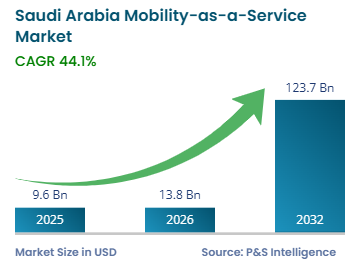
USD 9.6 Billion
Market Size in 2026
USD 13.8 Billion
Market Size by 2032
USD 123.7 Billion
Projected CAGR
44.1%
Largest Province
Al-Riyadh
Fastest-Growing Province
Makkah
Market Structure
Fragmented
Market Size
Explore the market potential with our data-driven report
Saudi Arabia Mobility-as-a-Service Market Outlook
The Saudi Arabian mobility-as-a-service market size will be an estimated USD 9.6 billion for 2025, and it will grow by 44.1% during 2026–2032, to reach USD 123.7 billion by 2032.
The market expansion is driven by rapid urbanization, increasing smartphone penetration, implementation of supportive government initiatives under Vision 2030, rising demand for sustainable transportation, advancements in digital infrastructure, and growing consumer preference for convenient, cost-effective, and integrated mobility solutions.
The government's Vision 2030 initiative, aimed at diversifying the economy and reducing reliance on oil, serves as a significant catalyst for innovation in the transportation sector. By August or May 2025, Saudi Arabia solidified its position as the largest digital economy across the MENA region by exceeding a value of SAR 495 billion. The kingdom targets to reduce carbon emissions by 278 Mtpa by 2030, driving the integration of eco-friendly transportation options into MaaS platforms. The ambitious infrastructure development projects, including NEOM and The Line, demonstrate the kingdom's commitment to smart mobility solutions.
Saudi Arabia Mobility-as-a-Service Market Dynamics
Environmental Sustainability Focus and Electric Vehicle Integration Are Key Trends
Environmental sustainability has become a critical focus within Saudi Arabia's MaaS ecosystem, reflecting the kingdom's commitment to reducing carbon emissions and fostering a greener future.
The integration of electric vehicles, e-scooters, and hybrid buses into MaaS platforms is gaining momentum through government policies, including investments in clean energy and EV infrastructure development.
Companies offering electric ride-hailing fleets, carbon footprint tracking for trips, and incentives for users choosing greener travel options are becoming more prevalent.
For instance, platforms such as TIER Mobility and Bird have launched e-scooter pilots in Riyadh and Jeddah, promoting sustainable, low-emission transport.
EVIQ, a PIF–SEC joint venture, plans to install 5,000+ fast chargers across 1,000+ locations by 2030 to boost EV adoption nationwide.
According to recent market analyses, fleet electrification in Saudi Arabia is accelerating across both passenger and goods transport.
Although EVs currently account for just over 1% of total vehicle sales, corporate fleet customers are projected to add about 50,000 electric vehicles by 2025.
Meanwhile, the ride-hailing market completed approximately 39 million trips in Q3 2025—a 78% year-on-year surge—highlighting the rapid expansion of shared mobility platforms that are increasingly integrating electric and hybrid vehicles.
Rapid Urbanization and Digital Infrastructure Development Are Biggest Drivers
Saudi Arabia's accelerating urbanization is creating unprecedented demand for integrated mobility solutions.
Major cities like Riyadh, Jeddah, and Dammam are experiencing rapid population growth, with millions migrating to urban areas for employment opportunities.
The Riyadh Metro project, spanning 176 km across six lines, represents one of the largest public transportation initiatives globally and demonstrates the kingdom's progress in developing effective public transport systems.
Saudi Arabia achieved 79% non-cash retail transactions in 2024, surpassing its Vision 2030 target and reflecting strong digital payment adoption.
The kingdom has achieved 5G coverage nearly double the global average, creating a robust digital backbone for connected mobility and data-driven transport systems.
The government’s National Transport and Logistics Strategy (NTLS) aims to position Saudi Arabia as a global logistics hub, integrating advanced mobility technologies across urban centers.
The increasing adoption of smart traffic management systems and AI-driven route optimization in major cities is improving efficiency and reducing congestion.
The rapid growth in mobile and digital app usage, with over 33 million smartphone users in 2024, is supporting high adoption of ride-hailing, car-sharing, and e-scooter services.
The expansion of smart city projects, such as NEOM, The Line, and Qiddiya, is further boosting demand for intelligent, connected transport solutions across the country.
Saudi Arabia Mobility-as-a-Service Market Segmentation Analysis
Service Type Analysis
The ride-hailing category holds the largest market share, of 60%, in 2025, driven by the widespread adoption of platforms like Uber and Careem, which have become integral to daily transportation in major Saudi cities. The category's dominance is supported by high smartphone penetration, government regulatory support, and the convenience offered by app-based booking systems.
The micromobility category will have the highest CAGR, of 44.3%, driven by government initiatives promoting sustainable transportation and last-mile connectivity solutions. The segment benefits from Madinah's completion of 70 km of bicycle paths in 2024 as part of its Humanization of the City program, with plans to reach 220 km of bike lanes by 2025.
The service types analyzed in this report are:
Ride Hailing (Largest Category)
Ride Sharing
Micromobility (Fastest-Growing Category)
Car Rental
Shuttle Service
Vehicle Type Analysis
The car category holds the largest market share, of 75%, in 2025, reflecting consumer preference for comfort and safety in ride-hailing services. The segment's leadership is supported by the widespread availability of car-based services from major operators and the cultural preference for private vehicle-like experiences. The expanding fleet of electric and hybrid vehicles within this category aligns with Vision 2030's sustainability goals.
The two-wheeler category will have the highest CAGR, of 44.4%, driven by increasing adoption of e-scooters and electric bikes for short-distance travel and last-mile connectivity. Supported by Vision 2030’s sustainability goals, rapid urbanization, and smart city initiatives, two-wheelers are becoming a key component of Saudi Arabia’s evolving urban mobility landscape.
The vehicle types analyzed in this report are:
Two-Wheeler (Fastest-Growing Category)
Car (Largest Category)
Bus
Payment Type Analysis
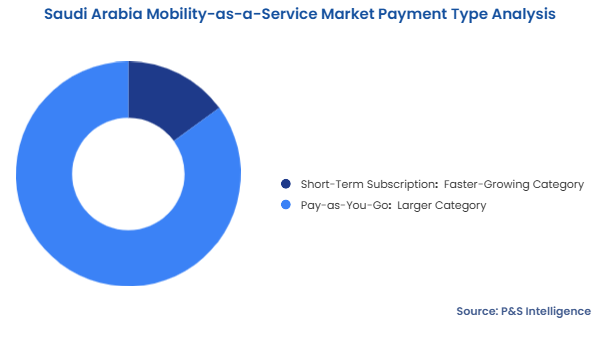
The pay-as-you-go category holds the larger market share, of 85%, in 2025, driven by consumer preference for flexible payment options without long-term commitments. This model's popularity is driven by the occasional nature of MaaS usage patterns and the desire for cost transparency among Saudi consumers.
The short-term subscription category will have the higher CAGR during the forecast period, driven by frequent commuters seeking cost-effective solutions for regular travel patterns. The growing adoption of subscription models is supported by improved digital payment infrastructure and consumer familiarity with subscription-based services across various sectors.
The payment types analyzed in this report are:
Short-Term Subscription (Faster-Growing Category)
Pay-as-You-Go (Larger Category)
Commuting Pattern Analysis
The daily commuting category holds the largest market share, in 2025, driven by employees traveling to and from work, students attending educational institutions, and regular errands. The Riyadh Metro's capacity to eliminate 250,000 daily car trips and save 400,000 liters of fuel daily demonstrates the significant demand for daily commuting solutions.
The last-mile connectivity category will have the highest CAGR during the forecast period due to the increasing adoption of micromobility solutions that enhance accessibility and convenience for commuters. The segment addresses the gap between public transportation terminals and final destinations. Micromobility solutions, including e-scooters and bike-sharing, are specifically designed to solve last-mile challenges. The Riyadh Metro's integration with bus services and micromobility options exemplifies coordinated last-mile solutions.
The commuting patterns analyzed in this report are:
Daily Commuting (Largest Category)
Last-Mile Connectivity (Fastest-Growing Category)
Occasional Commuting
End User Analysis
The personal category holds the larger market share, of 70%, in 2025, and it will have the higher CAGR during the forecast period, driven by individual consumers seeking flexible, on-demand transportation for personal trips, leisure activities, shopping, and social engagements. The segment has grown significantly following the 2018 lifting of the female driving ban, which expanded the consumer base substantially.
The end users analyzed in this report are:
Personal (Larger and Faster-Growing Category)
Business
Propulsion Type Analysis
The ICE category holds the largest market share, of 90%, in 2025, as it comprises the vast majority of ride-hailing, car rental, and personal vehicle fleets. ICE vehicles benefit from established infrastructure, low fuel costs due to domestic oil production, extensive service networks, and consumer familiarity. However, the segment's market share is expected to decline gradually as EV adoption accelerates under Vision 2030 initiatives.
The electric category will have the highest CAGR, of 44.5%, driven by Saudi Arabia’s Vision 2030 objectives to promote sustainable and smart mobility. The government’s focus on reducing carbon emissions, expanding EV charging infrastructure, and offering incentives for electric vehicle adoption is accelerating growth. Moreover, rising fuel costs, increasing environmental awareness, and collaborations between global EV manufacturers and local mobility service providers are encouraging the integration of electric vehicles into MaaS fleets, propelling the segment’s rapid expansion.
The propulsion types analyzed in this report are:
Electric (Faster-Growing Category)
ICE (Larger Category)
Drive strategic growth with comprehensive market analysis
Saudi Arabia Mobility-as-a-Service Market Geographical Analysis
Al-Riyadh Market Size
Al-Riyadh holds the largest market share, of 45%, in 2025, driven by its status as the capital and largest urban center. The province's leadership is supported by the massive Riyadh Metro project, extensive smartphone penetration, and the concentration of government and business activities. The King Abdulaziz Project, launched in 2024, plans to connect six metro lines, 85 metro stations, 80 bus routes, and 2,860 bus stops, creating a comprehensive integrated transportation network.
The province benefits from the highest concentration of ride-hailing services, with Uber and Careem maintaining a strong market presence. Government initiatives target 30% of vehicles in Riyadh to be electrified by 2030, supporting the integration of electric vehicles into MaaS platforms. The concentration of young, tech-savvy professionals in Riyadh drives higher adoption rates of digital mobility solutions compared to other regions.
Makkah Market Size
Makkah will have the highest CAGR, of 44.2%, driven by religious tourism and the continuous flow of pilgrims requiring efficient transportation solutions. The province's unique position as the destination for Hajj and Umrah creates consistent demand for integrated mobility services that can handle both resident and visitor transportation needs. The integration of MaaS solutions with tourism services creates opportunities for specialized offerings that combine transportation with religious and cultural experiences. The province's focus on sustainable transportation aligns with Vision 2030's environmental goals and the kingdom's commitment to responsible tourism development.
The provinces of the market are as follows:
Al-Riyadh (Largest Province)
Eastern Province
Makkah (Fastest-Growing Province)
Madinah
Qassim
Asir
Tabuk
Ha’il
Northern Borders
Jazan
Najran
Al-Baha
Al-Jouf
Saudi Arabia Mobility-as-a-Service Market Share
The market is fragmented with a diverse mix of international platforms, regional operators, and emerging local startups competing across various mobility service segments. The coexistence of ride-hailing, car-sharing, micromobility, and shuttle services has encouraged the entry of multiple niche providers. Varying regional demand patterns, evolving regulatory frameworks, and differing levels of digital infrastructure across provinces further contribute to the fragmented nature of the market. Moreover, ongoing innovation and new business models continue to attract specialized entrants.
Key Saudi Arabia Mobility-as-a-Service Companies:
Careem Networks FZ-LLC
Uber Technologies, Inc.
Jeeny Mobility Services Company
ekar Saudi Limited Branch
Swvl Holdings Corp.
Saferoad Information Technology Co. Ltd.
Telgani Car Rental Aggregator Company
Electromin Solutions Company
Gazal Mobility Company
Spiders Mobility Services Company
Capital Metro Company
WeRide Inc.
Saudi Arabia Mobility-as-a-Service Market News
In July 2025, Saudi Arabia’s Transport General Authority (TGA) launched a pilot program for autonomous delivery vehicles in Riyadh. This marks a significant step toward the kingdom’s Vision 2030 goal of developing a smart mobility ecosystem. The initiative tests self-driving vehicles on public roads, advancing smart and sustainable mobility.
In July 2025, WeRide Inc. and Uber Technologies, Inc. launched their Robotaxi pilot program in Riyadh.
In March 2025, Electric Vehicle Infrastructure Company (EVIQ) launched a highway EV charging station at SASCO Aljazeera. This enhances EV infrastructure and enables broader integration of electric mobility services into MaaS platforms.
Want a report tailored exactly to your business need?
Leading companies across industries trust us to deliver data-driven insights and innovative solutions for their most critical decisions. From data-driven strategies to actionable insights, we empower the decision-makers who shape industries and define the future. From Fortune 500 companies to innovative startups, we are proud to partner with organisations that drive progress in their industries.
Client Testimonials
Working with P&S Intelligence and their team was an absolute pleasure – their awareness of timelines and commitment to value greatly contributed to our project's success. Eagerly anticipating future collaborations.
McKinsey & Company
India
Unmatched Standards
Our insights into the minutest levels of the markets, including the latest trends and competitive landscape, give you all the answers you need to take your business to new heights
Complete Data Security
We take a cautious approach to protecting your personal and confidential information. Trust is the strongest bond that connects us and our clients, and trust we build by complying with all international and domestic data protection and privacy laws