Saudi Arabia Medical Devices Market Size & Opportunities Analysis - Growth Strategies, Competitiveness, and Forecasts (2026 - 2032)
This Report Provides In-Depth Analysis of the Saudi Arabia Medical Devices Market Report Prepared by P&S Intelligence, Segmented by Product Type (Diagnostic Devices, Therapeutic Devices, Surgical Devices, Monitoring Devices, Drug Delivery Devices), Clinical Subspecialty (Cardiology, Orthopedics, Neurology, Ophthalmology, Gynecology & Obstetrics, Gastroenterology, Resipratory Care, Wound Management, Dermatology & Aesthetics), End User (Hospitals & Ambulatory Surgical Centers (ASCs), Clinics, Home Healthcare Settings, Diagnostic Laboratories), Distribution Channel (Direct Tender/Institutional Sales, Retail Sales, E-commerce), and Geographical Outlook for the Period of 2019 to 2032
Explore the market potential with our data-driven report
Saudi Arabia Medical Devices Market Future Outlook
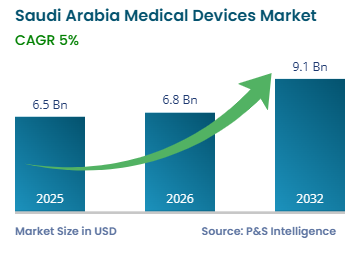
The Saudi Arabian medical devices market size will be an estimated USD 6.5 billion for 2025, and it will grow by 5.0% during 2026–2032, to reach USD 9.1 billion by 2032.
The market growth is primarily driven by the increasing prevalence of chronic diseases, substantial government healthcare investments under Vision 2030, and the rising demand for advanced medical technologies across the Kingdom.
The Saudi Arabian government has allocated USD 69 billion (SAR 260 billion) for health and social development in 2025, maintaining consistent investment levels from the previous year. This substantial healthcare expenditure underscores the government's commitment to transforming the healthcare sector as part of Vision 2030 initiatives. Saudi Arabia accounts for 60% of the Gulf Cooperation Council countries' healthcare expenditure, positioning the Kingdom as the largest healthcare market in the region.
The market is witnessing robust growth in monitoring devices and diagnostic imaging segments, driven by the increasing burden of non-communicable diseases. Saudi Arabia imports nearly 90% of its medical device requirements from other countries, primarily from the U.S. and Europe, due to limited local manufacturing capacity. This heavy import dependency presents opportunities for international manufacturers while highlighting the government's focus on developing domestic production capabilities through localization initiatives and public–private partnerships.
Saudi Arabia Medical Devices Market Emerging Trends
Digital Health and AI IntegrationAre Key Trends
The growing adoption of digital technologies and AI is a key trend transforming Saudi Arabia’s healthcare delivery, making it more efficient, data-driven, and patient-centric.
The Saudi Food and Drug Authority released MDS-G010 guidance, establishing clear regulatory requirements for AI and machine learning-based medical devices.
This regulation aligns with global standards while addressing local challenges, fostering innovation and investor confidence in digital health technologies.
The Kingdom's focus on telemedicine and remote patient monitoring has accelerated since the COVID-19 pandemic, with substantial investment in digital health infrastructure.
Vision 2030 emphasizes digital health as a cornerstone of healthcare transformation, promoting the development and integration of digital solutions and precision medicine.
The government has launched the National Unified Medical Record system, reflecting the commitment to digitalizing healthcare services and streamlining patient information management across providers.
Government Healthcare Infrastructure InvestmentsAre Biggest Drivers
The Saudi government’s large-scale investments in healthcare infrastructure act as a key driver for the medical devices market.
They directly increase demand for advanced diagnostic, monitoring, and treatment equipment across newly built and upgraded facilities.
Under Vision 2030, the Saudi government plans to invest over USD 65 billion to develop healthcare infrastructure, reorganize health services, and launch 21 health clusters across the country.
Recent infrastructure developments include the Ministry of Health granting Altakassusi Alliance Medical LLC a project to enhance radiology and imaging services across seven hospitals in June 2023.
This collaboration aims to transfer knowledge, upskill the local healthcare workforce, and improve care quality, directly contributing to medical device market growth through expanded imaging services requiring advanced diagnostic equipment.
The government targets to increase private sector participation in healthcare from 40% to 65% by 2030, including the privatization of 290 hospitals and 2,300 primary healthcare centers.
In April 2025, the Ministry of Health inaugurated infrastructure projects worth over SAR 1.8 billion, including new hospital towers, dialysis units, and specialized clinics, boosting procurement of medical equipment and consumables.
Saudi Arabia Medical Devices Market Segmentation Analysis
Product Analysis
The diagnostic devices category holds the largest market share in 2025, driven by increasing demand for early disease detection and the growing prevalence of chronic conditions requiring regular monitoring. The segment benefits from government initiatives prioritizing preventive healthcare and expanding diagnostic infrastructure across the Kingdom's health clusters.
The therapeutic devices category will have the highest CAGR during the forecast period, fueled by rising demand for cardiovascular and diabetes management devices. The aging population and increasing chronic disease burden drive demand for advanced therapeutic solutions, including insulin delivery systems, cardiac devices, and respiratory equipment. Government investments in specialized treatment centers and the focus on reducing healthcare-associated mortality support this segment's rapid expansion.
The products analyzed in this report are:
Diagnostic Devices (Largest Category)
In-Vitro Diagnostics (IVD)
Diagnostic Imaging Devices
Point-of-Care Testing Devices
Therapeutic Devices (Fastest-Growing Category)
Surgical Equipment
Implantable Devices
Drug Delivery Systems
Dialysis & Infusion Systems
Surgical Devices
Minimally Invasive Surgery
General Surgery
Ophthalmic
Dental
Monitoring Devices
Patient Monitoring Systems
Wearable Medical Devices
Drug Delivery Devices
Others
Clinical Subspecialty Analysis
The cardiology category holds the largest market share in 2025, driven by the high prevalence of cardiovascular diseases as the leading cause of mortality in the Kingdom. The cardiology segment's dominance reflects the substantial disease burden, with ischemic heart disease ranking highest among the top 10 causes of death in Saudi Arabia. The prevalence of cardiovascular risk factors, including hypertension, obesity, and diabetes, drives consistent demand for cardiac monitoring devices, diagnostic equipment, and therapeutic interventions.
The orthopedics category will have the highest CAGR of 5.2%, due to the rising incidence of musculoskeletal disorders, increasing trauma and accident cases, and expanding demand for joint replacement and rehabilitation solutions. Additionally, advancements in orthopedic implant technology and growing investments in healthcare infrastructure further accelerate the segment’s growth across the Kingdom.
The clinical subspecialities analyzed in this report are:
Cardiology (Largest Category)
Orthopedics (Fastest-Growing Category)
Neurology
Ophthalmology
Gynecology & Obstetrics
Gastroenterology
Respiratory Care
Wound Management
Dermatology & Aesthetics
Others
End User Analysis
The hospitals & ambulatory surgical centers category holds the largest market share, of 70%, in 2025, supported by substantial government investments in healthcare infrastructure expansion. The development of specialized medical centers and the privatization of healthcare facilities under Vision 2030 drive demand for advanced medical devices across hospital settings.
The home healthcare settings category will have the highest CAGR, of 5.4%, reflecting the shift toward patient-centric care and remote monitoring solutions. The increasing adoption of telemedicine and wearable devices, combined with the aging population's preference for home-based care, accelerates growth in this segment.
Home Healthcare Settings (Fastest-Growing Category)
Diagnostic Laboratories
Others
Distribution Channel Analysis
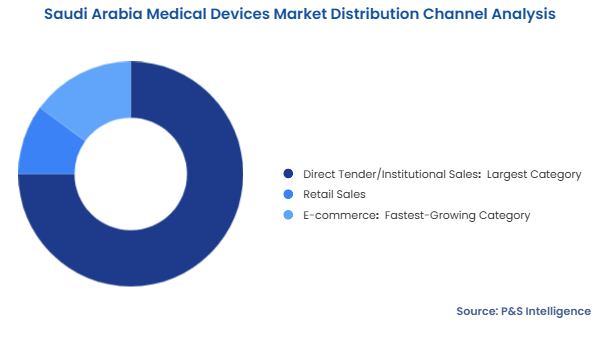
The direct tender/institutional sales category holds the largest market share, of 75%, in 2025, reflecting the government's centralized procurement system through the National Unified Company for Medical Supplies. NUPCO is responsible for centralized government procurement of pharmaceuticals, medical equipment, and supplies for all public healthcare facilities, which account for over 60% of the country's healthcare expenditure.
The dominance of institutional sales stems from Saudi Arabia's healthcare system structure, where government hospitals and healthcare facilities represent the primary purchasers of medical devices. NUPCO collects requirements from all government agencies in the healthcare sector and issues tenders to meet those demands, resulting in a centralized distribution framework that prioritizes bulk procurement agreements and approved suppliers.
The e-commerce category will have the highest CAGR, of 5.3%, driven by digital transformation initiatives and the increasing adoption of remote healthcare solutions. The growth of telemedicine and home healthcare services accelerates demand for medical devices through digital channels, particularly for monitoring equipment, diagnostic tools, and consumable medical supplies. The expansion of e-commerce in medical devices aligns with Vision 2030's digital health objectives and the Kingdom's broader e-commerce growth strategy. Healthcare providers increasingly utilize online platforms for the procurement of routine medical supplies, while patients access home healthcare devices through digital marketplaces, supporting the shift toward patient-centric care delivery models.
The distribution channels analyzed in this report are:
Direct Tender/Institutional Sales (Largest Category)
Retail Sales
E-commerce (Fastest-Growing Category)
Drive strategic growth with comprehensive market analysis
Saudi Arabia Medical Devices Market Regional Outlook
Al-Riyadh Medical Devices Market Size
Al-Riyadh holds the largest market share, of 35%, in 2025, driven by its position as the Kingdom's capital and the concentration of major healthcare institutions and government facilities. The province hosts King Faisal Specialist Hospital and Research Centre, Riyadh Military Hospital, and numerous specialized medical centers, creating substantial demand for advanced medical technologies and diagnostic equipment.
The province benefits from significant healthcare infrastructure investments, including the establishment of medical cities and the relocation of multinational healthcare companies' regional headquarters to Riyadh. GE Healthcare announced the relocation of its regional headquarters to Riyadh in October 2023, while Johnson & Johnson began direct operations in February 2024, highlighting the capital's strategic importance for medical device companies.
The province's robust healthcare spending and the presence of specialized treatment centers for cardiology, oncology, and diabetes care drive demand for monitoring devices, diagnostic imaging equipment, and therapeutic devices. Government initiatives to expand emergency services and increase weekly surgeries from 2,000 to 8,400 procedures further boost medical device adoption across the distribution network.
Eastern Province Medical Devices Market Size
Eastern Province will have the highest CAGR, of 5.1%, reflecting rapid healthcare infrastructure development and increasing industrial healthcare needs. The province's strategic location and oil industry presence drive demand for occupational health devices and emergency medical equipment across industrial facilities and healthcare centers.
The province houses major healthcare facilities, including King Fahad Hospital and multiple specialized centers, serving the industrial workforce and growing urban population. The development of new medical cities and the expansion of healthcare services to support Vision 2030's economic diversification initiatives create opportunities for medical device manufacturers across diagnostic, therapeutic, and monitoring segments.
The provinces of the market are as follows:
Al-Riyadh (Largest Province)
Eastern Province (Fastest-Growing Province)
Makkah
Madinah
Qassim
Asir
Tabuk
Ha'il
Northern Borders
Jazan
Najran
Al-Baha
Al-Jouf
Saudi Arabia Medical Devices Market Share
The market is semi-consolidated due to the presence of several dominant multinational corporations that maintain their positions through direct operations, joint ventures, and strategic investments in healthcare infrastructure, alongside a growing number of localized manufacturing and distribution partnerships. Recent strategic activities include equipment partnerships and facility expansions. These partnerships, often involving high-value medical technologies, signal a growing concentration of operational and technological capabilities among a select group of players. The competitive landscape is evolving as international companies establish manufacturing capabilities and strengthen their presence through localization strategies. The government's emphasis on developing domestic production capacity and reducing import dependency creates opportunities for companies investing in local manufacturing and technology transfer initiatives.
Key Saudi Arabia Medical Devices Companies:
Medtronic
Johnson & Johnson
GE Healthcare
Siemens Healthineers
Philips Healthcare Saudi Arabia Ltd.
Abbott Laboratories
Boston Scientific
Baxter Company Ltd.
Stryker Saudi Arabia
Becton, Dickinson and Company (BD)
Roche Diagnostics
Coloplast
Arabian Medical Products Manufacturing Company (ENAYAH)
Jamjoom Medical Industries Co. Ltd.
Nahdi Medical Company
Saudi Arabia Medical Devices Market News
In January 2025, Scientific & Medical Equipment House Co. signed a distribution agreement with Haier Germany to market and distribute operating room equipment in Saudi Arabia, strengthening its product portfolio and expanding its customer reach.
In November 2024, Becton, Dickinson and Company (BD) partnered with the Saudi Patient Safety Center to enhance patient safety and healthcare quality under Vision 2030, focusing on minimizing medication errors and reducing healthcare-associated infections across over 500 hospitals.
In April 2024, Johnson & Johnson announced the launch of the Cereglide aspiration catheter and Ethizia haemostatic sealing patch across Europe, the Middle East, and Africa, broadening its neurovascular and surgical solutions portfolio in regional markets.
In February 2024, Johnson & Johnson Medtech commenced direct operations in Saudi Arabia, aimed at improving customer engagement and creating employment opportunities in line with Vision 2030’s economic diversification goals.
In April 2023, Dr. Sulaiman AL Habib Medical Group invested USD 1.73 billion to construct six hospitals in Saudi Arabia with advanced medical facilities and innovative healthcare services, significantly expanding the Kingdom's healthcare infrastructure.
Want a report tailored exactly to your business need?
Leading companies across industries trust us to deliver data-driven insights and innovative solutions for their most critical decisions. From data-driven strategies to actionable insights, we empower the decision-makers who shape industries and define the future. From Fortune 500 companies to innovative startups, we are proud to partner with organisations that drive progress in their industries.
Client Testimonials
Working with P&S Intelligence and their team was an absolute pleasure – their awareness of timelines and commitment to value greatly contributed to our project's success. Eagerly anticipating future collaborations.
McKinsey & Company
India
Unmatched Standards
Our insights into the minutest levels of the markets, including the latest trends and competitive landscape, give you all the answers you need to take your business to new heights
Complete Data Security
We take a cautious approach to protecting your personal and confidential information. Trust is the strongest bond that connects us and our clients, and trust we build by complying with all international and domestic data protection and privacy laws