Saudi Arabia K-12 Education Market Size & Share Analysis - Trends, Drivers, Competitive Landscape, and Forecasts (2026 - 2032)
This Report Provides In-Depth Analysis of the Saudi Arabia K-12 Education Market Report Prepared by P&S Intelligence, Segmented by Grade Level (Elementary School, Middle School, High School), Institution Type (Public, Private), Delivery Mode (Traditional Classroom, Hybrid, Online), Curriculum Type (National Curriculum (Arabic), American Curriculum, British Curriculum, International Baccalaureate (IB), Central Board of Secondary Education (CBSE)), and Geographical Outlook for the Period of 2019 to 2032
Explore the market potential with our data-driven report
Saudi Arabia K-12 Education Market Overview
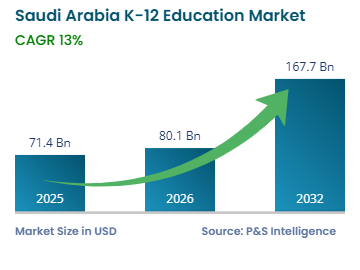
The Saudi Arabian K–12 education market size will be an estimated USD 71.4 billion for 2025, and it will grow by 13.0% during 2026–2032, to reach USD 167.7 billion by 2032.
The market expansion is primarily driven by Vision 2030 reforms, heavy government spending on school infrastructure, increasing preference for international education systems, and rapid digital integration across learning environments. Saudi Arabia's K–12 education system is undergoing major reform aligned with Vision 2030’s human capital development goals.
According to the Ministry of Education, the school-age population in Saudi Arabia is growing at 2.5% annually, and it is projected to reach 7.2 million students by 2030. This demographic expansion creates demand for approximately 1.2 million additional school seats, with private providers expected to supply a significant portion of this capacity. Digital learning platforms have achieved remarkable penetration across the kingdom. The government-backed Madrasati platform now reaches 98% of students, serving over 6 million learners across all educational levels, according to the World Bank.
Saudi Arabia K-12 Education Market Dynamics
Digitalization and Internationalization Are Key Trends
Technology adoption has accelerated dramatically across Saudi Arabia's K–12 education landscape, fundamentally changing how students learn and teachers instruct.
Government investment in digital infrastructure extends beyond platforms to include device provisioning, broadband connectivity enhancement, and teacher training in educational technology.
The success of these initiatives earned recognition from UNESCO, which selected Saudi Arabia among the top four international models in e-learning alongside South Korea, China, and Finland.
Artificial intelligence integration represents the next frontier in educational technology.
AI-driven adaptive learning platforms personalize instruction based on individual student performance, learning pace, and comprehension patterns.
Schools are implementing AI-powered assessment systems, intelligent tutoring software, and data analytics tools to enhance educational outcomes.
Saudi families are increasingly seeking international education options that provide global mobility, English proficiency, and pathways to prestigious universities worldwide.
The International Baccalaureate Diploma Programme attracts families seeking a globally standardized qualification recognized by top universities across multiple countries.
The 2017 decision to lift foreign ownership restrictions on K–12 schools sparked major foreign and private investment in new international school projects.
Global education operators, including GEMS Education, Maarif Education, and International Schools Group, have expanded their footprint across major cities.
In November 2024, EFG Hermes launched a USD 300 million Saudi Education Fund and acquired seven GCC schools with 12,000 seats, signaling strong investor confidence in the sector's growth trajectory.
Vision 2030 Reforms Propel Systemic Transformation in Education
The Saudi government has positioned education at the core of Vision 2030, launching the National Transformation Program to diversify the economy and develop human capital.
The strategic investment supports comprehensive reforms, including curriculum modernization, teacher training, infrastructure development, and quality assurance mechanisms.
The Human Capital Development Program, a key component of Vision 2030, sets ambitious targets for the education sector.
The National Center for Privatization & PPP (NCP) is transitioning 60 public schools to private operation, attracting substantial investment from domestic and international education operators.
These reforms create opportunities for innovation in pedagogy, facility design, and academic programs while maintaining regulatory oversight to ensure quality standards.
Vision 2030 emphasizes STEM education, English language proficiency, and digital literacy as core competencies for the future workforce.
The Ministry of Education introduced English language instruction from first grade onwards in 2021, accelerating language acquisition compared to the previous system where English began in fourth grade.
Additionally, the government launched an artificial intelligence curriculum for all public schools, with over 50,000 high schoolers piloting AI modules focusing on digital skills, ethics, and innovation, according to the Saudi Data and AI Authority.
Saudi Arabia K-12 Education Market Segmentation Analysis
Grade Level Analysis
The high school category holds the largest market share, of 50%, in 2025, due to the critical importance of secondary education in determining university admission prospects and career trajectories. High schools offer specialized academic tracks, including natural sciences, social sciences, and vocational pathways, allowing students to align their studies with future aspirations. The government's emphasis on STEM education and university preparedness has driven substantial investment in high school infrastructure, laboratory equipment, and qualified teaching staff.
The elementary school category will have the highest CAGR during the forecast period. This growth stems from Vision 2030's focus on early childhood education and the government's target to increase kindergarten enrollment. Families increasingly recognize the importance of strong foundational skills in literacy, numeracy, and English language acquisition established during elementary years.
The grade levels analyzed in this report are:
Elementary School (Grades 1–5) (Fastest-Growing Category)
Middle School (Grades 6–8)
High School (Grades 9–12) (Largest Category)
Institution Type Analysis
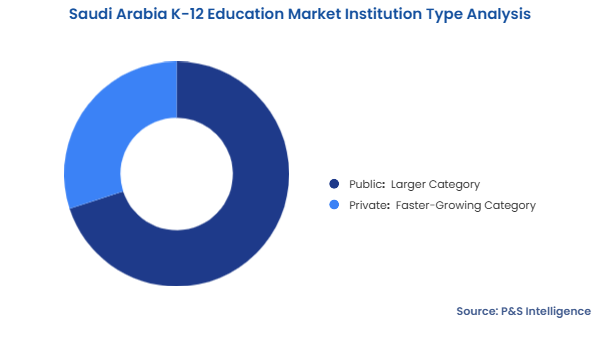
The public category holds the larger market share, of 70%, in 2025, because this education remains free at all levels, ensuring accessibility for the kingdom's entire citizen population. The government operates comprehensive school networks across all provinces, including remote and rural areas where private sector presence remains limited. Public schools follow the National Arabic Curriculum with mandatory instruction in Islamic studies, Arabic language, mathematics, science, and social studies. Gender-segregated education, a longstanding tradition in Saudi Arabia, continues across public schools with separate facilities for male and female students.
The private category will have the higher CAGR, of 13.2%, due to the rising household income, expatriate population growth, demand for international curricula, and government initiatives to increase private sector participation in education delivery. The NPC's transition of 60 public schools to private operation demonstrates official support for expanded private education options.
The institution types analyzed in this report are:
Public (Larger Category)
Private (Faster-Growing Category)
Delivery Mode Analysis
The traditional classroom category holds the largest market share, of 75%, in 2025, driven by the continued preference for face-to-face instruction remains the predominant delivery model, valued for its role in social and emotional development, peer interaction, hands-on learning experiences, and teacher-student relationship building. Public schools predominantly utilize traditional classroom settings, while private and international schools enhance offline instruction with technology integration, interactive whiteboards, and modern laboratory facilities. Cultural preference for structured, teacher-led classrooms ensures that traditional offline education continues to dominate across the kingdom.
The hybrid category will have the highest CAGR, of 13.3%. This model combines the benefits of face-to-face instruction with digital learning technologies, offering flexibility while maintaining essential in-person social interaction. Schools are implementing blended approaches through flipped classrooms where students review content online before engaging in collaborative problem-solving during class time. Hybrid models also enable personalized learning pathways where students progress through digital modules at individual paces while teachers provide targeted intervention and support. The government's substantial investment in digital infrastructure and the Madrasati platform positions Saudi Arabia to scale blended learning nationwide.
The delivery modes analyzed in this report are:
Traditional Classroom (Largest Category)
Hybrid (Fastest-Growing Category)
Online
Curriculum Type Analysis
The national curriculum category holds the largest market share, of 70%, in 2025, as this curriculum, mandated for all public schools, emphasizes Arabic language mastery, Islamic studies, mathematics, science, and social studies. The Ministry of Education modernized the curriculum in 2021 by introducing English language instruction from first grade, integrating STEM concepts, and developing digital literacy components. It strives to balance cultural and Islamic values with the competencies required for participation in a modern, knowledge-driven economy.
The British curriculum category will have the highest CAGR during the forecast period, driven by rising demand for globally recognized academic standards and English-language instruction. The British system's structured pathway through Key Stages, IGCSE examinations, and A-Level qualifications provides clear academic progression and globally recognized credentials. British curriculum schools appeal to families prioritizing English language proficiency, critical thinking development, and admission to UK, European, or Commonwealth universities. The curriculum's emphasis on independent learning and analytical skills aligns with Vision 2030's goals for developing innovative, creative thinkers.
The curriculum types analyzed in this report are:
National Curriculum (Arabic) (Largest Category)
American Curriculum
British Curriculum (Fastest-Growing Category)
International Baccalaureate (IB)
Central Board of Secondary Education (CBSE)
Others
Drive strategic growth with comprehensive market analysis
Saudi Arabia K-12 Education Market Geographical Analysis
Al-Riyadh K–12 Education Market Size
Al-Riyadh holds the largest market share, of 30%, in 2025, driven by population growth, rising disposable incomes, and ongoing mega-projects, such as NEOM and the Diriyah Gate development, that attract international talent requiring quality schooling options. The Riyadh education market benefits from Vision 2030's emphasis on transforming the capital into one of the world's top 10 most livable and competitive cities.
The Royal Commission for Riyadh City operates the International Schools Attraction program, offering "Super Licenses" that facilitate market entry for leading global education brands. These licenses provide regulatory advantages, including co-education flexibility up to Year 7, curriculum customization options, and streamlined visa processing for international teaching staff. Notable school openings include Kings College Riyadh in 2021, Buckswood School Riyadh in 2024, and multiple acquisitions by Spark Education Platform, which is rapidly expanding its portfolio across the capital.
Eastern Province K–12 Education Market Size
Eastern Province will have the highest CAGR, of 13.1%, due to the demographic expansion and continued economic activity in the energy sector. The government's efforts to diversify the Eastern Province economy beyond oil through tourism, logistics, and manufacturing sectors will likely attract additional families requiring quality schooling options. Saudi Aramco, the world's largest oil company, maintains company-operated schools serving employees' families, while independent international schools cater to the broader expatriate community and Saudi families.
The Eastern Province education market exhibits unique characteristics due to the longstanding presence of international oil companies and their associated expatriate communities. Schools in Dhahran, Khobar, and Dammam have operated for decades, establishing strong reputations and alumni networks. The concentration of engineering, technical, and management professionals creates demand for STEM-focused education and university preparatory programs aligned with competitive higher education pathways.
The provinces analyzed are as follows:
Al-Riyadh (Largest Province)
Eastern Province (Fastest-Growing Province)
Makkah
Madinah
Qassim
Asir
Tabuk
Ha'il
Northern Borders
Jazan
Najran
Al-Baha
Al-Jouf
Saudi Arabia K-12 Education Market Share
The market is semi-consolidated with numerous players large education groups, mid-sized operators, and standalone schools competing across different segments. While a handful of major private education companies operate extensive school networks, no single entity dominates the market comprehensively. Major education groups are pursuing roll-up strategies, acquiring smaller schools to build economies of scale in administration, procurement, curriculum development, and teacher recruitment. This consolidation exemplifies strategic moves by leading operators to strengthen market position through portfolio expansion.
Key Saudi Arabia K-12 Education Companies:
Ataa Educational Company
Maarif Education
GEMS Education KSA
International Schools Group (ISG)
SABIS Educational Services
Al-Rowad International Schools
Al-Khaleej Training & Education (Ajyal)
Rowad Al Khaleej International Schools
Arrowad Group
Kingdom Schools Company
British International School of Jeddah
Tatweer Educational Services Company
Saudi Arabia K-12 Education Market News
In June 2025, iSchool, a K–12 platform for artificial intelligence and coding education in the MENA region, acquired SEEDS, the EdTech division of Algoriza. With this, iSchool strengthened its position in Saudi Arabia's technology-driven education market.
In May 2025, GEMS Education Group announced its expansion into Saudi Arabia through a strategic partnership between First School Management and Spark Education Platform. This brings GEMS' 66 years of educational expertise to selected schools across the kingdom and Bahrain.
In January 2025, Spark Education Platform acquired a controlling interest in Qimam El Hayat International School in Riyadh. This transitioned the institution to a larger campus to accommodate enrollment expansion and enhance educational facilities.
In November 2024, EFG Hermes launched the USD 300-million Saudi Education Fund and, simultaneously, acquired the Britus Education portfolio comprising seven GCC schools with 12,000 student seats.
In August 2024, Ataa Educational opened Buckswood School Riyadh and relocated Al Wasat National School to a significantly larger complex, increasing total capacity from 1,400 to 2,590 seats while introducing British curriculum with International Baccalaureate options.
Want a report tailored exactly to your business need?
Leading companies across industries trust us to deliver data-driven insights and innovative solutions for their most critical decisions. From data-driven strategies to actionable insights, we empower the decision-makers who shape industries and define the future. From Fortune 500 companies to innovative startups, we are proud to partner with organisations that drive progress in their industries.
Client Testimonials
Working with P&S Intelligence and their team was an absolute pleasure – their awareness of timelines and commitment to value greatly contributed to our project's success. Eagerly anticipating future collaborations.
McKinsey & Company
India
Unmatched Standards
Our insights into the minutest levels of the markets, including the latest trends and competitive landscape, give you all the answers you need to take your business to new heights
Complete Data Security
We take a cautious approach to protecting your personal and confidential information. Trust is the strongest bond that connects us and our clients, and trust we build by complying with all international and domestic data protection and privacy laws