This Report Provides In-Depth Analysis of the Saudi Arabia Industrial IoT Market Report Prepared by P&S Intelligence, Segmented by Connectivity (Wired, Wireless, Hybrid), Application (SCADA, MES, PLM, Distribution Management), Component Type (Solutions, Platforms, Services), Vertical (Manufacturing, Oil & Gas, Energy, Transportation & Logistics, Healthcare, Agriculture, Metal & Mining, Retail), and Geographical Outlook for the Period of 2019 to 2032
Explore the market potential with our data-driven report
Saudi Arabia Industrial IoT Market Future Outlook
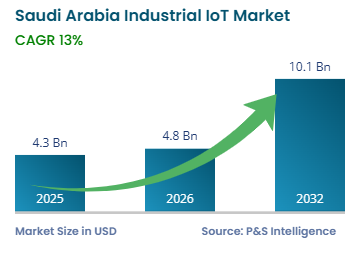
The Saudi Arabian industrial IoT market size will be an estimated USD 4.3 billion for 2025, and it will grow by 13.0% during 2026–2032, to reach USD 10.1 billion by 2032.
The market growth is primarily driven by the combination of government initiatives, advanced technological advancements, and the rising industry demand. Advancements in connectivity, including the deployment of 5G networks and cloud-based platforms, enable industries to implement reliable and low-latency IIoT solutions.
Demand across key sectors such as manufacturing, energy and utilities, healthcare, and transportation is rising, driven by the need for improved efficiency, productivity, and cost reduction. Additionally, partnerships with global technology providers and foreign investments are accelerating the adoption of advanced IIoT solutions. The focus on energy efficiency, sustainability, and compliance with emerging industrial standards further supports market expansion, positioning IIoT as a key enabler of Saudi Arabia’s industrial modernization and long-term economic growth.
Saudi Arabia Industrial IoT Market Emerging Trends & Growth Drivers
Adoption of Smart Factories and Digital Twins Is Key Trend
The growing adoption of smart factories and digital twins in Saudi Arabia is emerging as a key trend driving predictive maintenance and real-time monitoring across industries.
Smart factories use connected devices and sensors to enable real-time monitoring, automation, and predictive maintenance, improving efficiency and reducing downtime.
Digital twins, which are virtual replicas of physical systems, allow companies to analyze operations, simulate scenarios, and optimize processes without disrupting actual production.
This trend is gaining traction in industries such as manufacturing and energy, where efficiency, precision, and process optimization are critical.
By leveraging these technologies, companies can enhance operational performance, make data-driven decisions, and stay competitive in an increasingly digital industrial landscape.
The Public Investment Fund (PIF) and STC Group created a 50:50 IoT company to accelerate industrial/manufacturing IoT adoption, including digital‑twin capabilities.
IoT Squared is partnering with Rockwell Automation and Schneider Electric to push smart‑factory / Industry 4.0 solutions in Saudi industries.
SABIC is applying real‑time data analytics and machine learning in its factories for predictive maintenance and process optimization.
The Saudi Ministry of Industry aims to digitize ~4,000 factories under its Future Factories scheme, supporting IIoT, sensors, and smart manufacturing.
ALAT, a PIF-backed industrial-tech conglomerate, is building advanced industries units—including smart manufacturing—as part of its USD 100-billion plan by 2030.
Government initiatives under Vision 2030 Are Biggest Drivers
Government initiatives under Vision 2030 are a key driver of the Saudi Industrial IoT market because they actively promote the country’s industrial diversification and digital transformation.
Through Vision 2030, the government provides policies, incentives, and infrastructure support that encourage industries to adopt smart technologies, including IIoT solutions for predictive maintenance, real-time monitoring, and automation.
Regulatory measures from bodies such as the Communications and Information Technology Commission provide guidelines for NB-IoT deployment, IoT network security, and interoperability standards, while the Saudi Standards, Metrology and Quality Organization supports industrial quality standards and compliance.
Financial incentives, tax benefits, and public-private partnership frameworks facilitate investments in modern industrial facilities and technological upgrades.
By creating a favorable environment for digital adoption, Vision 2030 accelerates IIoT deployment, enhances operational efficiency, and helps Saudi industries align with global standards, making it a crucial driver of market growth.
In June 2025, the Saudi Ministry of Industry and Mineral Resources introduced the Advanced Manufacturing and Production Center to boost the utilization of advanced solutions, such as automation, artificial intelligence, robotics, and data-driven systems, in industries.
The center acts as a cohesive national platform that integrates multiple programs aimed at fostering the digital transformation of the manufacturing industry.
It will promote the implementation of contemporary technologies that improve production efficiency, lower operational expenses, and boost the global competitiveness of products manufactured in Saudi Arabia.
The Industrial Beacons Program) is working to get 10 Saudi factories recognized as “Lighthouses” by the World Economic Forum, meaning they will be global role models of smart/4IR manufacturing.
Saudi Arabia Industrial IoT Market Segmentation Analysis
Component Analysis
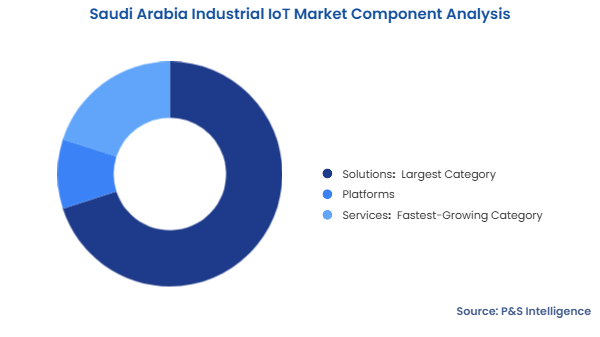
The solutions category holds the largest market share, of 70%, in 2025, because they encompass the essential hardware, software, and integrated systems needed for IIoT deployment, including sensors, devices, and applications like SCADA and MES. These solutions form the core of any industrial digitalization effort, making them critical for operational efficiency, real-time monitoring, and process automation across sectors such as manufacturing, energy, and utilities. In Saudi Arabia, these solutions are being adopted widely in industrial clusters, smart factories, and digital oilfields, where reliable hardware and integrated software are critical for operational efficiency and compliance with regulatory standards.
The services category will have the highest CAGR, of 13.4%, due to the increasing need for consulting, system integration, maintenance, and technical support to implement and optimize IIoT solutions effectively. As more companies adopt smart technologies and move toward digital transformation, demand for professional services rises, driving rapid growth in this segment. The increasing focus on digital skill development and technology transfer through partnerships with global technology providers further drives the growth of the services segment.
The components analyzed in this report are:
Solutions (Largest Category)
Platforms
Services (Fastest-Growing Category)
Connectivity Analysis
The wired category holds the largest market share, of 55%, in 2025, because it offers high reliability, stable performance, and secure data transfer, which are essential for critical industrial systems such as SCADA, MES, and automation in large factories, oil & gas facilities, and utilities. Wired connectivity also supports due to its high-bandwidth applications, real-time data acquisition, and integration with legacy industrial equipment, which remain crucial in heavy industries and energy infrastructure. Its robustness and low latency make it indispensable for safety-critical operations and large-scale industrial deployments.
The wireless category will have the highest CAGR, of 13.3%, driven by the adoption of 5G, Wi-Fi, and LPWAN technologies that enable flexible, scalable, and remote deployment of IIoT devices. Wireless networks support real-time monitoring, mobile asset tracking, and cloud integration, making them increasingly important for smart factories, digital twin implementations, and modern industrial digitalization initiatives across Saudi Arabia.
The connectivity types analyzed in this report are:
Wired (Largest Category)
Wireless (Fastest-Growing Category)
Hybrid
Application Analysis
The SCADA category holds the largest market share, of 50%, in 2025, because it is a well-established system used extensively in manufacturing, energy, and utilities for real-time monitoring, control, and automation of industrial processes. SCADA ensures reliable data collection and centralized process control, while MES drives real-time tracking, workflow optimization, and rapid Industry 4.0 adoption across Saudi industries.
The MES category will have the highest CAGR, of 13.2%, due to the increasing adoption of smart factories and Industry 4.0 initiatives. MES enables real-time production tracking, workflow optimization, and data-driven decision-making, which are essential for improving operational efficiency and reducing downtime. The rising focus on digital transformation and process optimization in Saudi Arabia is driving rapid MES deployment across industries, making it the fastest-growing application segment in the IIoT market.
The applications analyzed in this report are:
SCADA (Largest Category)
MES (Fastest-Growing Category)
PLM
Distribution Management
Others
Vertical Analysis
The manufacturing category holds the largest market share in 2025, because it has been the primary adopter of IIoT technologies, leveraging smart factories, predictive maintenance, and real-time process monitoring to enhance operational efficiency and productivity. The presence of major industrial hubs and the focus on modernizing manufacturing facilities make this sector the dominant consumer of IIoT solutions. The adoption of IIoT also supports energy management, waste reduction, and regulatory compliance, helping Saudi manufacturers align with global standards and sustainability targets.
The energy category will have the highest CAGR, during the forecast period, due to the country’s emphasis on digitalization in oil, gas, and utilities. Initiatives such as digital oilfields, smart grids, and remote monitoring systems are driving rapid IIoT adoption in this sector, enabling better asset management, operational efficiency, and downtime reduction, which fuels its accelerated growth compared to other industries. Saudi Arabia’s investments in industrial IoT infrastructure, 5G connectivity, and public-private partnerships are accelerating the deployment of these technologies across energy and utility networks, making the energy vertical the fastest-growing segment in the market.
The verticals analyzed in this report are:
Manufacturing (Largest Category)
Oil & Gas
Energy (Fastest-Growing Category)
Transportation & Logistics
Healthcare
Agriculture
Metal & Mining
Retail
Others
Drive strategic growth with comprehensive market analysis
Saudi Arabia Industrial IoT Market Geographical Analysis
Al-Riyadh Industrial IoT Market Size
Al-Riyadh holds the largest market share, of 45%, in 2025, due to its position as the country’s primary industrial and economic hub, hosting numerous manufacturing facilities, corporate headquarters, and industrial zones. The high concentration of industries in Riyadh drives significant adoption of IIoT solutions, supported by government policies and regulations under Vision 2030, which promote digital transformation, smart factory implementation, and technological modernization. Additionally, incentives such as tax benefits, industrial development funds, and public-private partnership frameworks encourage industries to invest in advanced IIoT solutions, enabling predictive maintenance, real-time monitoring, and automation.
Eastern Province Industrial IoT Market Size
Eastern Province will have the highest CAGR, of 13.1%, driven by its extensive oil, gas, and energy infrastructure. The government has introduced regulatory frameworks through bodies such as the Communications and Information Technology Commission for IoT network security, interoperability, and deployment standards, alongside financial incentives and public-private partnership initiatives. These policies facilitate rapid digitalization, enabling predictive maintenance, real-time monitoring, and automation across energy and industrial facilities, making the Eastern Province the fastest-growing market for IIoT adoption in Saudi Arabia. Public-private partnership initiatives, financial incentives, and infrastructure support further facilitate rapid digitalization, enabling predictive maintenance, real-time monitoring, and automation across energy and industrial facilities.
The provinces of the market are as follows:
Al-Riyadh (Largest Category)
Eastern Province (Fastest-Growing Category)
Makkah
Madinah
Qassim
Asir
Tabuk
Ha'il
Northern Borders
Jazan
Najran
Al Bahah
Al Jauf
Saudi Arabia Industrial IoT Market Share
The market is fragmented because it consists of a large number of local and international players, including system integrators, platform providers, solution vendors, and service providers, each targeting different verticals, applications, and industrial segments. While some global technology companies like Siemens, Schneider Electric, ABB, Honeywell, and GE Digital hold significant presence, no single player is dominating the market, and competition is spread across multiple small-to-medium providers offering specialized solutions for manufacturing, energy, transportation, and other sectors. The fragmented nature is also driven by the diversity of industries, connectivity types, and IIoT applications, which require tailored solutions rather than one-size-fits-all offerings.
Key in Saudi Arabia Industrial IoT Companies:
Siemens Saudi Arabia
Schneider Electric
General Electric
Rockwell Automation
Honeywell International
ABB Ltd.
IBM Middle East
Microsoft
PTC Inc.
Oracle
SAP SE
SaudiEx
Saudi Arabia Industrial IoT Market News
In September 2025, the Communications, Space & Technology Commission was named a strategic partner of the Global IoT Congress, to be hosted in Riyadh, signaling strong regulatory support for expanding IoT use across sectors.
In May 2025, Aramco Digital & LTIMindtree formed a next‑generation IT services JV in Saudi Arabia, NextEra, to accelerate the Kingdom’s digital transformation aligned with Vision 2030.
In January 2025, Semiconductor Holding Inc. participated in the 450 MHz Alliance Event, hosted by Saudi Aramco, to discuss innovations in low-band IoT networks and private 5G infrastructure.
In April 2024, Aramco signed an MOU with GCT Semiconductor to co-develop 4G/5G chipsets and modules, to support localization of IoT device manufacturing in the Kingdom.
Want a report tailored exactly to your business need?
Leading companies across industries trust us to deliver data-driven insights and innovative solutions for their most critical decisions. From data-driven strategies to actionable insights, we empower the decision-makers who shape industries and define the future. From Fortune 500 companies to innovative startups, we are proud to partner with organisations that drive progress in their industries.
Client Testimonials
Working with P&S Intelligence and their team was an absolute pleasure – their awareness of timelines and commitment to value greatly contributed to our project's success. Eagerly anticipating future collaborations.
McKinsey & Company
India
Unmatched Standards
Our insights into the minutest levels of the markets, including the latest trends and competitive landscape, give you all the answers you need to take your business to new heights
Complete Data Security
We take a cautious approach to protecting your personal and confidential information. Trust is the strongest bond that connects us and our clients, and trust we build by complying with all international and domestic data protection and privacy laws