This Report Provides In-Depth Analysis of the Saudi Arabia Industrial Cybersecurity Market Report Prepared by P&S Intelligence, Segmented by Component (Solutions, Services), Secrity Type (Network, Application, Endpoint, Cloud), Deployment (On-Premises, Cloud), Enterprises (Large Enterprises, Small and Medium Enterprises), Use Case (Security Monitoring, Network Traffic Analysis, Threat Hunting, Incident Response, Data Exfiltration), Industry (Oil& Gas, Energy & Power, Manufacturing, Transportation, Chmicals, Food & Beverages), and Geographical Outlook for the Period of 2019 to 2032
Saudi Arabia Industrial Cybersecurity Market Growth Potential
Key Highlights
Study Period
2019 - 2032
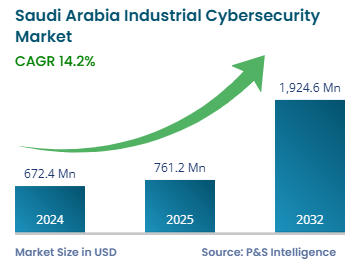
Market Size in 2024
USD 672.4 Million
Market Size in 2025
USD 761.2 Million
Market Size by 2032
USD 1924.6 Million
Projected CAGR
14.2%
Largest Region
Eastern Region
Fastest Growing Region
Al-Riyadh
Market Structure
Consolidated
Market Size
Major Companies
Important Takeaways
Market Size and Forecast
Industry Trend
Regulatory Landscape
Demand Trend Analysis
Companies Recent Strategical Developments
Key Stakeholders
Voice of Industry Experts/KOLs
Future Opportunity
Explore the market potential with our data-driven report
Saudi Arabia Industrial Cybersecurity Market Analysis
The Saudi Arabian industrial cybersecurity market size was USD 672.4 million in 2024, and it will grow by 14.2% during 2025–2032, to reach USD 1924.6 million by 2032.
The market growth is primarily driven by the Kingdom's Vision 2030 digital transformation initiatives, increasing cyber threats targeting critical infrastructure, and stringent regulatory compliance requirements across industrial sectors. Saudi Arabia is facing more cyberattacks due to the rapid digital transformation. According to the Saudi NCA, the number of cyberattacks went up by 71% in 2023, with energy and manufacturing companies being the main targets.
The kingdom's strategic position as a global energy supplier makes its industrial infrastructure particularly attractive to threat actors, necessitating robust cybersecurity measures. Furthermore, the implementation of the National Industrial Development and Logistics Program has expanded the industrial base, creating additional attack surfaces that require comprehensive security solutions. The convergence of operational technology and information technology systems in Saudi industrial facilities presents both opportunities and vulnerabilities. The Saudi government's mandatory cybersecurity frameworks, including the Essential Cybersecurity Controls and sector-specific regulations, compel industrial enterprises to invest significantly in security infrastructure to protect critical national assets and maintain operational continuity.
Saudi Arabia Industrial Cybersecurity Market Emerging Trends & Growth Drivers
Digital Transformation and Industry 4.0 Adoption Are Key Trends
As industrial organizations adopt Industry 4.0 technologies, including IoT sensors, automated control systems, and cloud-based platforms, the need for specialized industrial cybersecurity solutions becomes paramount.
These technologies enhance operational efficiency and productivity, but they exponentially expand the attack surface and introduce new vulnerability vectors requiring specialized security solutions.
The integration of operational technology with information technology systems breaks down traditional air-gapped security models, exposing industrial processes to cyber risks previously confined to corporate networks.
Smart sensors, connected machinery, and cloud-based industrial platforms generate vast amounts of data requiring protection throughout its lifecycle.
This convergence drives demand for unified threat management solutions, encryption technologies, and cloud security platforms specifically designed for industrial environments.
Organizations seek cybersecurity solutions that enable digital innovation while maintaining robust protection against evolving threats.
Saudi Arabia's Vision 2030 initiative has emerged as a powerful catalyst for industrial cybersecurity market growth through its emphasis on digital transformation across all sectors.
The kingdom's massive investments in smart cities and the adoption of Industry 4.0 technologies, such as IIoT, have exponentially increased the attack surface that requires protection.
Major projects, such as NEOM, with its smart city infrastructure, and the modernization of existing industrial facilities with connected sensors and automation systems necessitate comprehensive cybersecurity strategies.
The convergence of IT and OT networks, while enabling greater efficiency and data-driven decision-making, has created new security challenges that traditional IT security solutions cannot adequately address.
This drives the demand for specialized industrial cybersecurity technologies and expertise.
Increasing Sophistication of Cyberattacks at Critical Infrastructure Is Biggest Driver
The evolution of cyber threats specifically designed to target industrial control systems and supervisory control and data acquisition systems is a key driver for the market.
According to the Saudi Computer Emergency Response Team, industrial cyber incidents increased from 187 cases in 2022 to 319 cases in 2023, with ransomware attacks accounting for 43% of the total incidents.
These attacks have become increasingly sophisticated, employing advanced persistent threats and zero-day exploits specifically crafted to bypass traditional security measures in industrial environments.
The unique characteristics of industrial systems, including legacy equipment, proprietary protocols, and extended operational lifecycles, create vulnerabilities that cybercriminals actively exploit.
Recent incidents targeting Saudi industrial facilities have demonstrated the potential for significant operational disruption and financial losses.
For instance, Saudi Aramco reported investing over USD 500 million in cybersecurity infrastructure following attempted cyberattacks on its facilities.
The financial and reputational damage from successful attacks drives industrial organizations to adopt comprehensive cybersecurity solutions encompassing network segmentation, threat intelligence, and real-time monitoring capabilities.
Saudi Arabia Industrial Cybersecurity Market Segmentation Analysis
Component Analysis
The solutions category held the larger market share, of 65%, in 2024, driven by the critical need for comprehensive security technologies across industrial facilities. Industrial companies are increasingly investing in practical security solutions that provide swift protection and help meet compliance rules. The wide range of solutions, ranging from identity and access management to data loss prevention systems, addresses the multifaceted security requirements of modern industrial environments. Saudi industrial facilities, particularly in the oil & gas and energy sectors, deploy multiple security solutions in layered defense architectures to protect critical infrastructure assets.
The services category will have the higher CAGR, of approx. 14.5%, due to the growing complexity of industrial cybersecurity implementations and the shortage of specialized security expertise. As industrial systems become increasingly interconnected and sophisticated, organizations require professional guidance for security architecture design, threat assessment, and incident response planning. The managed services sub-category is growing quickly as industrial companies look to outsource security to experts who can provide 24/7 monitoring and immediate response. According to the Saudi Federation for Cybersecurity, Programming and Drones, the country faces a shortage of cybersecurity professionals, further driving demand for external security services.
The components analyzed in this report are:
Solutions (Larger Category)
Risk and compliance management
Identity and access management (IAM)
Firewall
Security and vulnerability management (SVM)
Encryption
Intrusion detection system/intrusion prevention system (IDS/IPS)
Unified threat management (UTM)
Distributed Denial of Service (DDoS) attack
Antivirus
Data loss prevention (DLP)
Services (Faster-Growing Category)
Managed
Design and integration
Risk and threat management
Support and maintenance
Consulting
Training and education
Professional
Security Type Analysis
The network category held the largest market share, of 40%, in 2024, due to the fundamental importance of perimeter defense and network segmentation in industrial environments. Industrial facilities use a large network that connects various control systems, business tools, and equipment, making network security a critical safeguard. The implementation of firewalls, network access control, and segmentation technologies helps industrial organizations isolate critical systems and prevent lateral movement of threats. Saudi industrial enterprises, particularly those in critical infrastructure sectors, invest heavily in next-generation network security solutions that provide advanced traffic analysis and protocol-specific detection.
The cloud category will have the highest CAGR, driven by the accelerating migration of industrial applications and data to cloud platforms. The Saudi Cloud First Policy, mandating government entities and their partners to prioritize cloud adoption, extends its influence to industrial sectors, creating substantial demand for cloud-specific security solutions. Industrial organizations deploying cloud-based SCADA systems, predictive maintenance platforms, and supply chain management solutions require robust cloud security measures to protect sensitive operational data and maintain compliance with data sovereignty regulations. Moreover, the growth in industrial IoT deployments, with cloud-based data analytics and storage, increases the demand for robust cloud security measures.
The security types analyzed in this report are:
Network (Largest Category)
Application
Endpoint
Cloud (Fastest-Growing Category)
Enterprise
Deployment Analysis
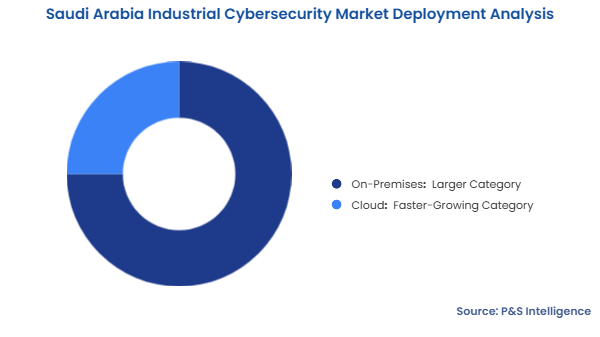
The on-premises category held the larger market share, of 75%, in 2024, due to various large industrial companies, especially oil & gas, chemicals, and utilities, preferring to keep an internal cybersecurity framework. They are required to take control over data and network to meet the need for strict regulation, such as OTCC-1:2022, by the National Cybersecurity Authority.
The cloud category will have the higher CAGR, due to the need for scalability and reduced upfront costs and increasing adoption of remote monitoring and centralized threat detection solutions across industrial facilities. Moreover, government agencies, such as the SDAIA and CST, are pushing for cloud-first methodologies as they could lead to up to 30% reduction in the TCO of software over five years.
The sales channels analyzed in this report are:
On-Premises (Larger Category)
Cloud (Faster-Growing Category)
Enterprise Analysis
The large enterprises category held the larger market share, of 85%, in 2024, because major companies, such as Saudi Aramco and SABIC, invest heavily in advanced cybersecurity tools, such as threat detection, network monitoring, and specialized OT firewalls.
The small and medium enterprises category will have the highest CAGR, of approx. 15%, because of the rising awareness of cyber threats, increasing regulatory pressure, and availability of affordable, scalable cybersecurity solutions to meet their operational requirements.
The enterprises analyzed in this report are:
Large Enterprises (Largest Category)
Small and Medium Enterprises (Fastest-Growing Category)
Use Case Analysis
The security monitoring category held the largest market share, of 45%, in 2024, as they monitor their systems 24/7 and detect and react to threats at an earlier stage. Under Saudi cybersecurity laws, a setup for the constant, real-time monitoring of operational technology environments is crucial.
The threat hunting category will have the highest CAGR. As cyberattacks are becoming increasingly advanced and difficult to detect, companies are going past traditional means and now investing in more-proactive styles of defense. Such tools include anomaly detection, behavioral analysis, and AI-based platforms to thwart the threat before damage.
The use cases analyzed in this report are:
Security Monitoring (Largest Category)
Network Traffic Analysis
Threat Hunting (Fastest-Growing Category)
Incident Response
Data Exfiltration
Industry Analysis
The oil & gas category held the largest market share, of 35%, in 2024, due to Saudi Arabia's position as a global energy powerhouse and the critical importance of protecting petroleum infrastructure. Saudi Aramco, the world's largest oil producer, operates extensive digital infrastructure spanning exploration, production, refining, and distribution operations, all requiring sophisticated cybersecurity protection. The sector's adoption of digital oilfield technologies, remote monitoring systems, and predictive analytics platforms creates numerous potential entry points for cyber threats. Recent global cyberthreats, such as the Colonial Pipeline hack, have pushed Saudi oil & gas companies to improve investments in cybersecurity for their operations.
The manufacturing category will have the higher CAGR. This is driven by the Kingdom's industrial diversification strategy and the rapid digitalization of production facilities. The National Industrial Development and Logistics Program aims to position Saudi Arabia as a leading industrial powerhouse, attracting investments in automotive, aerospace, and consumer goods manufacturing. These modern manufacturing facilities implement Industry 4.0 technologies, including robotic automation, digital twins, and connected supply chains, requiring comprehensive cybersecurity measures. According to the Ministry of Industry and Mineral Resources, the number of operational industrial facilities in Saudi Arabia grew by 10% in 2023, reaching 11,549, each representing a potential customer for industrial cybersecurity solutions.
The industries analyzed in this report are:
Oil & Gas (Largest Category)
Energy & Power
Manufacturing (Fastest-Growing Category)
Transportation
Chemicals
Food & Beverages
Others
Drive strategic growth with comprehensive market analysis
Saudi Arabia Industrial Cybersecurity Market Regional Market Performance
The Eastern region held the largest market share, of 35%, in 2024, driven by the concentration of oil & gas infrastructure and petrochemical complexes. This region is the main base of operation for the oil & gas industry and home to Abaqaiq, the world’s largest oil refinery; and Ras Tanura, which has a large refinery; making companies invest heavily in cybersecurity to protect these sites. The Eastern Province Municipality reports that the region contributes 60% of Saudi Arabia's industrial exports, primarily from the petroleum and petrochemical sectors, highlighting the economic importance of protecting these assets from cyber threats.
The fast growth in this region's industrial cybersecurity market is due to the expansion of industrial cities in Jubail and Dammam, the development of integrated petrochemical complexes, and the increasing digitalization of oil & gas operations. These facilities increasingly adopt advanced process control systems, digital twins, and predictive maintenance technologies, creating substantial demand for specialized industrial cybersecurity solutions. The region's proximity to other GCC markets also positions it as a hub for cybersecurity service providers addressing the demand for the Gulf industrial sector.
The AI-Riyadh will have the highest CAGR, as it is the epicenter of industrial digitalization and cybersecurity investments in the kingdom. The capital region hosts the headquarters of major industrial conglomerates, government agencies, and the National Cybersecurity Authority, creating a concentrated ecosystem for cybersecurity adoption. Riyadh hosts the largest number of factories, around 4,502 by the end of 2023, accounting for nearly 39% of the kingdom’s total industrial establishments. The presence of critical infrastructure facilities, including power generation plants, water treatment facilities, and manufacturing complexes, drives continuous investment in advanced security solutions.
Moreover, various projects, including the NEOM project's industrial components, King Salman Energy Park, and the expansion of industrial cities around Riyadh, create new opportunities for cybersecurity solution providers. The Saudi Industrial Property Authority reports Riyadh's industrial cities host over 2,500 factories, with 78% implementing some form of digital transformation, necessitating proportional cybersecurity investments. Furthermore, many cybersecurity companies, system integrators, and consulting firms based in Riyadh facilitate making it easier for industrial businesses to get security solutions and services according to their needs.
The geographical breakdown of the market is as follows:
Al-Riyadh (Fastest-Growing Regional Market)
Makkah
Al-Madinah
Al-Qaseem
Eastern Region (Largest Regional Market)
Aseer
Tabouk
Hayel
Northern Border
Jazan
Najran
Al-Baha
Al-Jouf
Saudi Arabia Industrial Cybersecurity Market Share Analysis
The market is moderately consolidated due to the specialized nature of industrial cybersecurity, where deep domain expertise in operational technology and critical infrastructure protection creates significant barriers to entry. The market comprises a mix of global cybersecurity leaders with established industrial divisions and specialized OT security vendors who have developed strong partnerships with Saudi industrial enterprises. The competitive landscape is characterized by intense rivalry among established players, while the rapid market growth and evolving threat landscape continue to attract new entrants, particularly in niche solution areas.
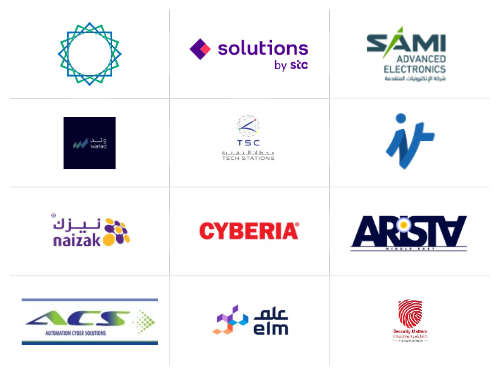
Key Saudi Arabia Industrial Cybersecurity Companies:
Solutions by STC
Elm Company
Advanced Electronics Company
Tech Stations Company
Watad Energy
Infratech Co
Naizak Global Engineering Systems
Cyberani Solutions
Cyberia Group
Security Matterz
Arista Middle East
Automation & Cyber Solutions
Saudi Arabia Industrial Cybersecurity Market Developments
In January 2025, Honeywell International Inc. established a new cybersecurity center in Jubail focused on providing specialized OT security services for industrial sectors, and enhancing operational technology protection and helping businesses maintain compliance with evolving regulations.
In November 2024, Security Matterz and Cofense announced a strategic partnership to enhance email security capabilities across Saudi Arabia's industrial sector, addressing the growing threat of spear-phishing attacks targeting OT personnel.
In December 2024, the National Cybersecurity Authority released the Cybersecurity Toolkit 2.0, introducing enhanced guidelines for operational technology security in industrial control systems and establishing new requirements for supply chain security in critical infrastructure.
In November 2023, Fortinet Inc. participated in Black Hat Middle East & Africa, hosted in Riyadh, where it presented its OT solutions.
Want a report tailored exactly to your business need?
Leading companies across industries trust us to deliver data-driven insights and innovative solutions for their most critical decisions. From data-driven strategies to actionable insights, we empower the decision-makers who shape industries and define the future. From Fortune 500 companies to innovative startups, we are proud to partner with organisations that drive progress in their industries.
Client Testimonials
Working with P&S Intelligence and their team was an absolute pleasure – their awareness of timelines and commitment to value greatly contributed to our project's success. Eagerly anticipating future collaborations.
McKinsey & Company
India
Unmatched Standards
Our insights into the minutest levels of the markets, including the latest trends and competitive landscape, give you all the answers you need to take your business to new heights
Complete Data Security
We take a cautious approach to protecting your personal and confidential information. Trust is the strongest bond that connects us and our clients, and trust we build by complying with all international and domestic data protection and privacy laws