Saudi Arabia Home Appliances Market Size & Share Analysis - Trends, Drivers, Competitive Landscape, and Forecasts (2026 - 2032)
This Report Provides In-Depth Analysis of the Saudi Arabia Home Appliances Market Report Prepared by P&S Intelligence, Segmented by Product Type (Major Appliances, Small Appliances), Distribution Channel (Supermarkets & Hypermarkets, Specialty/ Electronic stores, E-commerce / Online platforms, Direct sales / Distributor networks), Technology (Smart Appliances, Conventional Appliances, Energy-Efficient / Inverter Technology Appliances), End Use (Residential, Commercial, Institutional/ Government & Utilities), and Geographical Outlook for the Period of 2019 to 2032
Explore the market potential with our data-driven report
Saudi Arabia Home Appliances Market Overview
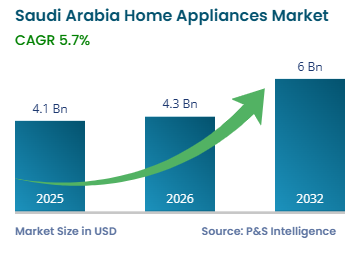
The Saudi Arabian home appliances market size will be an estimated USD 4.1 billion for 2025, and it will grow by 5.7% during 2026–2032, to reach USD 6.0 billion by 2032.
The market growth is primarily driven by Vision 2030 initiatives accelerating homeownership, massive giga-project developments creating demand for new housing units, and rising disposable incomes among Saudi households, encouraging premiumization and smart appliance adoption.
Moreover, increasing urbanization and rising household formation are creating steady demand for both essential and premium home appliances across major cities. The expansion of retail infrastructure, including supermarkets, hypermarkets, and brand outlets, is improving accessibility to a wide range of home appliances for consumers.
Additionally, the Saudi Standards, Metrology, and Quality Organization's (SASO) stringent energy efficiency requirements are reshaping the home appliances landscape.
Mandatory labeling encourages replacement cycles toward inverter-grade air conditioners and A-rated refrigerators, increasing demand for modern and energy-efficient appliances.
Saudi Arabia Home Appliances Market Dynamics
E-Commerce Expansion Is Key Trend Transforming Distribution and Consumer Access
The explosive growth of e-commerce in Saudi Arabia is fundamentally altering how consumers discover, compare, and purchase home appliances.
With 99% internet penetration and wide access to 5G networks, Saudi consumers increasingly prefer the convenience, product variety, and competitive pricing offered by online platforms.
According to the Saudi Press Agency, e-commerce transactions in the kingdom via Mada cards during the initial quarter of 2025 valued over SAR 69.3 billion.
This represents an annual growth of 56%, alongside an increase of roughly SAR 24.9 billion compared to the corresponding period in 2024, when sales were recorded at SAR 44.4 billion.
Online channels enable consumers in tier-2 and tier-3 cities to access premium appliance brands previously available only in major urban centers.
E-commerce platforms offer comprehensive product specifications, customer reviews, flexible payment options, including installment plans, and doorstep delivery, removing traditional barriers to appliance purchases.
This digital transformation also benefits manufacturers and retailers through reduced overhead costs, data-driven inventory management, and targeted marketing capabilities, collectively driving market penetration and revenue growth.
Vision 2030 Housing Program Is Biggest Driver
The Housing Program under Vision 2030 stands as a fundamental driver for the Saudi Arabian home appliances market.
As per the Ministry of Municipalities and Housing, the program has successfully increased homeownership from 47% in 2016 to 65.4% in 2024, with over 850,000 residential product contracts signed since its inception.
This rapid expansion in homeownership creates immediate demand for major appliances, including refrigerators, washing machines, and air conditioners, as new households establish their living spaces.
The program's provision of subsidized mortgages, flexible financing solutions, and land development contracts has made home acquisition accessible to a broader segment of the population, directly translating to increased appliance purchases.
The program has signed more than 26,000 land‑product contracts in 2023 as part of efforts to expand housing supply and affordability.
The program aims to raise the home‑ownership rate among Saudi families to 70% by 2030.
The government's commitment to achieving 70% homeownership by 2030 ensures sustained market momentum, as the remaining growth requires furnishing hundreds of thousands of additional homes with complete appliance suites, from cooking ranges to smart refrigerators.
Saudi Arabia Home Appliances Market Segmentation Analysis
Product Type Analysis
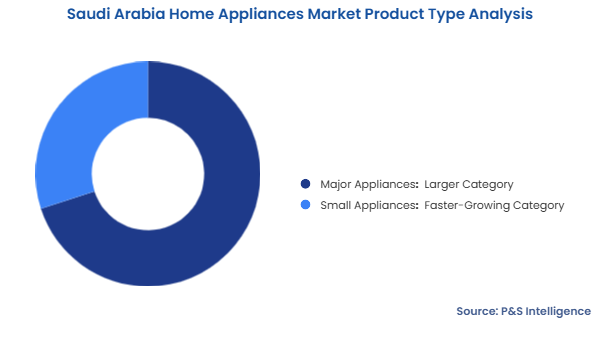
The major appliances category holds the larger market share, of 70%, in 2025. This substantial market position is primarily attributed to the essential nature of major appliances in Saudi households, where refrigerators, air conditioners, and washing machines constitute non-discretionary purchases for new homeowners and those undergoing appliance replacement cycles. Additionally, the average household size of 4.8 for Saudi nationals necessitates larger capacity appliances, further driving value sales within this category.
The small appliances category will have the higher CAGR, of 6.0%, driven by rising disposable incomes, lifestyle changes, and increasing awareness of specialized kitchen and cleaning solutions. The proliferation of smart home technologies has also spurred interest in connected small appliances offering convenience features like app-based controls and voice activation. Furthermore, small appliances typically have lower price points and shorter replacement cycles, encouraging frequent upgrades and impulse purchases, especially through expanding e-commerce channels that facilitate product discovery and competitive pricing.
The product types analyzed in this report are:
Major Appliances (Larger Category)
Refrigerators
Washing Machines
Air Conditioners & Heaters
Dishwashers
Dryers
Cooking Ranges & Ovens
Others
Small Appliances (Faster-Growing Category)
Coffee Makers
Blenders
Food Processors
Vacuum Cleaners
Air Purifiers
Irons
Others
Distribution Channel Analysis
The supermarkets & hypermarkets category holds the largest market share in 2025. These large-format retail outlets benefit from their extensive physical footprints across major cities, offering consumers the ability to physically examine appliances, compare multiple brands under one roof, and receive immediate product availability. During major shopping periods like Ramadan and national holidays, supermarkets and hypermarkets attract price-conscious consumers through promotional campaigns, seasonal discounts, extended warranties, and bundled offers.
The e-commerce/online platforms category will have the highest CAGR during the forecast period. The Kingdom's exceptional digital infrastructure and widespread smartphone adoption enable seamless mobile shopping experiences. Online platforms provide unparalleled convenience through 24/7 accessibility, doorstep delivery, flexible payment options, including buy-now-pay-later schemes, and comprehensive product information with customer reviews. The expansion of logistics networks and last-mile delivery capabilities, coupled with secure digital payment systems, such as Mada, Apple Pay, and STC Pay, has eliminated traditional barriers to online appliance purchases. Additionally, online retailers can offer competitive pricing through reduced overhead costs and targeted promotions, while data analytics enable personalized recommendations and enhanced customer engagement.
The distribution channels analyzed in this report are:
The conventional appliances category holds the largest market share, of 65%, in 2025, due to their established market presence, lower price points, and widespread familiarity among consumers. Conventional appliances continue to meet the basic functional requirements of households at accessible price ranges, making them particularly appealing to price-sensitive consumer segments and households prioritizing immediate affordability over advanced features. The extensive distribution networks and after-sales service infrastructure for conventional appliances also support their continued dominance, especially in tier-2 and tier-3 cities where premium technology penetration remains lower.
The smart appliances category will have the highest CAGR, of 5.9%, driven by the tech-savvy population and increasing awareness of IoT capabilities. The proliferation of smartphone usage and high-speed internet connectivity enables seamless integration of smart appliances with home automation ecosystems, allowing remote control, energy monitoring, and predictive maintenance through mobile applications. The giga-projects' emphasis on smart infrastructure, including NEOM's cognitive cities, is accelerating the adoption of connected appliances that interface with energy management platforms and demand response systems. Consumers increasingly value the convenience of voice-activated controls through assistants like Alexa and Google Home, scheduled operation for time-of-use electricity optimization, and real-time diagnostics that reduce service downtime.
The technologies analyzed in this report are:
Smart Appliances (Fastest-Growing Category)
Conventional Appliances (Largest Category)
Energy-Efficient/Inverter Technology Appliances
End User Analysis
The residential category holds the largest market share, of 75%, in 2025, driven by the Kingdom's focus on expanding homeownership and the substantial growth in household formation. Furthermore, according to the General Authority for Statistics, the average household's monthly disposable income reached approximately SAR 11,839 in 2023, with expenditure on furnishings and household equipment accounting for 7.0% of consumption. This demonstrates a strong purchasing capacity for both essential and premium appliances.
The commercial category will have the highest CAGR, of 6.1%, propelled by massive investments in hospitality, healthcare, and office infrastructure associated with giga-projects. The anticipated delivery of 330,000 hotel rooms in western Saudi Arabia by 2030 is set to drive significant demand for commercial-grade appliances, including industrial refrigeration, commercial dishwashers, and HVAC systems. Tourism sector growth, with passenger arrivals increasing by 58% in 2023 according to the Ministry of Tourism, is driving hotel and restaurant development, requiring specialized appliance installations. Additionally, the expansion of healthcare facilities and modern office complexes as part of economic diversification efforts necessitates commercial appliances designed for high-volume, continuous operation with stringent durability and efficiency standards.
The end users analyzed in this report are:
Residential (Largest Category)
Commercial (Fastest-Growing Category)
Institutional / Government & Utilities
Drive strategic growth with comprehensive market analysis
Saudi Arabia Home Appliances Market Geographical Analysis
Al-Riyadh Home Appliances Market Size
Al-Riyadh holds the largest market share, of 30%, in 2025. This dominant position is attributed to Riyadh's status as the Kingdom's capital and most populous city, with a population exceeding 7.9 million people representing nearly 24.9% of Saudi Arabia's total population. The capital serves as the nation's primary commercial, administrative, and economic hub, creating the highest concentration of households and purchasing power. Riyadh accounts for 22.7% of all Saudi households nationwide, with the Saudi household population alone reaching 681,591 households.
The city's ongoing transformation through landmark projects, including Diriyah Gate, King Salman Park, and the 220-kilometer Sports Boulevard, is reshaping the urban landscape and generating substantial demand for both residential and commercial appliances. The concentration of government institutions, corporate headquarters, and high-income professionals further solidifies Riyadh's position as the market leader, driving demand for premium and smart appliances alongside mass-market products.
Makkah Home Appliances Market Size
Makkah will have the highest CAGR, of 5.8%, driven by the western region's emergence as the centerpiece of Vision 2030, hosting 17 giga-projects with total announced investments of USD 431.3 billion since 2016. The province, which includes the major commercial hub of Jeddah, benefits from the concentration of transformative developments, including NEOM, the Red Sea Global project, and Qiddiya Coast, with USD 187.2 billion remaining in the pipeline for execution. These initiatives are expected to deliver more than 382,500 new homes, over 3 million square meters of office space, 4.3 million square meters of retail space, and 330,000 hotel rooms by 2030, creating unprecedented demand for home appliances across residential, commercial, and hospitality segments.
The provinces of the market are as follows:
Al-Riyadh (Largest Province)
Eastern Province
Makkah (Fastest-Growing Province)
Madinah
Qassim
Asir
Tabuk
Ha'il
Northern Borders
Jazan
Najran
Al-Baha
Al-Jouf
Saudi Arabia Home Appliances Market Share
The market is fragmented with multiple international and regional players competing across various product segments and price points. The market features established global brands leveraging their technological expertise and brand recognition alongside aggressive regional distributors offering competitive pricing and localized service networks. The competitive landscape is characterized by no single player holding dominant market control. This fragmentation creates opportunities for both established players to expand through innovation and premiumization, and for emerging brands to capture market share through value propositions, particularly in the rapidly growing smart appliances and energy-efficient categories. Recent strategic activities demonstrate market dynamism, with major players investing in manufacturing capabilities, forming retail partnerships, and launching innovative product lines.
Key Saudi Arabia Home Appliances Companies:
Samsung Electronics Co., Ltd.
LG Electronics Inc.
Whirlpool Corporation
Haier Group Corporation
Robert Bosch GmbH
Panasonic Corporation
Midea Group Co., Ltd.
Electrolux AB
Hisense Group
TCL Technology Group Corporation
Hitachi Global Life Solutions, Inc.
Daikin Industries, Ltd.
Gree Electric Appliances Inc.
Ar
Al-Jabr Trading & Industrial Co.
Saudi Arabia Home Appliances Market News
In May 2025, Panasonic Marketing Middle East and Africa announced a partnership with Alessa Industries Co., appointing it as the official distributor of Panasonic's premium large home appliances, including washing machines and refrigerators, in Saudi Arabia to strengthen market presence.
In December 2024, Al Hassan Ghazi Ibrahim Shaker Co. (Shaker) signed a strategic partnership with Stanley Black & Decker to distribute the BLACK+DECKER appliances range in Saudi Arabia.
In October 2024, Mastercard Inc. implemented new technology infrastructure in Saudi Arabia, enabling local processing of e-commerce transactions, designed to offer secure and efficient payment services.
In February 2024, Al Hassan Ghazi Ibrahim Shaker Co. (Shaker), LG Electronics, and the Ministry of Investment of Saudi Arabia signed an MoU to explore local manufacturing of AC compressors in Saudi Arabia.
Want a report tailored exactly to your business need?
Leading companies across industries trust us to deliver data-driven insights and innovative solutions for their most critical decisions. From data-driven strategies to actionable insights, we empower the decision-makers who shape industries and define the future. From Fortune 500 companies to innovative startups, we are proud to partner with organisations that drive progress in their industries.
Client Testimonials
Working with P&S Intelligence and their team was an absolute pleasure – their awareness of timelines and commitment to value greatly contributed to our project's success. Eagerly anticipating future collaborations.
McKinsey & Company
India
Unmatched Standards
Our insights into the minutest levels of the markets, including the latest trends and competitive landscape, give you all the answers you need to take your business to new heights
Complete Data Security
We take a cautious approach to protecting your personal and confidential information. Trust is the strongest bond that connects us and our clients, and trust we build by complying with all international and domestic data protection and privacy laws