Saudi Arabia Heritage Tourism Market Size & Opportunities Analysis - Growth Strategies, Competitiveness, and Forecasts (2026 - 2032)
This Report Provides In-Depth Analysis of the Saudi Arabia Heritage Tourism Market Report Prepared by P&S Intelligence, Segmented by Type (Cultural Heritage, Natural Heritage, Intangible Heritage), Age Group (30 and Under, 31 to 50, 51 to 70, 71 and Above), Booking Mode (Offline, Online), Visitor Type (Domestic, International), Travel Purpose (Leisure & Recreation, Education & Research, Festivals & Cultural Events, Religious & Pilgrimage-Linked Heritage, Business, MICE & Institutional Visits), and Geographical Outlook for the Period of 2021 to 2032
Saudi Arabia Heritage Tourism Market Growth Potential
Key Highlights
Study Period
2021 - 2032
Market Size in 2025
USD 5.3 Billion
Market Size in 2026
USD 5.6 Billion
Market Size by 2032
USD 8.1 Billion
Projected CAGR
6.2%
Largest Province
Makkah
Fastest-Growing Province
Madinah
Market Structure
Fragmented
Market Size
Explore the market potential with our data-driven report
Saudi Arabia Heritage Tourism Market Outlook
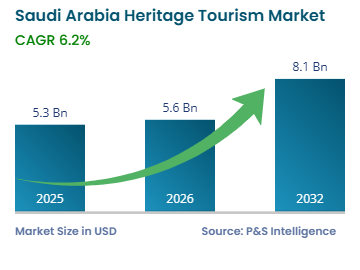
The Saudi Arabian heritage tourism market size will be an estimated USD 5.3 billion for 2025, and it will grow by 6.2% during 2026–2032, to reach USD 8.1 billion by 2032.
This robust expansion is primarily driven by the Kingdom's transformative Vision 2030 initiative, substantial government investments in heritage site restoration and development, and the country's strategic positioning as a hub for cultural and historical exploration in the Middle East.
The Saudi government has committed more than USD 800 billion to tourism infrastructure development by 2030, with heritage and cultural tourism identified as a key driver of economic diversification. Flagship giga-projects, such as AlUla, Diriyah Gate, and the restoration of Historic Jeddah Al-Balad, are transforming centuries-old heritage sites into world-class tourist destinations. According to UNESCO, Saudi Arabia now has eight World Heritage Sites, including seven cultural sites and one natural site, reflecting the Kingdom's rich historical and archaeological significance spanning from Nabataean civilizations to Islamic heritage.
The market benefits from simplified visa procedures introduced in 2019, expanded international flight connectivity, and enhanced digital infrastructure supporting heritage site accessibility. Domestic tourism interest has surged simultaneously, with 86.2 million domestic travelers in 2024 increasingly exploring local heritage sites, supported by national campaigns promoting Saudi cultural identity and historical awareness.
Saudi Arabia Heritage Tourism Market Growth Factors
Digital Technology Integration and Immersive ExperiencesAre Key Trends
Saudi heritage sites are increasingly deploying advanced technologies to enhance visitor experiences and educational outcomes.
Augmented reality applications enable tourists to visualize historical reconstructions of archaeological sites, viewing ancient structures in their original contexts.
At Hegra, visitors use AR-enabled devices to experience three-dimensional representations of Nabataean tombs and settlements as they appeared 2,000 years ago, deepening engagement with cultural heritage narratives.
Virtual reality installations at heritage museums and visitor centers provide immersive journeys through different historical periods.
The National Museum in Riyadh utilizes VR technology to transport visitors through Saudi Arabia's geological formation, prehistoric settlements, and Islamic civilization milestones.
Artificial intelligence-powered guide systems offer personalized heritage tours based on visitor preferences, language requirements, and time availability.
Smart applications provide multilingual audio guides, historical context, and navigation assistance across large heritage complexes.
Digital ticketing systems, contactless payments, and mobile-based information platforms streamline visitor operations, improving overall heritage site accessibility and operational efficiency.
3D documentation and digital preservation efforts create permanent digital records of heritage sites, supporting both conservation management and educational applications.
Photogrammetry and laser scanning technologies capture detailed site measurements and conditions, enabling virtual access for global audiences and academic researchers unable to visit physically.
These digital archives support long-term conservation monitoring and restoration planning.
Social media platforms and digital marketing campaigns expand heritage tourism reach to international markets.
UNESCO recognition announcements, archaeological discoveries, and cultural festivals generate significant social media engagement, attracting global attention to Saudi heritage assets.
According to tourism analytics, heritage-related content drives substantial online traffic, translating into increased visitation inquiries and booking conversions for heritage tourism packages.
Saudi Arabia's Vision 2030 framework represents a comprehensive national transformation program aimed at reducing oil dependency and diversifying economic revenue streams.
Heritage tourism has emerged as a cornerstone of this strategy, with the government targeting 150 million annual visitors by 2030, a substantial increase from 116 million tourists recorded in 2024.
According to the World Travel and Tourism Council, tourism is forecast to contribute SAR 836 billion to GDP by 2034, representing nearly 16% of the Saudi economy.
The government established dedicated authorities, including the Royal Commission for AlUla and Diriyah Gate Development Authority, to oversee heritage preservation and tourism development.
These authorities implement international best practices in heritage conservation, visitor experience design, and sustainable tourism management.
Investment in heritage infrastructure includes the construction of visitor centers, museums, hospitality facilities, and transportation networks connecting remote heritage sites to major urban centers.
The Public Investment Fund allocated billions of riyals toward cultural tourism projects, partnering with global hospitality brands, such as Ritz-Carlton, Park Hyatt, and Accor, to develop luxury accommodations near heritage destinations.
This public–private partnership model accelerates infrastructure development, while ensuring heritage sites maintain authenticity and historical integrity.
According to the Saudi Ministry of Tourism, over 1,000 tourism and cultural projects are under development across the Kingdom, many centered on heritage assets and historical narratives.
The strategy emphasizes community involvement and local economic empowerment.
Heritage site development creates employment opportunities in hospitality, guiding services, traditional crafts, and cultural programming.
Training programs equip Saudi citizens with specialized skills in heritage conservation, tourism management, and multilingual communication, addressing both youth employment objectives and sector professionalization requirements.
Saudi Arabia Heritage Tourism Market Segmentation Analysis
Type Analysis
The cultural heritage category holds the largest market share, of 55%, in 2025, driven by the Kingdom's extensive portfolio of UNESCO World Heritage Sites, Islamic historical landmarks, and traditional architectural complexes. This category encompasses archaeological sites, such as Hegra and Al-Faw; historic urban districts, such as Jeddah Al-Balad and At-Turaif in Diriyah; traditional markets, museums showcasing Saudi Arabian history, and cultural festivals celebrating regional heritage.
The natural heritage category will have the highest CAGR, of 8.3%, driven by government initiatives emphasizing eco-tourism development, adventure tourism offerings, and conservation of unique desert, mountain, and coastal ecosystems. This segment includes protected natural reserves, desert landscapes, mountain regions such as Asir and Tabuk, coastal areas along the Red Sea and Arabian Gulf, and geological formations showcasing Arabia's natural history. Giga-projects like the Red Sea Development and NEOM incorporate natural heritage preservation within luxury tourism frameworks, demonstrating Saudi Arabia's capacity to develop eco-conscious tourism infrastructure.
The types analyzed in this report are:
Cultural Heritage (Largest Category)
Natural Heritage (Fastest-Growing Category)
Intangible Heritage
Age Group Analysis
The 51 to 70 years category holds the largest market share, of 60%, in 2025, driven by the strong preferences for culturally enriching, historically significant, and educational travel experiences. This demographic comprises financially stable pre-retirees and retirees with substantial disposable income, flexible travel schedules, and a deep appreciation for historical narratives, architectural heritage, and cultural authenticity. Heritage tourism appeals to this age group's desire for meaningful travel experiences that provide intellectual stimulation, spiritual connections, and nostalgic engagement with traditional cultures and historical periods.
The 31 to 50 years category will have the highest CAGR, of 8.4%, driven by the rising preferences for culturally rich, experience-based travel among mid-career professionals and young families. This demographic seeks balance between leisure and learning, demonstrating strong interest in authentic experiences, offering deeper engagement with historical, spiritual, and architectural heritage. Growth drivers include higher disposable incomes among Saudi professionals, increasing exposure to international travel trends, and a desire for family-oriented educational vacations aligning with personal values. This segment exhibits greater digital adoption in travel planning and booking processes, preferring online research, user-generated reviews, and social media recommendations over traditional travel agency consultations.
The age groups analyzed in this report are:
30 Years and Under
31 to 50 Years (Fastest-Growing Category)
51 to 70 Years (Largest Category)
71 Years and Above
Booking Mode Analysis
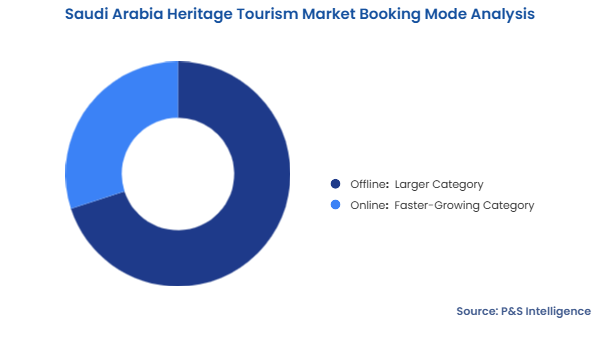
The offline category holds the larger market share, of 70%, in 2025, representing the dominant booking method, particularly among older travelers, group tour participants, and international visitors seeking personalized travel planning for culturally significant experiences. Heritage tourism's complexity, involving multi-day itineraries, remote destination access, and immersive cultural programming, drives preference for professional travel agents and tour operators offering expertise, assurance, and tailored service delivery.
The online category will have the higher CAGR, of 8.5%, driven by the increasing digital adoption among younger travelers, enhanced online booking platforms offering comprehensive heritage tourism products, and preference for self-directed travel planning with real-time information access. Growth factors include smartphone penetration, improved internet connectivity, and digital payment infrastructure facilitating online transactions.
The booking modes analyzed in this report are:
Offline (Larger Category)
Online (Faster-Growing Category)
Visitor Type Analysis
The domestic category holds the larger market share in 2025, driven by high local travel volumes, government-backed domestic tourism promotion, and growing engagement of Saudi citizens with national heritage assets. Government initiatives promoting domestic heritage tourism include Saudi Seasons programs, national holiday heritage programming, and educational campaigns encouraging Saudi citizens to explore historical and cultural sites.
The international category will have the higher CAGR, supported by visa policy reforms, expanded air connectivity, and rising global interest in Saudi Arabia’s UNESCO-listed heritage and archaeological destinations. International tourists contribute high-value visitation with longer stay durations and higher spending patterns compared to domestic travelers. With approximately 30 million international visitors in 2024, foreign tourism drives heritage destination development and premium product offerings. International heritage tourists seek authentic cultural experiences, archaeological site access, and deep engagement with Saudi Arabian history, distinguishing the Kingdom from generic tourism destinations.
The visitor types analyzed in this report are:
Domestic (Larger Category)
International (Faster-Growing Category)
Travel Purpose Analysis
The leisure & recreation category holds the largest market share in 2025, driven by strong demand for experiential cultural tourism, heritage sightseeing, and leisure-oriented programming across major heritage destinations. Heritage destinations develop leisure-oriented programming, including sound-and-light shows at archaeological sites, cultural performances, traditional craft demonstrations, and culinary experiences featuring regional cuisines. These offerings transform passive heritage site visitation into engaging leisure activities appealing to diverse tourist interests. Winter at Tantora Festival in AlUla exemplifies the successful integration of heritage assets with contemporary leisure programming, attracting both domestic and international leisure tourists.
The festivals & cultural events category will have the highest CAGR during the forecast period, driven by the Kingdom’s goal to diversify its economy beyond oil and strengthen the tourism sector under Vision 2030. Festivals promote Saudi culture and heritage globally, enhance the country’s international image, and encourage cultural exchange, supporting long-term sustainable economic and social development.
The travel purposes analyzed in this report are:
Leisure & Recreation (Largest Category)
Education & Research
Festivals & Cultural Events (Fastest-Growing Category)
Religious & Pilgrimage-Linked Heritage
Business, MICE & Institutional Visits
Others
Drive strategic growth with comprehensive market analysis
Saudi Arabia Heritage Tourism Market Regional Outlook
Makkah Heritage Tourism Market Size
Makkah holds the largest market share, of 25%, in 2025, driven by the integration of Islamic heritage tourism with religious pilgrimage traffic and development of Historic Jeddah as a major heritage tourism destination. The province benefits from massive religious tourism flows, with millions of pilgrims visiting annually for Hajj and Umrah, creating opportunities for heritage tourism, complementing religious travel.
Historic Jeddah Al-Balad, inscribed as a UNESCO World Heritage Site in 2014, represents the province's premier heritage tourism asset. The district features approximately 600 traditional coral-stone buildings showcasing Red Sea architectural traditions, wooden Roshan windows, and narrow alleyways reflecting centuries of maritime trade heritage. Restoration programs preserve historical structures while introducing contemporary cultural venues, art galleries, cafes, and boutique hotels.
Jeddah's position as Saudi Arabia's second-largest city and main Red Sea port provides substantial hospitality infrastructure, international airport connectivity, and diverse visitor services supporting heritage tourism. The city serves as a gateway for international tourists arriving by sea or air, with heritage tourism offerings complementing beach tourism, business travel, and urban cultural activities. Jeddah Season festivals and cultural programming create year-round heritage tourism appeal beyond religious tourism peak seasons.
Makkah city's Islamic historical sites, including early Islamic monuments, historical mosques beyond the Grand Mosque, and locations significant to Islamic history, attract religiously motivated heritage tourists. While access restrictions apply to non-Muslims in Makkah's holy areas, Muslim heritage tourists increasingly explore Islamic historical sites during pilgrimage visits.
Madinah Heritage Tourism Market Size
Madinah will have the highest CAGR, of 8.2%, with dual advantages of religious pilgrimage traffic and significant early Islamic heritage sites surrounding the Prophet's Mosque. Heritage tourism in Madinah focuses on Islamic historic locations, including battlefields, early mosques, historical gardens, and sites connected to Prophet Muhammad's life and early Islamic period. Muslim tourists visiting for religious purposes extend stays to explore these heritage sites, generating substantial heritage tourism demand.
The province invested significantly in heritage site conservation, visitor facilities, and interpretation centers explaining Islamic historical narratives. Museums showcase early Islamic artifacts, historical documents, and archaeological findings from early Islamic settlements. These facilities serve both educational purposes for Muslim visitors, deepening religious knowledge and heritage tourism objectives, attracting cultural tourists interested in Islamic civilization.
Madinah's relatively compact urban form allows heritage tourists to access multiple sites efficiently, supporting day-long heritage itineraries combining religious site visitation with historical exploration. Tour guides specializing in Islamic history and early Islamic period provide interpretation services, enhancing heritage tourist experiences and understanding of sites' religious and historical significance.
The provinces of the market are as follows:
Al-Riyadh
Eastern Province
Makkah (Largest Province)
Madinah (Fastest-Growing Province)
Qassim
Asir
Tabuk
Ha'il
Northern Borders
Jazan
Najran
Al-Baha
Al-Jouf
Saudi Arabia Heritage Tourism Market Share
The market is fragmented due to the presence of diversified operators, including global tour companies, regional travel agencies, specialized heritage tourism operators, destination management companies, and government-backed tourism authorities. Market fragmentation reflects the sector's development stage, with numerous players establishing positions as heritage tourism expands under Vision 2030 initiatives. Government entities play significant roles as heritage site operators and tourism development authorities. The competitive environment encourages collaboration alongside competition, with tour operators partnering with heritage site authorities, accommodation providers, and cultural institutions to deliver comprehensive heritage tourism experiences.
Key Saudi Arabia Heritage Tourism Companies:
Seera Group
Platinum Heritage
Zahid Travel Group
Al Faris International Travel & Tourism
Fursan Travel
Rahhalah Explorers
Awtad Travel & Tourism
Tourist Saudi
Jana Tours
Wadi Tours
Abercrombie & Kent
Tetrapylon Destination Management Company
Saudi Arabia Heritage Tourism Market News
In April 2025, Almosafer announced a strategic partnership with Wyndham Hotels & Resorts, Inc. during Arabian Travel Market 2025, expanding access to over 9,300 Wyndham properties across 95 countries. The collaboration supports Saudi Arabia’s Vision 2030 tourism objectives by strengthening accommodation availability near key heritage destinations.
In November 2024, Diriyah Company signed five major travel trade agreements at World Travel Market London with Almosafer, Tetrapylon Destination Management Company, and Abercrombie & Kent USA LLC to enhance Diriyah’s international positioning as a leading cultural and heritage destination through coordinated marketing initiatives and destination-focused toolkits.
In July 2024, UNESCO inscribed the Cultural Landscape of Al-Faw Archaeological Area as Saudi Arabia's eighth World Heritage Site during the World Heritage Committee session in New Delhi. The designation recognizes the site’s exceptional pre-Islamic archaeological and cultural significance, strengthening the Kingdom’s global heritage tourism profile.
Want a report tailored exactly to your business need?
Leading companies across industries trust us to deliver data-driven insights and innovative solutions for their most critical decisions. From data-driven strategies to actionable insights, we empower the decision-makers who shape industries and define the future. From Fortune 500 companies to innovative startups, we are proud to partner with organisations that drive progress in their industries.
Client Testimonials
Working with P&S Intelligence and their team was an absolute pleasure – their awareness of timelines and commitment to value greatly contributed to our project's success. Eagerly anticipating future collaborations.
McKinsey & Company
India
Unmatched Standards
Our insights into the minutest levels of the markets, including the latest trends and competitive landscape, give you all the answers you need to take your business to new heights
Complete Data Security
We take a cautious approach to protecting your personal and confidential information. Trust is the strongest bond that connects us and our clients, and trust we build by complying with all international and domestic data protection and privacy laws