Saudi Arabia Healthcare IT Market Size & Opportunities Analysis - Growth Strategies, Competitiveness, and Forecasts (2026 - 2032)
This Report Provides In-Depth Analysis of the Saudi Arabia Healthcare IT Market Report Prepared by P&S Intelligence, Segmented by Deployment Mode (Cloud-Based, On-Premises, Web-Based), Component (Services, Software, Hardware), Method (Hospital-Based Care, Home Healthcare & Remote Monitoring, Ambulatory & Outpatient Care, Post-Acute & Rehabilitation Care, Preventive & Community Health Services), Application (Clinical Information Systems, Non-Clinical Information Systems, Telehealth & Remote Care Solutions, eClinical Solutions, Population Health & Analytics Solutions, Licensing & Delivery Solutions), and Geographical Outlook for the Period of 2019 to 2032
Saudi Arabia Healthcare IT Market Revenue Insights
Key Highlights
Study Period
2019 - 2032
Market Size in 2025
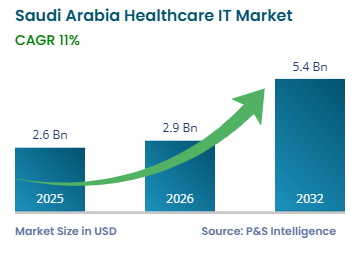
USD 2.6 Billion
Market Size in 2026
USD 2.9 Billion
Market Size by 2032
USD 5.4 Billion
Projected CAGR
11%
Largest Province
Al-Riyadh
Fastest-Growing Province
Makkah
Market Structure
Semi-Consolidated
Market Size
Explore the market potential with our data-driven report
Saudi Arabia Healthcare IT Market Future Outlook
The Saudi Arabian healthcare IT market size will be an estimated USD 2.6 billion for 2025, and it will grow by 11.0% during 2026–2032, to reach USD 5.4 billion by 2032.
The market growth is driven by government support through Vision 2030 healthcare digitalization initiatives, the rising prevalence of chronic diseases, and expanding adoption of telehealth and electronic health records across healthcare facilities.
The Saudi government has made substantial investments to transform the healthcare landscape through digital technologies. The establishment of nationwide digital health platforms such as Seha Virtual Hospital, which connects over 224 healthcare facilities, reflects the kingdom's dedication to improving healthcare access and efficiency through information technology solutions.
The growing burden of chronic diseases is driving demand for advanced healthcare IT systems that enable better disease management, remote patient monitoring, and data-driven clinical decision-making. The integration of artificial intelligence, predictive analytics, and cloud-based platforms is positioning Saudi Arabia as a frontrunner in regional digital health transformation.
Saudi Arabia Healthcare IT Market Trends & Drivers
Telehealth Adoption for Enhanced Healthcare Delivery Is Key Trend
The rapid adoption of telehealth and remote care solutions represents a transformative trend in the Saudi healthcare IT market.
Saudi Arabia has launched the Seha Virtual Hospital, connecting over 224 facilities and using AI and augmented reality to provide virtual consultations.
This massive virtual care infrastructure demonstrates the kingdom's commitment to overcoming geographical barriers and improving healthcare accessibility across vast rural and urban areas.
The government actively supports telemedicine through digital platforms, such as Sehhaty and Wasfaty applications, which enable citizens to access medical consultations, prescription refills, and health information remotely.
The 937 Call Center provides nationwide telehealth services, offering patients convenient access to medical advice without requiring physical clinic visits.
Smartphone penetration and improved internet infrastructure have accelerated consumer adoption of digital health services, particularly among Saudi Arabia's young, tech-savvy population.
Citizens increasingly engage with fitness applications, wearable devices, and online consultation platforms to monitor and manage their health.
The convergence of telecommunications technology, cloud computing, and healthcare services underscores Saudi Arabia's evolution toward a patient-centric, technologically advanced healthcare ecosystem that prioritizes accessibility, efficiency, and quality medical care for its growing population.
Vision 2030 InitiativeIs Biggest Driver
The Saudi Vision 2030 strategic framework serves as the primary catalyst propelling healthcare IT adoption across the kingdom.
Vision 2030 aims to modernize Saudi Arabia's healthcare system through the integration of advanced technologies, such as electronic health records, telemedicine, and other next-generation medical innovations.
The Health Sector Transformation Programme, launched under this initiative, focuses on restructuring the health sector into a comprehensive, effective, and integrated health system based on value-based care principles.
As part of Vision 2030, the kingdom established the Saudi Data & AI Authority to drive AI adoption and strategic data use, positioning itself as a global AI leader, with USD 1.5 billion allocated for health information technology.
The government has committed USD 57.04 billion (SAR 214 billion) to health and social development in 2024, prioritizing new hospitals, health services expansion, and digital infrastructure development.
The Ministry of Health aims for at least 70% of Saudi citizens to have unified digital health records, demonstrating the ambitious scope of digital transformation efforts.
The National eHealth strategy facilitates the integration of healthcare information systems across public and private sectors, ensuring seamless data exchange and interoperability.
These government-led initiatives create a favorable regulatory environment that accelerates healthcare IT implementation, encourages private sector participation through public-private partnerships, and establishes the foundation for a technologically advanced healthcare ecosystem throughout the kingdom.
Saudi Arabia Healthcare IT Market Segmentation Analysis
Deployment Mode Analysis
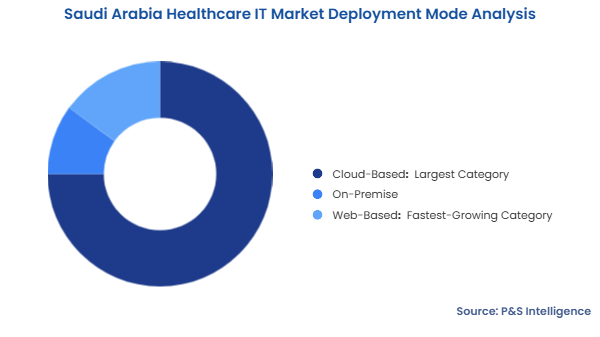
The cloud-based category holds the largest market share, of 75%, in 2025, due to scalability advantages, cost-effectiveness, and improved accessibility to real-time data. Cloud infrastructure enables real-time data exchange across multiple healthcare facilities, supports big data analytics and AI-driven predictive modeling, and provides robust cybersecurity frameworks essential for protecting sensitive health information in an increasingly digital environment.
The web-based category will have the highest CAGR, of 11.4%, due to the increasing demand for flexible, subscription-based software models that reduce upfront capital expenditure for healthcare providers. Small and medium-sized clinics, diagnostic centers, and specialty hospitals particularly benefit from SaaS platforms that offer enterprise-grade functionality without requiring extensive on-premises IT infrastructure. The growing ecosystem of healthcare technology startups developing innovative SaaS applications for specific clinical specialties and administrative functions is expanding market options for Saudi healthcare organizations.
The deployment modes analyzed in this report are:
Cloud-Based (Largest Category)
On-Premise
Web-Based (Fastest-Growing Category)
Component Analysis
The services category holds the largest market share, of 50%, in 2025. This lead reflects the substantial demand for implementation support, system integration, cybersecurity management, training programs, and ongoing maintenance required for complex healthcare IT deployments. Healthcare providers increasingly rely on specialized consulting services to navigate regulatory requirements, optimize workflows, and ensure successful technology adoption across clinical and administrative staff.
The software category will have the highest CAGR, of 11.3%, due to the continuous innovation in healthcare applications, increasing adoption of AI-powered diagnostic tools, and expanding demand for specialized clinical software solutions. The development of Arabic language health applications, culturally tailored telemedicine platforms, and locally compliant e-prescribing systems is further propelling software market expansion.
The components analyzed in this report are:
Services (Largest Category)
Consulting
Implementation & Integration
Support & Maintenance
Training & Education
Software (Fastest-Growing Category)
Clinical
Administrative
Analytics
Hardware
Method Analysis
The hospital-based care category holds the largest market share, of 55%, in 2025, driven by substantial investments in hospital information systems, picture archiving and communication systems, and integrated care delivery platforms across major medical facilities. Large tertiary care hospitals and medical cities increasingly deploy advanced IT infrastructure to manage complex patient data, facilitate multidisciplinary care, and maintain compliance with evolving healthcare regulations. Government hospitals and private healthcare networks are modernizing their technology stacks to improve patient outcomes and operational efficiency.
The home healthcare & remote monitoring category will have the highest CAGR, of 11.2%, due to demographic shifts toward an aging population, increasing prevalence of chronic conditions requiring continuous monitoring, and technological advancements in wearable devices and IoT-enabled health sensors. The convenience and cost-effectiveness of home-based care delivery, combined with enhanced connectivity infrastructure, enable healthcare providers to extend services beyond traditional facility boundaries. Remote monitoring solutions for diabetes management, cardiac monitoring, and post-operative care are becoming standard practice.
The methods analyzed in this report are:
Hospital-Based Care (Largest Category)
Home Healthcare & Remote Monitoring (Fastest-Growing Category)
Ambulatory & Outpatient Care
Post-Acute & Rehabilitation Care
Preventive & Community Health Services
Application Analysis
The telehealth & remote care solutions category holds the largest market share in 2025, driven by strong government investments in virtual-care infrastructure, rising demand for accessible healthcare, and proven telemedicine effectiveness in chronic-disease management. The substantial success of platforms like Seha Virtual Hospital in delivering remote consultations and the growing acceptance of virtual care among both providers and patients are driving rapid expansion. The integration of AI-powered diagnostics, wearable device monitoring, and augmented reality technologies into telemedicine platforms further enhances the value proposition of remote care solutions.
The population health & analytics solutions category will have the highest CAGR during the forecast period, due to the government’s focus on data-driven healthcare planning under Vision 2030. These solutions enable predictive analytics, disease surveillance, and outcome measurement across large populations, supporting value-based care, chronic disease management, and efficient resource allocation within the expanding digital health ecosystem.
The applications analyzed in this report are:
Clinical Information Systems
Non-Clinical Information Systems
Telehealth & Remote Care Solutions (Largest Category)
eClinical Solutions
Population Health & Analytics Solutions (Fastest-Growing Category)
Licensing & Delivery Solutions
Others
Drive strategic growth with comprehensive market analysis
Saudi Arabia Healthcare IT Market Regional Outlook
Al-Riyadh Healthcare IT Market Size
Al-Riyadh holds the largest market share, of 35%, in 2025, due to the concentration of major healthcare facilities, government health institutions, and technology companies in the capital region. Al-Riyadh serves as the epicenter of healthcare innovation in Saudi Arabia, housing leading medical cities such as King Fahd Medical City, Prince Sultan Military Medical City, and King Saud Medical City, all of which have implemented advanced healthcare IT systems.
The presence of government headquarters and regulatory bodies in Riyadh facilitates faster adoption of new digital health policies and technologies. Major healthcare IT vendors, including Oracle Cerner, Siemens Healthineers, and Philips Healthcare, maintain significant operations in the capital region to serve the dense concentration of healthcare providers. The province's robust digital infrastructure, extensive internet connectivity, and strong healthcare spending have accelerated the adoption of electronic health records, telemedicine platforms, and advanced diagnostic systems across public and private facilities.
Makkah Healthcare IT Market Size
Makkah will have the highest CAGR, of 11.1%, due to substantial healthcare infrastructure investments driven by the annual Hajj pilgrimage and Umrah visits, which bring millions of visitors requiring medical services. Major cities within Makkah province, particularly Jeddah and the holy cities of Makkah and Madinah, are experiencing rapid expansion of healthcare facilities equipped with modern IT systems.
The Ministry of Health prioritizes digital health infrastructure in these regions to ensure pilgrims receive timely, coordinated care during mass gathering events. Investments in mobile health units, emergency response systems, and multilingual telemedicine platforms address the diverse healthcare requirements of international visitors while benefiting the local Saudi population through enhanced medical service capabilities.
The provinces of the market are as follows:
Al-Riyadh (Largest Province)
Eastern Province
Makkah (Fastest-Growing Province)
Madinah
Qassim
Asir
Tabuk
Ha'il
Northern Borders
Jazan
Najran
Al-Baha
Al-Jouf
Saudi Arabia Healthcare IT Market Share
The market is semi-consolidated due to the presence of established international technology companies alongside emerging local healthcare technology firms. The market concentration reflects the substantial capital requirements, technical expertise, and regulatory knowledge necessary to deploy comprehensive healthcare IT solutions across the kingdom's evolving digital health ecosystem. Major international vendors, including Oracle Cerner, Siemens Healthineers, Philips Healthcare, Epic Systems, GE HealthCare, and Allscripts, maintain significant market presence through strategic partnerships with Saudi healthcare providers and government entities. Meanwhile, local healthcare technology startups are gaining traction by developing specialized solutions tailored to Saudi Arabia's specific healthcare needs, regulatory environment, and cultural context. Market participants are pursuing growth strategies through public-private partnerships, technology collaborations with academic medical centers, and acquisitions of complementary capabilities.
Key Saudi Arabia Healthcare IT Companies:
Oracle Corporation
Infor Inc.
InterSystems Corporation
Epic Systems Corporation
Cognizant Technology Solutions Corporation
Koninklijke Philips N.V.
GE HealthCare Technologies Inc.
Dell Technologies Inc.
Balsam United Co. Ltd.
Sehati for Information Technology Services LLC
MedIQ
SISGAIN
Saudi Arabia Healthcare IT Market News
In June 2025, Powerful Medical s.r.o. and Alphaiota strengthened their partnership by launching PMcardio, an AI-powered cardiac diagnostic platform, in Saudi Arabia. This initiative aims to enhance early detection and management of heart attacks, expanding access to advanced cardiovascular diagnostics across the kingdom.
In February 2025, Aster DM Healthcare Limited introduced its first digital health platform, myAster, in Saudi Arabia. It allows users to monitor health vitals, view laboratory reports and medical history, and manage chronic diseases like diabetes and hypertension through an integrated mobile application.
In October 2024, the World Health Organization and the kingdom of Saudi Arabia upgraded the Hajj Health Card Program under the WHO’s Global Digital Health Certification Network. This enables secure storage of vital health data such as medications, allergies, immunization records, and previous medical conditions for millions of pilgrims.
In August 2024, Saudi Arabia's Ministry of Health launched the Regulatory Healthcare Sandbox, a digital health service platform designed to accelerate innovation by offering startups and companies a secure environment to test and refine digital health and AI solutions before integration into the national healthcare system.
Want a report tailored exactly to your business need?
Leading companies across industries trust us to deliver data-driven insights and innovative solutions for their most critical decisions. From data-driven strategies to actionable insights, we empower the decision-makers who shape industries and define the future. From Fortune 500 companies to innovative startups, we are proud to partner with organisations that drive progress in their industries.
Client Testimonials
Working with P&S Intelligence and their team was an absolute pleasure – their awareness of timelines and commitment to value greatly contributed to our project's success. Eagerly anticipating future collaborations.
McKinsey & Company
India
Unmatched Standards
Our insights into the minutest levels of the markets, including the latest trends and competitive landscape, give you all the answers you need to take your business to new heights
Complete Data Security
We take a cautious approach to protecting your personal and confidential information. Trust is the strongest bond that connects us and our clients, and trust we build by complying with all international and domestic data protection and privacy laws