Saudi Arabia Fintech Market Size & Share Analysis - Emerging Trends, Growth Opportunities, Competitive Landscape, and Forecasts (2026 - 2032)
This Report Provides In-Depth Analysis of the Saudi Arabia Fintech Market Report Prepared by P&S Intelligence, Segmented by Business Model (B2C, B2B, B2B2C , Marketplace), Technology (Artificial Intelligence, Blockchain, Application Programming Interface (API), Robotic Process Automation, Data Analytics), Deployment Mode (Cloud-based, On-premises), Application (Payment and Fund Transfer, Digital Lending, Insurance, Wealth Management, Personal Finance), By End User (Banking, Insurance Companies, Investment Firms), and Geographical Outlook for the Period of 2019 to 2032
Explore the market potential with our data-driven report
Saudi Arabia Fintech Market Future Outlook
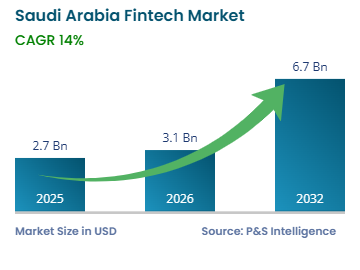
The Saudi Arabian fintech market size will be an estimated USD 2.7 billion for 2025, and it will grow by 14.0% during 2026–2032, to reach USD 6.7 billion by 2032.
The market expansion is driven by Vision 2030 initiatives promoting digital transformation, the implementation of open banking frameworks, and near-universal internet penetration across the kingdom.
Saudi Arabia achieved a remarkable milestone by reaching 79% cashless transactions in 2024, surpassing its 2025 target of 70% two years ahead of schedule. The number of fintech companies operating in the kingdom surged to over 280 by mid-2025, demonstrating the sector's rapid growth trajectory.
The fintech sector plays a crucial role in the kingdom's economic diversification strategy, with non-oil sectors accounting for 50% of GDP in 2023. The Financial Sector Development Program, a key component of Vision 2030, established regulatory sandboxes and open banking frameworks that enable innovation while maintaining financial stability.
Saudi Arabia Fintech Market Trends & Drivers
High Smartphone and Internet Penetration Are Key Trends
Saudi Arabia boasts exceptional digital infrastructure, with 99% internet penetration and 97% smartphone penetration as of 2024.
Mobile devices dominate internet usage, underscoring a mobile-first approach to financial services.
As of 2024, Saudi Arabia ranks 4th among G20 countries in median mobile internet speed, achieving 129 Mbps.
This tech-savvy population readily embraces innovative payment solutions, lending platforms, and investment tools, driving sustained market growth.
This widespread connectivity, combined with a young and digitally literate population, is driving sustained growth in fintech adoption, encouraging both startups and established financial institutions to innovate in payments, lending, digital wallets, and embedded finance offerings.
The Saudi Central Bank (SAMA) has implemented the Regulations of the Payments and Payment Services Law from July 2023, ensuring secure and efficient digital financial services.
Regulatory and Open Banking Initiatives Propel Fintech Innovation
The Saudi Central Bank's regulatory sandbox has become instrumental in nurturing fintech innovation.
The framework allows companies to test innovative solutions in a controlled environment while regulators gain insights into potential risks and establish necessary frameworks.
The regulatory environment provides clear licensing pathways and supervisory expectations that foster responsible innovation.
Several key regulations, including electronic money institutions, crowdfunding, and digital payments, have been shaped directly through sandbox engagements.
SAMA launched its Open Banking Framework in November 2022, initially enabling Account Information Services.
In September 2024, the framework expanded to include Payment Initiation Services, strengthening the fintech ecosystem and creating opportunities for companies to develop innovative products.
The framework consists of comprehensive legislation, regulatory guidelines, and technical standards aligned with international best practices.
The Open Banking Lab, launched in January 2023, provides a technical testing environment enabling banks and fintech firms to develop, test, and certify their services.
This infrastructure facilitates secure API-based data sharing between banks and licensed fintech firms, unlocking new digital products and creating greater transparency and consumer control.
The open banking initiative supports the development of embedded finance, digital wallets, and integrated payment solutions across multiple sectors.
Saudi Arabia Fintech Market Segmentation Analysis
Business Model Analysis
The B2C category holds the largest market share, of 45%, in 2025, and it will have the highest CAGR during the forecast period, driven by the rapid adoption of digital wallets, neobanks, and retail payment solutions among individual consumers. The segment benefits from high smartphone penetration and the government's push toward a cashless economy, with consumers increasingly preferring mobile-based financial services for everyday transactions.
The business models analyzed in this report are:
B2C (Largest and Fastest-Growing Category)
Neobanks
Retail Payment
Others
B2B
Payments Infrastructure
Banking-as-a-Service
Others
B2B2C
Fintech Companies
White-Label Platforms
Others
Marketplace
P2P Lending
Crowd-funding Platforms
Others
Technology Analysis
The API category holds the largest market share, of 40%, in 2025, due to its critical role in facilitating data exchange between software systems and enabling new service development. Application Programming Interfaces serve as the backbone of open banking implementations, payment integrations, and third-party service connections. Financial institutions and fintech firms extensively deploy APIs to create seamless customer experiences and integrate various financial services into single platforms.
The artificial intelligence category will have the highest CAGR of 14.2%, driven by its expanding applications in fraud detection, customer engagement, and predictive analytics across Saudi fintech platforms. Smart chatbots handle customer inquiries on fintech apps, improving service efficiency while providing personalized responses and 24/7 availability. AI applications extend to credit scoring, investment recommendations, and predictive analytics for customer behavior.
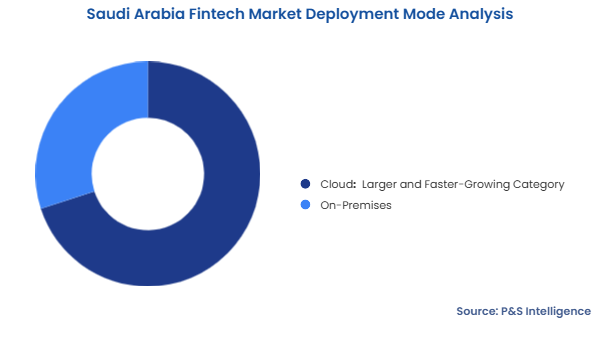
The cloud category holds the larger market share, of 70%, in 2025, and it will have the higher CAGR, driven by its scalability, cost-effectiveness, and faster time-to-market advantages. Cloud infrastructure enables fintech companies to rapidly deploy services, scale operations according to demand, and avoid significant upfront capital investments. The kingdom's robust digital infrastructure and high-speed internet connectivity support cloud adoption, while regulatory frameworks ensure data security and compliance.
Moreover, the growth is fueled by increasing adoption of Software-as-a-Service models, growing trust in cloud security measures, and the need for flexible, remote-accessible financial services. Financial institutions increasingly migrate legacy systems to cloud platforms to enhance operational efficiency and enable rapid innovation cycles.
The deployment modes analyzed in this report are:
Cloud (Larger and Faster-Growing Category)
On-Premises
Application Analysis
The payment & fund transfer category holds the largest market share, of 50%, in 2025, supported by the government's cashless economy initiatives and widespread adoption of digital payment methods. The segment encompasses digital wallets, mobile payment platforms, cross-border remittances, and instant payment systems. The integration of payment solutions into e-commerce platforms, retail establishments, and government services drives continued dominance.
The digital lending category will have the highest CAGR, of 14.3%, due to its low traditional lending penetration and a rapidly growing demand for accessible, technology-driven credit solutions. Peer-to-peer lending platforms and digital loan marketplaces expand financial inclusion by serving previously underserved segments. Additionally, the integration of AI-based credit scoring and open banking frameworks is enhancing transparency and borrower profiling, further boosting the sector’s scalability and adoption.
The applications analyzed in this report are:
Payment & Fund Transfer (Largest Category)
Digital Lending (Fastest-Growing Category)
Insurance
Wealth Management
Personal Finance
Others
End User Analysis
The banks category holds the largest market share, of 55%, in 2025, driven by the rise in smartphone payment transactions and banks' increasing deployment of fintech solutions. Financial institutions leverage fintech technologies to offer enhanced services, including digital lending, e-wallets, and seamless financial transactions. Banks collaborate with fintech companies to modernize infrastructure, improve customer experience, and remain competitive in the digital age.
The investment firms category will have the highest CAGR, of 14.4%, due to the growing demand for digital wealth management solutions, robo-advisory services, and automated investment platforms. Shariah-compliant investment products delivered through digital channels attract significant interest, while younger demographics increasingly adopt app-based investment tools for portfolio management and diversification.
The end users analyzed in this report are:
Banks (Largest Category)
Insurance Companies
Investment Firms (Fastest-Growing Category)
Others
Drive strategic growth with comprehensive market analysis
Saudi Arabia Fintech Market Geographical Analysis
Al-Riyadh Fintech Market Size
Al-Riyadh holds the largest market share, of 35%, in 2025, due to the kingdom's capital and largest city, Riyadh, serving as the primary hub for fintech innovation, hosting the headquarters of major fintech companies, including Tamara, STC Pay, and numerous digital banking initiatives. The province benefits from concentrated government institutions, financial services infrastructure, and technology development zones.
Riyadh's fintech ecosystem is supported by government-backed initiatives, accelerator programs, and venture capital presence. The city hosts numerous fintech events, regulatory bodies, including SAMA, and technology parks that foster collaboration between startups and established financial institutions. The province's large population base, high disposable incomes, and advanced digital infrastructure create favorable conditions for fintech adoption. Government digital payment systems and smart city initiatives further accelerate the deployment of fintech solutions across various sectors.
Eastern Province Fintech Market Size
Eastern Province will have the highest CAGR, of 14.1%, driven by its status as the kingdom's industrial and oil production hub. The province, home to Dammam, Dhahran, and Khobar, hosts numerous multinational corporations, petrochemical facilities, and industrial complexes that drive demand for B2B fintech solutions. The region's focus on economic diversification aligns with Vision 2030 objectives, spurring the adoption of digital financial services.
The Eastern Province leads in internet penetration at 99.9%, the highest in the kingdom, creating optimal conditions for fintech deployment. Payment infrastructure providers serve industrial sectors with specialized solutions for supply chain finance, corporate treasury management, and automated payroll systems. The province's proximity to neighboring Gulf states facilitates cross-border fintech collaboration and attracts international fintech companies seeking regional expansion. Small and medium enterprises increasingly adopt cloud-based accounting platforms, digital lending services, and automated payment solutions to improve operational efficiency.
The provinces of the market are as follows:
Al-Riyadh (Largest Province)
Makkah
Eastern Province (Fastest-Growing Province)
Madinah
Qassim
Asir
Tabuk
Ha'il
Northern Borders
Jazan
Najran
Al-Baha
Al-Jouf
Saudi Arabia Fintech Market Share
The market is fragmented due to the presence of numerous players ranging from established financial institutions to innovative startups. Despite the emergence of major players, market share is distributed across many firms rather than concentrated in a few. The diversity of fintech verticals, including payments, lending, wealth management, and insurance technology, further contributes to this fragmentation, with different players specializing in distinct areas of the ecosystem. This competitive dispersion is further intensified by the influx of international fintech firms establishing local partnerships and subsidiaries, attracted by Saudi Arabia’s supportive regulatory framework and Vision 2030 digital transformation agenda. Moreover, the continuous entry of new startups supported by venture capital funding and regulatory sandboxes adds to the dynamic and competitive landscape. As a result, no single company dominates the market, and innovation-driven differentiation remains a key factor for maintaining market position and growth.
Key Saudi Arabia Fintech Companies:
STC Pay
Tamara Finance Company
PayTabs Group
HyperPay
Hala Payments Company
Lean Technologies
Rasan Information Technology
Geidea Co. for Technology
Mozn
Simplified Financial Solutions Private Limited
Lynk
noon payments
Saudi Arabia Fintech Market News
In February 2025, Tabby Inc. secured USD 160 million in Series E funding, for a USD 3.3-billion valuation, led by Blue Pool Capital and Hassana Investment Company. The firm also announced plans for a potential IPO in late 2025 or 2026.
In February 2025, the Saudi Central Bank approved four new fintech startups to operate under its Regulatory Sandbox: SpireTech for open banking solutions, The Lending Hub and Soar for peer-to-peer lending services, and Ldun for factoring services targeting micro, small, and medium enterprises.
In January 2025, STC Bank commenced digital banking operations after receiving SAMA approval, building on STC Pay's wallet network with a SAR 2.5-billion capitalization, marking a significant expansion into comprehensive banking services beyond payment solutions.
In September 2024, SAMA issued the second release of the Open Banking Framework, focusing on Payment Initiation Services, expanding beyond the initial Account Information Services to enable secure third-party payment initiation through various applications.
In September 2024, Tabby Inc. acquired digital wallet startup Tweeq InternationalCo., marking its entry into comprehensive digital banking and adding virtual and physical payment cards to its product suite to compete with traditional financial institutions.
Want a report tailored exactly to your business need?
Leading companies across industries trust us to deliver data-driven insights and innovative solutions for their most critical decisions. From data-driven strategies to actionable insights, we empower the decision-makers who shape industries and define the future. From Fortune 500 companies to innovative startups, we are proud to partner with organisations that drive progress in their industries.
Client Testimonials
Working with P&S Intelligence and their team was an absolute pleasure – their awareness of timelines and commitment to value greatly contributed to our project's success. Eagerly anticipating future collaborations.
McKinsey & Company
India
Unmatched Standards
Our insights into the minutest levels of the markets, including the latest trends and competitive landscape, give you all the answers you need to take your business to new heights
Complete Data Security
We take a cautious approach to protecting your personal and confidential information. Trust is the strongest bond that connects us and our clients, and trust we build by complying with all international and domestic data protection and privacy laws