Saudi Arabia EV Battery Recycling Market Size & Share Analysis - Trends, Drivers, Competitive Landscape, and Forecasts (2026 - 2032)
This Report Provides In-Depth Analysis of the Saudi Arabia EV Battery Recycling Market Report Prepared by P&S Intelligence, Segmented by Battery Type (Lithium-Ion, Lead-Acid, Nickel-based), Application (Transportation, Industrial), Recycling Process (Hydrometallurgical, Pyrometallurgical, Physical / Mechanical), Material Recovered (Metals, Graphite / Carbon, Electrolyte, Plastics & Separators), Value Chain Stage (Collection & Reverse Logistics, Dismantling & Pre-processing, Material Recovery & Refining, Second-Life Repurposing, Disposal of Residual Waste), and Geographical Outlook for the Period of 2021 to 2032
Saudi Arabia EV Battery Recycling Market Valuation
Key Highlights
Study Period
2021 - 2032
Market Size in 2025
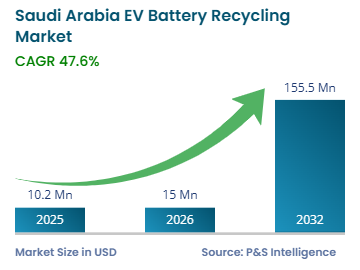
USD 10.2 Million
Market Size in 2026
USD 15.0 Million
Market Size by 2032
USD 155.5 Million
Projected CAGR
47.6%
Largest Province
Eastern Province
Fastest-Growing Province
Al-Riyadh
Market Structure
Fragmented
Market Size
Explore the market potential with our data-driven report
Saudi Arabia EV Battery Recycling Market Outlook
The Saudi Arabian EV battery recycling market size will be an estimated USD 10.2 million for 2025, and it will grow by 47.6% during 2026–2032, to reach USD 155.5 million by 2032.
The market is experiencing rapid expansion driven by the Kingdom's ambitious electrification targets under Vision 2030, which aims for 30% of vehicles in Riyadh to be electric by 2030, alongside strategic initiatives to establish domestic lithium extraction capabilities through the Aramco-Ma'aden joint venture targeting commercial production by 2027.
The market is witnessing unprecedented momentum as Saudi Arabia transitions from a nascent EV ecosystem to a regional manufacturing hub, with local production facilities, including Lucid Motors' plant in King Abdullah Economic City, targeting 150,000 units annually by 2025. This domestic manufacturing expansion, combined with Vision 2030’s circular economy mandate to divert 82% of waste from landfills by 2035, positions battery recycling as a critical component of the national sustainability agenda.
Saudi Arabia’s EV battery recycling market is governed by the Waste Management Law, which establishes comprehensive requirements for the handling, storage, transportation, and treatment of hazardous waste, including lithium-ion batteries. The law mandates licensing of waste operators, traceability of hazardous materials, and compliance with environmental protection standards.
Hazardous waste transport regulations require certified vehicles, trained personnel, and adherence to dangerous goods handling protocols to mitigate fire and environmental risks associated with battery logistics. Oversight and implementation are coordinated by the National Center for Waste Management (MWAN), which is responsible for policy execution, permitting, monitoring, and enforcement, providing the institutional framework necessary for scaling formal battery recycling operations.
Saudi Arabia EV Battery Recycling Market Growth Factors
Technological Advancement in Recycling Processes Is Key Trend
The evolution of advanced recycling technologies, particularly hydrometallurgical processes, offering recovery rates exceeding 95% for critical battery materials, is a key trend transforming the economic dynamics of battery recycling operations in Saudi Arabia.
These technologies operate at lower temperatures than traditional pyrometallurgical methods, while achieving higher lithium recovery rates and improved resource efficiency, aligning perfectly with the Kingdom's sustainability objectives and water conservation priorities.
The operationalization of hydrometallurgical facilities enables the recovery of battery-grade materials suitable for direct reintegration into new battery production, creating a closed-loop system that significantly reduces production costs and environmental impact.
Direct lithium extraction technologies being piloted by the Aramco-Ma'aden joint venture at the Ghawar oil field, combined with innovations in mechanical separation and automated dismantling systems, are reducing operational costs while improving material recovery efficiency.
These technological advancements, coupled with artificial intelligence applications for battery sorting and classification, enable recyclers to process diverse battery chemistries effectively while maintaining economic viability even with fluctuating commodity prices.
Growing EV Adoption and Battery Waste Generation Is Biggest Driver
The exponential growth in electric vehicle adoption across Saudi Arabia represents the primary catalyst driving the EV battery recycling market forward.
The dramatic shift in transportation preferences is generating substantial volumes of spent lithium-ion batteries, necessitating robust recycling infrastructure to manage these valuable yet potentially hazardous materials effectively.
The surge in battery waste generation is further amplified by the deployment of utility-scale battery energy storage systems supporting the Kingdom's renewable energy initiatives.
With Saudi Arabia commissioning its largest battery energy storage system of 500-MW/2,000-MWh capacity in Bisha, Asir province, in January 2025, the accumulated end-of-life batteries from both transportation and stationary storage applications create a compelling economic opportunity for recycling operations.
Regulatory mandates under Saudi Arabia’s Waste Management Law and hazardous-waste handling regulations are accelerating the formalization of EV battery collection and recycling, ensuring that rising end-of-life battery volumes are channeled toward licensed recycling operators rather than informal disposal.
Saudi Arabia EV Battery Recycling Market Segmentation Analysis
Battery Type Analysis
The lithium-ion category holds the largest market share, of 70%, in 2025, and it will have the highest CAGR, driven by its widespread adoption in electric vehicles and energy storage systems across the Kingdom. The predominance of lithium-ion batteries stems from their superior energy density, longer lifespan, and compatibility with fast-charging infrastructure being deployed nationwide, with over 1,000 public charging stations operational by 2024. The high value of recoverable materials from lithium-ion batteries, including lithium, cobalt, nickel, and manganese, makes them the most economically attractive segment for recycling operations, particularly as these critical minerals command premium prices in international markets while supporting Saudi Arabia's strategic objective to develop domestic battery manufacturing capabilities.
The battery types analyzed in this report are:
Lithium-Ion (Largest and Fastest-Growing Category)
Lead–Acid
Nickel-based
Others
Application Analysis
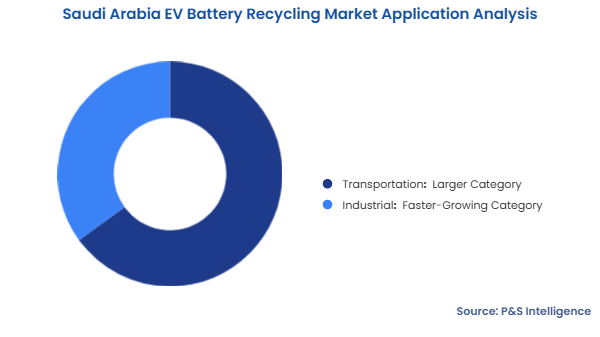
The transportation category holds the largest market share, of 65%, in 2025, reflecting the primary source of battery waste from the rapidly expanding electric vehicle fleet and the government's ambitious target to achieve 30% EV penetration in Riyadh by 2030. The transportation application benefits from concentrated battery volumes from fleet operators, including public transport electrification initiatives deploying 560 electric buses in Riyadh, and corporate fleet conversions reporting operational cost reductions of up to 40% after switching to electric vehicles.
The industrial category will have the highest CAGR, of 47.9%, driven by the proliferation of battery energy storage systems supporting industrial facilities and renewable energy projects across the Kingdom. The deployment of grid-scale storage systems, including BYD's 12.5-GWh contract with Saudi Electricity Company, generates large-volume battery waste streams that justify dedicated recycling facilities and specialized recovery processes. Industrial applications benefit from centralized battery management systems that facilitate end-of-life battery collection and enable direct partnerships between industrial users and recycling operators, reducing logistics costs while ensuring proper handling of hazardous materials.
The applications analyzed in this report are:
Transportation (Larger Category)
Industrial (Faster-Growing Category)
Recycling Process Analysis
The hydrometallurgical category holds the largest market share, of 60%, in 2025, and it will have the highest CAGR, of 47.8%. This is because it is the most-technologically advanced and materially comprehensive approach to battery recycling. It employs chemical leaching, solvent extraction, and precipitation techniques to recover high-purity metals suitable for remanufacturing into battery-grade materials.
This process is expected to form the cornerstone of Saudi Arabia's future lithium-ion battery recycling capabilities, particularly as the market prioritizes recovery of high-value materials, including lithium, cobalt, nickel, and manganese. Key advantages of hydrometallurgical processing include high recovery rates, flexibility across battery chemistries, lower energy consumption, and production of high-purity battery-grade materials.
The recycling processes analyzed in this report are:
Hydrometallurgical (Largest and Fastest-Growing Category)
Pyrometallurgical
Physical/Mechanical
Material Recovered Analysis
The metals category holds the largest market share, in 2025, and it will have the highest CAGR, driven by the high economic value of recoverable lithium, cobalt, and nickel. The recovery of these critical metals aligns with Saudi Arabia's strategic initiatives to develop domestic battery manufacturing capabilities, particularly through the Aramco-Ma'aden joint venture targeting lithium production from both recycled batteries and local extraction sources.
The materials recovered analyzed in this report are:
Metals (Largest and Fastest-Growing Category)
Lead
Lithium
Cobalt
Nickel
Manganese
Copper
Aluminum
Others
Graphite/Carbon
Electrolyte
Plastics & Separators
Others
Value Chain Stage Analysis
The material recovery & refining category holds the largest market share, of 45%, in 2025, as it captures the maximum economic value through the extraction and purification of high-value materials such as lithium, cobalt, and nickel. This stage involves capital-intensive processing, advanced chemical technologies, and stringent quality control to achieve battery-grade outputs, resulting in a higher revenue share compared to collection, dismantling, or disposal activities.
The collection & reverse logistics category will have the highest CAGR, of 47.7%, as rising EV adoption rapidly increases the number of end-of-life batteries that must be identified, retrieved, and transported before any downstream processing can occur. Regulatory momentum toward structured take-back systems, the need to prevent safety risks from informal handling, and the emergence of Extended Producer Responsibility frameworks are accelerating investment in organized collection networks. As recycling capacity expands, securing consistent feedstock becomes the immediate priority, driving faster growth in collection infrastructure than in downstream processing stages.
The value chain stages analyzed in this report are:
Drive strategic growth with comprehensive market analysis
Saudi Arabia EV Battery Recycling Market Regional Outlook
Eastern Province EV Battery Recycling Market Size
Eastern Province holds the largest market share, of 35%, in 2025, primarily attributed to its strategic position as Saudi Arabia's industrial heartland, hosting major petrochemical complexes and the emerging battery manufacturing ecosystem. The province's industrial infrastructure, anchored by facilities in Jubail Industrial City and the King Abdullah Economic City, provides essential support systems for battery recycling operations, including specialized waste handling capabilities, chemical processing expertise, and established logistics networks, for hazardous material transportation. The concentration of industrial facilities generating substantial volumes of industrial battery waste, combined with the province's role as the primary hub for lithium extraction initiatives through Aramco's operations, creates a synergistic environment where battery recycling operations benefit from proximity to both feedstock sources and end-market consumers.
The ports in Dammam and Jubail enable efficient import of end-of-life batteries from neighboring GCC countries, while providing export routes for recovered materials to international markets, positioning the Eastern Province as a regional recycling hub. The presence of technical universities and Aramco's research facilities supports workforce development and technological innovation in recycling processes, while the Saudi Electricity Company's grid infrastructure investments facilitate the deployment of advanced recycling facilities requiring substantial power inputs for hydrometallurgical processing operations.
Al-Riyadh EV Battery Recycling Market Size
Al-Riyadh will have the highest CAGR, of XX%, driven by its position as the epicenter of electric vehicle adoption in Saudi Arabia, with a significant share of national EV sales concentrated in the region. The concentration of government institutions, corporate headquarters, and high-income households in Riyadh creates early-adopter dynamics that accelerate battery waste generation, while the capital's role as the administrative center ensures priority implementation of recycling infrastructure under national waste management strategies.
The establishment of specialized recycling facilities in Riyadh benefits from proximity to research institutions, including King Saud University and the planned Lucid Motors R&D center, fostering innovation in recycling technologies and process optimization. The capital's comprehensive waste management infrastructure, overseen by Riyadh Municipality in coordination with the National Center for Waste Management and Saudi Investment Recycling Company, provides institutional support for battery collection networks and recycling facility development. The concentration of logistics companies and transportation networks in Riyadh facilitates efficient battery collection from across the central region, while the presence of financial institutions and government funding agencies ensures access to capital for recycling infrastructure investments.
The provinces of the market are as follows:
Al-Riyadh (Fastest-Growing Province)
Eastern Province (Largest Province)
Makkah
Madinah
Qassim
Asir
Tabuk
Ha'il
Northern Borders
Jazan
Najran
Al-Baha
Al-Jouf
Saudi Arabia EV Battery Recycling Market Share
The market is fragmented due to its early stage of development, with limited large-scale commercial recycling facilities currently in operation. Market activities are spread across multiple specialized participants involved in collection, logistics, dismantling, technology licensing, and pilot-scale processing rather than being dominated by a few vertically integrated players. Inconsistent feedstock availability, evolving regulatory frameworks, and continued reliance on partnerships with international technology providers further prevent market concentration. Additionally, the collection and reverse logistics segment involves numerous formal and informal participants, reinforcing fragmentation across the value chain until large capital-intensive recovery facilities reach full commercial scale.
Key Saudi Arabia EV Battery Recycling Companies:
Saudi Investment Recycling Company (SIRC)
Veolia Environment S.A.
Averda
Bee
Umicore
Saudi Aramco
Saudi Arabian Mining Company (Ma'aden)
EADA
Enviroserve
National Industrialization Company (Tasnee)
Nesma Environmental Solutions
Naqaa Solutions
Saudi Arabia EV Battery Recycling Market News
In January 2025, Saudi Aramco Oil Company and Saudi Arabian Mining Company (Ma'aden) signed non-binding Heads of Terms to establish a joint venture for lithium extraction from high-concentration deposits and recycled batteries. They plan to achieve commercial production by 2027, using advanced direct lithium extraction technologies at the Ghawar oil field.
In December 2024, Saudi Investment Recycling Company (SIRC) and Veolia Environment S.A. signed an MoU to cooperate on waste-treatment and recycling infrastructure in Saudi Arabia.
Frequently Asked Questions About This Report
What is the size of the Saudi Arabia EV battery recycling market in 2025?+
The market for Saudi Arabian EV battery recycling values USD 10.2 million in 2025.
What is the Saudi Arabia EV battery recycling industry nature?+
The Saudi Arabia EV battery recycling industry is fragmented.
Which is the largest application in the Saudi Arabia EV battery recycling market?+
Transportation is the largest application in Saudi Arabia EV battery recycling market.
What are the major drivers for the Saudi Arabia EV battery recycling industry?+
The major drivers of the Saudi Arabia EV battery recycling industry include rapid EV adoption, Vision 2030
Want a report tailored exactly to your business need?
Leading companies across industries trust us to deliver data-driven insights and innovative solutions for their most critical decisions. From data-driven strategies to actionable insights, we empower the decision-makers who shape industries and define the future. From Fortune 500 companies to innovative startups, we are proud to partner with organisations that drive progress in their industries.
Client Testimonials
Working with P&S Intelligence and their team was an absolute pleasure – their awareness of timelines and commitment to value greatly contributed to our project's success. Eagerly anticipating future collaborations.
McKinsey & Company
India
Unmatched Standards
Our insights into the minutest levels of the markets, including the latest trends and competitive landscape, give you all the answers you need to take your business to new heights
Complete Data Security
We take a cautious approach to protecting your personal and confidential information. Trust is the strongest bond that connects us and our clients, and trust we build by complying with all international and domestic data protection and privacy laws