Saudi Arabia Electric Vehicle Market Size & Share Analysis - Trends, Drivers, Competitive Landscape, and Forecasts (2026 - 2032)
This Report Provides In-Depth Analysis of the Saudi Arabia Electric Vehicle Market Report Prepared by P&S Intelligence, Segmented by Vehicle Type (Passenger Vehicles, Commercial Vehicles), Charging Type (AC Charging, DC Charging, Inductive Charging), Speed (<125 mph, >125 mph), Propulsion Type (Battery Electric Vehicle, Plug-in Hybrid Vehicle, Fuel Cell Electric Vehicle), and Geographical Outlook for the Period of 2019 to 2032
Saudi Arabia Electric Vehicle Market Size Forecast
Key Highlights
Study Period
2019 - 2032
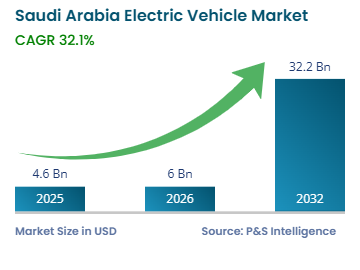
Market Size in 2025
USD 4.6 Billion
Market Size in 2026
USD 6.0 Billion
Market Size by 2032
USD 32.2 Billion
Projected CAGR
32.1%
Largest Province
Al-Riyadh
Fastest-Growing Province
Eastern
Market Structure
Semi-consolidated
Market Size
Explore the market potential with our data-driven report
Saudi Arabia Electric Vehicle Market Overview
The electric vehicle market size will be an estimated USD 4.6 billion for 2025, and it will grow by 32.1% during 2026–2032, to reach USD 32.2 billion by 2032.
This remarkable growth trajectory is primarily driven by the kingdom's Vision 2030 diversification strategy, substantial Public Investment Fund (PIF) allocations for EV ecosystem development, and the ambitious target to achieve 30% electric vehicle penetration in Riyadh by 2030. The transformation of Saudi Arabia's automotive sector represents a fundamental shift in the nation's economic strategy. The increasing supply chain depth due to the large-scale domestic production commitments from Lucid and Ceer, persistent battery cost declines, and rapid charger rollouts are improving the total cost of ownership.
Additionally, growing consumer awareness of sustainability, rising adoption of smart mobility solutions, and supportive financial incentives are contributing to the accelerated adoption of EVs across urban and suburban areas. The kingdom’s focus on developing a skilled workforce and local suppliers for the EV value chain further strengthens the long-term industrial ecosystem.
Air pollution in Saudi Arabia remains a major health and environmental concern. The national average PMâ‚‚.â‚… concentration in 2024 was around 25.1 µg/m³, over four times the WHO guideline of 5 µg/m³. According to Saudi Arabia’s UNFCCC report, the transport sector emitted 132,670 Gt COâ‚‚-equivalent in 2021. To reduce this, the kingdom targets 30% electric vehicles in Riyadh by 2030, supported by rapid EV imports and fleet electrification to curb traffic-related emissions and improve air quality.
Saudi Arabia Electric Vehicle Market Dynamics
Infrastructure Development to Address Range Anxiety Is Key Trend
The rapid expansion of charging infrastructure is a key trend in the Saudi Arabian electric vehicle market.
EVIQ plans to deploy over 5,000 fast-charging stations across more than 1,000 locations by 2030, covering major cities and highways.
This comprehensive network addresses the primary concern of range anxiety that has historically limited EV adoption in the kingdom's vast geographic expanse.
The strategic placement of these charging stations along major highways and urban centers ensures maximum accessibility for EV users.
EVIQ has also established an advanced R&D Facility in Riyadh, the first-of-its-kind in the region, for testing a spectrum of chargers and software to ensure the deployment of best-in-class equipment.
The infrastructure development strategy emphasizes technological sophistication and user convenience.
The current charger mix includes AC Level 2 (7–22 kW) comprising 70% of the network, with DC fast charger (>50 kW) installation growing in NEOM and King Abdullah Economic City (KAEC) and ultra-fast charger availability (≥150 kW) limited to flagship installations by Lucid and Tesla.
This diversified approach ensures compatibility with various EV models, while providing options for different charging scenarios, from overnight residential charging to rapid highway top-ups.
Government Support, Vision 2030, and Strategic PartnershipsAre Biggest Drivers
The Saudi government's comprehensive policy framework under Vision 2030 and its strategic partnership serve as the cornerstone for electric vehicle market expansion.
Under Vision 2030, the kingdom made a promise to have 30% of all vehicles in Riyadh electric by 2030 and has backed it with investments totaling over USD 50 billion in EV manufacturing and infrastructure development.
Vision 2030 earmarks a USD 39-billion funding envelope for the electric mobility ecosystem, of which USD 18 billion is to be channeled into new manufacturing lines.
These investments are yielding tangible results, with Lucid Motors manufacturing 800 electric vehicles at its first global facility in KAEC in 2023.
The regulatory environment has evolved to support rapid market growth through comprehensive incentive structures.
Collaborations with global companies, such as BMW, Tesla, and Schneider Electric, have introduced advanced technologies for the production of high-quality EVs in Saudi Arabia.
The establishment of domestic manufacturing capabilities through joint ventures represents a strategic approach to industrial development.
Ceer Motors was created in a joint venture between PIF and Taiwan's Foxconn.
It designs, manufactures, and sells a range of vehicles, including sedans and SUVs, for the Saudi and MENA markets, utilizing technology licensed from BMW.
The company is set to employ 30,000 people and contribute USD 8 billion to the Saudi Economy by 2034, demonstrating the substantial economic multiplier effects of the EV sector.
Manufacturing localization efforts are gaining momentum with multiple production facilities under development.
Hyundai, in collaboration with PIF, has commenced construction on a USD 500 million plant that aims to assemble 50,000 vehicles each year, with production slated to kick off in 2026.
These developments collectively position Saudi Arabia to achieve its ambitious target of 500,000 annual EV production capacity by 2030, transforming the kingdom from an importer to a regional manufacturing hub.
Saudi Arabia Electric Vehicle Market Segmentation Analysis
Vehicle Type Analysis
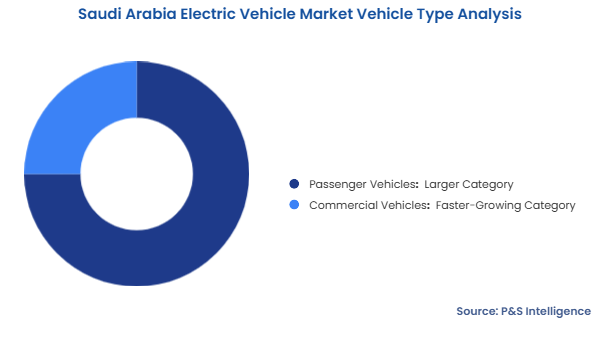
The passenger category holds the larger market share, of 75%, in 2025, driven by rising consumer preference for personal EVs, supported by expanding model availability from premium brands and the growing environmental consciousness among Saudi households. According to recent data, luxury electric vehicles lead the market, with Tesla, Lucid, and BMW collectively capturing 65% of new EV registrations.
The commercial category will have the higher CAGR, of 32.5%, driven by government fleet electrification mandates, corporate sustainability commitments, and the compelling total cost of ownership advantages for high-mileage applications. The corporate sector's commitment to fleet electrification could add another 50,000 EVs to Saudi roads by 2025, with logistics companies and government entities leading the transition to zero-emission commercial fleets.
The vehicle types analyzed in this report are:
Passenger Vehicles (Larger Category)
Commercial Vehicles (Faster-Growing Category)
Charging Type Analysis
The AC category holds the largest market share, of 70%, in 2025, reflecting the prevalence of Level 2 chargers in residential, workplace, and destination charging scenarios. This segment benefits from lower installation costs and sufficient charging speeds for overnight or extended parking situations, making it the preferred solution for daily commuting needs. The widespread deployment of AC chargers in corporate campuses, shopping malls, and residential complexes supports this segment's continued dominance.
The DC category will have the highest CAGR, of 32.4%, driven by the growing demand for fast-charging infrastructure along highways and the increasing consumer expectation for refueling experiences comparable to conventional vehicles. The collaboration between ABB E-mobility and Electromin to set up a public EV charging network of 100 stations includes DC fast chargers and DC ultra-fast chargers, addressing the growing demand for rapid charging capabilities.
The charging types analyzed in this report are:
AC Charging (Largest Category)
DC Charging (Fastest-Growing Category)
Inductive Charging
Speed Analysis
The <125 mph category holds the larger market share in 2025, encompassing the majority of passenger and commercial vehicles designed for urban and inter-city transportation. This category includes most mainstream EV models that prioritize efficiency, range, and practicality over extreme performance, aligning with typical Saudi driving patterns and speed regulations on public roads.
The >125 mph category will have the higher CAGR during the forecast period, driven by the increasing availability of high-performance luxury EVs and the Saudi market's traditional affinity for premium vehicles. The segment particularly benefits from Lucid's local manufacturing presence, as their vehicles offer industry-leading performance capabilities that resonate with affluent Saudi consumers seeking both sustainability and driving excitement.
The speeds analyzed in this report are:
<125 mph (Larger Category)
>125 mph (Faster-Growing Category)
Propulsion Type Analysis
The battery electric vehicle category holds the largest market share, of 65%, in 2025, driven by the expanding charging infrastructure network and increasing availability of long-range models suited to Saudi Arabia's driving patterns. The segment benefits from complete zero-emission operation, aligning perfectly with the kingdom's environmental objectives under the Saudi Green Initiative. Government procurement programs particularly favor BEVs, with the Saudi government pledging to buy 100,000 Lucid vehicles over 10 years.
The fuel cell electric vehicle category will have the highest CAGR, of 32.3%, due to the kingdom's strategic investments in green hydrogen production infrastructure, combined with its abundant renewable energy resources. This creates ideal conditions for FCEV deployment, particularly in heavy-duty commercial applications, where hydrogen's rapid refueling advantage is most pronounced.
The propulsion types analyzed in this report are:
Battery Electric Vehicle (Largest Category)
Plug-in Hybrid Vehicle
Fuel Cell Electric Vehicle (Fastest-Growing Category)
Drive strategic growth with comprehensive market analysis
Saudi Arabia Electric Vehicle Market Regional Outlook
Al-Riyadh Electric Vehicle Market Size
Al-Riyadh holds the largest market share, of 35%, in 2025, driven by large municipal fleets, the highest charger density, the densest charging infrastructure, and pilot initiatives aligned with Vision 2030 targets. The capital's ambitious electrification targets serve as a national showcase for sustainable urban mobility transformation.
The province's dominance stems from concentrated government initiatives and superior infrastructure development. Public-transport electrification, including 560 electric buses, cements the city as an early-adopter hub. Furthermore, Riyadh has set its sights higher than anyone else; by 2030, 30% of the city's streets will be lined with electric vehicles. This aggressive target drives substantial public and private sector investments in charging infrastructure, with EVIQ prioritizing Riyadh for its initial fast-charger deployments.
Eastern Province Electric Vehicle Market Size
Eastern Province will have the highest CAGR, of 32.2%, as industrial infrastructure in Jubail and King Abdullah Economic City nurtures a complete battery-to-vehicle supply chain. The region's strategic importance extends beyond consumption to encompass manufacturing and export capabilities.
The province's growth trajectory is underpinned by its evolving role as Saudi Arabia's EV manufacturing hub. Port facilities open export routes to wider GCC and African markets, positioning the region as a manufacturing and logistics anchor for the Saudi Arabia electric vehicle market. The presence of Lucid's manufacturing facility in King Abdullah Economic City creates a complete ecosystem encompassing production, testing, and distribution capabilities, attracting supplier investments and skilled workforce development.
Makkah Electric Vehicle Market Size
Makkah Province, encompassing Jeddah and the holy cities, represents a substantial opportunity for sustainable mobility solutions. Makkah Province represents a sizeable opportunity tied to religious-tourism mobility. The province's unique combination of large urban populations and millions of annual religious visitors creates distinct requirements for electric mobility infrastructure.
The province leverages Jeddah’s position as Saudi Arabia’s commercial hub and key gateway on the Red Sea. The Western Region (including Jeddah and Makkah) accounts for 30% of total EV registrations, with growing adoption among both residents and commercial fleet operators. The development of NEOM in the northwestern region further enhances the province's electric mobility prospects, with the futuristic city implementing 100% electric transportation from inception.
The provinces of the market are as follows:
Al-Riyadh (Largest Provincial Market)
Eastern Province (Fastest-Growing Provincial Market)
Makkah
Madinah
Qassim
Asir
Tabuk
Ha'il
Northern Borders
Jazan
Najran
Al-Baha
Al-Jouf
Saudi Arabia Electric Vehicle Market Share
The market is semi-consolidated due to the presence of global automotive giants, emerging domestic manufacturers, and technology-focused new entrants. The market's competitive landscape is rapidly evolving as international players establish local operations while Saudi-backed ventures leverage technology partnerships to build domestic capabilities. Strategic partnerships between charging infrastructure providers and automotive manufacturers, such as EVIQ's collaborations with multiple OEMs, create integrated ecosystems that enhance competitive positioning.
Key Saudi Arabia Electric Vehicle Companies:
BYD Company Limited
Tesla, Inc.
Lucid Group, Inc.
Ceer National Automotive Company
Bayerische Motoren Werke AG (BMW)
Mercedes-Benz Group AG
Hyundai Motor Company
Kia Corporation
Volkswagen AG
Nissan Motor Co., Ltd.
Toyota Motor Corporation
Porsche AG
Audi AG
Ford Motor Company
MG Motor (UK) Limited
Geely Automobile Holdings Ltd.
Volvo Car Group AB / Polestar Automotive Holding UK Limited
Jaguar Land Rover Automotive PLC
Renault S.A.
Stellantis N.V.
Lexus International Co., Ltd.
Rolls-Royce Motor Cars Limited
Zeekr Intelligent Technology Holding Limited
Chevrolet
Saudi Arabia Electric Vehicle Market News
In October 2025, EVIQ entered into a strategic partnership with Apsco to collaborate on the deployment of fast EV charging infrastructure across Saudi Arabia, integrating EVIQ's advanced charging technologies with Apsco's extensive service station network.
In October 2025, the fourth edition of the EV Auto Show Riyadh, scheduled for 27 to 29 at the Riyadh International Convention and Exhibition Center, emphasized new electric vehicle models, local manufacturing, and training initiatives. More than 120 exhibitors from 35 countries will participate, presenting the most recent advancements in electric and plug-in hybrid technologies.
In September 2025, Foxconn Interconnect Technology (FIT), a division of Taiwan's Foxconn, announced plans to inaugurate its inaugural manufacturing facility in the Middle East this December. Situated in Saudi Arabia, the plant will manufacture electric vehicle chargers beginning in 2026.
In August 2025, E-FILL launched an electric vehicle charging network in Saudi Arabia, owned and managed by ASX eMobility, itself part of AlSharif Group Holding, introduced a subscription-based EV charging model. The Basic, Standard, and Business/Fleet plans offer EV drivers enhanced cost predictability, economical charging options, and easy access to E-FILL’s expanding fast-charging network across the nation.
In May 2025, Hyundai Motor Company, in collaboration with PIF, commenced the construction of a USD-500 million assembly plant, targeting an annual production capacity of 50,000 vehicles, with operations expected to commence in 2026.
In April 2025, Saudi Aramco Technologies Company (SATC), a subsidiary of Aramco, signed a joint development agreement with BYD to develop technologies aimed at enhancing efficiency and environmental performance in new energy vehicles.
In September 2023, Lucid Group Inc. operationalized its assembly plant in Jeddah's King Abdullah Economic City, which spans more than 1.35 million square meters.
Want a report tailored exactly to your business need?
Leading companies across industries trust us to deliver data-driven insights and innovative solutions for their most critical decisions. From data-driven strategies to actionable insights, we empower the decision-makers who shape industries and define the future. From Fortune 500 companies to innovative startups, we are proud to partner with organisations that drive progress in their industries.
Client Testimonials
Working with P&S Intelligence and their team was an absolute pleasure – their awareness of timelines and commitment to value greatly contributed to our project's success. Eagerly anticipating future collaborations.
McKinsey & Company
India
Unmatched Standards
Our insights into the minutest levels of the markets, including the latest trends and competitive landscape, give you all the answers you need to take your business to new heights
Complete Data Security
We take a cautious approach to protecting your personal and confidential information. Trust is the strongest bond that connects us and our clients, and trust we build by complying with all international and domestic data protection and privacy laws