Saudi Arabia E-commerce Market Size & Share Analysis - Emerging Trends, Growth Opportunities, Competitive Landscape, and Forecasts (2026 - 2032)
This Report Provides In-Depth Analysis of the Saudi Arabia E-commerce Market Report Prepared by P&S Intelligence, Segmented by Product (Electronics, Apparel and Footwear, Home Appliances and Furniture, Grocery and Essentials, Health and Beauty Products, Books and Stationery, Toys and Baby Products, Automotive Parts and Accessories), Platform (Business-to-Consumer, Business-to-Business, Consumer-to-Consumer), Payment Method (Digital Wallets, Credit/Debit Cards, Net Banking, Cash on Delivery (COD), Buy Now, Pay Later (BNPL)), Business Model (Marketplace, Inventory-led, Hybrid), Delivery Time (Standard Delivery, Same-Day/Next-Day Delivery, Click and Collect (BOPIS), Drop Shipping, Cross-border/International Shipping), and Geographical Outlook for the Period of 2019 to 2032
Explore the market potential with our data-driven report
Saudi Arabia E-commerce Market Future Outlook
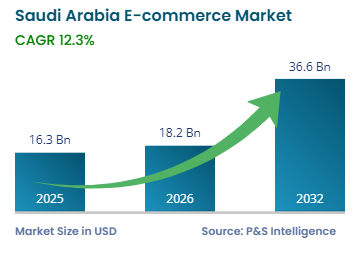
The Saudi Arabian e-commerce market size will be an estimated USD 16.3 billion in 2025, and it will grow by 12.3% during 2026–2032, to reach USD 36.6 billion by 2032.
The market has witnessed remarkable expansion, driven by nearly universal internet penetration, widespread smartphone adoption, and robust government support through Vision 2030 initiatives that have encouraged foreign ownership in e-commerce businesses and substantial venture capital investments exceeding USD 428 million in the sector.
The transformation of Saudi Arabia's digital commerce landscape reflects a fundamental shift in consumer behavior. The Nusuk wallet was introduced in 2024 to facilitate digital payments for pilgrims, reflecting growing adoption of e-commerce solutions. According to the Saudi Central Bank (SAMA), electronic payments accounted for 79% of all retail transactions in Saudi Arabia in 2024, significantly exceeding the 70% target originally set for 2025 under the Financial Sector Development Program. This rapid adoption of digital payment methods, combined with approximately 90% of consumers using emerging payment methods such as digital wallets and money transfer applications, has created a robust foundation for sustained e-commerce growth.
Saudi Arabia E-commerce Market Trends & Drivers
Digital Connectivity and Evolving Consumer Behavior Are Key Trends
The explosive growth of Saudi Arabia's e-commerce market is fundamentally driven by the country's exceptional digital infrastructure development and consumer connectivity, and it is a key trend shaping online retail.
Internet penetration in Saudi Arabia stood at 99.0% at the start of 2024, with 36.84 million internet users, representing an increase of 527,000 users from the previous year.
Adopting a mobile-first approach has reshaped e-commerce strategies, as nearly 92% of Saudi residents had access to or owned a smartphone in 2024.
This widespread smartphone adoption has enabled seamless shopping experiences, with consumers increasingly comfortable making purchases through mobile applications.
The advanced connectivity infrastructure ensures fast, reliable online shopping experiences, reducing friction in the customer journey and enabling features like real-time inventory updates, high-quality product visualizations, and smooth checkout processes.
As per reports, the demographic composition of Saudi Arabia further amplifies this digital transformation, with approximately 25% of the population falling within the 18–24 age range.
This creates a tech-savvy consumer base, which readily embraces online shopping and digital payment methods.
The transformation of Saudi consumer behavior represents a fundamental shift in shopping preferences.
Convenience, price competitiveness, and wide product availability drive the adoption of digital payment methods such as Mada, Apple Pay, and STC Pay.
This behavioral evolution is reflected in transaction data, with e-commerce spending using Mada cards surging to SAR 197.42 billion in 2024, representing a 25.82% year-on-year increase.
According to recent statistics, around 90% of the consumers used emerging payment methods, such as contactless wallets or money transfer apps in 2024.
The higher security and the booming e-commerce market play significant roles in this transformation.
The focus on security, combined with convenient return policies and Arabic-first customer service strategies, has helped overcome traditional barriers to e-commerce adoption.
Government Initiatives Under Vision 2030 Are Biggest Drivers
Saudi Arabia's Vision 2030 has emerged as a powerful catalyst for e-commerce growth, implementing comprehensive reforms that have transformed the digital commerce landscape.
The kingdom aims to increase the share of non-cash transactions to 70% by 2025, with electronic payments already exceeding cash transactions for the first time since 2021.
This strategic focus on digital payments has created a supportive ecosystem for e-commerce expansion.
The Saudi government's cultivation of a robust digital economy through Vision 2030 has generated numerous employment opportunities, particularly in digital marketing, logistics, and technology sectors.
It is also enabling SMEs to expand their market reach and compete globally.
The regulatory environment has also evolved to support e-commerce growth, with the government allowing 100% foreign ownership of e-commerce businesses that obtain licenses and meet minimum capital requirements.
This liberalization has attracted international players while encouraging domestic entrepreneurship, creating a competitive marketplace that benefits consumers through improved services and pricing.
Saudi Arabia E-commerce Market Segmentation Analysis
Product Analysis
The electronics category holds the largest market share, of 30%, in 2025, supported by a tech-savvy population eager for the newest gadgets and consumer electronics. The proliferation of smartphone brands and regular product launches, combined with competitive online pricing and exclusive e-commerce deals, has made electronics the most traded category online. Rising interest in smart home devices and personal electronics continues to drive demand, with online shops offering extensive product details, user feedback, and comparison tools that help buyers make informed decisions.
The grocery & essentials category will have the highest CAGR during the forecast period due to rising demand for time-saving, convenient shopping among urban working consumers. Backed by Vision 2030’s digital transformation goals, rapid adoption of mobile wallets, AI-driven fulfillment, and dark-store quick-commerce infrastructure, consumers now prefer ultrafast delivery and reliable quality for everyday necessities delivered to their doorstep.
The products analyzed in this report are:
Electronics (Largest Category)
Apparel & Footwear
Home Appliances & Furniture
Grocery & Essentials (Fastest-Growing Category)
Health & Beauty Products
Books & Stationery
Toys & Baby Products
Automotive Parts & Accessories
Others
Platform Type Analysis
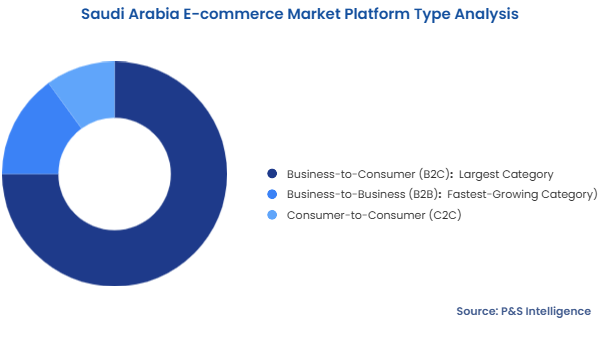
The B2C category holds the largest market share, of 75%, in 2025, as established marketplaces, such as Amazon.sa and Noon; and specialized retailers dominate the digital commerce landscape. The B2C segment benefits from sophisticated logistics networks, established consumer trust, and comprehensive product ranges that cater to diverse consumer needs. Major e-commerce players have invested heavily in customer fulfillment centers, with Noon.com opening a massive 45,000-m² facility in Riyadh to ensure rapid delivery across the kingdom.
The B2B category will have the highest CAGR, of 12.7%, as Saudi businesses increasingly digitize their procurement processes and supply chain management. The B2B category’s expansion is driven by Vision 2030's emphasis on private sector development and the growing need for efficient, transparent business transactions. Digital B2B platforms are revolutionizing traditional wholesale and distribution models, offering bulk ordering, customized pricing, credit facilities, and integrated inventory management systems that appeal to SMEs seeking operational efficiency.
The credit/debit cards category holds the largest market share in 2025, highlighting strong consumer trust in traditional electronic payment methods and their widespread acceptance across e-commerce platforms. The dominance of card payments is supported by robust banking infrastructure and consumer protection mechanisms that provide security and dispute resolution capabilities.
The BNPL category will have the highest CAGR during the forecast period, due to its appeal to younger, tech-savvy consumers who prefer flexible installment options. Its seamless integration with e-commerce platforms, combined with regulatory support from SAMA and the rapid expansion of online retail, drives high adoption. Rising awareness and trust in digital financial solutions further accelerate BNPL adoption across diverse consumer segments. Merchants also benefit from increased conversion rates and higher average order values, making BNPL advantageous for both consumers and retailers.
The payment methods analyzed in this report are:
Digital Wallets
Credit/Debit Cards (Largest Category)
Net Banking
Cash on Delivery (COD)
Buy Now, Pay Later (BNPL) (Fastest-Growing Category)
Business Model Analysis
The marketplace category holds the largest market share, of 55%, in 2025, with Noon, Amazon.sa, and niche marketplaces offering a wide variety of products from multiple sellers under a single platform. This model's success stems from its network effects, where increasing numbers of buyers attract more sellers and vice versa, creating a virtuous cycle of growth and product diversity. Marketplaces also benefit from lower inventory risks and capital requirements while providing consumers with competitive pricing through seller competition.
The hybrid category will have the highest CAGR, of 12.6%, as traditional retailers and new entrants recognize the benefits of combining marketplace operations with owned inventory strategies. Companies are increasingly offering specialized e-commerce solutions, such as last-mile delivery, same-day delivery, and reverse logistics, creating comprehensive ecosystems that blend multiple business models. This approach allows businesses to maintain control over key product categories while leveraging third-party sellers to expand their offerings and improve unit economics.
The business models analyzed in this report are:
Marketplace (Largest Category)
Inventory-led
Hybrid (Fastest-Growing Category)
Delivery Time Analysis
The standard delivery category holds the largest market share, of 45%, in 2025, serving as the backbone of e-commerce operations for non-urgent purchases where customers prioritize cost savings over speed. This delivery method remains popular for bulk purchases, non-perishable goods, and price-sensitive consumers who plan their purchases in advance. Standard delivery's continued relevance is supported by its cost-effectiveness and the ability to consolidate shipments for improved logistics efficiency.
The same-day/next-day delivery category will have the highest CAGR, of 12.5%, reflecting evolving consumer expectations for instant gratification and the competitive dynamics of the Saudi e-commerce market. The growth is facilitated by innovations such as Salasa's AI-powered logistics platform and partnerships with over 40 logistics providers, enabling predictive and automated operations that improve delivery speed and accuracy.
Drive strategic growth with comprehensive market analysis
Saudi Arabia E-commerce Market Regional Outlook
Al-Riyadh E-commerce Market Size
Al-Riyadh holds the largest market share, of 40%, in 2025, leveraging its position as the nation's capital and economic powerhouse to drive digital commerce adoption. Riyadh’s dense concentration of government institutions and large enterprises supports B2B e-commerce growth, as businesses increasingly digitize their procurement activities.
Riyadh's status as a fintech hub is reinforced by the fact that it anchors fintech headquarters and early Open Banking pilots, giving capital-region consumers first access to cutting-edge wallet features and payment innovations. The city's advanced digital infrastructure, with near-complete 5G coverage and the densest point-of-sale networks in the country, has created an ideal environment for e-commerce growth.
The capital's e-commerce ecosystem benefits from a highly educated, affluent population with significant disposable income and a strong preference for digital services. The concentration of government offices and large corporations in Riyadh also drives B2B e-commerce growth, with businesses increasingly digitizing procurement processes.
Eastern Province E-commerce Market Size
Eastern Province will have the highest CAGR, of 12.4%, driven by its strategic position as Saudi Arabia's industrial heartland and gateway for international trade. With 6,488 e-commerce registrations, the Eastern Province ranks third in the kingdom for digital commerce activity, reflecting its growing importance in the national e-commerce landscape.
The province benefits from a diverse, cosmopolitan population, including significant expatriate communities that drive demand for international products and cross-border e-commerce services. The booming e-commerce adoption in Dammam and Khobar is backed by advanced retail infrastructure and a tech-oriented consumer base. The upcoming mega-projects and industrial cities in the region are expected to further accelerate e-commerce growth by attracting new residents and businesses requiring digital commerce solutions.
The provinces of the market are as follows:
Al-Riyadh (Largest Provincial Market)
Makkah
Eastern Province (Fastest-Growing Provincial Market)
Madinah
Qassim
Asir
Tabuk
Ha'il
Northern Borders
Jazan
Najran
Al-Baha
Al-Jouf
Saudi Arabia E-commerce Market Share
The market is semi-consolidated due to the rapid growth of social commerce. The emergence of niche product categories, and the expanding geographical coverage beyond major cities, presenting growth opportunities for innovative players. Additionally, the B2B e-commerce segment remains relatively fragmented, offering potential for specialized platforms serving specific industries or business needs. Specialized e-commerce platforms focusing on specific product categories such as fashion, electronics, and beauty products, creating a multi-layered competitive environment. Strategic partnerships, regional expansion, and targeted niche offerings further sustain competition, reinforcing a market structure that is partially consolidated yet dynamic and evolving.
Key Saudi Arabia E-commerce Companies:
Amazon.com Inc.
Noon AD Holdings Ltd.
Jarir Bookstore
eXtra
Namshi Holding Limited
Ounass
Sary Technologies
Carrefour Saudi Arabia
Lulu Hypermarket
Talabat
HungerStation
Haraj Co.
Saudi Arabia E-commerce Market News
In November 2024, Noon partnered with Beyoung to support the brand's entry into the Middle East, utilizing Noon's established logistics network and customer base to expand fashion e-commerce offerings in Saudi Arabia.
In October 2024, Visa Inc. inaugurated an innovation center in Riyadh’s King Abdullah Financial District, reinforcing its commitment to advancing digital payments infrastructure and fostering the growth of Saudi Arabia’s e-commerce market.
In June 2024, the Ministry of Hajj and Umrah, in collaboration with Saudi National Bank, launched the Nusuk digital wallet, providing pilgrims with secure fund management, AI-powered services, and biometric authentication features.
In February 2024, Careem partnered with Redbox, a parcel locker network in the MENA region, to enhance last-mile delivery solutions for e-commerce packages across Saudi Arabia's major cities.
Want a report tailored exactly to your business need?
Leading companies across industries trust us to deliver data-driven insights and innovative solutions for their most critical decisions. From data-driven strategies to actionable insights, we empower the decision-makers who shape industries and define the future. From Fortune 500 companies to innovative startups, we are proud to partner with organisations that drive progress in their industries.
Client Testimonials
Working with P&S Intelligence and their team was an absolute pleasure – their awareness of timelines and commitment to value greatly contributed to our project's success. Eagerly anticipating future collaborations.
McKinsey & Company
India
Unmatched Standards
Our insights into the minutest levels of the markets, including the latest trends and competitive landscape, give you all the answers you need to take your business to new heights
Complete Data Security
We take a cautious approach to protecting your personal and confidential information. Trust is the strongest bond that connects us and our clients, and trust we build by complying with all international and domestic data protection and privacy laws