Key Highlights
| Study Period | 2019 - 2030 |
| Market Size in 2025 | USD 1,265.3 Million |
| Market Size in 2026 | USD 1,391.7 Million |
| Market Size by 2030 | USD 1,994.2 Million |
| Projected CAGR | 9.5% |
| Largest | NA |
| Fastest-Growing | NA |
| Market Structure | Moderately Fragmented |

| Study Period | 2019 - 2030 |
| Market Size in 2025 | USD 1,265.3 Million |
| Market Size in 2026 | USD 1,391.7 Million |
| Market Size by 2030 | USD 1,994.2 Million |
| Projected CAGR | 9.5% |
| Largest | NA |
| Fastest-Growing | NA |
| Market Structure | Moderately Fragmented |
Explore the market potential with our data-driven report
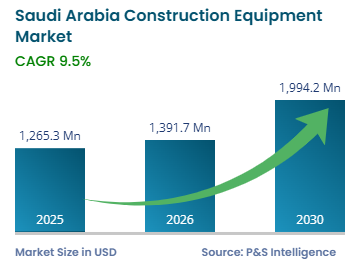
The Saudi Arabia construction equipment market size was USD 1,265.3 million for 2025, and it will grow by 9.5% during 2025–2030, to reach USD 1,994.2 million by 2030.
The Saudi Arabia construction equipment market is witnessing robust growth, supported by large-scale infrastructure development, rapid urbanization, expanding industrial activities, and increasing investments in residential, commercial, tourism, and logistics projects. Demand for construction equipment is rising as contractors adopt advanced machinery to improve productivity, reduce project timelines, and address labor shortages. Equipment utilization continues to expand across earthmoving, excavation, material handling, lifting, road construction, and mining applications, particularly in large-scale infrastructure developments and challenging desert and coastal environments.
Saudi Vision 2030 serves as the primary driver of market expansion by promoting economic diversification through extensive investments in infrastructure and urban development. The program includes planned investments exceeding USD 1 trillion, encompassing transformative projects such as NEOM, The Line, Qiddiya, Diriyah Gate, and Red Sea Global, which are generating sustained demand for construction equipment throughout planning, construction, and development phases. According to the Ministry of Municipal and Rural Affairs and Housing, urbanization has exceeded 80% in major metropolitan areas such as Riyadh and Jeddah, while continued investments in housing, mixed-use developments, and public infrastructure are strengthening long-term equipment demand.
The market is further supported by significant government investments in transportation infrastructure, including roads, railways, airports, ports, and logistics corridors aimed at enhancing regional connectivity and positioning Saudi Arabia as a global logistics hub. The expansion of industrial cities, special economic zones, and mining activities under the Kingdom's industrial diversification strategy is also contributing to higher demand for heavy construction equipment. In addition, the increasing adoption of technologically advanced and fuel-efficient equipment equipped with telematics, automation, and fleet management solutions is improving operational efficiency and reducing equipment downtime, further supporting market growth.
The increasing adoption of advanced and smart construction equipment is a key trend in the Saudi Arabia construction equipment market, driven by the need to enhance operational efficiency and reduce overall project costs. Contractors are increasingly deploying machinery integrated with telematics, GPS tracking, and real-time monitoring systems to improve equipment utilization and minimize downtime. These technologies enable predictive maintenance, reduce unexpected breakdowns, and optimize fuel consumption, making them highly valuable in large-scale construction operations.
The shift toward automation and intelligent machinery is further strengthening this trend, as modern equipment with semi-autonomous capabilities allows for higher precision and improved productivity in tasks such as grading and compaction. Telematics-enabled equipment and automation also help improve efficiency, reduce downtime, and enhance overall construction productivity. In addition, Saudi Arabia’s increasing focus on smart mobility and digitally integrated infrastructure projects is accelerating the adoption of connected construction technologies across the Kingdom. The Riyadh Metro project, spanning approximately 176 km across six lines and 85 stations, represents one of the world’s largest driverless metro systems and significantly supports demand for technologically advanced and precision-based construction equipment. Furthermore, government-backed urban modernization initiatives, such as the Riyadh Metro and smart mobility programs, are encouraging the adoption of telematics-enabled and digitally connected construction equipment. This growing focus on efficiency, cost optimization, and performance enhancement is accelerating the adoption of smart construction equipment across both large and mid-sized contractors.
A major driver for the Saudi Arabia construction equipment market is the accelerated execution of large-scale infrastructure projects and urban transformation initiatives under national development strategies. Flagship developments such as NEOM, The Line, and Red Sea Global are driving substantial demand for heavy construction machinery, including dozers, motor graders, excavators, and compaction equipment. These projects involve extensive land development, transport corridor construction, and foundational infrastructure work, resulting in sustained equipment utilization across multiple construction phases. The scale of these developments is significant, with NEOM alone spanning approximately 26,500 square kilometers, requiring continuous excavation, grading, and site preparation. Backed by substantial investments from the Public Investment Fund (PIF), these projects create long-term visibility for construction activity, ensuring consistent demand for equipment across earthmoving, road construction, and material handling applications.
Saudi Arabia’s transport infrastructure expansion further reinforces this demand. Under the National Transport and Logistics Strategy, the Kingdom aims to expand its rail network to around 8,000 km, including the 1,300-km Landbridge project connecting the Red Sea and Arabian Gulf. In addition, the government is investing in over 7,000 km of new railway and road infrastructure, along with metro system expansions in major cities such as Riyadh. Additionally, the Roads General Authority is actively implementing road quality improvement and safety enhancement programs, further increasing construction and maintenance activities requiring heavy equipment deployment across the Kingdom. Furthermore, rising foreign direct investment in infrastructure, supported by regulatory reforms and privatization initiatives, is accelerating construction activity. In parallel, equipment manufacturers such as Caterpillar Inc. and Komatsu Ltd. continue to support large-scale projects through their regional presence, supplying advanced and heavy-duty machinery suited for high-demand construction environments.
The Saudi Arabia construction equipment market is constrained by a strong dependence on imported machinery, as a significant share of equipment is sourced from global manufacturers Caterpillar Inc., Komatsu Ltd., and Volvo. This dependence increases exposure to international supply chain disruptions, currency fluctuations, and higher procurement costs, creating pricing pressure for contractors and project developers. It also leads to longer equipment lead times and limited availability of spare parts, which can delay project timelines and reduce operational efficiency, particularly in remote construction locations.
In addition, harsh environmental conditions, including extreme temperatures and desert terrain, accelerate equipment wear and increase maintenance requirements. These factors result in higher lifecycle costs and more frequent servicing, particularly for heavy-duty machinery used in large-scale projects. The need for specialized, climate-adapted equipment further adds to cost burdens and limits adoption among small and mid-sized contractors. Moreover, high fuel consumption and increased downtime associated with operating in extreme conditions further raise total cost of ownership, making it challenging for contractors to maintain profitability in price-sensitive projects.
A major opportunity in the Saudi Arabia construction equipment market is the growing preference for equipment rental and fleet management services, driven by the increasing requirement for flexible and cost-efficient machinery deployment across infrastructure and industrial projects. The opportunity is being strengthened by government-backed industrial and logistics initiatives aimed at improving private sector participation and operational efficiency. Under the National Industrial Development and Logistics Program (NIDLP), the government is focusing on logistics modernization, industrial localization, digital transformation, and development of smart supply chain infrastructure to improve equipment utilization and service efficiency across construction activities. The program also supports private investment, industrial service development, and technology integration within logistics and infrastructure sectors.
In addition, Saudi Arabia’s ongoing privatization and industrial development policies are creating favorable conditions for rental fleet operators and aftermarket service providers. In early 2026, the Saudi government approved implementation of the National Privatization Strategy targeting more than 220 privatization contracts across 18 sectors by 2030, aimed at expanding private sector involvement in infrastructure and public projects. Furthermore, initiatives such as Made in Saudi and industrial localization programs are encouraging development of domestic industrial services, equipment support operations, and technologically advanced fleet solutions. Simultaneously, increasing adoption of telematics-enabled machinery, GPS-based fleet monitoring, and predictive maintenance systems is improving asset utilization and reducing equipment downtime across large-scale projects in the Kingdom.
The dozers hold the largest market share, of 25%, in 2025, driven by their extensive use in large-scale earthmoving operations, land clearing, site grading, and infrastructure development under giga-projects. Dozers are indispensable for foundational construction activities across NEOM, Red Sea Global, Qiddiya, and Diriyah Gate, where large volumes of earth excavation and terrain preparation are required before construction begins. Their ability to operate efficiently in rugged desert terrains and harsh climatic conditions further supports their widespread adoption across infrastructure, mining, and industrial development projects. Additionally, the Public Investment Fund (PIF) continues to finance giga-project developments across multiple regions, sustaining consistent demand for high-capacity earthmoving equipment.
The tandem drum rollers category will have the highest CAGR, of 11.9%, driven by their critical role in asphalt compaction, road paving, and surface finishing applications. These machines are essential for achieving uniform density, smooth surface quality, and long-lasting pavement performance across highways, urban roads, airport runways, and industrial infrastructure projects. Increasing government investments in transportation infrastructure and road modernization are creating significant demand for advanced compaction equipment. Furthermore, the growing emphasis on road durability, lifecycle performance, and compliance with stringent construction quality standards is encouraging contractors to adopt technologically advanced tandem drum rollers.
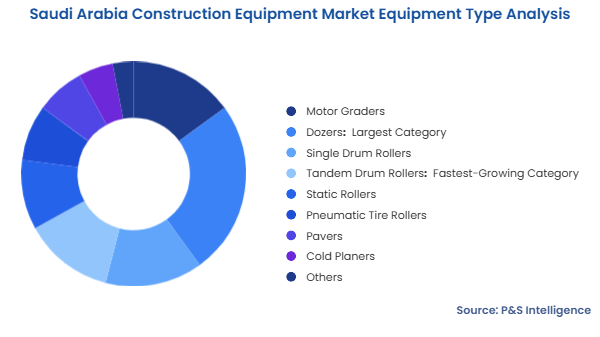
The equipment types analyzed in this report are:
Drive strategic growth with comprehensive market analysis
The Eastern Province holds the largest market share in 2025, primarily due to its position as the country's industrial and energy hub. The province hosts major oil and gas fields, petrochemical complexes, mining operations, and industrial cities such as Jubail, Dammam, and Ras Al Khair, which generate continuous demand for heavy construction equipment, including excavators, wheel loaders, cranes, dump trucks, and material handling machinery. Additionally, ongoing investments in industrial expansion, logistics infrastructure, ports, and energy-related developments continue to drive equipment demand for large-scale construction, site preparation, and infrastructure development across the province.
Al-Riyadh is expected to witness the highest CAGR during the forecast period, driven by the rapid expansion of large-scale urban development and infrastructure projects under Saudi Vision 2030. Mega projects such as New Murabba, Diriyah Gate, Qiddiya, King Salman International Airport, and extensive metro, road, and residential developments are significantly increasing the demand for construction equipment. Additionally, rising investments in commercial, hospitality, transportation, and public infrastructure, supported by preparations for Expo 2030 and the FIFA World Cup 2034, are creating sustained opportunities for equipment deployment across excavation, earthmoving, road construction, and material handling applications.
These provinces are covered:
The Saudi Arabia construction equipment market is moderately fragmented, characterized by the presence of numerous international manufacturers, regional distributors, and equipment rental providers serving diverse end-use industries. Market participants compete by expanding their product portfolios, strengthening distribution and service networks, enhancing after-sales support, and introducing technologically advanced equipment to address the growing demand from infrastructure, residential, commercial, industrial, and mining projects. Continuous investments under Vision 2030 are further encouraging market participants to strengthen their presence and expand their operational capabilities, contributing to a dynamic and competitive market environment.
Want a report tailored exactly to your business need?
Request CustomizationLeading companies across industries trust us to deliver data-driven insights and innovative solutions for their most critical decisions. From data-driven strategies to actionable insights, we empower the decision-makers who shape industries and define the future. From Fortune 500 companies to innovative startups, we are proud to partner with organisations that drive progress in their industries.

Working with P&S Intelligence and their team was an absolute pleasure – their awareness of timelines and commitment to value greatly contributed to our project's success. Eagerly anticipating future collaborations.
McKinsey & Company
India
Our insights into the minutest levels of the markets, including the latest trends and competitive landscape, give you all the answers you need to take your business to new heights

We take a cautious approach to protecting your personal and confidential information. Trust is the strongest bond that connects us and our clients, and trust we build by complying with all international and domestic data protection and privacy laws


Customize the Report to Align with Your Business Objectives

Request the Free Sample Pages