This Report Provides In-Depth Analysis of the Saudi Arabia Cloud Kitchen Market Report Prepared by P&S Intelligence, Segmented by Service (Passenger Air Transport, Air Freight and Cargo, Aircraft Maintenance, Repair & Overhaul (MRO), Ground Handling Services & Airport Services, Leasing & Charter Services, Training & Simulation), Application (Commercial Aviation, General Aviation, Military Aviation), Technology (Conventional, Hybrid Electric, Electric, Autonomous/Unmanned), and Geographical Outlook for the Period of 2019 to 2032
Saudi Arabia Cloud Kitchen Market Revenue Insights
Key Highlights
Study Period
2019 - 2032
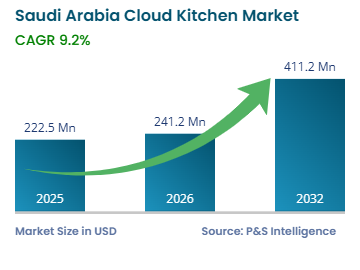
Market Size in 2025
USD 222.5 Million
Market Size in 2026
USD 241.2 Million
Market Size by 2032
USD 411.2 Million
Projected CAGR
9.2%
Largest Province
Al-Riyadh
Fastest-Growing Province
Makkah
Market Structure
Fragmented
Market Size
Explore the market potential with our data-driven report
Saudi Arabia Cloud Kitchen Market Future Outlook
The Saudi Arabia cloud kitchen market was valued at USD 222.5 million in 2025 and is projected to grow at a CAGR of 9.2% during 2026–2032, reaching USD 411.2 million by 2032. The market growth is primarily driven by the surging demand for online food delivery services, rapid digital transformation aligned with Vision 2030 objectives and evolving consumer preferences towards convenient dining solutions.
Saudi Arabia achieved 99.0% internet penetration in 2024, with 36.84 million internet users, creating a robust digital infrastructure that supports the expansion of cloud kitchen operations. Smartphone penetration reached 92% in 2024, with 33.55 million smartphone users, enabling seamless access to food delivery platforms. This technological readiness, combined with a 92.1% urbanisation rate and a median age of 29.6 years, has positioned the country as a highly attractive market for cloud kitchen operators who leverage delivery-only business models to serve tech-savvy urban consumers.
The rapid expansion of third-party delivery platforms has significantly accelerated market growth. These aggregator platforms have democratized access to cloud kitchens, allowing operators to reach customers across major urban centres, including Riyadh, Jeddah and Dammam, without establishing traditional dine-in facilities. Furthermore, the growing adoption of diverse cuisine offerings and the increasing preference for quick, convenient meals among millennials and Generation Z are reshaping the foodservice landscape, creating substantial opportunities for cloud kitchen concepts that combine operational efficiency with culinary diversity.
Saudi Arabia Cloud Kitchen Market Trends & Drivers
Evolving Consumer Preferences towards Diverse Cuisines Are Key Trend
Saudi consumers’ palates are becoming increasingly experimental, driven by exposure to international cuisines through travel, social media and the influx of expatriate communities.
Cloud kitchens are uniquely positioned to capitalize on this trend by offering flexibility to test new concepts and cuisines without the capital intensity of traditional restaurants.
Approximately 37% of Saudi Arabia's population is under 25 years old, representing a demographic cohort that values variety, authenticity and Instagram-worthy food experiences delivered to their doorstep.
This evolving demand pattern has encouraged cloud kitchen operators to adopt multi-brand strategies, where a single kitchen facility prepares menus for multiple virtual restaurant brands targeting different cuisines and price points.
The model allows operators to maximize kitchen utilisation while catering to diverse consumer preferences without brand dilution concerns.
Additionally, health-conscious eating trends are gaining momentum, prompting cloud kitchens to introduce specialized menus focused on organic ingredients, dietary-specific options and nutritional transparency.
The ability to rapidly iterate menu offerings based on real-time sales data and customer feedback provides cloud kitchens with a competitive advantage over traditional restaurants that face higher costs and longer timelines for menu modifications.
Rising Demand for Online Food Delivery Services Is Propelling Market Growth
The proliferation of delivery aggregator platforms has fundamentally transformed consumer behaviour, with ordering food online becoming a routine part of daily life for urban residents.
Cloud kitchens benefit from this trend by eliminating the overhead costs associated with prime retail locations, dine-in infrastructure and front-of-house staff, while focusing exclusively on food preparation and delivery fulfilment.
The convenience factor has become paramount for Saudi consumers, particularly among working professionals and young families who prioritize time-saving solutions.
The average Saudi Arabian adult spends 4 hours and 25 minutes browsing the internet on mobile phones daily, reflecting high digital engagement that naturally extends to food ordering behaviours.
Major delivery platforms, including Jahez, HungerStation and Talabat, have invested heavily in enhancing user experience through improved mobile applications, real-time order tracking and diversified restaurant options.
This helps them in effectively bridging the gap between cloud kitchens and consumers.
Additionally, the introduction of subscription models and loyalty programs by these platforms has encouraged repeat ordering, providing cloud kitchens with predictable demand patterns that support operational planning and inventory management.
Vision 2030 and Digital Transformation Initiatives Are Accelerating Sector Development
Saudi Arabia's Vision 2030 framework has catalysed significant investments in digital infrastructure, e-commerce enablement and entrepreneurship support, directly benefiting the cloud kitchen sector.
The government's focus on economic diversification beyond oil revenues has positioned the foodservice industry as a strategic growth area.
Saudi Arabia's population surged from 32.2 million in 2022 to 35.3 million in 2024, with urban centres experiencing even more rapid expansion as the country invests in smart city developments and modern infrastructure.
These macro-level transformations have created favourable conditions for cloud kitchen operators to scale operations efficiently.
Regulatory reforms aimed at simplifying business licensing, reducing bureaucratic barriers and attracting foreign investment have lowered entry barriers for both local entrepreneurs and international cloud kitchen brands.
The establishment of special economic zones and logistics hubs has improved supply chain efficiency, allowing cloud kitchens to source ingredients more reliably and cost-effectively.
Moreover, government initiatives promoting digital payment adoption and fintech innovation have streamlined transaction processes, reducing cash-handling complexities and improving financial transparency for cloud kitchen operators.
The convergence of these policy-driven enablers with strong consumer demand has positioned Saudi Arabia as one of the most dynamic cloud kitchen markets in the Middle East region.
Saudi Arabia Cloud Kitchen Market Segmentation Analysis
Type Insights
The independent cloud kitchen category accounts for approximately 45% market share in 2025. They offer operational flexibility and entrepreneurial freedom that appeals to both first-time food entrepreneurs and established restaurateurs seeking to expand their delivery footprint. These facilities enable operators to control brand identity, menu development and customer experience without franchise obligations or profit-sharing arrangements. The lower capital requirements compared to traditional restaurant establishments have made independent cloud kitchens an attractive entry point for culinary entrepreneurs who can launch operations with minimal upfront investment while accessing established delivery infrastructure through third-party platforms.
The commissary/shared kitchen category is projected to grow at the highest CAGR, of 9.5%, during 2026–2032, driven by increasing demand for flexible, cost-efficient kitchen infrastructure among startups and small food businesses. Shared commissary facilities provide access to commercial-grade equipment, regulatory-compliant spaces and collaborative networking opportunities without the burden of facility ownership.
This model has gained particular traction in secondary cities where real estate costs remain manageable, allowing commissary operators to offer competitive rental rates that support higher profit margins for tenant businesses. The category's growth is further supported by the entry of specialized commissary operators who provide value-added services, including ingredient sourcing, logistics coordination and business advisory support, effectively lowering operational complexities for kitchen tenants.
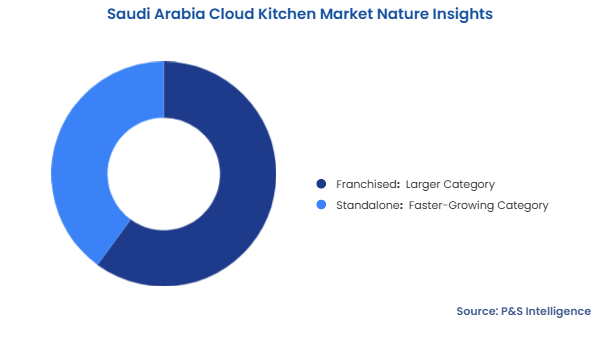
The franchised category has approximately 60% market share in 2025, benefiting from established brand recognition, proven operational systems and comprehensive marketing support that reduce entrepreneurial risk. Franchised cloud kitchens leverage recognizable brand names to attract customers through delivery platforms where trust and familiarity significantly influence ordering decisions. The backing of established restaurant brands provides franchisees with access to standardized recipes, supply chain networks, quality control protocols and ongoing operational guidance that streamline business management. Major franchise operators have adapted their business models specifically for cloud kitchen formats, offering territory exclusivity and lower franchise fees compared to traditional dine-in locations, making franchising an attractive proposition for investors seeking turnkey food delivery operations.
The standalone category is expected to grow at the higher CAGR, of 9.4%, during the forecast period, driven by entrepreneurial innovation and the desire for operational independence. Standalone cloud kitchens focus exclusively on delivery without franchise obligations, allowing specialisation in specific cuisines or niche menu items tailored directly to local consumer preferences. This model offers greater menu customisation flexibility and the ability to capture 100% of profits without franchise royalty payments.
Additionally, standalone operators can rapidly adjust pricing strategies, promotional activities and operational hours in response to market dynamics without requiring corporate approvals. The proliferation of delivery aggregator platforms has reduced the historical advantage of franchise brand recognition, enabling standalone operators with quality food offerings and strong delivery execution to compete effectively through positive customer reviews and platform-based visibility.
These natures are covered:
Franchised (Larger Category)
Standalone (Faster-Growing Category)
Cuisine Insights
Asian cuisine commands approximately 40% market share in 2025. The dominance of Asian cuisine reflects both Saudi Arabia's significant expatriate population from South Asian countries and the growing local appreciation for diverse flavours from Chinese, Japanese, Thai, Indian and Korean culinary traditions. Asian dishes often travel well during delivery, maintaining flavour profiles and presentation quality that satisfy customer expectations.
The versatility of Asian cuisine, spanning from quick comfort foods to premium gourmet experiences, allows cloud kitchen operators to serve multiple price and occasion-based dining needs. Saudi Arabia was home to 35.10 million social media users in January 2024, with platforms like Instagram and TikTok amplifying the visual appeal and cultural cachet of Asian dishes, driving trial and repeat orders.
Middle Eastern cuisine is expected to grow at the highest CAGR during 2026–2032, fuelled by increasing demand for authentic regional flavours and the growing emphasis on cultural preservation among Saudi consumers. Traditional Middle Eastern dishes resonate strongly with local palates while appealing to tourists and expatriates seeking authentic culinary experiences. Cloud kitchen operators specializing in Middle Eastern cuisine benefit from established supply chains for traditional ingredients and the ability to offer regional variations that cater to diverse taste preferences across the Arabian Peninsula.
The category's growth is further supported by Ramadan seasonality, where the demand for traditional iftar and suhoor meals experiences significant spikes, providing cloud kitchens with opportunities to maximize revenue during peak periods. Additionally, the increasing global recognition of Middle Eastern cuisine has positioned it as a growth category with strong differentiation potential in competitive markets.
These cuisines are covered:
Asian (Largest Category)
Middle Eastern (Fastest-Growing Category)
European
North American
African
Others
Ordering Model Insights
Third-party aggregators account for approximately 65% market share in 2025, serving as the primary channel connecting cloud kitchens with end consumers. These platforms provide cloud kitchens with immediate access to large customer bases, established payment infrastructure and delivery logistics without requiring individual investments in technology or rider fleets. The aggregator model has effectively commoditized customer acquisition for cloud kitchens, allowing operators to focus on food quality and operational efficiency while outsourcing marketing and last-mile delivery.
Major platforms, including Jahez, HungerStation and Talabat, have invested substantially in enhancing platform features, including personalized recommendations, streamlined ordering interfaces and loyalty programs that drive higher order frequencies and basket sizes.
Direct-to-consumer websites are projected to grow at the highest CAGR, of 9.5%, during 2026–2032, as cloud kitchen operators seek to reduce dependence on aggregator commissions and build direct customer relationships. Establishing branded ordering channels allows cloud kitchens to capture customer data, implement targeted marketing campaigns and improve profit margins by avoiding commission fees that typically range from 15% to 30% of order values.
The category's growth is supported by advancing web technologies, progressive web applications and the proliferation of digital payment solutions that simplify direct online transactions. Additionally, subscription meal plans are gaining traction among corporate clients and health-focused consumers seeking predictable meal solutions, creating recurring revenue opportunities for cloud kitchens that effectively leverage direct-to-consumer channels.
Drive strategic growth with comprehensive market analysis
Saudi Arabia Cloud Kitchen Market Geographical Analysis
Al-Riyadh Province Cloud Kitchen Market Size
Al-Riyadh Province holds approximately 40% market share in 2025. As the capital province and administrative heart of the kingdom, Al-Riyadh represents the epicentre of cloud kitchen innovation and investment activity. Riyadh is the most-populated city in Saudi Arabia with 7.95 million people, providing the largest addressable market for food delivery services in the country. The province's ongoing transformation under Vision 2030, including mega-projects like King Abdullah Financial District, NEOM administrative offices and extensive infrastructure modernisation, has attracted substantial expatriate populations, business travellers and young professionals who represent high-frequency users of delivery services.
Cloud kitchen operators in Al-Riyadh Province benefit from several competitive advantages, including well-developed logistics infrastructure that enables efficient last-mile delivery, competitive industrial real estate costs that support favourable unit economics and the strongest concentration of third-party delivery platforms that ensure comprehensive market coverage. The province's demographic composition skews younger and more affluent than the national average, with residents demonstrating higher digital literacy and greater willingness to experiment with diverse cuisines.
Additionally, Al-Riyadh serves as the testing ground for new cloud kitchen concepts and technologies, with successful models subsequently replicated across other provinces. The presence of major corporate headquarters, government institutions and educational campuses creates consistent weekday demand patterns that complement weekend leisure ordering, supporting stable revenue streams for cloud kitchen operators.
Makkah Cloud Kitchen Market Growth
Makkah is projected to grow at the highest CAGR, of 9.3%, during 2026–2032, driven by its unique combination of religious tourism, commercial significance and cosmopolitan urban centres. Jeddah accommodates 5.02 million residents, serving as the province's commercial capital and primary gateway city. The province encompasses the holy cities of Mecca and Medina, which attract millions of pilgrims annually during Hajj and Umrah seasons, creating extraordinary demand spikes for food delivery services during peak religious periods.
The cosmopolitan character of Jeddah has cultivated sophisticated culinary preferences and openness to international cuisines that cloud kitchens effectively address through diverse menu offerings. The city's coastal location, historical role as a trading hub and status as Saudi Arabia's most culturally diverse city create ideal conditions for multi-cuisine cloud kitchen concepts.
The province's tourism infrastructure continues expanding under Vision 2030 initiatives, with investments in waterfront developments, cultural attractions and hospitality facilities that support sustained growth in food delivery demand. Cloud kitchen operators benefit from year-round baseline demand from local residents, complemented by seasonal surges during religious seasons, when delivery services provide essential meal solutions for pilgrims seeking convenient, halal-certified food options.
The strategic importance of Makkah Province extends beyond religious tourism. The province represents a critical corridor connecting Jeddah's port infrastructure with inland regions, facilitating efficient ingredient sourcing and supply chain management. Major food delivery platforms have established robust operations across Makkah Province, with dedicated logistics networks designed to handle both routine daily orders and extraordinary peak-season volumes. As Saudi Arabia progresses towards its target of attracting 150 million annual visitors by 2030, Makkah Province is positioned to capture substantial growth in tourism-related food delivery demand.
These provinces are covered:
Al-Riyadh (Largest Provincial Market)
Makkah (Fastest-Growing Provincial Market)
Eastern Province
Madinah
Qassim
Asir
Tabuk
Ha'il
Northern Borders
Jazan
Najran
Al-Baha
Al-Jouf
Saudi Arabia Cloud Kitchen Market Share
The Saudi Arabia cloud kitchen market exhibits a slightly fragmented competitive structure, characterized by a mix of international operators, regional players and local startups competing across different operational models and cuisines. While several established brands maintain a significant presence, the market remains accessible to new entrants due to relatively low barriers to entry and ongoing consumer demand growth that accommodates multiple players.
This fragmentation reflects the diverse nature of cloud kitchen operations, where operators may specialize by cuisine type, service model, or geographic focus, limiting direct head-to-head competition. Additionally, many cloud kitchens operate multiple virtual brands from a single facility, creating complexity in measuring true competitive positions. The market structure supports both large-scale operators pursuing multi-city expansion and niche players focusing on specific culinary concepts or local neighbourhoods.
Leading international cloud kitchen operators have established strong positions through technology-driven operational excellence and multi-brand portfolio strategies. Other key competitive strategies include investment in proprietary technology platforms for order management and kitchen operations, strategic partnerships with delivery aggregators to ensure prominent platform placement, acquisition of local restaurant brands to expand cuisine portfolios and geographic expansion into secondary cities ahead of market saturation in major urban centres. Companies are also differentiating through sustainability initiatives, with operators adopting eco-friendly packaging and waste reduction programs aligned with Vision 2030's environmental goals.
Key Saudi Arabia Cloud Kitchen Companies:
Kaykroo
Kitopi
IKCON
Talabat
Kitchen Park
Matbakhi
Grubtech
Kook
Rebel Foods
Sweetheart Kitchen
The Leap Nation
Kitch
Saudi Arabia Cloud Kitchen Market News
In March 2025, Keeta, a division of Meituan, announced plans to invest USD 266.6 million (SAR 1 billion) to expand its presence and operations in Riyadh.
In July 2023, Delivery Hero SE acquired all outstanding minority shareholdings, 37%, in HungerStation Holding Limited, the sole shareholder of HungerStation Company Ltd. in Saudi Arabia, consolidating full ownership of its Saudi operations.
In July 2023, Rebel Foods entered Saudi Arabia with two cloud kitchens in Riyadh.
Want a report tailored exactly to your business need?
Leading companies across industries trust us to deliver data-driven insights and innovative solutions for their most critical decisions. From data-driven strategies to actionable insights, we empower the decision-makers who shape industries and define the future. From Fortune 500 companies to innovative startups, we are proud to partner with organisations that drive progress in their industries.
Client Testimonials
Working with P&S Intelligence and their team was an absolute pleasure – their awareness of timelines and commitment to value greatly contributed to our project's success. Eagerly anticipating future collaborations.
McKinsey & Company
India
Unmatched Standards
Our insights into the minutest levels of the markets, including the latest trends and competitive landscape, give you all the answers you need to take your business to new heights
Complete Data Security
We take a cautious approach to protecting your personal and confidential information. Trust is the strongest bond that connects us and our clients, and trust we build by complying with all international and domestic data protection and privacy laws