Saudi Arabia Cement Market Size & Opportunities Analysis - Growth Strategies, Competitiveness, and Forecasts (2026 - 2032)
This Report Provides In-Depth Analysis of the Saudi Arabia Cement Market Report Prepared by P&S Intelligence, Segmented by Type (Portland Pozzolana Cement, Ordinary Portland Cement, High Alumina Cement, Blast Furnace Slag Cement, Sulphate Resistant Cement, Fast-Setting Cement, Rapid Hardening Cement, Extra Rapid Hardening Cement, Quick Setting Cement, Low Heat Cement, White Cement, Colored Cement, Air Entraining Cement, Expansive Cement, Hydrographic Cement, Portland Limestone Cement), Application (Residential Construction, Commercial Construction, Industrial Construction, Infrastructure, Decorative & Architechtural), and Geographical Outlook for the Period of 2019 to 2032
Explore the market potential with our data-driven report
Saudi Arabia Cement Market Overview
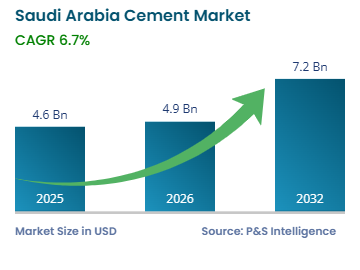
The Saudi Arabian cement market size will be an estimated USD 4.6 billion for 2025, and it will grow by 6.7% during 2026–2032, to reach USD 7.2 billion by 2032.
The market growth is driven by Vision 2030 megaprojects, rapid urbanization, and extensive infrastructure development across the Kingdom. This massive investment is creating sustained demand for cement across residential, commercial, infrastructure, and industrial applications.
The Kingdom's commitment to economic diversification beyond oil is spurring the construction of industrial zones, logistics hubs, and special economic zones, all requiring significant cement supplies. Additionally, sustainability initiatives are reshaping the industry, with cement manufacturers increasingly adopting alternative fuels and developing low-carbon cement products to align with Saudi Arabia's carbon neutrality target of 2060. Government-led housing programs and infrastructure investments further reinforce continuous demand for cement across multiple sectors.
Saudi Arabia Cement Market Trends & Drivers
Sustainability Initiatives Are Key Trends
Environmental sustainability has emerged as a critical trend, with Saudi cement producers investing in green technologies to reduce carbon footprints and align with national climate goals.
The Kingdom targets carbon neutrality by 2060, prompting industry-wide adoption of alternative fuels, carbon capture technologies, and low-carbon cement formulations.
Government incentive programs offer up to SAR 60 million annually to manufacturers adopting greener technologies, improving energy efficiency, and reducing emissions.
In January 2025, King Abdullah University of Science and Technology (KAUST) launched the Future Cement Initiative in collaboration with the Ministry of Industry and National Cement Committee, focusing on reducing carbon emissions in cement manufacturing.
This research initiative aims to develop sustainable production strategies positioning Saudi Arabia as a leader in eco-friendly cement practices.
Al Jouf Cement's green cement received approval for use in NEOM projects in December 2024, as it claims to reduce carbon emissions by 30% and enhance concrete durability.
Cement manufacturers are implementing refuse-derived fuel (RDF) in kilns at the pilot scale, aligned with Saudi Green Initiative goals.
Yamama Cement and Arabian Cement have introduced RDF into production processes, signing memoranda of understanding with municipalities and waste management firms to source biomass and industrial waste for thermal energy substitution.
These initiatives reduce reliance on conventional fossil fuels while addressing waste management challenges.
Additionally, digital plant upgrades incorporating predictive maintenance, automated emissions tracking, and fuel mix optimization are improving operational efficiency and compliance with evolving environmental regulations.
Hoffmann Green Cement Technologies commenced construction of Saudi Arabia's first clinker-free cement production facility in Rabigh in June 2024, under a 22-year exclusive contract with Shurfah Group, signaling a long-term commitment to sustainable cement alternatives.
Rapid Urbanization and Population Growth Propel Market Expansion
Rapid urbanization and population growth are key drivers for the Saudi cement market because they directly increase demand for residential, commercial, and infrastructure construction, ensuring continuous consumption of cement across the Kingdom.
The Eastern Province exhibits a 93.2% urbanization rate, while Riyadh shows 90.9%, according to the United Nations.
This urban concentration amplifies cement requirements for housing, commercial developments, and supporting infrastructure, including roads, schools, hospitals, and utilities.
Government initiatives addressing housing needs further stimulate cement demand.
Vision 2030 emphasizes affordable housing provision, with programs targeting underserved communities and first-time homebuyers.
The Riyadh Urban Project aims to enhance the quality of life through improved infrastructure, expanded green spaces, and diverse housing options.
According to the Ministry of Municipal and Rural Affairs, approximately 138,114 companies operate within the construction sector, reflecting the industry's scale and employment generation capacity.
Saudi Arabia Cement Market Segmentation Analysis
Type Analysis
The ordinary Portland cement category holds the largest market share, of 70%, in 2025, driven by its versatility, proven performance characteristics, and widespread acceptance across construction applications. OPC remains the preferred choice for structural applications, including residential buildings, commercial complexes, bridges, highways, and general construction, due to its reliable strength development and cost-effectiveness. Saudi Arabia's major cement manufacturers maintain substantial OPC production capacity, with integrated plants capable of producing multiple grades to serve diverse application requirements.
The Portland pozzolana cement category will have the highest CAGR, of 6.9%, supported by increasing emphasis on sustainable construction practices and enhanced durability requirements. PPC incorporates pozzolanic materials such as fly ash, reducing clinker content and consequently lowering carbon emissions while improving long-term strength and resistance to sulfate attack and alkali-aggregate reactions. The material's superior performance in aggressive environments makes it particularly suitable for coastal construction, marine structures, and projects in regions with high groundwater salinity. The adoption of PPC in public sector projects is being accelerated by government initiatives that promote eco-friendly building materials and green construction certifications.
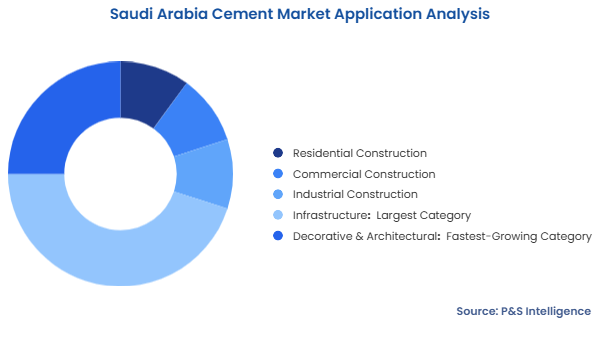
The infrastructure category holds the largest market share, of 45%, in 2025, driven by the scale of Vision 2030 mega-projects, such as NEOM, the Red Sea Project, Qiddiya, transport corridors, and nationwide utilities upgrades. These projects consume massive volumes of bulk cement for foundations, tunnels, bridges, highways, and large civil works, making infrastructure the dominant demand center. Major projects include metro systems in Riyadh, Jeddah, and Dammam, highway expansions connecting urban centers and facilitating regional trade, and airport modernization accommodating projected tourism growth.
The decorative & architectural applications category will have the highest CAGR during the forecast period, supported by rising demand for white cement, precast architectural elements, premium façades, and aesthetic finishes across luxury tourism, hospitality, and high-end real estate developments. Its rapid adoption is further supported by developers’ increasing preference for visually distinct, durable, and sustainable façade solutions in flagship construction projects.
Drive strategic growth with comprehensive market analysis
Saudi Arabia Cement Market Geographical Analysis
Al-Riyadh Cement Market Size
Al-Riyadh holds the largest market share, of 35%, in 2025, reflecting its status as the political, economic, and administrative capital, driving concentrated construction activity. Government ministries, corporate headquarters, and financial institutions are concentrated in Riyadh, spurring ongoing office construction and supporting infrastructure development. Its central location in the Kingdom enhances material distribution and logistical efficiency for cement suppliers. Major cement manufacturers, including Saudi Cement and Yamama Cement, maintain production facilities strategically positioned to serve Riyadh's substantial requirements, with logistics partnerships optimizing supply chain efficiency.
The Riyadh Urban Project aims to transform the capital into a world-class metropolis through enhanced public transportation, expanded green spaces, including King Salman Park, and modernized utilities infrastructure. These initiatives create sustained demand for diverse cement grades serving structural, architectural, and specialized applications.
Eastern Province Cement Market Size
Eastern Province will have the highest CAGR, of 6.8%, driven by industrial expansion, port development, and petrochemical sector growth. King Fahd Industrial Port in Jubail, one of the world's largest industrial ports, drives cement demand for manufacturing facilities, storage infrastructure, and logistics operations.
Eastern Province's strategic importance for hydrocarbon production and export generates ongoing demand for specialized cement applications, including offshore platforms, pipeline infrastructure, and refinery expansions. The region's coastal location supports maritime construction, port facilities, and related infrastructure requiring sulfate-resistant and marine-grade cement formulations. Government initiatives to develop the Eastern Province as an industrial and logistics hub complement the efforts to diversify economic activity beyond petroleum extraction, sustaining construction activity across multiple segments. The region's role in Saudi Arabia's oil and gas sector sustains demand for cement in well drilling operations, facility expansions, and infrastructure connecting production sites to processing and export terminals.
Makkah Cement Market Size
Makkah Province maintains a substantial market presence with steady growth driven by unique requirements serving the Islamic pilgrimage infrastructure and commercial development in Jeddah, the Kingdom's second-largest city. These projects require specialized cement meeting stringent quality standards for structural integrity, durability, and resistance to heavy foot traffic and environmental exposure. The region is witnessing large-scale mixed-use developments such as the Masar Destination covering 3.8 million m² of buildings (including 10,000 homes and 24,000 hotel rooms), which will drive substantial cement demand.
The provinces of the market are as follows:
Al-Riyadh (Largest Province)
Eastern Province (Fastest-Growing Province)
Makkah
Madinah
Qassim
Asir
Tabuk
Ha'il
Northern Borders
Jazan
Najran
Al-Baha
Al-Jouf
Saudi Arabia Cement Market Share
The market is fragmented due to the presence of numerous manufacturers and widespread production facilities, which prevents any single company from dominating the industry. While a few players hold relatively higher production capacities, the majority of capacity is distributed among smaller companies, creating a competitive landscape. Geographic dispersion of cement plants across multiple regions means companies primarily serve localized demand rather than operating nationally, which limits consolidation. Additionally, installed capacity consistently exceeds domestic demand, fostering competition on pricing and market share. The combination of these factors, multiple active players, regional focus, overcapacity, and diverse market participation, results in a fragmented market structure.
Key Saudi Arabia Cement Companies:
Arabian Cement Company
Saudi Cement Company
Yamama Cement Company
Yanbu Cement Company
Southern Province Cement Company
Qassim Cement Company
Al Safwa Cement Company
Tabuk Cement Company
Najran Cement Company
Hail Cement Company
Al Jouf Cement Company
Umm Al Qura Cement Company
Saudi Arabia Cement Market News
In January 2025, King Abdullah University of Science and Technology (KAUST) in collaboration with the Ministry of Industry and the National Cement Committee, launched the Future Cement Initiative to reduce carbon emissions in cement manufacturing, supporting Saudi Arabia’s goal of carbon neutrality by 2060.
In January 2025, the NovusCrete Consortium was established through a memorandum of understanding among SIKA AG, ClimateCrete Inc., NEOM, the Saudi Investment Recycling Company, and the Public Investment Fund. The initiative focuses on developing sustainable concrete production methods using advanced technologies and eco-friendly materials to lower the construction industry’s carbon footprint.
In December 2024, Al Jouf Cement's green cement received approval for use in NEOM projects, demonstrating a 30% reduction in carbon emissions while improving concrete durability.
In July 2024, Al Jouf Cement Company signed an agreement with Italy's Webuild SpA to supply cement USD 27.7 million (SAR 104 million), to NEOM projects over 41 months, ensuring long-term revenue visibility for the manufacturer.
Want a report tailored exactly to your business need?
Leading companies across industries trust us to deliver data-driven insights and innovative solutions for their most critical decisions. From data-driven strategies to actionable insights, we empower the decision-makers who shape industries and define the future. From Fortune 500 companies to innovative startups, we are proud to partner with organisations that drive progress in their industries.
Client Testimonials
Working with P&S Intelligence and their team was an absolute pleasure – their awareness of timelines and commitment to value greatly contributed to our project's success. Eagerly anticipating future collaborations.
McKinsey & Company
India
Unmatched Standards
Our insights into the minutest levels of the markets, including the latest trends and competitive landscape, give you all the answers you need to take your business to new heights
Complete Data Security
We take a cautious approach to protecting your personal and confidential information. Trust is the strongest bond that connects us and our clients, and trust we build by complying with all international and domestic data protection and privacy laws