Saudi Arabia CCUS Market Size & Share Analysis - Trends, Drivers, Competitive Landscape, and Forecasts (2026 - 2032)
This Report Provides In-Depth Analysis of the Saudi Arabia CCUS Market Report Prepared by P&S Intelligence, Segmented by Technology (Pre-Combustion Capture, Post-Combustion Capture, Oxy-Fuel Combustion), End User (Power Generation, Oil & Gas, Fertilizers, Chemicals), Service (Capture, Transportation, Utilization, Storage), and Geographical Outlook for the Period of 2019 to 2032
Explore the market potential with our data-driven report
Saudi Arabia CCUS Market Overview
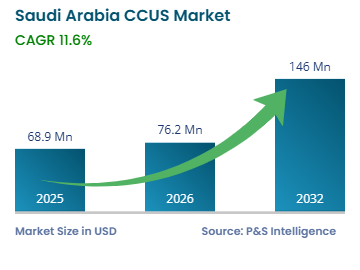
The Saudi Arabian carbon capture, utilisation and storage market value is estimated at USD 68.9 million in 2025, and it is projected to grow at a CAGR of 11.6% during 2026–2032, to reach USD 146.0 million by 2032.
The primary factors driving this market include the kingdom's ambitious net-zero emissions target by 2060, strategic investments in large-scale CCUS infrastructure, and the growing demand for enhanced oil recovery solutions.
Saudi Arabia has committed to reducing CO2 emissions by 278 million tonnes annually by 2030, as part of the Saudi Green Initiative. The Eastern Province, particularly Jubail Industrial City, has emerged as the focal point for CCUS development, hosting several operational and planned facilities. The Aramco CCS hub in Jubail is designed to capture and sequester 9 million metric tonnes of CO2 annually by 2027, representing one of the world's largest carbon capture facilities.
Saudi Arabia operates the Uthmaniyah CO2-EOR project, which has the capability to capture and process 45 million standard cubic feet of CO2 at its NGL plant in Hawiyah. The captured CO2 is transported through an 85-kilometre pipeline for injection into oil reservoirs, demonstrating the dual benefits of emissions reduction and enhanced oil recovery. The kingdom's vast hydrocarbon infrastructure, abundant natural gas resources, and strategic location position it favourably for cost-effective CCUS deployment across multiple industrial sectors.
Saudi Arabia CCUS Market Dynamics
CCUS Integration in Enhanced Oil Recovery Applications Is Key Trend
The Uthmaniyah Carbon Dioxide Enhanced Oil Recovery project captures and stores approximately 800,000 tonnes of CO2 per year from a natural gas production facility.
Its objectives include the determination of incremental oil recovery, estimation of sequestered CO2, and addressing operational risks.
CO2-EOR technology helps maintain reservoir pressure while extending the productive life of mature oil fields, creating dual value streams of emissions reduction and increased hydrocarbon recovery.
CO2 injection has been successfully implemented in Saudi Aramco's Uthmaniyah field, improving recovery rates by approximately 10%.
The kingdom's giant fields, including Ghawar, Khurais, and Shaybah, present significant opportunities for CO2-EOR implementation.
As these fields mature and conventional recovery methods become less effective, the demand for advanced EOR techniques incorporating carbon capture will intensify, supporting both energy security and climate objectives.
Vision 2030 and Net-Zero Commitments Are Accelerating Market Growth
Saudi Arabia aims to achieve net-zero greenhouse gas emissions by 2060, targeting 50% renewable energy and reducing 278 million tonnes of CO2 equivalent annually by 2030 under Vision 2030.
This ambitious roadmap focuses on economic diversification and enhanced quality of life while addressing climate challenges.
The kingdom's Circular Carbon Economy approach, adopted during its G20 presidency, provides the framework for comprehensive carbon management strategies.
Saudi Arabia has pledged to extract, use and store 44 million metric tonnes of CO2 by 2035, driving massive investments in CCUS infrastructure.
The government's strong policy support includes favourable regulations, fiscal incentives for carbon capture projects, and mandates for industrial facilities to implement emissions reduction technologies.
These initiatives create a conducive environment for market expansion across the oil and gas, power generation, chemicals, and fertilizer sectors.
Aramco is expected to achieve its target to capture 6 million metric tonnes of CO2 starting in 2027, with plans to further scale up deployment as it boosts gas production.
The development of the 2-billion-cubic-foot-per-day Jafurah unconventional gas field by 2030 will provide additional high-concentration CO2 streams for capture.
Large-Scale Industrial Clusters Offer Opportunities for CCUS Deployment
Saudi Arabia's industrial landscape is characterized by large-scale emitters and is well-positioned for cost-effective CCUS implementation, with an average CO2 capture cost of USD 69 per tonne.
The Eastern region, with its concentration of petrochemical facilities, refineries, and gas processing plants in Jubail, offers economies of scale that significantly reduce capital and operational expenses.
Ammonia production emerges as the most cost-efficient sector at USD 11 per tonne CO2, driven by its high CO2 concentration.
The co-location of emission sources with storage infrastructure minimizes transportation costs and technical complexities.
SABIC operates the world's largest carbon capture and utilization plant in Jubail, capturing 500,000 metric tonnes of CO2 annually from ethylene glycol production.
The purified CO2 is channelled through a network to other SABIC affiliates for urea and methanol production, demonstrating successful industrial symbiosis.
This integrated approach enhances project viability and attracts private sector investments in CCUS technologies across the kingdom.
Saudi Arabia CCUS Market Segmentation Analysis
Technology Analysis
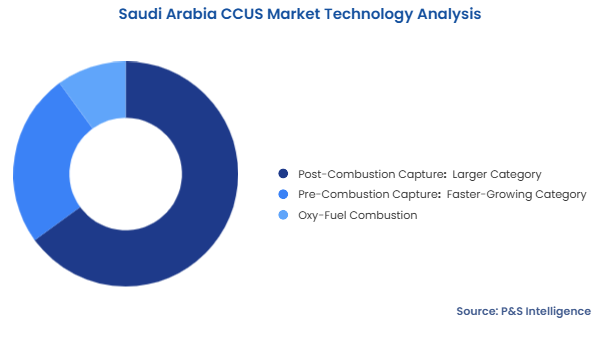
The post-combustion capture category holds the largest share in the Saudi Arabian carbon capture, utilisation and storage market in 2025, of 65%, and it is expected to retain its position in the coming years. Post-combustion capture technology separates CO2 from flue gases after fuel combustion, making it highly suitable for retrofitting existing industrial facilities. Post-combustion carbon capture allows customers to trap CO2 from flowing flue gases and meet emissions limits effectively. The technology's flexibility enables implementation across diverse applications, including power plants, refineries, and cement facilities, without requiring major process modifications.
Pre-combustion capture will witness the highest CAGR during the forecast period, driven by Saudi Arabia's expanding gas-to-hydrogen projects and blue ammonia production facilities. The Jubail CCS project will be key to Aramco's plans to use natural gas from the Jafurah development to produce blue hydrogen and ammonia. Pre-combustion technology offers efficiency advantages when integrated with gasification and reforming processes, with CO2 concentrations reaching up to 40%, compared to 3–15% in post-combustion applications. The kingdom's strategic focus on becoming a global leader in clean hydrogen production positions pre-combustion capture for accelerated adoption.
These technologies are covered:
Post-Combustion Capture (Larger Category)
Pre-Combustion Capture (Faster-Growing Category)
Oxy-Fuel Combustion
End User Analysis
The oil & gas category holds the largest share in the Saudi Arabian carbon capture, utilisation and storage market in 2025, of 40%. This dominance stems from the sector's established infrastructure, high emission volumes, and economic incentives from CO2-EOR applications. Natural gas processing plants have the capacity to capture 2 million metric tonnes of CO2 per year at facilities like Wasit, Fadhili and Khursaniyah. The cost advantages of capturing CO2 from gas processing, where concentrations are naturally high, make deployment particularly attractive for this category.
Power generation will experience the highest CAGR during the forecast period, driven by increasing electricity demand and government mandates for emissions reduction. In 2023, Saudi Arabia still produced nearly 100% of its electricity with fossil fuels, with around 63% from fossil gas and 36% from oil. As the kingdom transitions toward its target of 50% renewable energy by 2030, CCUS technology will play a critical role in decarbonizing the remaining fossil fuel-based generation capacity, particularly for baseload and peaking power plants that ensure grid stability.
These end users are covered:
Oil & Gas (Largest Category)
Power Generation (Fastest-Growing Category)
Fertilizers
Chemicals
Others
Service Analysis
The capture category holds the largest share in 2025, of 45%, as it represents the most technologically complex and capital-intensive component of the CCUS value chain. Specialized engineering, proprietary solvents, and customized equipment drive substantial revenue generation in this category. Saudi Arabia's focus on developing indigenous capture technologies and manufacturing capabilities supports domestic value creation and reduces dependence on international suppliers.
Storage will witness the higher CAGR during the forecast period, driven by the kingdom's vast geological storage potential and expanding infrastructure for permanent CO2 sequestration. The Jubail CCS hub will sequester CO2 in a saline aquifer, with an initial capacity of 9 million metric tonnes annually. The Eastern Province's deep saline formations and depleted hydrocarbon reservoirs provide multiple gigaton-scale storage opportunities. As capture capacity expands across industrial sectors, the demand for reliable, monitored storage solutions will accelerate, attracting investments in characterization, monitoring, and verification technologies.
These services are covered:
Capture (Largest Category)
Transportation
Utilization
Storage (Fastest-Growing Category)
Drive strategic growth with comprehensive market analysis
Saudi Arabia CCUS Market Regional Outlook
Eastern Province Carbon Capture, Utilisation and Storage Market Size
The Eastern Province holds the largest share in the Saudi Arabia market in 2025, of 40%, and it is expected to maintain its position in the coming years. This dominance is attributed to the concentration of major industrial facilities, including Saudi Aramco's gas plants, SABIC's petrochemical complexes, and numerous refineries in Jubail and Dammam. The Eastern region, with its planned CCS hub in Jubail, emerges as the most promising for near-term deployment. The province benefits from proximity to offshore geological storage formations and existing pipeline infrastructure that reduces implementation costs.
SABIC's carbon capture plant in Jubail captures 500,000 metric tonnes of CO2 per year, utilizing the CO2 for urea and methanol production through an integrated pipeline network. The strategic clustering of emission-intensive industries creates synergies for shared CCUS infrastructure, enabling multiple facilities to access centralized capture and storage services. The Eastern Province's well-developed industrial zones, skilled workforce, and established supply chains provide competitive advantages for CCUS project development and operation.
The province is also home to Saudi Arabia's largest oil fields, including Ghawar and Safaniya, where CO2-EOR applications offer immediate commercial value. Ghawar field has more than 3,000 producer and injector wells and a network of 25 gas and oil separation plants. This extensive infrastructure facilitates the rapid deployment of carbon capture systems with minimal additional capital investment. The government's designation of Jubail as a global CCUS hub reinforces the Eastern Province's leadership position in the market.
Al-Riyadh Carbon Capture, Utilisation and Storage Market Outlook
Al-Riyadh is expected to witness the highest CAGR, of approx. 11.6%, during 2026–2032. The capital region's expanding industrial sector, including cement plants, power stations, and manufacturing facilities, presents substantial decarbonization opportunities. The kingdom's Vision 2030 initiatives have accelerated industrial development in Riyadh, creating new emission sources that require carbon management solutions.
The proximity to government institutions and policy-making centres enhances access to regulatory support and funding mechanisms for CCUS projects. Riyadh's strategic position as Saudi Arabia's economic and administrative hub attracts international technology providers and facilitates partnerships between domestic and foreign companies. The development of demonstration projects and pilot facilities in the region serves as a testing ground for innovative CCUS technologies before broader commercial deployment.
These provinces are covered:
Eastern Province (Largest Provincial Market)
Al-Riyadh (Fastest-Growing Provincial Market)
Makkah
Madinah
Qassim
Asir
Tabuk
Ha'il
Northern Borders
Jazan
Najran
Al-Baha
Al-Jouf
Saudi Arabia CCUS Market Share
The Saudi Arabian carbon capture, utilisation and storage market is consolidated, with a few major players controlling significant market share due to the capital-intensive nature and technical complexity of CCUS projects. Saudi Aramco dominates the landscape through its extensive infrastructure development, operational experience, and strategic partnerships with international technology providers. The company's integrated approach, combining capture from gas plants with storage in saline aquifers and depleted reservoirs, establishes industry best practices.
Saudi Aramco's significance stems from its vast capital resources, access to emission sources, and control over suitable geological storage formations. Strategic partnerships characterize the competitive landscape, with major players forming alliances to leverage complementary capabilities. Opportunities exist for new entrants specializing in niche technologies, such as direct-air capture, modular capture systems, and advanced monitoring solutions. The government's support for technology localization and capacity building creates pathways for domestic companies to participate in the growing market through manufacturing, engineering services, and project management.
Key Saudi Arabia CCUS Companies:
Saudi Arabian Oil Company
Saudi Basic Industries Corporation
Schlumberger N.V.
Linde plc
Aker Solutions
Air Liquide S.A.
Baker Hughes Company
Exxon Mobil Corporation
Fluor Corporation
General Electric
Equinor ASA
Shell plc
Siemens AG
Mitsubishi Heavy Industries Ltd.
Honeywell International Inc.
Saudi Arabia CCUS Market News
In March 2025, Saudi Aramco launched a direct-air capture test unit, in collaboration with Siemens Energy, to assess commercial scale-up of emissions-reduction technologies.
In February 2025, Saudi Aramco awarded Larsen & Toubro Limited a USD 1.5-billion EPC contract for the inaugural phase of its CCS hub in Jubail, with planned operational start by 2027.
In December 2024, Saudi Aramco, Schlumberger N.V., and Linde plc signed a shareholders' agreement to develop the Jubail CCS project, targeting a 9 million metric tonnes annual CO2 capture capacity.
In October 2024, Saudi Aramco completed its first certified bulk shipment of blue ammonia to Japan using CCS technologies.
In July 2023, Aker Carbon Capture and Sudi Aramco signed a memorandum of understanding to explore partnership opportunities for deploying modular CCUS solutions and industrial modularization in Saudi Arabia.
Want a report tailored exactly to your business need?
Leading companies across industries trust us to deliver data-driven insights and innovative solutions for their most critical decisions. From data-driven strategies to actionable insights, we empower the decision-makers who shape industries and define the future. From Fortune 500 companies to innovative startups, we are proud to partner with organisations that drive progress in their industries.
Client Testimonials
Working with P&S Intelligence and their team was an absolute pleasure – their awareness of timelines and commitment to value greatly contributed to our project's success. Eagerly anticipating future collaborations.
McKinsey & Company
India
Unmatched Standards
Our insights into the minutest levels of the markets, including the latest trends and competitive landscape, give you all the answers you need to take your business to new heights
Complete Data Security
We take a cautious approach to protecting your personal and confidential information. Trust is the strongest bond that connects us and our clients, and trust we build by complying with all international and domestic data protection and privacy laws