Saudi Arabia Buy Now Pay Later (BNPL) Market Size & Share Analysis - Emerging Trends, Growth Opportunities, Competitive Landscape, and Forecasts (2026 - 2032)
This Report Provides In-Depth Analysis of the Saudi Arabia Buy Now Pay Later Market Report Prepared by P&S Intelligence, Segmented by Channel (Online, Point of Sale), Industry (Fashion & Personal Care, Consumer Electronics, Healthcare, Kitchen Appliances, Home Furnishings, Travel & Entertainment), Business Model (Pay-in-4 (4 Equal Instalments, Interest-Free), Long-Term Instalments (6–60 Months), Pay-in-30 (Single Payment after 30 Days), Subscription-Based BNPL), Provider Type (Local, International, Bank-Affiliated, Payment-Gateway-Integrated), Age Group (Gen Z (18–24 years), Millennials (25–40 years), Gen X (41–56 years), Baby Boomers (57+ years)), Gender (Male, Female), Income Level (Low (below SAR 5,000 per Month), Middle (SAR 5,000–15,000 per Month), High (above SAR 15,000 per Month)), and Geographical Outlook for the Period of 2019 to 2032
Saudi Arabia Buy Now Pay Later Market Revenue Insights
Key Highlights
Study Period
2019 - 2032
Market Size in 2025
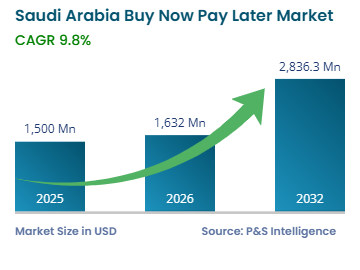
USD 1500.0 Million
Market Size in 2026
USD 1632.0 Million
Market Size by 2032
USD 2836.3 Million
Projected CAGR
9.8%
Largest Region
Al-Riyadh
Fastest Growing Region
Makkah
Market Structure
Fragmented
Market Size
Explore the market potential with our data-driven report
Saudi Arabia Buy Now Pay Later Market Future Outlook
The Saudi Arabia buy now pay later market size is estimated at USD 1500.0 million in 2025, and it is projected to grow at a CAGR of 9.8% during 2026–2032, to reach USD 2836.3 million by 2032.
The primary factors driving the market expansion include the rapid digital transformation of payment systems, growing smartphone penetration, and increasing preference for flexible payment options among young consumers. The kingdom's Vision 2030 initiative has accelerated the adoption of digital financial services, with electronic payments accounting for 70% of all retail transactions in 2024, creating favourable conditions for BNPL services to flourish.
The surge in e-commerce activities has significantly contributed to the BNPL market growth in Saudi Arabia. Young Saudi consumers, particularly millennials and Generation Z who constitute over 70% of the population under age 35, are embracing BNPL services as an alternative to traditional credit cards. This demographic shift, combined with the low credit card penetration, of approximately 27.7%, in the kingdom, presents substantial opportunities for BNPL providers to capture market share and establish themselves as preferred payment solutions for both online and in-store purchases.
Saudi Arabia Buy Now Pay Later Market Trends & Drivers
Rising E-commerce Penetration Is Major Trend
The exponential growth of e-commerce in Saudi Arabia is a key market trend.
According to the CST Commission of Saudi Arabia, in 2023, 63.7% of the internet users bought products or services online, with 74.6% of those purchases being made by women.
This digital commerce revolution has created an ideal ecosystem for BNPL services to thrive, as online retailers increasingly integrate flexible payment options to enhance conversion rates and average order values.
According to the Saudi Central Bank (SAMA), retail consumer electronic payments surged to 79% of total retail payments in 2024, up from 62% in 2022 and 70% in 2023.
The widespread adoption of digital payment methods has normalized the concept of alternative payment solutions, making consumers more receptive to BNPL offerings.
Saudi Arabia was home to 35.10 million social media users in January 2024, equating to 94.3% of the total population.
The integration of BNPL services with major e-commerce platforms and retail groups has streamlined the checkout process, reducing friction in the payment journey.
Local BNPL providers have established partnerships with over 30,000 merchants across various sectors, including fashion, electronics, and home goods, making these payment options widely accessible to consumers.
The convenience of spreading payments over time without interest charges particularly appeals to budget-conscious shoppers who seek to manage their cash flow effectively while maintaining purchasing power.
Favourable Demographics and Changing Consumer Behaviour Drive Adoption
Saudi Arabia's youthful population structure creates optimal conditions for BNPL market growth.
Over 70% of the population is under the age of 35, representing a generation that prioritizes financial flexibility and digital-first solutions.
This demographic exhibit distinct consumption patterns, favouring experiences and quality products while seeking alternatives to traditional credit mechanisms that may involve complex approval processes or religious considerations regarding interest payments.
According to the Saudi Central Bank, contactless payments have a 94% penetration rate in the country, demonstrating the population's readiness to adopt innovative payment technologies.
The high smartphone penetration rate, with over 33 million active users, enables seamless access to BNPL services through mobile applications and digital wallets.
Young Saudi consumers view BNPL as a budgeting tool rather than a credit product, aligning with their preference for transparent, straightforward financial services.
Cultural factors also contribute to BNPL adoption, as Shariah-compliant BNPL models offering zero-interest instalments resonate with consumers seeking Islamic finance alternatives.
The traditional aversion to interest-bearing credit products in Saudi society has created a gap that BNPL services effectively fill, providing access to credit without conflicting with religious principles.
This cultural alignment, combined with the convenience and transparency of BNPL offerings, has accelerated market acceptance across various consumer segments.
Saudi Arabia Buy Now Pay Later Market Segmentation Analysis
Channel Analysis
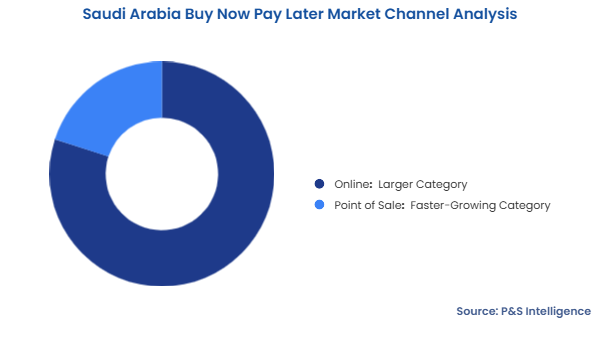
The online channel dominates the Saudi Arabia BNPL market in 2025 with 80% share, driven by the seamless integration of BNPL options into e-commerce checkout processes. The convenience of completing BNPL applications digitally, with instant approval decisions and minimal documentation requirements, has made online channels the preferred gateway for BNPL adoption. Major e-commerce platforms including Noon, Amazon.sa, and local marketplaces have embedded BNPL solutions prominently in their payment options, normalizing their use among digital shoppers.
The point of sale (POS) channel has the higher CAGR, during 2026–2032, as BNPL providers expand their physical presence through card programs and QR code-based solutions. The presence of over 1 million POS terminals across the kingdom, combined with the widespread adoption of contactless payment technology, facilitates smooth BNPL transactions at physical retail locations. In-store BNPL adoption particularly resonates with consumers making high-value purchases in categories such as electronics, furniture, and luxury goods, where the ability to spread payments provides immediate purchasing power without depleting savings.
The channels covered include:
Online (Larger Category)
Point of Sale (Faster-Growing Category)
Business Model Analysis
The Pay-in-4 model dominates the Saudi BNPL market in 2025 with 45% market share, as its short-term, interest-free structure appeals to both consumers and merchants. This model typically divides purchases into four equal instalments over six to eight weeks, providing immediate gratification while maintaining manageable payment amounts. The zero-interest nature of Pay-in-4 plans aligns with Islamic finance principles, making them culturally acceptable across broad consumer segments in Saudi Arabia.
Long-term instalment plans represent the fastest-growing category, during 2026–2032, particularly for high-ticket purchases such as electronics, furniture, and travel bookings. These extended payment periods, ranging from six to sixty months, enable consumers to finance larger purchases while merchants benefit from increased average order values and reduced cart abandonment rates. The flexibility to choose payment terms based on purchase size and personal financial circumstances enhances the appeal of BNPL services across diverse consumer needs.
The business models covered include:
Pay-in-4 (Largest Category)
Long-term Instalments (Fastest-Growing Category)
Pay-in-30
Subscription-based BNPL
Provider Type Analysis
Local BNPL providers dominate the Saudi market in 2025, capturing 45% market share, driven by their deep understanding of cultural preferences and ability to offer Shariah-compliant financing solutions. Companies like Tamara and Tabby have leveraged their local expertise to build trust with Saudi consumers, establishing partnerships with regional retailers and tailoring their services to meet specific market needs. Their success stems from localized marketing strategies, Arabic-first user interfaces, and customer service that resonates with Saudi cultural values and shopping behaviours.
International BNPL providers represent the fastest-growing category, during 2026–2032, as global players like Afterpay, Klarna, and Affirm explore entry strategies into the lucrative Saudi market. These providers bring sophisticated technology platforms, proven risk management systems, and extensive experience from other markets. Bank-affiliated BNPL services are emerging as significant competitors, with traditional financial institutions leveraging their existing customer bases and regulatory compliance infrastructure to offer integrated BNPL solutions within their digital banking platforms.
The provider types covered include:
Local (Largest Category)
International (Fastest-Growing Category)
Bank-Affiliated
Payment-Gateway-Integrated
Age Group Analysis
Millennials (25–40 years) constituted the largest user category in 2025 with 45% share, as they display digital fluency and possess established purchasing power. This age group actively uses BNPL services for diverse purchases ranging from fashion and electronics to travel and home furnishings. Their comfort with digital financial services and preference for budget management tools makes them ideal BNPL customers who appreciate the transparency and control these services provide.
Gen Z (18–24 years) is the fastest-growing category, driven by their entry into the workforce and increasing financial independence. According to the current data, BNPL platforms are primarily targeting a tech-savvy young audience. BNPL's quick growth illustrates that the Gen Z is increasingly rejecting traditional services in favour of something that better suits their financial needs. This generation views BNPL as a natural payment option rather than a credit product, seamlessly integrating it into their digital-first shopping experiences.
The age groups covered include:
Gen Z (18–24 years) (Fastest-Growing Category)
Millennials (25–40 years) (Largest Category)
Gen X (41–56 years)
Baby Boomers (57+ years)
Gender Analysis
Female users dominate BNPL usage in 2025, accounting for 85% share, particularly driven by their higher engagement in fashion and personal care purchases. Major BNPL providers, such as Tabby, have reported significant traction in this category, with their integration into prominent fashion platforms and retail groups contributing to the category's substantial market presence. Women in Saudi Arabia increasingly utilize BNPL services for both online and in-store purchases, appreciating the ability to manage household budgets while maintaining lifestyle preferences.
Males represent the faster-growing category, during the forecast period, as BNPL adoption expands beyond traditional retail categories into electronics, automotive accessories, and sports equipment. The increasing awareness of BNPL services among male consumers, combined with their integration into gaming platforms and technology retailers, drives adoption growth. Male users typically demonstrate higher average transaction values, particularly for electronics and travel-related purchases.
The genders covered include:
Male (Faster-Growing Category)
Female (Larger Category)
Income Level Analysis
Middle-income consumers (SAR 5,000–15,000 per month) form the largest category in 2025 with 65% share, as they seek financial flexibility to enhance their purchasing power without depleting savings. This income bracket actively uses BNPL services to manage cash flow, particularly for seasonal purchases, special occasions, and unexpected expenses. Their stable income provides confidence to commit to instalment payments while maintaining financial prudence.
High-income consumers (above SAR 15,000 per month) have the highest CAGR, during 2026–2032, as affluent shoppers discover BNPL's convenience for luxury purchases and travel bookings. They appreciate BNPL not for financial necessity but for cash flow optimization and the ability to earn rewards or returns on invested capital, while spreading payments. Their lower default risk and higher transaction values make them attractive customers for BNPL providers seeking to improve portfolio quality.
The income levels covered include:
Low (Below SAR 5,000 per Month)
Middle (SAR 5,000–15,000 per Month) (Largest Category)
High (above SAR 15,000 per Month) (Fastest-Growing Category)
Industry Analysis
Fashion & personal care have emerged as the largest category in 2025, commanding 35% market share, driven by frequent purchase cycles and moderate ticket sizes that align perfectly with BNPL instalment structures. Young Saudi consumers, particularly women under 30, actively utilize BNPL services for fashion purchases, appreciating the ability to acquire trending items immediately while managing monthly budgets effectively.
Healthcare represents the fastest-growing category, during the forecast period, as medical providers increasingly offer BNPL options for elective procedures, diagnostic services, and wellness programs. The integration of zero-interest financing solutions in healthcare settings addresses affordability concerns while ensuring patients can access necessary medical services without financial strain.
The industries covered include:
Fashion & Personal Care (Largest Category)
Consumer Electronics
Healthcare (Fastest-Growing Category)
Kitchen Appliances
Home Furnishings
Travel & Entertainment
Others
Drive strategic growth with comprehensive market analysis
Saudi Arabia Buy Now Pay Later Market Geographical Analysis
Al-Riyadh BNPL Market Growth
Al-Riyadh commands the largest share of the Saudi Arabia BNPL market in 2025, of 40%, driven by the capital city's concentration of retail activity, higher disposable incomes, and advanced digital infrastructure. Riyadh, the capital and administrative centre of Saudi Arabia, is home to 7.95 million people, representing the kingdom's largest urban market with sophisticated consumers actively embracing digital payment innovations. The province's thriving e-commerce ecosystem, supported by numerous logistics hubs and same-day delivery services, creates ideal conditions for BNPL adoption across both online and offline channels.
The concentration of government institutions, corporate headquarters, and educational facilities in Riyadh generates steady employment and income streams, enabling residents to confidently utilize BNPL services for discretionary spending. Major shopping destinations, including Riyadh Park Mall, kingdom Centre, and Al Nakheel Mall, have integrated BNPL options extensively, with leading providers establishing physical presence through kiosks and partnership counters. The upcoming mega-projects in Riyadh, including the King Salman Park and Sports Boulevard, are expected to further stimulate retail activity and BNPL usage as new commercial districts emerge.
Makkah BNPL Market Dynamics
Makkah is the fastest-growing regional market for BNPL services, with a projected CAGR of approx. 10.5% during 2026–2032, fuelled by the unique combination of religious tourism, local consumption, and the economic dynamism of Jeddah. Jeddah, with 5.02 million residents, is a major port city on the Red Sea, serving as the kingdom's commercial hub and gateway for millions of pilgrims annually. The province's diverse economy, spanning trade, hospitality, and retail sectors, creates multiple touchpoints for BNPL adoption across various consumer segments.
The influx of religious visitors to Makkah and Madinah throughout the year generates substantial retail activity, with BNPL services facilitating purchases of gifts, religious items, and travel-related expenses. Local BNPL providers have developed specialized offerings for the hospitality sector, enabling hotels and travel agencies to offer flexible payment options for accommodation and package bookings. The ongoing development of tourism infrastructure under Vision 2030, including the expansion of the Grand Mosque and new hospitality projects, positions Makkah Province as a critical growth market for BNPL services catering to both residents and visitors.
These provinces are covered:
Al-Riyadh (Largest Province)
Makkah (Fastest-Growing Province)
Eastern Province
Madinah
Qassim
Asir
Tabuk
Ha'il
Northern Borders
Jazan
Najran
Al-Baha
Al-Jouf
Saudi Arabia Buy Now Pay Later Market Share
The Saudi Arabia BNPL market is currently fragmented, with multiple players competing across segments. Local fintech firms, such as Tamara and Tabby, dominate, but smaller firms and regional entrants such as Spotti, Cashew, and Postpay also operate actively. The low barrier to entry, rapid digital adoption, and high consumer demand have encouraged new startups to emerge. This fragmentation has led to varied offerings, competitive pricing, and innovative payment models. However, the lack of a dominant player creates challenges in standardization and customer trust. As regulation tightens and funding concentrates, smaller players may struggle to scale, potentially setting the stage for future consolidation.
Key Saudi Arabia Buy Now Pay Later Companies:
Tamara Finance Company
Tabby FZ LLC
Zip Co Limited
Jeel Pay
Kadi Pay
MIS Forward
Spotti
Postpay
Arabian Pay
ToYou
Madafuou Alarabia
Saudi Arabia Buy Now Pay Later Market News
In March 2025, Arabian Pay signed a pre-seed funding agreement with Al Bassami Holding Group to strengthen its market presence, expedite the advancement of its platform, and broaden its partnerships.
In September 2024, Tabby L.L.C-FZ completed the acquisition of Tweeq International Company, a licensed Saudi digital wallet, strengthening its position in the digital payments ecosystem and expanding its service portfolio beyond traditional BNPL offerings to include comprehensive financial services.
In January 2024, Tamara Finance Company acquired PayTabs to enhance its technological infrastructure and provide more seamless transaction processing capabilities across its merchant network.
Want a report tailored exactly to your business need?
Leading companies across industries trust us to deliver data-driven insights and innovative solutions for their most critical decisions. From data-driven strategies to actionable insights, we empower the decision-makers who shape industries and define the future. From Fortune 500 companies to innovative startups, we are proud to partner with organisations that drive progress in their industries.
Client Testimonials
Working with P&S Intelligence and their team was an absolute pleasure – their awareness of timelines and commitment to value greatly contributed to our project's success. Eagerly anticipating future collaborations.
McKinsey & Company
India
Unmatched Standards
Our insights into the minutest levels of the markets, including the latest trends and competitive landscape, give you all the answers you need to take your business to new heights
Complete Data Security
We take a cautious approach to protecting your personal and confidential information. Trust is the strongest bond that connects us and our clients, and trust we build by complying with all international and domestic data protection and privacy laws