Saudi Arabia Beauty and Personal Care Products Market Size & Share Analysis - Key Trends, Future Opportunities, Growth Strategies, and Forecasts (2026 - 2032)
This Report Provides In-Depth Analysis of the Saudi Arabia Beauty and Personal Care Products Market Report Prepared by P&S Intelligence, Segmented by Product Type (Skin Care, Color Cosmetics, Hair Care, Baby Care, Bath and Shower, Oral Care, Men's Grooming, Deodrant, Sun Care, Fragnance, Depilatory), Distribution Channel (Marketplace Platform, Professional Health & Beauty Outlet, Club/Value Store, Brand Owner to Store/Franchise, Local Marketplace Platform, Brand Owner to Home, Specialist Marketplace Platform, Dermatologist, Social Commerce, New Cross-Category Distribution Point), Type (Conventional, Organic), and Geographical Outlook for the Period of 2019 to 2032
Saudi Arabia Beauty and Personal Care Products Market Size Estimation
Key Highlights
Study Period
2019 - 2032
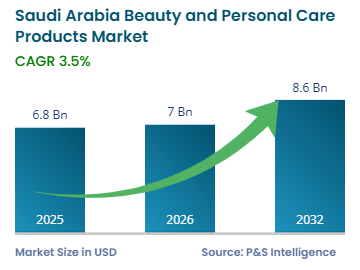
Market Size in 2025
USD 6.8 Billion
Market Size in 2026
USD 7.0 Billion
Market Size by 2032
USD 8.6 Billion
Projected CAGR
3.5%
Largest Country
Al-Riyadh
Fastest-Growing Country
Eastern Region
Market Structure
Fragmented
Market Size
Explore the market potential with our data-driven report
Saudi Arabia Beauty and Personal Care Products Market Analysis
The Saudi Arabian beauty and personal care products market size will be an estimated USD 6.8 billion for 2025, and it will grow by 3.5% during 2026–2032, to reach USD 8.6 billion by 2032.
The market is experiencing robust growth driven by a predominantly young population, with over 60% under the age of 30, coupled with rising disposable incomes and increasing female workforce participation. Economic diversification under Vision 2030 is reshaping the market, providing opportunities for both international and domestic beauty brands to expand their presence in the Kingdom.
The surge in digital connectivity, with internet penetration reaching 99.0% and social media users accounting for 94.3% of the population, has revolutionized consumer behavior and beauty purchasing patterns. According to industry reports, there were 36.84 million internet users in Saudi Arabia at the start of 2024, when internet penetration stood at 99.0%. This digital transformation has enabled beauty brands to reach consumers through innovative channels, while the growing acceptance of e-commerce has made premium and mass beauty products more accessible across all regions. The market's evolution reflects broader societal changes, including women's increasing participation in public life and the workforce, which has amplified demand for professional makeup, skincare, and grooming products suitable for the Kingdom's climate and cultural preferences.
Saudi Arabia Beauty and Personal Care Products Market Emerging Trends
Digital Transformation and Social Media Influence Are Key Trends
The beauty and personal care products market in Saudi Arabia is undergoing a digital revolution driven by the Kingdom's tech-savvy population and widespread social media adoption.
Saudi Arabia was home to 35.10 million social media users in January 2024, equaling 94.3% of the total population.
Saudi consumers increasingly rely on platforms such as Instagram, TikTok, and Snapchat to explore and buy beauty products, with influencers significantly influencing trends and beauty preferences.
According to the Chalhoub report, Saudi women are the "most-engaged users of makeup and fragrance and gain most of their inspiration from social media."
This digital engagement has created direct-to-consumer channels that bypass traditional retail, while real-time product demonstrations and user-generated content enhance transparency and trust.
Beauty brands are investing heavily in digital marketing strategies, influencer collaborations, and social commerce capabilities to capture the attention of younger consumers who constitute the majority of beauty product purchasers.
Empowered Female Consumers Propel Demand for Halal-Certified Beauty Products
The increasing participation of Saudi women in the workforce represents a fundamental shift that is significantly impacting the beauty and personal care market.
According to the report, the labor force participation rate of Saudi females has reached 36.2%, indicating a substantial shift in employment demographics.
This transformation has created new demand patterns for workplace-appropriate cosmetics, professional grooming products, and time-efficient beauty solutions that cater to working women's needs.
The rising disposable income among working women has strengthened their ability to purchase premium beauty items, and workplace norms have further driven demand for daily makeup and grooming products.
The expansion of women in customer-facing roles, particularly in retail and corporate sectors, has accelerated demand for long-lasting, heat-resistant formulations that maintain performance in the Kingdom's challenging climate conditions.
The demand for halal-certified beauty and personal care products is experiencing unprecedented growth in Saudi Arabia, driven by increasing consumer awareness about ingredients and religious compliance.
The government's support through Vision 2030 initiatives, including the establishment of the Halal Products Development Company by the Public Investment Fund, demonstrates its commitment to positioning Saudi Arabia as a global center for halal products.
This strategic focus has attracted both international brands seeking halal certification and local manufacturers developing Shariah-compliant formulations, creating a competitive landscape that benefits consumers through increased choice and innovation.
In September 2024, the Saudi Food and Drug Authority updated the "Guidelines and Requirements for Cosmetic Products Listing" to enhance consumer awareness of regulatory procedures and improve access to circulars on cosmetic products through the unified online system.
Saudi Arabia Beauty and Personal Care Products Market Segmentation Analysis
Product Type Analysis
The skin care category holds the largest market share, of 30%, in 2025, and will have the highest CAGR, of 3.6%, driven by increasing awareness about skincare routines, the harsh desert climate requiring specialized formulations, and growing demand for anti-aging and sun protection products. The extreme weather conditions, with temperatures often exceeding 45 °C and low humidity levels, create specific skincare needs that drive consistent demand for moisturizers, serums, and protective formulations. Influenced by Korean beauty and global wellness trends, the increasing awareness of daily skincare has expanded the category beyond simple cleansing to multi-step routines including toners, essences, and specialized treatments.
The product types analyzed in this report are:
Skin Care (Largest and Fastest-Growing Category)
Color Cosmetics
Hair Care
Baby Care
Bath and Shower
Oral Care
Men's Grooming
Deodorant
Sun Care
Fragrance
Depilatory
Distribution Channel Analysis
The marketplace platform category holds the largest market share in 2025, reflecting the rapid digital transformation and changing shopping preferences among Saudi consumers. Online platforms, such as Amazon, Noon, and dedicated beauty e-tailers, have transformed shopping by making it easy to compare products, read reviews, and access international brands. The high smartphone penetration and advanced digital payment infrastructure support seamless online shopping experiences, while same-day delivery options in major cities enhance the appeal of digital channels.
The professional health & beauty outlet category will have the highest CAGR, of 3.8%, driven by consumers' increasing preference for personalized service, product authenticity guarantees, and the experiential retail environment these stores provide. Specialty retailers like Sephora, Faces, and local beauty chains are expanding their footprint across the Kingdom, offering exclusive brands, professional consultations, and beauty services that cannot be replicated online. The growth of these outlets is supported by their omnichannel strategies that integrate digital tools with in-store experiences, creating seamless customer journeys that cater to the sophisticated Saudi consumer.
The distribution channels analyzed in this report are:
Marketplace Platform (Largest Category)
Professional Health & Beauty Outlet (Fastest-Growing Category)
Club/Value Store
Brand Owner to Store/Franchise
Local Marketplace Platform
Brand Owner to Home
Specialist Marketplace Platform
Dermatologist
Social Commerce
New Cross-Category Distribution Point
Others
Type Analysis
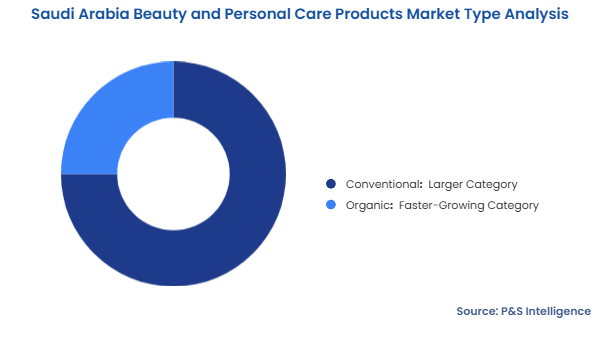
The conventional category holds the larger market share, of 75%, in 2025, supported by established supply chains, competitive pricing, and consumer familiarity with trusted formulations. This category benefits from widespread availability across all distribution channels and price points, making it accessible to the diverse Saudi population. The presence of major international brands with proven track records in conventional formulations provides consumers with confidence in product safety and efficacy, particularly important in categories like color cosmetics and hair care where performance is paramount.
The organic category will have the higher CAGR, of 3.9%, driven by increasing health consciousness, environmental awareness, and the alignment of natural ingredients with halal certification requirements. Younger consumers, particularly millennials and Gen Z, are willing to pay premium prices for products free from harmful chemicals, sustainably sourced, and ethically produced. The government's support for sustainable initiatives under Vision 2030 further accelerates this category's growth through favorable regulations and consumer education programs.
The types analyzed in this report are:
Conventional (Larger Category)
Organic (Faster-Growing Category)
Drive strategic growth with comprehensive market analysis
Saudi Arabia Beauty and Personal Care Products Market Regional Market Performance
AI-Riyadh Beauty and Personal Care Products Market Size
AI-Riyadh holds the largest market share, of 35%, in 2025, as the epicenter of Saudi Arabia's beauty and personal care market. As the capital city and commercial hub, Riyadh benefits from the highest concentration of government employees, corporate professionals, and international expatriates, creating diverse consumer segments with substantial purchasing power. The city's rapid infrastructure development, including new shopping destinations and entertainment complexes, provides ideal environments for beauty retail expansion. Riyadh and Jeddah are at the forefront of adopting global beauty trends, supporting robust growth in the halal cosmetics sector.
The presence of flagship stores from international brands, coupled with the headquarters of major distributors and the country's most sophisticated logistics networks, positions Riyadh as the testing ground for new product launches and innovative retail concepts. Riyadh’s young, educated residents adopt global beauty trends while maintaining cultural authenticity, driving demand for both premium international brands and locally-produced halal cosmetics. Government initiatives centered in the capital, including women's empowerment programs and economic diversification efforts, directly impact beauty consumption patterns as more women enter the workforce and seek professional grooming products.
Eastern Region Beauty and Personal Care Products Market Size
Eastern Region will have the highest CAGR, of 3.7%, driven by its unique demographic composition and economic prosperity from the oil industry. Dammam and Al Khobar are hubs for luxury brands and specialist retailers. A growing expatriate community adds diversity to product preferences. A large population of petroleum sector professionals and expatriates in the Eastern Region drives demand for premium and international beauty brands that may not be as prevalent in other regions.
The Eastern region, known for its oil wealth, boasts a high-income population that drives demand for premium beauty and personal care products. The coastal location of cities like Dammam and Al Khobar influences specific beauty needs, with increased demand for sun protection, anti-humidity hair products, and long-wearing cosmetics. The region's proximity to other GCC markets facilitates cross-border beauty trends and shopping tourism, while ongoing economic diversification projects, including NEOM and other mega-developments, promise to create new consumer segments with unique beauty preferences.
The geographical breakdown of the market is as follows:
Al-Riyadh (Largest Regional Market)
Makkah
Al-Madinah
Al-Qaseem
Eastern Region (Fastest-Growing Regional Market)
Aseer
Tabouk
Hayel
Northern Border
Jazan
Najran
Al-Baha
Al-Jouf
Saudi Arabia Beauty and Personal Care Products Market Share
The market is fragmented with international giants competing alongside regional champions and emerging local brands. Local and regional players are gaining momentum by emphasizing cultural authenticity, halal compliance, and deep understanding of Saudi beauty traditions, particularly in fragrance and traditional cosmetics categories. The digital transformation has democratized market entry, enabling direct-to-consumer brands and social commerce entrepreneurs to challenge established players through innovative marketing approaches and personalized product offerings.
Key Saudi Arabia Beauty and Personal Care Products Companies:
L’Oréal S.A.
Unilever Gulf FZE
Procter & Gamble (P&G)
Estée Lauder Companies Inc.
Beiersdorf AG
Coty Inc.
Shiseido Company, Limited
Kao Group
Oriflame Holdings BV
Revlon, Inc.
Johnson & Johnson Services, Inc.
Arabian Oud Company
Saudi Arabia Beauty and Personal Care Products Market News
In January 2025, Saudi Arabian e-commerce website for cosmetic and personal care products Nice One listed on Tadawul, the kingdom’s stock exchange.
In November 2024, Kosas Cosmetics LLC announced its official entry to the Saudi market with a range of skincare-focused makeup products. It also plans to engage the local community through workshops and events focused on clean beauty and skin health.
In September 2024, FSN E-Commerce Ventures Ltd., the parent company of the fashion e-retailer Nykaa, established a subsidiary in Saudi Arabia for the sale of beauty products both online and offline. The newly formed subsidiary, named Nysaa Trading LLC, will sell cosmetics, toiletries, perfumes, soaps, as well as beauty and hair care products under the brand name Nysaa KSA.
In July 2024, Henkel AG & Co. KGaA inaugurated a beauty care manufacturing facility in Riyadh, producing products under the Pert brand, including shampoos and conditioners tailored for the Middle Eastern market.
Want a report tailored exactly to your business need?
Leading companies across industries trust us to deliver data-driven insights and innovative solutions for their most critical decisions. From data-driven strategies to actionable insights, we empower the decision-makers who shape industries and define the future. From Fortune 500 companies to innovative startups, we are proud to partner with organisations that drive progress in their industries.
Client Testimonials
Working with P&S Intelligence and their team was an absolute pleasure – their awareness of timelines and commitment to value greatly contributed to our project's success. Eagerly anticipating future collaborations.
McKinsey & Company
India
Unmatched Standards
Our insights into the minutest levels of the markets, including the latest trends and competitive landscape, give you all the answers you need to take your business to new heights
Complete Data Security
We take a cautious approach to protecting your personal and confidential information. Trust is the strongest bond that connects us and our clients, and trust we build by complying with all international and domestic data protection and privacy laws