Saudi Arabia Aviation Market Size & Opportunities Analysis - Growth Strategies, Competitiveness, and Forecasts (2026 - 2032)
This Report Provides In-Depth Analysis of the Saudi Arabia Aviation Market Report Prepared by P&S Intelligence, Segmented by Service Type (Passenger Air Transport, Air Freight & Cargo, Aircraft Maintenance, Repair & Overhaul, Ground Handling Services & Airport Services, Leasing & Charter Services, Training & Simulation), Application (Commercial Aviation, General Aviation, Military Aviation), Technology (Conventional, Hybrid Electric, Electric, Autonomous/Unmanned), and Geographical Outlook for the Period of 2019 to 2032
Explore the market potential with our data-driven report
Saudi Arabia Aviation Market Future Outlook
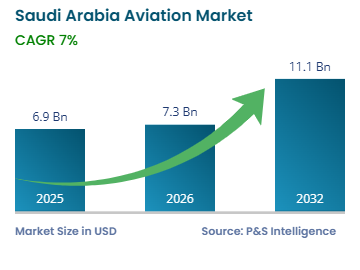
The Saudi Arabian aviation market size will be an estimated USD 6.9 billion for 2025, and it will grow by 7.0% during 2026–2032, to reach USD 11.1 billion by 2032.
The market growth is primarily driven by Vision 2030 strategic initiatives positioning the Kingdom as a global aviation hub, substantial infrastructure investments exceeding USD 100 billion, and ambitious passenger traffic targets of 330 million annually by 2030. The launch of Riyadh Air in 2025 as the Kingdom's second national carrier represents a cornerstone development, targeting 100 international destinations by 2030 with strategic partnerships including Delta Air Lines and Singapore Airlines.
Tourism expansion under Vision 2030 is creating substantial aviation demand, with the Kingdom targeting 150 million tourists and 30 million pilgrims annually by 2030. New tourism destinations including NEOM, AlUla, and the Red Sea Project are generating dedicated airport requirements and airline partnerships. The government has streamlined visa processes and implemented year-round Umrah access, significantly increasing religious tourism beyond traditional Hajj seasons.
Saudi Arabia Aviation Market Dynamics
Digital Transformation and Technological IntegrationAre Key Trends
Saudi Arabia's aviation sector is undergoing rapid digital transformation as part of Vision 2030's emphasis on creating a digitally-first environment.
The General Authority of Civil Aviation has implemented the e-cargo manifesto program that clears air freight shipments digitally before wheels-up, significantly reducing destination dwell times and enhancing supply chain efficiency.
This digitalization extends beyond cargo operations to encompass passenger processing, with the Red Sea International Airport partnering with SITA to deploy automated check-in and departure systems using cutting-edge solutions including SITA Flex and Maestro departure control systems.
The maintenance, repair, and overhaul sector demonstrates the most advanced technological adoption, with Saudia Technic investing heavily in predictive maintenance capabilities and digital inspection tools at its expanded Jeddah MRO Village.
Through partnerships with GE Aerospace and Embraer Services & Support, the facility is integrating advanced engine performance analytics and AI-driven diagnostic systems that enable proactive maintenance scheduling and minimize aircraft downtime.
Ground handling operations are similarly embracing automation and smart technology solutions.
Saudi Ground Services, which handles over 88 million passengers annually across 28 airports, has implemented smart hangar systems and digital workflow management to streamline operations and reduce turnaround times.
The company has invested in baggage handling automation and integrated systems that enhance operational effectiveness while reducing staffing requirements during peak travel periods.
These technological investments support Vision 2030 capacity expansion objectives by enabling scalable, efficient, and digitally driven aviation operations across the Kingdom.
Airlines are leveraging AI for route optimization, dynamic pricing, and customer service enhancement, while airports deploy machine learning algorithms for predictive crowd management and security screening optimization.
This comprehensive digital transformation is positioning Saudi Arabia as a technology leader in regional aviation, creating operational efficiencies that support the Kingdom's rapid capacity expansion while maintaining high service standards across the growing aviation ecosystem.
Vision 2030–Led Aviation Transformation and Megaproject Development Are Biggest Drivers
Saudi Arabia's Aviation Strategy under Vision 2030 and the development of megaproject represent the fundamental transformation reshaping the Kingdom's aviation sector.
The strategy commits USD 100 billion in combined public and private investment to position Saudi Arabia among the world's top aviation centers.
Key infrastructure initiatives include expanding connectivity to 250 global destinations from 29 airports and doubling air cargo capacity to 4.5 million tons annually by 2030.
The General Authority of Civil Aviation has implemented comprehensive regulatory reforms to accelerate sector growth.
Saudi Arabia has decreased permit approval times from 45 days to 12 days, with annual blanket authorizations reducing administrative costs by 35%.
Airport privatization initiatives have opened infrastructure development to international operators, attracting foreign direct investment in terminal expansions and ground handling capabilities across the Kingdom.
The sector's economic contribution is substantial and growing.
Aviation currently contributes USD 90.6 billion to GDP, representing 8.5% of the economy, and supports 1.4 million jobs.
The Kingdom's USD 800-billion investment in tourism and giga-projects is generating unique aviation infrastructure needs.
NEOM's 170-kilometer linear city requires dedicated airport facilities supporting international connectivity, while the Red Sea International Airport operates entirely on renewable energy, setting sustainability precedents for future developments.
AlUla and Diriyah development are driving route development and charter operations to serve heritage tourism sectors.
These megaprojects are attracting international airline partnerships and service expansions.
Wizz Air became the first airline to operate direct flights between London Gatwick and Medina, while Delta Air Lines announced plans to launch nonstop flights to Saudi Arabia in October 2026, becoming the first U.S. carrier serving the Kingdom directly.
The diversification of international routes beyond traditional Middle Eastern and Asian connections is enhancing the Kingdom's global connectivity profile.
Saudi Arabia Aviation Market Segmentation Analysis
Service Type Analysis
The passenger air transport category holds the largest market share in 2025, driven by Vision 2030's core emphasis on tourism development and business connectivity. Saudia carried over 17.5 million passengers in the first half of 2025 alone, marking 7.2% growth year-over-year. The expansion of low-cost carriers has broadened access to air travel, improving domestic connectivity across the Kingdom's diverse provinces from Riyadh to Tabuk and Jazan.
The aircraft maintenance, repair & overhaul category will have the highest CAGR during the forecast period. The Kingdom's harsh desert environment with extreme heat and dust accelerates engine wear and component degradation, creating intensive maintenance demand. Saudi Arabia's MRO industry benefits from Saudia Technic's expansion initiatives, including partnerships with GE Aerospace and Embraer Services & Support, to add predictive maintenance and digital inspection capabilities at the new Jeddah MRO Village. The localization strategy under Vision 2030 aims for 50% local content in MRO supply chains, reducing dependence on overseas expertise.
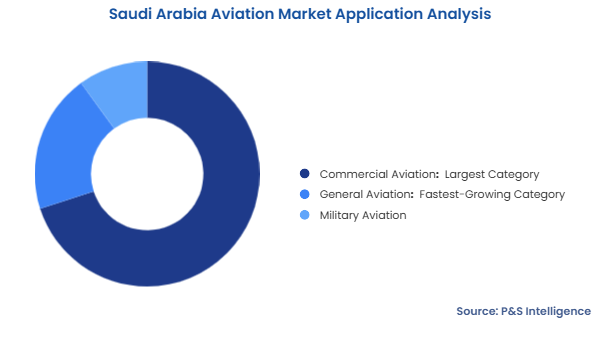
The commercial category holds the largest market share, of 70%, in 2025, driven by passenger airline expansion and cargo growth. This segment encompasses scheduled airline operations by Saudia and Riyadh Air, low-cost carriers, including flynas and flyadeal, and dedicated cargo operators. The commercial segment benefits from government-backed route development initiatives and airport capacity expansions that prioritize commercial passenger and freight movements.
The general category will have the highest CAGR, of 7.2%, reflecting increasing business jet operations and private aviation demand. The Gulf region experienced an 18% increase in ultra-high-net-worth individuals in 2024, with Saudi Arabia contributing significantly to this growth. Saudi Private Aviation is expanding its business jet fleet with plans to wet lease up to six aircraft, while the Kingdom's blanket-permit regime facilitates year-round operations. The development of luxury FBO facilities at major airports is enhancing service standards for private aviation operators.
The applications analyzed in this report are:
Commercial Aviation (Largest Category)
General Aviation (Fastest-Growing Category)
Military Aviation
Technology Analysis
The conventional category holds the largest market share, of 95%, in 2025, reflecting the current composition of commercial and military fleets operated by Saudi carriers. The Kingdom's fleet consists predominantly of proven Boeing and Airbus platforms, including 787 Dreamliners, 777s, the A320 family, and A350s. This conventional technology base provides operational reliability and established maintenance infrastructure essential for scaling passenger operations to 330 million annually by 2030.
The hybrid electric category will have the highest CAGR, of 7.3%, driven by sustainability commitments under Vision 2030. Red Sea International Airport operates entirely on renewable energy, demonstrating the Kingdom's commitment to sustainable aviation infrastructure. The Arabian Petroleum Supply Company is studying domestic sustainable aviation fuel production, with SAF blends already available at select airports. New airport developments, including King Salman International, are designed for full renewable power operations, creating infrastructure readiness for next-generation electric propulsion systems.
The technologies analyzed in this report are:
Conventional (Largest Category)
Hybrid Electric (Fastest-Growing Category)
Electric
Autonomous/Unmanned
Drive strategic growth with comprehensive market analysis
Saudi Arabia Aviation Market Geographical Analysis
Al-Riyadh Aviation Market Size
Al-Riyadh holds the largest market share, of 40%, in 2025, driven by its status as the political and commercial capital hosting major airport development projects. King Salman International Airport represents a USD 30-billion investment to handle 120 million passengers annually by 2030, eventually expanding to 185 million by 2050.
Riyadh Air's launch from King Khalid International Airport in 2025 positions the province as the operational center for the Kingdom's newest national carrier. The airline has secured a USD 400 million ground handling contract with Saudi Ground Services covering comprehensive passenger and ramp operations across domestic and international flights. With ambitious plans to serve 100 destinations by 2030, Riyadh Air is attracting strategic partnerships with established carriers including Delta Air Lines and Singapore Airlines, enhancing the province's global connectivity profile.
The concentration of government institutions, multinational corporations, and diplomatic missions in Riyadh generates substantial business travel demand. Advanced development of airport facilities and air traffic management systems supports growing commercial aviation operations, while government efforts to diversify the economy through Vision 2030 initiatives create sustained aviation sector growth opportunities in the capital region.
Makkah Aviation Market Size
Makkah will have the highest CAGR, of 7.1%, driven by religious tourism expansion and infrastructure modernization in Jeddah. King Abdulaziz International Airport in Jeddah reached a milestone by handling 50 million passengers in 2025.
The streamlining of visa processes and implementation of year-round Umrah access have fundamentally transformed religious tourism patterns. Airlines are expanding both seasonal and year-round routes to Jeddah and directly to Prince Mohammad bin Abdulaziz International Airport in Madinah. Wizz Air's pioneering service from London Gatwick to Madinah demonstrates growing international carrier interest in serving the religious tourism market beyond traditional Middle Eastern and Asian connections.
Jeddah's strategic location on the Red Sea coast positions it as a natural hub for African and European connectivity. The Red Sea Project development with its renewable-energy-powered international airport is creating additional aviation infrastructure supporting luxury tourism initiatives. Saudia maintains a significant operational base in Jeddah with Saudia Technic's MRO Village providing comprehensive maintenance capabilities, while the city's business community generates substantial corporate travel demand, complementing religious tourism flows.
The provinces of the market are as follows:
Al-Riyadh (Largest Province)
Eastern Province
Makkah (Fastest-Growing Province)
Madinah
Qassim
Asir
Tabuk
Ha'il
Northern Borders
Jazan
Najran
Al-Baha
Al-Jouf
Saudi Arabia Aviation Market Share
The market is semi-consolidated with established national carriers holding significant operational scale alongside emerging competitors. The market concentration reflects substantial capital requirements for fleet acquisition, airport slot access, and maintenance infrastructure that create barriers to entry. Despite these entry barriers, the market remains open to controlled competition under government-led liberalization initiatives, enabling the entry of new, well-capitalized carriers. The presence of a limited number of dominant full-service and low-cost airlines, alongside emerging entrants, results in competitive intensity without excessive fragmentation. Strong regulatory oversight and strategic capacity planning further shape a balanced competitive environment across the aviation value chain. However, government-backed sector liberalization has enabled the entry of new, well-funded airlines, increasing competition, while maintaining structural stability.
Key Saudi Arabia Aviation Companies:
Saudi Arabian Airlines Corporation (Saudia)
Riyadh Air
Flynas
Flyadeal
Nesma Airlines
SaudiGulf Airlines
Qatar Airways
The Boeing Company
Airbus SE
Lockheed Martin Corporation
Saudia Cargo
Saudi Ground Services Company
Honeywell International Inc.
Thales Group
RTX Corporation
Saudi Arabia Aviation Market News
In November 2025, Saudia Group introduced a three-weekly service between Dammam King Fahd International Airport and London Heathrow, strengthening air connectivity between the Eastern Province and the UK.
In December 2024, Saudia Group signed an MoU with Air France-KLM S.A. to expand and localize maintenance, repair, and overhaul (MRO) operations in Saudi Arabia, including the assembly and disassembly of GE90 aircraft engine modules, supporting national aviation localization objectives.
In July 2024, Flynas gave Airbus SE an order for 160 new aircraft, comprising 75 A320neos and 15 A321XLRs.
In May 2024, Saudia Group signed a firm order for an additional 105 A320neo Family aircraft for Saudia and flyadeal Airline Company, significantly expanding the group's narrowbody fleet capacity to support domestic and regional route development under Vision 2030 initiatives.
In February 2024, Mace Limited secured the bid to develop King Salman International Airport in Riyadh, a USD 30 billion aviation megaproject designed to accommodate 120 million passengers annually by 2030 and position the capital as a major global aviation hub.
Want a report tailored exactly to your business need?
Leading companies across industries trust us to deliver data-driven insights and innovative solutions for their most critical decisions. From data-driven strategies to actionable insights, we empower the decision-makers who shape industries and define the future. From Fortune 500 companies to innovative startups, we are proud to partner with organisations that drive progress in their industries.
Client Testimonials
Working with P&S Intelligence and their team was an absolute pleasure – their awareness of timelines and commitment to value greatly contributed to our project's success. Eagerly anticipating future collaborations.
McKinsey & Company
India
Unmatched Standards
Our insights into the minutest levels of the markets, including the latest trends and competitive landscape, give you all the answers you need to take your business to new heights
Complete Data Security
We take a cautious approach to protecting your personal and confidential information. Trust is the strongest bond that connects us and our clients, and trust we build by complying with all international and domestic data protection and privacy laws