Saudi Arabia Automotive Aftermarket Size & Share Analysis - Key Trends, Future Opportunities, Growth Strategies, and Forecasts (2026 - 2032)
This Report Provides In-Depth Analysis of the Saudi Arabia Automotive Aftermarket Report Prepared by P&S Intelligence, Segmented by Component (Engine Parts, Drive Transmission & Steering Parts, Suspension & Braking Parts, Equipment, Electrical Parts, Other Miscellaneous), Distribution Channel (Offline, Online), and Geographical Outlook for the Period of 2019 to 2032
Saudi Arabia Automotive Aftermarket Size Estimation
Key Highlights
Study Period
2019 - 2032
Market Size in 2025
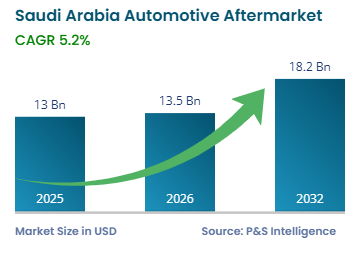
USD 13.0 Billion
Market Size in 2026
USD 13.5 Billion
Market Size by 2032
USD 18.2 Billion
Projected CAGR
5.2%
Largest Region
Al-Riyadh
Fastest Growing Region
Eastern Province
Market Structure
Fragmented
Market Size
Explore the market potential with our data-driven report
Saudi Arabia Automotive Aftermarket Future Outlook
The Saudi Arabian automotive aftermarket revenue is estimated at USD 13.0 billion in 2025, and it is projected to grow at a CAGR of 5.2% during 2026–2032, to reach USD 18.2 billion by 2032.
The growth of the market is primarily driven by the increasing vehicle parc, rising average vehicle age and the growing preference for vehicle maintenance and repair over new vehicle purchases amid economic diversification initiatives.
The Saudi automotive aftermarket industry is experiencing significant transformation as the kingdom's Vision 2030 drives economic diversification and modernisation of the transportation sector. According to reports, the number of registered vehicles in Saudi Arabia reached 23.7 million in 2024, with passenger cars accounting for approximately 65% of the total vehicle fleet. This expanding vehicle population creates substantial demand for replacement parts and maintenance services across the kingdom.
The market dynamics are further influenced by the harsh desert climate conditions that accelerate the wearing and tearing of automotive components, necessitating more frequent replacements compared to temperate regions. Temperature extremes reaching up to 50°C during summer months particularly affect engine cooling systems, air conditioning components and battery life, driving consistent demand for these replacement parts. Additionally, the government's initiatives to develop the domestic automotive manufacturing sector through the National Industrial Development and Logistics Program (NIDLP) are creating opportunities for local aftermarket parts production and distribution networks.
Saudi Arabia Automotive Aftermarket Emerging Trends & Growth Drivers
Digital Transformation and E-Commerce Adoption Are Key Trends
The rapid digitalization of Saudi Arabia's retail sector is fundamentally transforming automotive aftermarket distribution channels.
This digital shift enables consumers to compare prices, verify part compatibility and access a wider range of products than traditional brick-and-mortar stores can offer.
Mobile commerce applications specifically designed for automotive parts have gained significant traction.
Platforms now offer VIN-based part identification, augmented reality for part visualization and same-day delivery services in major cities.
The integration of digital technologies extends beyond retail to encompass the entire supply chain, with distributors implementing advanced inventory management systems and predictive analytics to optimize stock levels.
This technological advancement reduces lead times and improves parts availability, particularly for fast-moving items such as filters, brake pads and batteries.
The establishment of regional distribution centres equipped with automated warehousing systems has enhanced the efficiency of both online and offline channels, ensuring rapid fulfilment of customer orders across the kingdom's diverse geographic regions.
Rising Vehicle Age and Extended Ownership Periods Are Driving Market Growth
The increasing average age of vehicles in Saudi Arabia represents a fundamental driver for the automotive aftermarket industry.
According to reports, the average vehicle age in the kingdom has increased from 5.2 years in 2019 to 7.8 years in 2024.
This trend directly correlates with increased demand for replacement parts and maintenance services as older vehicles require more frequent repairs and component replacements.
Economic factors play a crucial role in this shift, as Saudi consumers increasingly opt to maintain and repair existing vehicles rather than purchasing new ones.
The introduction of value-added tax (VAT) and economic reforms under Vision 2030 have influenced household spending patterns, making vehicle maintenance a more economically viable option.
According to industry experts, the average Saudi household spending on vehicle maintenance and repairs increased by 23% between 2022 and 2024.
The development of comprehensive vehicle inspection programs, including the mandatory periodic technical inspection (Fahas) system, ensures that vehicle owners maintain their vehicles to the required safety standards.
This regulatory framework creates consistent demand for quality aftermarket parts across all vehicle categories.
The Saudi Standards, Metrology and Quality Organization (SASO) reported that the proportion of vehicles meeting the requirements and standards for periodic inspections was 39.51%, as per the indicator sanctioned by the Ministerial Committee for Traffic Safety.
This indicator aims to achieve a target of 50 percent by the conclusion of 2024.
The organization also announced that the total number of authorized vehicle maintenance and repair centres in the first half of 2024 has reached 155, increasing the overall count to 585 centres.
Saudi Arabia Automotive Aftermarket Segmentation Analysis
Component Analysis
The engine parts category holds the largest share, of 35%, and it is expected to maintain its dominance throughout the forecast period. This stems from the critical nature of engine components and their susceptibility to wear under the kingdom's extreme climate conditions. High ambient temperatures, frequent sandstorms and extended driving distances characteristic of Saudi Arabia accelerate engine component degradation, necessitating regular replacement of items such as air filters, oil filters and cooling system components. The prevalence of turbocharged engines in modern vehicles further contributes to demand, as these systems require more frequent maintenance and higher-quality lubricants to maintain optimal performance.
Electrical parts will witness the highest CAGR, during 2026–2032, driven by the increasing electronic content in modern vehicles and the particular vulnerability of electrical components to heat-related failures. The extreme temperatures experienced in Saudi Arabia significantly impact battery life, with the average battery replacement cycle being 2–3 years compared to 4–5 years in temperate climates. Low temperatures reduce battery efficiency, resulting in lower range, slower charging, and decreased power output, while high temperatures may improve short-term performance but accelerate degradation and shorten battery lifespan. Furthermore, the growing adoption of start–stop systems, ADAS, and infotainment technologies increases the complexity and value of electrical components in the aftermarket.
These component types are covered:
Engine Parts (Largest Category)
Pistons & piston rings
Engine valves & parts
Fuel injection systems & carburettors
Powertrain components & others
Drive Transmission & Steering Parts
Gearboxes
Wheels
Steering systems
Axles
Clutch assembly systems & other parts
Suspension & Braking Parts
Brake callipers
Brake pads
Suspension systems
Equipment
Headlights & headlight components
Wipers & washer systems
Dashboard instruments
Other equipment
Electrical Parts (Fastest-Growing Category)
Starter motors
Spark plugs
Electric ignition systems
Batteries & other parts
Miscellaneous
Distribution Channel Analysis
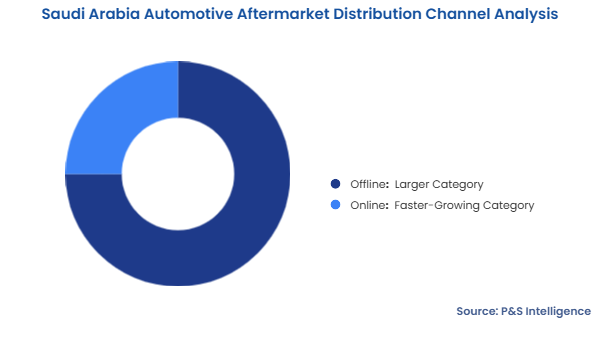
The offline distribution channel has the largest market share, of 75%, primarily due to the established network of authorized service centres, independent workshops and traditional spare parts retailers across the kingdom. The preference for offline channels reflects consumer trust in physical inspection of parts, immediate availability for urgent repairs and the value placed on expert consultation from experienced technicians. The presence of major automotive districts in cities like Riyadh, Jeddah and Dammam, where clusters of parts suppliers and workshops operate, reinforces the offline channel's dominance.
The online distribution channel will witness the highest CAGR, during 2026–2032, fuelled by improving digital infrastructure, increasing smartphone penetration and the convenience of home delivery services. According to the Ministry of Communications and Information Technology, Saudi Arabia's e-commerce sector grew by 32% in 2023, with automotive parts representing a key growth category. The emergence of specialized automotive e-commerce platforms offering features such as part compatibility verification, installation service booking and warranty management is accelerating online adoption among younger, tech-savvy consumers.
These distribution channels are covered:
Offline (Larger Category)
Online (Faster-Growing Category)
Drive strategic growth with comprehensive market analysis
Saudi Arabia Automotive Aftermarket Regional Market Performance
Al-Riyadh Province Automotive Aftermarket Size
Al-Riyadh province holds the largest share, of 40%, in 2025, driven by its position as the kingdom's capital and largest economic centre. The province houses over 7.7 million residents and accounts for approximately 30% of the national vehicle fleet, creating substantial demand for aftermarket parts and services. According to studies, the province registered 6.8 million vehicles in 2024, with an annual growth rate of 4.5% in vehicle registrations over the past five years.
The concentration of government institutions, corporate headquarters and industrial facilities in Riyadh generates significant commercial vehicle traffic, contributing to higher maintenance and replacement part requirements. The presence of major automotive distributors' regional headquarters and warehousing facilities in Riyadh Industrial City ensures efficient parts availability and competitive pricing. Furthermore, the ongoing Riyadh Metro project and urban expansion initiatives are expected to influence vehicle usage patterns and aftermarket demand, particularly for suspension and braking components subjected to construction-related road conditions.
Eastern Province Automotive Aftermarket Outlook
The Eastern Province is experiencing the fastest growth, with a projected CAGR of approx. 5.5% during 2026–2032. This exceptional growth is primarily attributed to the province's role as the kingdom's oil and gas hub, hosting Saudi Aramco's operations and numerous petrochemical facilities that maintain extensive vehicle fleets. According to the Eastern Province Municipality, the region's vehicle population grew by 6.2% annually between 2020 and 2024, outpacing the national average due to industrial expansion and population growth in Dammam, Khobar and Jubail.
The development of the King Salman Energy Park (SPARK) and the expansion of Jubail Industrial City are creating additional demand for both passenger and commercial vehicle aftermarket services. The province's strategic location as a gateway for automotive imports through King Abdulaziz Port in Dammam facilitates parts availability and distribution efficiency. According to the Saudi Ports Authority, automotive parts imports through Eastern Province ports increased by 28% in 2023, reflecting the region's growing importance in the national aftermarket supply chain.
Makkah Province Automotive Aftermarket Share
Makkah province accounts for 20% market share, benefiting from its large population base and unique demand drivers related to religious tourism. The province hosts over 8.5 million residents and receives millions of pilgrims annually for Hajj and Umrah, creating exceptional transportation demands that accelerate vehicle wear and maintenance requirements. According to the General Authority for Statistics, Makkah province registered 5.7 million vehicles in 2024, with commercial vehicles and buses experiencing particularly intensive usage during pilgrimage seasons.
The extreme temperature variations between coastal Jeddah and mountainous areas like Taif create diverse operating conditions that affect component wear patterns differently across the province. The ongoing development of NEOM and Red Sea tourism projects in the province's northern regions is expected to further stimulate aftermarket demand through increased vehicle traffic and the establishment of new service networks.
These provinces are covered:
Al-Riyadh (Largest Province)
Makkah
Eastern Province (Fastest-Growing Province)
Madinah
Qassim
Asir
Tabuk
Ha'il
Northern Borders
Jazan
Najran
Al-Baha
Al-Jouf
Saudi Arabia Automotive Aftermarket Share
The Saudi Arabian automotive aftermarket is fragmented, with numerous international and regional players competing across different product categories and distribution channels. The market structure reflects the diverse nature of automotive components and the presence of both original equipment suppliers and independent aftermarket manufacturers.
The market includes a mix of global automotive component manufacturers, regional distributors and local retailers operating through various business models. International brands maintain strong positions in critical components such as batteries, filters and brake systems, leveraging their technical expertise and quality certifications. Meanwhile, local and regional players compete effectively in the distribution and retail segments, utilizing their understanding of local market dynamics and established customer relationships.
Market participants are increasingly focusing on expanding their distribution networks and enhancing service capabilities to differentiate themselves in this competitive environment. The establishment of authorized service networks, technical training centres and warranty programs represents key competitive strategies. Companies are also investing in digital platforms and e-commerce capabilities to capture the growing online category while maintaining their traditional offline presence.
Strategic partnerships between international manufacturers and local distributors have become prevalent, combining global product expertise with local market knowledge. These collaborations often include technology transfer agreements and local assembly operations, aligning with the kingdom's localization objectives under Vision 2030. The Saudi government's support for domestic manufacturing through the National Industrial Development and Logistics Program (NIDLP) is encouraging new market entries and capacity expansions.
Key Saudi Arabia Automotive Aftermarket Companies :
Petromin Corporation
Abdul Latif Jameel Motors
Aljomaih Automotive Company
ZF Friedrichshafen AG
DENSO Corporation
Isuzu Motors Ltd.
Tesla, Inc.
Bridgestone Corporation
Continental AG
Michelin Group
The Goodyear Tire & Rubber Company
Robert Bosch GmbH
Aisin Corporation
Mann+Hummel GmbH
KYB Corporation
Saudi Arabia Automotive Aftermarket News
In May 2025, SOUEAST Motor Co. Ltd. inaugurated its first spare parts centre in Saudi Arabia, under a partnership with Starlinks.
In April 2025, the seventh edition of the Automechanika Riyadh, a regional trade exhibition for the automotive aftermarket sector in Saudi Arabia, was organised at the Riyadh International Convention and Exhibition Center (RICEC) from April 28 to 30.
In January 2024, Robert Bosch GmbH opened its new headquarters in Saudi Arabia to expand its automotive aftermarket operations and leverage growing demand for smart mobility solutions in the region.
In November 2023, the Saudi Standards, Metrology and Quality Organization introduced enhanced quality certification requirements for imported aftermarket parts, mandating improved traceability measures and testing protocols to ensure consumer safety and product reliability across the kingdom's automotive aftermarket sector.
Want a report tailored exactly to your business need?
Leading companies across industries trust us to deliver data-driven insights and innovative solutions for their most critical decisions. From data-driven strategies to actionable insights, we empower the decision-makers who shape industries and define the future. From Fortune 500 companies to innovative startups, we are proud to partner with organisations that drive progress in their industries.
Client Testimonials
Working with P&S Intelligence and their team was an absolute pleasure – their awareness of timelines and commitment to value greatly contributed to our project's success. Eagerly anticipating future collaborations.
McKinsey & Company
India
Unmatched Standards
Our insights into the minutest levels of the markets, including the latest trends and competitive landscape, give you all the answers you need to take your business to new heights
Complete Data Security
We take a cautious approach to protecting your personal and confidential information. Trust is the strongest bond that connects us and our clients, and trust we build by complying with all international and domestic data protection and privacy laws