This Report Provides In-Depth Analysis of the Rotary Power Tool Market Report Prepared by P&S Intelligence, Segmented by Tool Type (Oscillating Multi-Tools, Rotary Tools), Power Source (Corded, Cordless, Pneumatic), User Type (Professional, DIY / Consumer), Distribution Channel (DIY Stores / Home Improvement Superstores, Wholesalers & Industrial Distributors, Ecommerce & Online Marketplaces, Specialist Trade Channels, Manufacturer Direct / Web Stores), Operating Speed Range (15,000 to 30,000 RPM, Above 30,000 RPM, Up to 15,000 RPM), and Geographical Outlook for the Period of 2022 to 2033
Explore the market potential with our data-driven report
Rotary Power Tool Market Overview
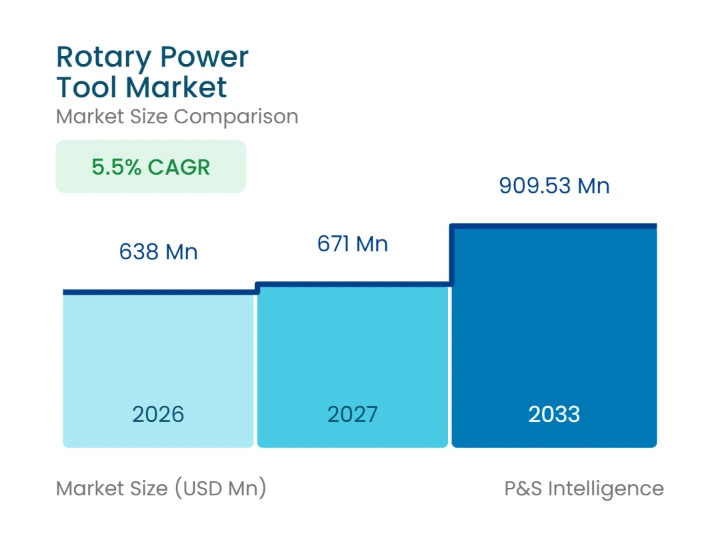
The global rotary power tool market is estimated at USD 638.00 Million in 2026 and is expected to reach USD 671.00 Million in 2027 and USD 909.53 Million by 2033, a 5.5% CAGR over 2027-2033. Remodeling contractors, carpenters, electricians, and vehicle maintenance shops generate most of this revenue, buying oscillating multi-tools and high-speed rotary tools for flush cuts, cutouts, and detail grinding that a saw or drill handles poorly. Sales therefore track renovation workloads and trade hiring more closely than new construction starts.
Trade users and homeowners who already own one brand's battery packs are turning the multi-tool into an add-on purchase, because a bare tool sold without a battery costs less than a full kit. As per Einhell's 2025 results, published in April 2026, its Power X-Change cordless platform rose to 54% of group revenue, which shows how far one DIY-oriented brand's sales have consolidated around shared batteries. Corded units still produce the larger part of rotary power tool market revenue, since bench users in jewelry, model making, and fabrication value steady speed over portability.
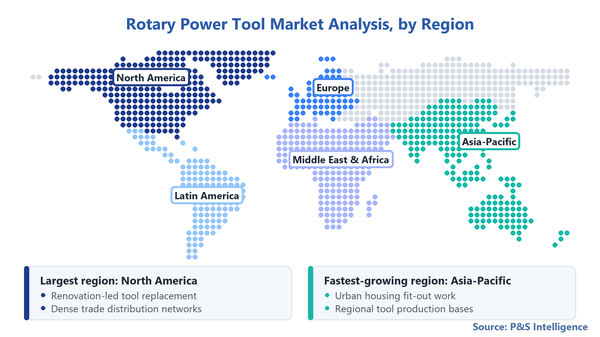
North America is the largest regional market, supported by older owner-occupied homes in the United States and Canada, a professional trade base buying brushless cordless platforms, and dense distribution networks. Asia-Pacific is set to grow fastest through 2033, as urban housing programs in India create fit-out work for carpenters, tilers, and electricians, and production bases in China and Vietnam keep entry-level tools affordable. North America grows mainly through replacement and upgrades, while Asia-Pacific adds first-time professional users, so the two regions reward different product lines and price points.
Key market insights
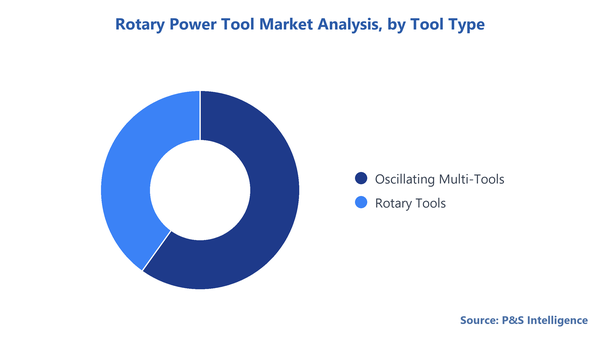
By tool type, oscillating multi-tools account for 59.89% of revenue in 2026 and are projected to grow fastest, at a 5.8% CAGR during 2027-2033.
By power source, corded tools account for 73.5% in 2026, while cordless tools are projected to post the fastest growth during 2027-2033.
By user type, professional users account for 58.11% in 2026 and are projected to grow fastest, at a 6.5% CAGR during 2027-2033.
By distribution channel, ecommerce and online marketplaces account for 22.4% in 2026 and are projected to grow fastest, at a 6.9% CAGR during 2027-2033.
By operating speed range, tools rated at 15,000 to 30,000 RPM account for 48.0% of revenue in 2026.
By geography, North America holds the largest share in 2026, while Asia-Pacific is projected to post the fastest growth during 2027-2033.
Rotary Power Tool Market Dynamics
Low-vibration engineering is reshaping how professional multi-tools are specified
Brands now launch professional multi-tools on vibration figures as well as cutting speed, because employers must track how long each worker holds a vibrating tool during a shift. Long stretches of grout removal or plunge cutting can use up a worker's daily exposure allowance before the shift ends, which forces a contractor to rotate staff or buy a smoother-running tool. Wider oscillation arcs, brushless motors, and damped housings let newer models finish a cut faster and with less vibration, which shortens trigger time per job.
The UK Health and Safety Executive sets a daily hand-arm vibration exposure action value of 2.5 m/s² and a limit value of 5 m/s², both normalized to an eight-hour day, and treats the limit as the level above which workers should not be exposed. Contractors working under rules of this kind are likely to compare declared vibration values when they replace a multi-tool, which gives low-vibration models a buying argument beyond price. Brands that publish lower vibration figures at comparable cutting speed are better positioned in fleet orders, where site safety teams can review approved tool lists.
Trade workforce turnover is fueling a steady flow of first-kit purchases
Professional users generate the larger part of rotary power tool demand, and each new carpenter, remodeler, or maintenance technician needs a multi-tool early in a working career. Oscillating models handle door-jamb undercuts, drywall cutouts, and flush trimming that would otherwise take several tools, so they tend to appear on first purchase lists. Employer-supplied tool programs and apprentices buying their own kits both add volume that depends on hiring more than on new construction starts.
According to the US Bureau of Labor Statistics, about 62,800 openings for carpenters are projected each year on average over the decade to 2035, against roughly 889,700 jobs held in 2025. Most of those openings come from workers who retire or move to other occupations, so the trade keeps adding new tool owners even with modest employment growth. The figure measures hiring, not tool sales, but it suggests that brands offering apprentice bundles through trade counters can win users at the point they choose a battery platform.
Hose-free alternatives to air tools are opening a replacement pathway in maintenance shops
Automotive repair bays, fabrication shops, and facility maintenance teams still run many die grinders on compressed air, and cordless rotary tools are increasingly offered for the same deburring, rust removal, and cutting tasks. A pneumatic grinder needs a compressor, hoses, and fittings, so a technician working under a vehicle or at a remote site loses time on setup. A battery-powered grinder removes that step and moves easily between bays, which suits intermittent work.
Air tools keep an edge in continuous, high-duty grinding, where a shop compressor runs all day and the tools are cheap to replace. The air supply has a running cost, as a Compressed Air Challenge fact sheet for industry notes that leaks can waste 20-30% of a compressor's output. Shops where grinding is occasional and hose runs are long have the clearest cost case for a battery-powered grinder. Brands whose 12V or 18V packs sit in a mechanic's toolbox can sell a die grinder as a bare tool, narrowing the price gap against an air tool that still works.
Higher import duties on battery packs are constraining cordless kit pricing
Many cordless oscillating and rotary tool kits sold in the United States carry lithium-ion packs or cells sourced from China, so a higher tariff on those batteries raises landed costs for brands and retailers. Kits that bundle one or two packs with the tool carry most of that increase, and price-sensitive homeowners can delay a purchase or switch to a corded model. Entry-level kits feel the pressure most, since the battery makes up a large part of their shelf price.
Figures from the Office of the United States Trade Representative put the Section 301 tariff on lithium-ion non-electric-vehicle batteries from China at 25% from January 1, 2026, up from 7.5%. Brands can shift pack assembly or cell sourcing to other countries, although requalifying cells takes time. Techtronic Industries said in its 2025 annual results that margin expansion accelerated in the second half as its tariff mitigation efforts took effect, which indicates that groups with factories in several countries can absorb part of the cost. Smaller private-label importers are likely to have fewer options.
Segmentation Analysis
Tool Type
Oscillating multi-tools account for 59.89% of rotary power tool market revenue in 2026. Remodelers, carpenters, and tile installers buy them because one tool handles drywall plunge cuts, door-casing undercuts, and grout removal. Each of those jobs would otherwise need a jigsaw, a hand saw, or a scraper. Those tasks cluster in smaller remodeling jobs, and the National Association of Home Builders' Remodeling Market Index gave projects under $20,000 a reading of 73 in the third quarter of 2026, above its moderate- and large-project components. Selling prices above those of hobby rotary tools mean each multi-tool sale adds more revenue.
The same category is projected to post the fastest growth, at a 5.8% CAGR during 2027-2033. Brushless 18V and 20V models with wider oscillation arcs are positioned to take the place of older brushed and corded units as contractors renew their tools, and each such upgrade tends to move the buyer to a higher price point. Renovation work in older housing, where trim, flooring, and drywall must be cut in place, keeps the tool in daily use. Rotary tools, which include high-speed multi-tools, die grinders, and cutout tools, remain the choice for engraving, detail grinding, and metal finishing.
Copyright P&S Intelligence. Reuse requires attribution under CC BY 4.0.
Power Source
Corded tools account for 73.5% of revenue in 2026. Workshop users such as jewelers, model makers, and fabricators run rotary tools for long periods at a bench, where a mains cord gives steady speed without battery swaps or recharge downtime. Corded units also cost less up front, which suits occasional DIY users who do not own a battery platform. Pneumatic die grinders keep their place in automotive and industrial shops that already run compressed air, where the compressor is a sunk cost.
Cordless tools are projected to post the fastest growth on this axis during 2027-2033. Trade users who already carry 12V or 18V packs can add a bare multi-tool for less than a kit, and brushless motors have narrowed the power gap with corded units. In Europe, the EU Batteries Regulation requires portable batteries in appliances to be readily removable and replaceable by end users from February 18, 2027. The rule is technology-neutral, but hobby rotary tools with sealed internal cells must be redesigned, a change likely to favor brands already selling swappable packs.
User Type
Professional users account for 58.11% of revenue in 2026. Contractors, carpenters, electricians, plumbers, and HVAC installers use multi-tools daily, wear them out faster, and buy higher-specification brushless models with larger price tags. Many buy through trade counters and industrial distributors that hold open accounts with contractors, which supports repeat tool sales to the same buyers. Because professional purchases are tied to billable work, the tool's cost is easier to justify than it is for a homeowner.
The professional segment is projected to grow fastest, at a 6.5% CAGR during 2027-2033. Contractors running small crews favor tools that save time per task, and an oscillating tool that makes a flush cut in one pass reduces rework. Associated Builders and Contractors estimates that the US construction industry must bring in 456,000 new workers in 2027, up from 349,000 in 2026, as construction spending growth resumes. Each added crew member widens the professional buyer base, while homeowners buy a multi-tool once and use it occasionally, which lengthens their replacement cycles.
Distribution Channel
Ecommerce and online marketplaces account for 22.4% of revenue in 2026, the largest single channel in a mix that also includes home-improvement superstores, industrial distributors, specialist trade stores, and manufacturer web stores. Online listings let buyers compare oscillation angles, speeds, and kit contents across brands, and bare tools sell well online because the buyer already knows which platform they need. Eurostat recorded that 78% of EU internet users bought goods or services online in 2025, against 62% in 2015, which gives marketplace sellers of hobby and craft tools a wide audience without superstore shelf space.
Online sales are projected to grow fastest as well, at a 6.9% CAGR during 2027-2033. US Census Bureau data show that retail e-commerce reached 17.1% of total US retail sales in the second quarter of 2026, with e-commerce sales up 12.2% on the same quarter of 2025. That figure covers all retail categories, not tools, but it confirms the shift in household purchasing that marketplace tool sellers draw on. Brands that align pricing across their own web stores and marketplace listings can limit discount-driven conflict with retail partners.
Operating Speed Range
Tools rated at 15,000 to 30,000 RPM account for 48.0% of revenue in 2026. This band covers most general-purpose rotary multi-tools and cordless die grinders, which sand, cut small parts, deburr, and polish at speeds that suit the most common accessories. Homeowners and trade users who need one tool for wood, plastic, and soft metal tend to buy in this range, so brands build most of their kit bundles and accessory sets around it.
Tools above 30,000 RPM serve jewelers, dental technicians, engravers, and model makers, who need fine control on small workpieces and accept a higher price for precision. Tools rated up to 15,000 RPM suit heavier cutting and grinding, where torque matters more than speed. Product lines that span all three bands let a brand serve hobby, craft, and industrial users with one accessory family, which helps keep those users within the brand as their work changes.
The following segments are analysed in this report.
Tool Type
Oscillating Multi-Tools
Rotary Tools
Power Source
Corded
Cordless
Pneumatic
User Type
Professional
DIY / Consumer
Distribution Channel
DIY Stores / Home Improvement Superstores
Wholesalers & Industrial Distributors
Ecommerce & Online Marketplaces
Specialist Trade Channels
Manufacturer Direct / Web Stores
Operating Speed Range
15,000 to 30,000 RPM
Above 30,000 RPM
Up to 15,000 RPM
Geographical Analysis
North America rotary power tool market outlook
North America holds the largest share of global revenue in 2026, supported by an older owner-occupied housing stock, a professional trade base that pays for premium cordless platforms, and dense networks of home-improvement chains and industrial distributors. The United States is the region's largest market, where remodeling contractors and homeowners cut trim, flooring, and drywall in place during repair work. Canada follows the same renovation-led pattern on a smaller base, with tools sold largely through the same national chains and trade suppliers.
Harvard University's Joint Center for Housing Studies projects that year-over-year growth in US home renovation and repair spending will slow to 0.5% by the second quarter of 2027. Slower remodeling growth limits the number of new users, so revenue in the region depends more on contractors replacing worn tools and trading up to brushless models with wider oscillation arcs. The region's lead is likely to hold through 2033, and brands with deep trade-channel relationships and large installed battery bases are better positioned while growth relies on upgrades.
Asia-Pacific rotary power tool market growth
Asia-Pacific is projected to post the fastest growth during 2027-2033, as new housing and a widening base of trade workers add first-time tool buyers. India's urban housing program creates electrical, plumbing, tiling, and carpentry fit-out work in every completed unit, and much of that work uses cutting and finishing tools. China and Vietnam host large tool production bases, which keeps entry-level corded and cordless models priced within reach of new professional users across the region. Japan and Australia are more mature, with trade users who already own battery platforms, so they contribute value more than first-time volume.
Figures from India's Press Information Bureau put sanctions under the Pradhan Mantri Awas Yojana-Urban program at 12.5 million houses, with more than 10 million delivered across its two phases. Housing counts measure construction volume, not tool adoption, but they indicate a large pool of fit-out work for local trades. Lower-priced kits are likely to dominate first purchases, which favors brands with regional factories and value product lines. As those users gain experience, upgrades to brushless platforms could lift average selling prices later in the forecast period.
Copyright P&S Intelligence. Reuse requires attribution under CC BY 4.0.
Europe market analysis
Europe contributes a mature share of global revenue, with professional craft trades in Germany, Switzerland, Austria, and the Nordic countries buying higher-specification tools through specialist dealers. Workplace vibration rules and long daily tool use push these contractors toward premium, low-vibration models, which supports value per unit more than unit volume. Renovation of older apartment buildings in Western European cities also keeps oscillating tools in use for flush cutting and tile work.
Under the EU Machinery Regulation, which applies from January 20, 2027 and replaces the Machinery Directive, manufacturers face updated safety requirements, including protection of safety-related control software against corruption, and may supply instructions in digital form. The rule covers all machinery placed on the EU market, not a particular tool type, but it adds documentation and conformity work to every new launch. European brands with in-house certification teams can spread that cost across large product lines more easily than smaller importers.
Latin America market analysis
Latin America trails the larger regions but adds users through public housing construction and incremental home renovation, with Brazil and Mexico as notable markets within it. Households that renovate in stages tend to buy affordable corded tools through home-improvement chains and online marketplaces, while professional contractors buy cordless kits more selectively. Currency swings can raise the local price of imported cordless kits, which slows the shift away from corded models among price-sensitive households.
Brazil's federal government recorded more than 2.4 million homes contracted under the Minha Casa, Minha Vida program between January 2023 and July 2026, with a target of 3 million by the end of 2026. Each contracted unit becomes fit-out and finishing work for local contractors once construction proceeds, which supports purchases of entry-level cutting and sanding tools. Brands with local distribution and corded value models are likely to gain first, while cordless adoption depends on battery pricing.
Middle East & Africa market analysis
Middle East & Africa holds a smaller share of global revenue, with demand concentrated in Gulf housing programs, oil and gas maintenance, and South Africa's DIY retail sector. Industrial maintenance crews in Saudi Arabia, the U.A.E., and Qatar use die grinders and rotary tools for pipe and equipment repair, often on compressed air in large facilities. Many buyers in the region rely on importers and distributors, which makes availability and after-sales service as important as price.
According to Saudi Arabia's Ministry of Municipalities and Housing, homeownership among Saudi households passed 66% in 2025, against a target of 70% by 2030. Rising ownership tends to lift spending on fit-out and home improvement, since owners rather than landlords pay for upgrades, which supports homeowner purchases of multi-tools. Suppliers with regional distributors, local service centers, and online storefronts are better positioned to reach these new homeowners as the ownership target approaches.
The following geographies are analysed in this report.
North America
U.S.
Canada
Asia-Pacific
Japan
South Korea
Taiwan
China
India
Australia
Rest of Asia-Pacific
Europe
Germany
U.K.
France
Italy
Netherlands
Spain
Rest of Europe
Latin America
Brazil
Mexico
Rest of Latin America
Middle East & Africa
Saudi Arabia
U.A.E.
South Africa
Rest of Middle East & Africa
Rotary Power Tool Market Competitive Landscape
The rotary power tool market is moderately fragmented, with no single brand leading across both professional oscillating tools and hobby rotary tools. In professional cordless tools, manufacturers that own large battery platforms hold an advantage, because a contractor who carries one brand's packs would need new batteries and chargers to switch for a single tool. Corded hobby and precision tools are more open, since they need no battery system and accept accessories with common shank sizes. The split is shifting as more categories move to cordless, which extends platform lock-in to tool types once bought on price alone.
Robert Bosch GmbH, Stanley Black & Decker Inc., Techtronic Industries Company Limited, and Makita Corporation compete in the professional tier on brushless performance, low vibration, jobsite durability, and trade distribution reach. Einhell Germany AG and Positec Tool Corporation pursue homeowners through home-improvement chains and online marketplaces with cross-tool battery systems and lower price points. TTS Tooltechnic Systems AG & Co. KG and C. & E. Fein GmbH hold narrower positions built on system woodworking and heavy-duty professional oscillating tools, where buyers pay for precision and durability.
For buyers, committing to a platform lowers the cost of each additional tool but raises the cost of leaving a brand. Cross-brand battery alliances, such as the AMPShare system that Bosch shares with partner brands including Fein, ease that lock-in for some users and widen the choice of specialist tools on one pack. Brands outside the large platforms tend to compete through accessory compatibility, price, or precision features that the volume makers give less attention.
Major Companies in Rotary Power Tool Market:
Robert Bosch GmbH
Stanley Black & Decker Inc.
Techtronic Industries Company Limited
Makita Corporation
Hilti Corporation
TTS Tooltechnic Systems AG & Co. KG
Einhell Germany AG
Positec Tool Corporation
C. & E. Fein GmbH
PROXXON S.A.
Rotary Power Tool Market News
In August 2026, Stanley Black & Decker Inc. introduced the DEWALT 20V MAX XR Oscillating Multi-Tool (DCS359) with a brushless motor and a 4.2-degree oscillation angle, as part of a wider cordless carpentry launch for carpenters, remodelers, and general contractors. Launching it beside track saws, sanders, and nailers lets the brand sell multi-tools into whole-kit carpentry upgrades on one battery platform.
In July 2026, Einhell Germany AG told its annual general meeting that its Power X-Change range, already above 350 compatible devices, is set to reach 400 by the end of 2026, and that new sales hubs for the Middle East, Africa, and the Indian subcontinent are expected to deliver first substantial revenues in the second half of the year. The hubs carry a shared-battery platform into markets where housing programs are adding new homeowners.
In April 2026, Robert Bosch GmbH launched the EXPERT EXOP18V-40 cordless oscillating multi-cutter with a 4.0-degree oscillation angle and power equivalent to 550 watts of corded performance, within its Professional 18V System. Matching corded output in a cordless body targets workshop users who still buy mains-powered multi-tools for heavy cutting.
Last Updated: October 2026
Frequently Asked Questions About This Report
How big is the rotary power tool market?+
The global rotary power tool market is estimated at USD 638.00 Million in 2026 and is expected to reach USD 671.00 Million in 2027 and USD 909.53 Million by 2033, a 5.5% CAGR over 2027-2033.
Why are trade users and homeowners buying more cordless multi-tools?+
Trade users and homeowners who already own one brand's battery packs are turning the multi-tool into an add-on purchase, because a bare tool sold without a battery costs less than a full kit.
Which region leads the rotary power tool market?+
North America is the largest regional market, supported by older owner-occupied homes in the United States and Canada, a professional trade base buying brushless cordless platforms, and dense distribution networks.
Which tool type holds the largest share of the rotary power tool market?+
Oscillating multi-tools account for 59.89% of rotary power tool market revenue in 2026. Remodelers, carpenters, and tile installers buy them because one tool handles drywall plunge cuts, door-casing undercuts, and grout removal.
Which region is growing fastest in the rotary power tool market?+
Asia-Pacific is projected to post the fastest growth during 2027-2033, as new housing and a widening base of trade workers add first-time tool buyers.
How do US tariffs affect lithium-ion power tool batteries from China?+
Figures from the Office of the United States Trade Representative put the Section 301 tariff on lithium-ion non-electric-vehicle batteries from China at 25% from January 1, 2026, up from 7.5%.
Who are the major rotary power tool manufacturers?+
Robert Bosch GmbH, Stanley Black & Decker Inc., Techtronic Industries Company Limited, and Makita Corporation compete in the professional tier on brushless performance, low vibration, jobsite durability, and trade distribution reach.
Want a report tailored exactly to your business need?
Leading companies across industries trust us to deliver data-driven insights and innovative solutions for their most critical decisions. From data-driven strategies to actionable insights, we empower the decision-makers who shape industries and define the future. From Fortune 500 companies to innovative startups, we are proud to partner with organisations that drive progress in their industries.
Client Testimonials
Working with P&S Intelligence and their team was an absolute pleasure – their awareness of timelines and commitment to value greatly contributed to our project's success. Eagerly anticipating future collaborations.
McKinsey & Company
India
Unmatched Standards
Our insights into the minutest levels of the markets, including the latest trends and competitive landscape, give you all the answers you need to take your business to new heights
Complete Data Security
We take a cautious approach to protecting your personal and confidential information. Trust is the strongest bond that connects us and our clients, and trust we build by complying with all international and domestic data protection and privacy laws