Rolling Stock Market Size & Share Analysis - Trends, Drivers, Competitive Landscape, and Forecasts (2026 - 2032)
This Report Provides In-Depth Analysis of the Rolling Stock Market Report Prepared by P&S Intelligence, Segmented by Product Type (Locomotive, Rapid Transit Vehicle, Passenger Coaches, Wagons), Propulsion Type (Diesel, Electric, Hybrid), Application (Rail Freight, Passenger Rail), and Geographical Outlook for the Period of 2021 to 2032
Explore the market potential with our data-driven report
Rolling Stock Market Future Prospects
Rolling Stock Market Key Insights
The locomotive category holds the largest market share, of 45% in 2025, driven by its central role in freight and long-distance rail operations.
The rapid transit vehicle category will have the highest CAGR, of approximately 5.4%, supported by expanding metro and urban rail projects.
The electric propulsion category holds the largest market share, of 60% in 2025, and it will have the highest CAGR, driven by electrification mandates and sustainability targets.
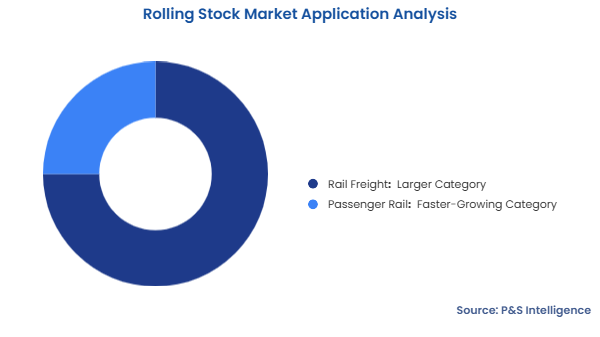
The rail freight category holds the largest market share, of 75% in 2025, supported by high global freight volumes.
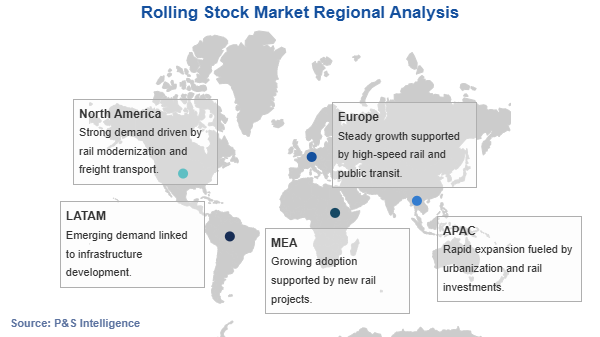
Asia-Pacific holds the largest market share, of 40% in 2025, and it will have the highest CAGR, driven by large-scale rail infrastructure investments.
Rolling Stock Market Overview
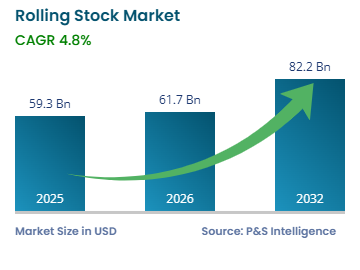
The rolling stock market size was USD 59.3 billion for 2025, and it will grow by 4.8% during 2026–2032, to reach USD 82.2 billion by 2032.
The market growth is supported by the accelerating electrification of rail networks, increasing investments in urban transit infrastructure, and the recovery of passenger traffic volumes across global rail systems. Rolling stock, including locomotives, rapid transit vehicles, coaches, and freight wagons, forms the core operational backbone of rail transportation systems, where performance, efficiency, and lifecycle reliability directly influence network capacity and service quality.
The expansion of rail transport infrastructure is structurally reinforcing rolling stock demand. According to the International Energy Agency, rail accounts for nearly 8% of global passenger transport and 7% of freight activity, while contributing less than 2% of total transport emissions, highlighting its role in sustainable mobility. Additionally, the International Union of Railways indicates that global rail networks span over one million kilometers, with ongoing expansion in emerging economies. Urban transit investment is also accelerating, with the World Bank indicating that cities are investing heavily in metro and rapid transit systems to manage urban congestion. These structural developments are expanding the installed base of rail assets and sustaining long-term demand for rolling stock procurement.
Rolling Stock Market Trends and Drivers
Electrification and Green Propulsion Mandates Are Key Trends
A defining trend in the rolling stock market is the transition toward electrified and low-emission propulsion systems driven by stringent environmental regulations and decarbonization targets. Governments across major rail markets are mandating reductions in greenhouse gas emissions, accelerating the replacement of diesel-powered fleets with electric and hybrid alternatives. This transition is reshaping procurement strategies, with operators prioritizing energy-efficient rolling stock with lower lifecycle emissions.
Policy frameworks are reinforcing this shift. The European Union Green Deal targets a 90% reduction in transport emissions by 2050, while the U.S. Department of Transportation is supporting rail electrification and modernization programs. In addition, countries such as India are advancing toward 100% rail electrification, with the Ministry of Railways India reporting 99.2% route electrification achieved. These developments are driving demand for electric locomotives and multiple units, positioning electrification as a central determinant of future rolling stock procurement.
Rising Urbanization and Passenger Traffic Recovery Are Biggest Drivers
Rising urbanization and the recovery of passenger traffic volumes are the primary drivers accelerating demand for rapid transit vehicles. Increasing urban population density is creating significant pressure on public transport systems, leading to large-scale investments in metro, suburban rail, and light rail transit networks. Rapid transit vehicles are essential for handling high passenger volumes in urban corridors, where efficiency and frequency are critical.
According to the United Nations, 55% of the global population lives in urban areas, projected to reach 68% by 2050, significantly increasing demand for mass transit solutions. Additionally, the International Association of Public Transport reports a steady recovery in public transport ridership following pandemic-related declines, with major cities witnessing near pre-pandemic passenger levels. As urban populations continue to expand, cities are increasingly crossing density thresholds where road-based transport becomes inefficient, prompting governments to prioritize high-capacity rail systems such as metro and commuter rail, directly driving sustained demand for rapid transit rolling stock. This recovery, combined with ongoing metro expansion projects in Asia and Europe, is driving procurement of rapid transit rolling stock, reinforcing market growth.
High Capital Intensity and Supply Chain Volatility Are Key Restraints
High capital intensity and supply chain volatility represent key constraints in the rolling stock market. Rolling stock manufacturing requires substantial upfront investment in production facilities, advanced engineering capabilities, and compliance with stringent safety standards. Procurement cycles are typically long-term and capital-intensive, limiting flexibility for operators and manufacturers.
Supply chain disruptions are further impacting market responsiveness. According to the Organisation for Economic Co-operation and Development, global supply chain disruptions have affected industrial production timelines, including transportation equipment manufacturing. Critical components such as semiconductors, steel, and propulsion systems have experienced supply constraints, leading to project delays and cost escalations. These factors are moderating market growth by extending delivery timelines and increasing overall project costs. In addition, dependence on globally distributed supplier networks increases exposure to geopolitical risks and trade restrictions, further affecting component availability and procurement timelines. Project execution is also influenced by regulatory approvals and tendering processes, which can extend procurement timelines and reduce responsiveness to sudden demand fluctuations.
Autonomous and Digital Rail Technologies Are Biggest Opportunities
The emergence of autonomous and digital rail technologies presents a significant opportunity for the rolling stock market. Advances in automation, predictive maintenance, and digital signaling systems are enabling the development of next-generation rolling stock with enhanced operational efficiency and safety. Autonomous train operations, particularly in metro systems, are gaining traction as operators seek to reduce labor costs and improve service reliability.
Digital transformation initiatives are accelerating adoption. The European Union Agency for Railways is promoting the deployment of the European Rail Traffic Management System (ERTMS), while advanced signaling and automation technologies are being implemented globally. In addition, predictive maintenance systems using IoT sensors are reducing downtime and improving asset utilization. For instance, Siemens Mobility is actively deploying digital rail solutions such as automated train operations and intelligent signaling systems, supporting the integration of autonomous and connected rolling stock. These technological advancements are creating new value pools for manufacturers and operators, supporting long-term market expansion.
Rolling Stock Market Segmentation Analysis
Product Type Analysis
The locomotive category holds the largest market share, of 45%, in 2025, driven by its essential role in freight transportation and long-distance passenger rail operations. Locomotives form the primary traction units across rail networks, supporting high-load freight movement and intercity connectivity. According to the International Energy Agency, three-quarters of global passenger rail transport activity takes place on electric trains. The sustained expansion of freight corridors and heavy-haul rail systems reinforces procurement demand for high-power locomotives across both developed and emerging markets.
The rapid transit vehicle category will have the highest CAGR, supported by accelerating urban transit investments and metro rail expansion projects. These vehicles are designed for high-frequency operations in densely populated urban corridors, where capacity, efficiency, and reliability are critical. According to the International Union of Railways, passenger traffic across reporting regions increased by approximately 7% in 2024, returning to near pre-pandemic levels, supporting continued investment in urban rail systems.
The product types analyzed in this report are:
Locomotive (Largest Category)
Rapid Transit Vehicle (Fastest-Growing Category)
Passenger Coaches
Wagons
Propulsion Type Analysis
The electric category holds the largest market share, of 60%, in 2025, and it will have the highest CAGR, of approximately 5.2%, driven by global electrification initiatives and environmental regulations. Electric rolling stock offers higher energy efficiency, lower emissions, and reduced operating costs compared to diesel alternatives, making it the preferred choice for modern rail networks. Government-led electrification programs are accelerating adoption. The International Energy Agency highlights rail electrification as a key pathway for decarbonizing transport, while major economies are investing heavily in electric rail infrastructure.
The propulsion types analyzed in this report are:
Diesel
Electric (Largest and Fastest-Growing Category)
Hybrid
Application Analysis
The rail freight category holds the larger market share, of 75%, in 2025, supported by high global freight volumes and the efficiency of rail transport for bulk goods. Rail freight remains a critical component of supply chains, particularly for commodities such as coal, minerals, and agricultural products. Rail-based freight corridors are increasingly being prioritized to improve long-distance logistics efficiency and reduce transportation costs, reinforcing steady demand for freight rolling stock.
The passenger rail category will have the higher CAGR, driven by increasing investments in urban and intercity passenger transport systems. The recovery of passenger traffic and expansion of high-speed rail networks are supporting this growth. For instance, Alstom continues to expand its high-speed and metro rolling stock portfolio through new contracts across Europe and Asia, reflecting sustained investment in passenger rail infrastructure.
The applications analyzed in this report are:
Rail Freight (Larger Category)
Passenger Rail (Faster-Growing Category)
Drive strategic growth with comprehensive market analysis
Rolling Stock Market Geographical Analysis
Asia-Pacific Rolling Stock Market Size
Asia-Pacific holds the largest market share, of 40%, in 2025, and it will have the highest CAGR, of approximately 5.7%, driven by multi-decade rail investment programs led by national planning authorities in China, India, Japan, and South Korea. These programs guarantee continuous order pipelines for locomotives, rapid transit vehicles, and freight wagons, providing the structural foundation that no other region replicates at the present scale.
India reinforces regional growth momentum through consistent budgetary support for rolling stock procurement. The Ministry of Railways India, allocated INR 52,108.73 crore (~USD 6.2 billion) to rolling stock in Budget 2026–27. This reflects sustained fleet modernization across the Vande Bharat, Amrit Bharat, and Namo Bharat programs spanning passenger and freight segments. Southeast Asian economies, including Indonesia, Vietnam, and Thailand, are adding regional depth through greenfield rapid transit projects. Multilateral development bank financing and technology-transfer arrangements underpin these projects, enabling local assembly and skills development.
China Rolling Stock Market Size
China is the largest country within the Asia-Pacific rolling stock market, driven by state-directed investment and domestic manufacturing capacity through CRRC Corporation Limited, along with an extensive network scale. It anchors regional dominance through the world's most extensive high-speed rail network, which exceeds 40,000 km according to the International Energy Agency, sustaining long-term rolling stock demand as expansion continues.
Urban rail infrastructure is also expanding, with multiple new metro corridors approved in recent years, generating sustained rolling stock procurement demand for rapid transit vehicles, signaling, and depot systems. The state’s ongoing Belt and Road Initiative further extends rolling stock demand beyond domestic markets, positioning Chinese manufacturers as key suppliers across Asia, Africa, and Latin America through export contracts and joint venture partnerships.
Europe Rolling Stock Market Size
Europe has a significant presence in the global rolling stock market, driven by its dense electrified rail network and strong policy support for sustainable and interoperable rail systems. A dense, integrated rail network and binding policy frameworks create durable procurement demand across the region. According to Eurostat, the European Union maintained approximately 200,947 kilometers of railway lines in 2023, reflecting the bloc's deep commitment to sustainable infrastructure and cross-border rail interoperability.
Fleet renewal timelines for operators such as Deutsche Bahn, SNCF, and Trenitalia are accelerating. Government funding plays a dominant role in rolling stock procurement, underscoring the market's dependence on public budgetary cycles and infrastructure policy continuity. Germany is the largest market in Europe, supported by long-term rail modernization programs. The United Kingdom is among the fastest-growing markets, driven by fleet decarbonization commitments and commuter rail renewal initiatives.
The regions and countries of the market are as follows:
North America
U.S. (Larger and Faster-Growing Country Market)
Canada
Europe
Germany (Largest Country Market)
U.K. (Fastest-Growing Country Market)
France
Italy
Spain
Rest of Europe
Asia-Pacific (Largest and Fastest-Growing Regional Market)
China (Largest Country Market)
India (Fastest-Growing Country Market)
Japan
South Korea
Australia
Rest of APAC
Latin America
Brazil (Largest Country Market)
Mexico (Fastest-Growing Country Market)
Rest of LATAM
Middle East and Africa
Saudi Arabia (Largest Country Market)
South Africa
U.A.E. (Fastest-Growing Country Market)
Rest of MEA
Rolling Stock Market Competitive Landscape
The market is semi-consolidated, characterized by the dominance of a few large global OEMs such as CRRC Corporation Limited, Alstom, and Siemens Mobility, which secure significant shares of high-value contracts due to their advanced technology, extensive manufacturing capacity, and integrated service offerings. High entry barriers, including substantial capital requirements, stringent regulatory standards, and long product development cycles, limit the entry of new global competitors and reinforce market concentration. However, the presence of regional manufacturers remains strong, supported by government procurement policies, localization mandates, and domestic sourcing preferences in many countries. In addition, public-sector-led rail projects often encourage joint ventures and technology partnerships, enabling smaller players to participate in large-scale contracts. This coexistence of dominant multinational firms and regionally protected suppliers results in a balanced competitive structure within the market.
Leading Companies in the Rolling Stock Market:
CRRC Corporation Limited
Siemens AG
Alstom SA
Stadler Rail AG
Wabtec Corporation
Hitachi Rail
Construcciones y Auxiliar de Ferrocarriles (CAF)
Hyundai Rotem Company
Kawasaki Heavy Industries
Mitsubishi Heavy Industries
Nippon Sharyo
Talgo, S.A.
Rolling Stock Market News & Updates
In April 2026, Hitachi Rail signed an agreement to acquire Clever Devices, a U.S.-based intelligent transportation systems provider, to enhance its digital rail and passenger information solutions portfolio and strengthen its global mobility solutions business.
In September 2025, Wabtec Corporation signed a USD 4.2 billion multi-year agreement with Kazakhstan Temir Zholy to supply Evolution Series locomotives along with maintenance services, marking the largest locomotive contract in the company’s history and reinforcing its presence in Central Asia’s freight rail market.
In June 2025, Alstom SA signed a contract with SNCF Voyageurs to supply 96 additional RER NG trainsets for approximately EUR 1.7 billion, financed by Île-de-France Mobilites, supporting the modernization of the Paris regional rail network and strengthening its long-term commuter rail backlog.
In February 2025, Hyundai Rotem Company signed a contract with Morocco’s national railway operator ONCF to supply double-deck electric trains, marking one of its largest international rolling stock deals and strengthening its presence in the African rail market.
Frequently Asked Questions About This Report
Want a report tailored exactly to your business need?
Leading companies across industries trust us to deliver data-driven insights and innovative solutions for their most critical decisions. From data-driven strategies to actionable insights, we empower the decision-makers who shape industries and define the future. From Fortune 500 companies to innovative startups, we are proud to partner with organisations that drive progress in their industries.
Client Testimonials
Working with P&S Intelligence and their team was an absolute pleasure – their awareness of timelines and commitment to value greatly contributed to our project's success. Eagerly anticipating future collaborations.
McKinsey & Company
India
Unmatched Standards
Our insights into the minutest levels of the markets, including the latest trends and competitive landscape, give you all the answers you need to take your business to new heights
Complete Data Security
We take a cautious approach to protecting your personal and confidential information. Trust is the strongest bond that connects us and our clients, and trust we build by complying with all international and domestic data protection and privacy laws