Robotic Catheter Systems Market Size & Share Analysis - Emerging Trends, Growth Opportunities, Competitive Landscape, and Forecasts (2026 - 2032)
This Report Provides In-Depth Analysis of the Robotic Catheter Systems Market Report Prepared by P&S Intelligence, Segmented by Type (Multi-specialty Systems, Single-specialty Systems), Technology (Electromechanical Systems, Magnetic Navigation Systems), Application (Interventional Electrophysiology Procedures, Peripheral Vascular Procedures), Component (Systems, Accessories), End User (Hospitals, Ambulatory Surgical Centers (ASCs), Specialty Clinics), and Geographical Outlook for the Period of 2021 to 2032
Explore the market potential with our data-driven report
Robotic Catheter Systems Market Key Insights
The interventional electrophysiology procedurescategory holds the larger market share, of 75%, in 2025, and it will have the higher CAGR of 15.1%, supported by the clinical fit between robotic catheter navigation and the precision demands of cardiac ablation.
The systems category holds the larger market share, of 75% in 2025, due to high upfront costs and long-term amortization of robotic platforms.
The accessories category will have the higher CAGR, of 15.3%, due to rising installed base and recurring demand for disposable components.
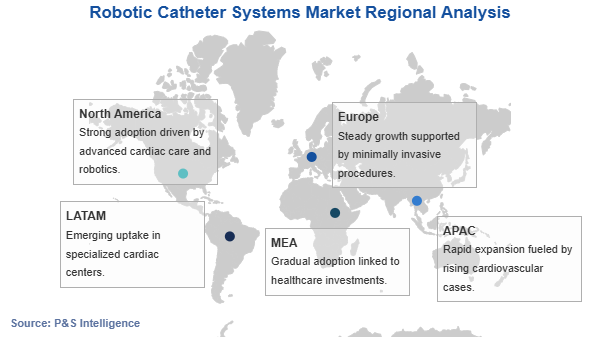
North America holds the largest market share, of 45%, in 2025, supported by one of the highest densities of hospital-based cardiac catheterization laboratories globally.
Asia-Pacific will have the highest CAGR, of 15.6%, due to expanding cardiac infrastructure and government-led healthcare modernization.
Robotic Catheter Systems Market Overview
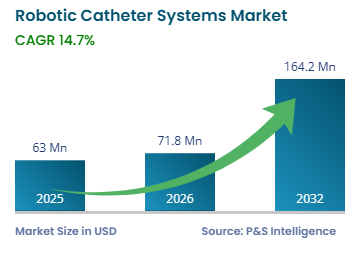
The robotic catheter systems market size was USD 63.0 million for 2025, and it will grow by 14.7% during 2026–2032, to reach USD 164.2 million by 2032.
This growth is supported by the advancing integration of electromechanical and magnetic navigation technologies in catheter-based cardiac procedures, the rising clinical adoption of robotic platforms for complex interventional electrophysiology and peripheral vascular interventions, and growing hospital investments in precision catheterization laboratory infrastructure. As cardiovascular disease burden intensifies globally and procedural volumes for arrhythmia management and coronary intervention expand, robotic catheter systems are increasingly embedded as essential precision instruments in tertiary cardiac care settings.
Institute for Health Metrics and Evaluation (IHME) research, published through the Global Burden of Disease 2023 Cardiovascular Collaborators, indicates that cardiovascular diseases were responsible for 19.2 million deaths globally in 2023, increasing from 13.1 million deaths in 1990. This establishes a structurally escalating procedural pipeline for catheter-based cardiac interventions that underpins sustained long-term demand for precision robotic navigation systems. The World Health Organization (WHO) estimates that cardiovascular diseases account for approximately 1 in 3 deaths globally, with ischemic heart disease and stroke comprising the two leading contributory conditions, generating persistent procedural demand for robotic navigation platforms in high-volume cardiac care centers.
Robotic Catheter Systems Market Trends & Drivers
AI-Integrated Navigation and Digitized Electrophysiology Infrastructure Are Key Trends
A defining trend reshaping the robotic catheter systems market is the transition from standalone electromechanical platforms toward fully integrated, AI-enhanced navigation ecosystems embedded within digitized catheterization laboratory infrastructure. The current generation incorporates real-time 3D anatomical mapping fusion and AI-assisted catheter tip positioning, along with, in some cases, haptic feedback. This enables operators to execute complex ablation protocols with greater consistency and reduced procedural variability. Deeper interoperability between robotic navigation systems and advanced electroanatomical mapping platforms, EP recording systems, and intracardiac imaging modalities is transforming the catheterization laboratory into a coordinated digital workflow environment. Recent product developments, such as Medtronic plc’s Affera Mapping and Ablation System, integrating mapping and ablation functionalities, reflect the ongoing shift toward more integrated and workflow-efficient electrophysiology platforms.
The U.S. Food and Drug Administration indicates that cardiovascular applications represent one of the most frequently authorized domains among AI/ML-enabled medical devices, with submissions accelerating since 2020. This regulatory momentum is encouraging manufacturers to deepen AI integration into robotic catheter guidance architectures. Next-generation platforms are being positioned as intelligent procedural systems rather than mechanical navigation tools. As AI-driven catheter navigation matures, competitive differentiation will depend on software intelligence and workflow integration depth rather than hardware mechanics alone.
Rising Global Atrial Fibrillation Burden Is Biggest Driver Propelling Catheter Ablation Procedure Volumes
The global atrial fibrillation (AFib) burden represents the most consequential external force driving robotic catheter system adoption. Catheter ablation, particularly pulmonary vein isolation, has emerged as a key rhythm control strategy for symptomatic and drug-refractory AFib patients. As AFib prevalence rises with aging demographics and increasing cardiovascular risk factor exposure, annual catheter ablation procedure volumes are expanding at high-volume electrophysiology centers globally. This expansion is directly increasing demand for robotic catheter navigation systems, as these platforms improve ablation precision, help reduce radiation exposure for operators, and enable more consistent lesion formation across complex anatomical targets.
Peer-reviewed research published in The Lancet as part of Global Burden of Disease analyses indicates that atrial fibrillation affects 52.5 million people globally, supporting the positioning of robotic navigation systems as clinical infrastructure investments in cardiac centers managing high-complexity or high-volume AFib ablation caseloads. As AFib prevalence continues rising alongside global population aging, catheter ablation procedure growth is expected to sustain consistent demand expansion for robotic catheter platforms worldwide.
High System Acquisition Costs and Reimbursement Gaps Are Biggest Restraints
High capital requirements for robotic catheter system acquisition and the absence of consistent reimbursement frameworks across many healthcare markets represent the most significant constraint on broader market penetration. Robotic catheter systems generally require initial capital investment ranging from USD 500,000 to over USD 2 million per installation, with ongoing maintenance, calibration, and software upgrade costs extending the total cost of ownership well beyond the purchase price. For the majority of global catheterization laboratories operating in community hospitals, emerging markets, and public healthcare systems, this capital threshold places robotic catheter navigation systems outside economically feasible procurement ranges. Adoption is accordingly concentrated within well-capitalized academic medical centers and high-volume private cardiac hospitals.
Limited healthcare spending in lower-income markets and the absence of dedicated reimbursement codes for robotic catheter-assisted procedures restrict broader adoption of these systems. Hospitals are consequently required to absorb incremental procedural costs without revenue offset, discouraging broader adoption beyond specialized centers. Manufacturers are responding through service-based financing models, reduced-entry-cost system modularity, and engagement with payer organizations to support reimbursement code development as a parallel commercial strategy. This barrier continues to moderate rather than prevent growth in the current market environment.
Expanding Neurovascular and Remote Robotic Catheterization Applications Is Key Opportunity
The concentration of robotic catheter systems in cardiac electrophysiology and percutaneous coronary intervention highlights a significant opportunity to expand into underserved clinical application areas. Neurovascular procedures, including catheter-based stroke thrombectomy, cerebral aneurysm coiling, and carotid artery stenting, require the same precision navigation and potential to reduce radiation exposure that robotic systems provide in cardiac settings. Dedicated robotic catheter solutions for neurovascular access remain largely in clinical investigation or early commercialization phases. Mechanical thrombectomy eligibility applies to approximately 10%–15% of all ischemic stroke patients, a subset that requires catheter-based intervention and reinforces the need for precise catheter navigation technologies. This gap creates a significant addressable expansion for manufacturers capable of adapting existing robotic navigation architectures to the anatomical and technical requirements of cerebrovascular intervention.
World Stroke Organization data indicate that approximately 12 million new stroke cases occur globally each year, and this disease burden generates a growing volume of catheter-based neurovascular interventions that could benefit from robotic navigation precision. The emerging concept of teleoperated robotic catheterization enables operators to conduct complex procedures from remote locations. This capability presents a distinct pathway to addressing geographic disparities in specialist interventional access in rural and lower-resource healthcare settings where skilled operators are scarce.
Robotic Catheter Systems Market Segmentation Analysis
Type Analysis
The multi-specialty category holds the larger market share, of 75%, in 2025, and it will have the higher CAGR, of 14.9%, driven by the proliferation of hybrid catheterization laboratory programs integrating electrophysiology and vascular capabilities within shared procedural suites, which is expanding cross-specialty adoption. Multi-specialty robotic platforms support multiple clinical workflows within a single installation, improving return on capital investment compared to procedure-specific alternatives and reducing per-procedure costs across diverse catheterization laboratory case mixes.
The Society for Cardiovascular Angiography and Interventions highlights that high-volume interventional programs integrate multiple catheter-based procedure types, including coronary angiography, percutaneous coronary intervention (PCI), and electrophysiology ablation, within shared catheterization laboratory environments. This integration reinforces institutional demand for robotic platforms designed for multi-procedure versatility.
The types analyzed in this report are:
Multi-specialty Systems (Larger and Faster-Growing Category)
Single-specialty Systems
Technology Analysis
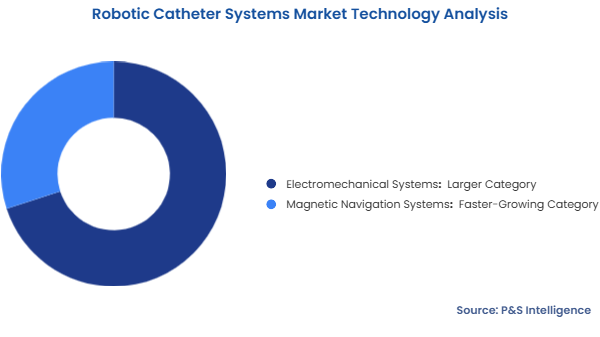
The electromechanical systems category holds the larger market share, of 70%, in 2025, supported by broad mechanical compatibility with existing catheterization laboratory layouts and established operator training programs. These systems integrate into standard catheterization suites with minimal facility modification, aligning with interoperability requirements highlighted by the Society for Cardiovascular Angiography and Interventions technical standards and lowering adoption barriers across the global installed base of cardiac laboratories.
The magnetic navigation systems category will have the higher CAGR, of 15.0%, driven by the navigation advantages in complex three-dimensional cardiac anatomies. High-risk arrhythmia ablation procedures represent the primary clinical context for this growth. Superior catheter tip controllability and reduced tissue contact variability support improved procedural precision in challenging anatomical conditions. The European Society of Cardiology clinical guidelines indicate that magnetic catheter navigation is beneficial for complex and high-risk ablation cases requiring stable and precise catheter positioning.
The technologies analyzed in this report are:
Electromechanical Systems (Larger Category)
Magnetic Navigation Systems (Faster-Growing Category)
Application Analysis
The interventional electrophysiology procedurescategory holds the larger market share, of 75%, in 2025, and it will have the higher CAGR, supported by the clinical fit between robotic catheter navigation and the precision demands of cardiac ablation. Catheter stability and contact force govern lesion quality, and robotic catheter systems improve three-dimensional positioning accuracy, reduce fluoroscopy exposure for operators, and enable more consistent lesion formation across multiple ablation modalities. Innovations such as Boston Scientific Corporation’s Farawave Nav ablation catheter and Faraview software demonstrate the increasing adoption of integrated mapping and pulsed field ablation technologies in electrophysiology procedures.
The applications analyzed in this report are:
Interventional Electrophysiology Procedures (Larger and Faster-Growing Category)
Ablation Procedures
Coronary Procedures
Peripheral Vascular Procedures
Component Analysis
The systems category holds the larger market share in 2025, driven by the high unit cost and multi-year amortization structure of robotic navigation platforms relative to associated accessories and consumables. Robotic catheter systems require high upfront investment across hardware, software, and installation, driving the revenue dominance of the systems category. The Organisation for Economic Co-operation and Development indicates that capital medical equipment expenditure represents a considerable share of hospital investment. This expenditure pattern supports the high-cost positioning of advanced interventional technologies within institutional procurement frameworks.
The accessories category will have the higher CAGR, driven by the expanding global installed base of robotic catheter systems generating recurring demand for compatible disposable catheters, guidewires, sheaths, and mapping accessories consumed on a per-procedure basis. Manufacturers are building proprietary catheter portfolios designed for their robotic platforms, converting installed base growth into sustained accessories revenue streams. The Centers for Medicare & Medicaid Services reports reimbursement provisions for disposable catheter components used in hospital-based interventional procedures. This reimbursement coverage supports continued accessories procurement alongside system adoption.
The components analyzed in this report are:
Systems (Larger Category)
Accessories (Faster-Growing Category)
End User Analysis
The hospitals category holds the largest market share, of 40%, in 2025, driven by the operational requirements of robotic catheter platforms. These platforms demand dedicated catheterization laboratory infrastructure, specialized clinical teams, and advanced imaging capabilities that align with hospital-based care environments. Large academic medical centers and high-volume cardiac referral hospitals form the primary adoption base, as their procedural scale, capital capacity, and concentration of skilled interventional specialists collectively support this institutional concentration. Studies indicate that approximately 1,975 to over 2,100 U.S. hospitals and sites operate cardiac catheterization laboratories. This infrastructure base reinforces hospitals as the primary deployment setting for robotic catheter systems.
The ambulatory surgical centers category will have the highest CAGR, driven by the increasing shift of suitable catheter-based procedures toward outpatient settings. Rising demand for cost-efficient care delivery is reinforcing this shift. Expanding clinical acceptance of same-day discharge procedures and advancements in minimally invasive techniques are supporting ASC adoption of catheter-based interventions. The Centers for Medicare & Medicaid Services Outpatient Prospective Payment System has expanded coverage for catheter-based procedures in outpatient settings. This coverage expansion supports the continued growth of ASC-based interventions.
Drive strategic growth with comprehensive market analysis
Robotic Catheter Systems Market Geographical Analysis
North America Robotic Catheter Systems Market Size
North America holds the largest market share, of 45%, in 2025, supported by one of the highest densities of hospital-based cardiac catheterization laboratories globally. Long-established Medicare and Medicaid reimbursement provisions for electrophysiology and coronary catheter-based procedures provide a stable procurement environment for robotic navigation systems. Stereotaxis, Inc. and Siemens Healthineers (Corindus Vascular Robotics) maintain headquarters and R&D operations in North America, reinforcing the region's role as the primary hub for robotic catheter system development. Early FDA clearances for remote catheter navigation systems, beginning with initial approvals in the early 2000s, have established deep clinical workflow integration in North American hospitals. This integration reinforces continued investment in system upgrades and next-generation platforms.
The U.S. Centers for Disease Control and Prevention (CDC) data show that coronary heart disease caused 371,506 deaths annually in the United States, reinforcing its position as the leading cardiac diagnosis and a key contributor to catheter-based procedural volumes in U.S. catheterization laboratories.
U.S. Robotic Catheter Systems Market Size
The U.S. represents the largest country market in North America in 2025, driven by high per-capita healthcare expenditure and a large installed base of catheterization laboratories. A regulatory framework enabling successive FDA clearances for robotic EP and peripheral vascular navigation systems has reinforced the U.S. as the primary commercial deployment environment for these platforms. The high clinical prevalence of atrial fibrillation, a major clinical indication for robotic catheter-assisted ablation, sustains growing procedural volumes at specialized electrophysiology referral centers nationwide.
U.S. National Heart, Lung, and Blood Institute (NHLBI) data indicate that atrial fibrillation affects between 2.7 million and 6.1 million people in the United States, supporting widespread use of catheter ablation and sustaining a large recurring procedural base for robotic navigation systems.
Asia-Pacific Robotic Catheter Systems Market Size
Asia-Pacific will have the highest CAGR, of 15.6%, driven by cardiac care infrastructure expansion and active government investment in healthcare modernization, which are broadening the procedural base across the region. Aging demographics across China, Japan, and South Korea are driving higher cardiovascular disease incidence, and rising minimally invasive procedure adoption in tertiary hospitals is converting this clinical burden into catheter-based procedural volumes. The region's catheterization laboratory network is expanding in urban centers across China and India. Cardiovascular disease burden is intensifying alongside urbanization and dietary shifts in both markets. China alone has over 330 million people living with cardiovascular diseases, while cardiovascular diseases account for over 28% of total deaths in India.
Moreover, India represents one of the fastest-growing country markets within Asia-Pacific, driven by private hospital group investments in EP laboratory capacity, with robotic platform deployment expanding across metropolitan cardiac centers. Japan's population aged 65 and above exceeds 29% of the total population, sustaining elevated arrhythmia incidence and growing electrophysiology procedure volumes requiring advanced catheter navigation technologies.
China Robotic Catheter Systems Market Size
China represents the largest country market within Asia Pacific, driven by the government's Healthy China 2030 initiative, which is expanding cardiac intervention access across the country. A large and growing patient pool for atrial fibrillation and coronary artery disease is reinforcing institutional demand for catheter-based interventional capacity. Domestic deployment of robotic EP navigation platforms is increasing through Tier 3 hospital expansion programs. China's cardiac catheterization laboratory network has expanded across urban centers, where tertiary hospitals are integrating robotic catheter systems to manage rising procedural complexity. National healthcare policies under the Healthy China 2030 framework promote early diagnosis and minimally invasive cardiovascular treatment, reinforcing the continued build-out of advanced catheterization laboratory infrastructure.
World Health Organization (WHO) China Country Office data indicate that cardiovascular diseases account for nearly 2 out of every 5 deaths in China. Ischemic heart disease and stroke are the predominant contributors to this burden, positioning China among the world’s largest clinical populations requiring catheter-based cardiac intervention and driving institutional procurement of robotic navigation systems.
The regions and countries of the market are as follows:
North America (Largest Regional Market)
U.S. (Larger Country Market)
Canada (Faster-Growing Market)
Europe
Germany (Largest Country Market)
U.K. (Fastest-Growing Country Market)
France
Italy
Spain
Rest of Europe
Asia-Pacific (Fastest-Growing Regional Market)
China (Largest Country Market)
India (Fastest-Growing Country Market)
Japan
South Korea
Australia
Rest of APAC
Latin America
Brazil (Largest Country Market)
Mexico (Fastest-Growing Country Market)
Rest of LATAM
Middle East and Africa
Saudi Arabia (Largest Country Market)
South Africa
U.A.E. (Fastest-Growing Country Market)
Rest of MEA
Robotic Catheter Systems Market Share
The market is semi-consolidated, with a limited number of established players operating alongside emerging entrants. High R&D investment requirements, complex clinical validation processes, and stringent regulatory approvals, including EU MDR compliance, restrict participation and narrow the field of viable participants. The integration of robotic systems into catheterization laboratory workflows increases switching costs, strengthening the position of existing providers. However, ongoing technological advancements, expanding clinical applications, and the entry of new companies offering cost-effective solutions prevent full consolidation. The competitive landscape remains concentrated yet open to selective innovation-driven competition.
Leading Companies in the Robotic Catheter Systems Market:
Stereotaxis, Inc.
Siemens Healthineers AG
Robocath S.A.S.
Microbot Medical Inc.
Magnetecs Corporation
Catheter Precision, Inc.
Medtronic plc
Abbott Laboratories
Johnson & Johnson
Robotic Catheter Systems Market News
In October 2025, Stereotaxis, Inc. entered into a collaboration with CardioFocus, Inc. to develop robotic pulsed field ablation treatment for cardiac arrhythmias.
In September 2025, Microbot Medical Inc. received FDA 510(k) clearance for the LIBERTY Endovascular Robotic System, a novel FDA-cleared single-use, remotely operated robotic system for peripheral vascular interventions, and announced USD 92.2 million in financing for commercialization.
Frequently Asked Questions About This Report
What is the current size of the robotic catheter systems market?+
The robotic catheter systems market was valued at USD 63.0 million in 2025.
What factors are driving the growth of the robotic catheter systems market?+
The market is driven by the rising prevalence of cardiovascular diseases, increasing preference for minimally invasive procedures, and reduced radiation exposure for physicians.
What are the major challenges in the robotic catheter systems market?+
The market faces challenges such as high capital investment requirements, limited accessibility in developing regions, stringent regulatory pathways, and the need for skilled professionals to operate advanced robotic systems.
What technological advancements are influencing the robotic catheter systems market?+
The advancements in robotic navigation systems, integration of imaging technologies, AI-assisted guidance, and enhanced precision control are significantly improving procedural outcomes and driving market adoption.
What is the nature of the robotic catheter systems market?+
The robotic catheter systems market is semi-consolidated.
Want a report tailored exactly to your business need?
Leading companies across industries trust us to deliver data-driven insights and innovative solutions for their most critical decisions. From data-driven strategies to actionable insights, we empower the decision-makers who shape industries and define the future. From Fortune 500 companies to innovative startups, we are proud to partner with organisations that drive progress in their industries.
Client Testimonials
Working with P&S Intelligence and their team was an absolute pleasure – their awareness of timelines and commitment to value greatly contributed to our project's success. Eagerly anticipating future collaborations.
McKinsey & Company
India
Unmatched Standards
Our insights into the minutest levels of the markets, including the latest trends and competitive landscape, give you all the answers you need to take your business to new heights
Complete Data Security
We take a cautious approach to protecting your personal and confidential information. Trust is the strongest bond that connects us and our clients, and trust we build by complying with all international and domestic data protection and privacy laws