Renewable Energy Asset Management Market Size & Share Analysis - Trends, Drivers, Competitive Landscape, and Forecasts (2026 - 2032)
This Report Provides In-Depth Analysis of the Renewable Energy Asset Management Market Report Prepared by P&S Intelligence, Segmented by Component (Software, Services), Application (Solar Energy, Wind Energy, Hydropower, Bioenergy, Geothermal Energy), Deployment Mode (Cloud-Based, On-Premise), Enterprise Size (Large Enterprises, Small and Medium Enterprises), End User (Utilities, Commercial & Industrial Enterprises, Independent Power Producers, Renewable Energy Project Developers, Asset Management Companies), and Geographical Outlook for the Period of 2021 to 2032
Renewable Energy Asset Management Market Size Estimation
Key Highlights
Study Period
2021 - 2032
Market Size in 2025
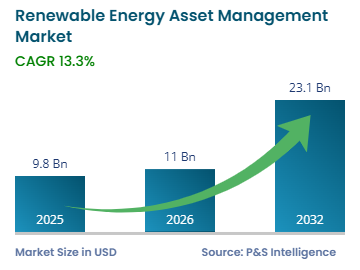
USD 9.8 Billion
Market Size in 2026
USD 11.0 Billion
Market Size by 2032
USD 23.1 Billion
Projected CAGR
13.3%
Largest Region
North America
Fastest Growing Region
Asia-Pacific
Market Structure
Fragmented
Market Size
Explore the market potential with our data-driven report
Renewable Energy Asset Management Market Future Outlook
The renewable energy asset management market size was USD 9.8 billion in 2025, and it will grow by 13.3% during 2026–2032 to reach USD 23.1 billion by 2032.
The market is expanding as renewable energy operators manage larger portfolios of solar, wind, hydro, hybrid generation, and battery energy storage assets across geographically distributed locations. Utilities, independent power producers, and commercial energy companies are adopting digital asset management platforms to improve operational visibility, reduce equipment downtime, strengthen performance forecasting, and support lifecycle planning across complex renewable infrastructure.
Digitalization is reshaping renewable operations through cloud-based monitoring, digital twins, predictive analytics, and AI-driven asset optimization. Digital twins allow operators to simulate equipment behavior and compare real-time performance with expected operating conditions, while AI tools support fault detection, maintenance prioritization, energy-yield improvement, and earlier identification of performance losses. Battery energy storage system asset management is also becoming more important as storage assets are increasingly operated alongside renewable generation and require continuous monitoring of availability, degradation, charging cycles, and system performance.
According to the International Renewable Energy Agency, global renewable power capacity reached 5,149 GW in 2025, with 692 GW added during the year. This statistic demonstrates the scale of the expanding installed asset base; the resulting increase in demand for asset management platforms is market analysis. As renewable portfolios grow, operators require centralized systems that combine remote diagnostics, maintenance scheduling, operational analytics, forecasting, and performance optimization across generation and storage assets. These capabilities are becoming increasingly important for improving reliability, extending equipment life, reducing disruptions, and managing distributed renewable infrastructure more efficiently.
Key Market Insights
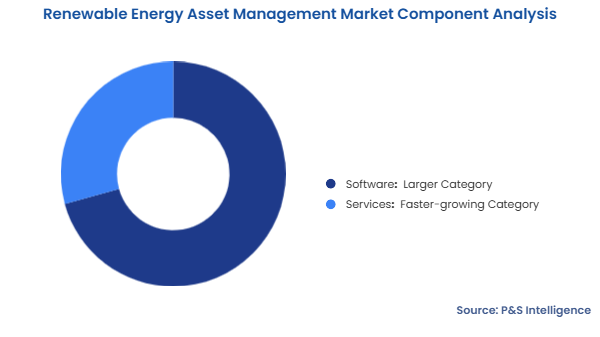
Software is the larger category, holding a market share of 70.5%, due to rising adoption of AI-enabled renewable monitoring and predictive maintenance platforms.
Wind Energy is the fastest-growing category, registering a CAGR of 13.5%, driven by expanding offshore wind projects requiring advanced remote asset monitoring systems.
Cloud-Based is the larger and faster-growing category, holding a market share of 85.5% and registering a CAGR of 14.2%, because renewable operators increasingly require centralised multi-site operational visibility.
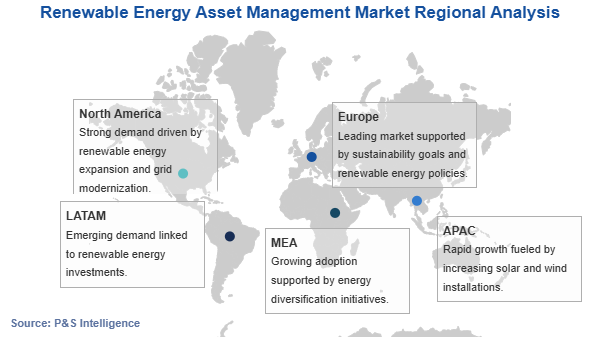
North America holds the largest share of 45.5%, due to large utility-scale renewable installations and increasing deployment of AI-enabled asset management systems.
Asia-Pacific is the fastest-growing region, registering a CAGR of 15.0%, driven by rapid renewable infrastructure expansion and increasing adoption of cloud-based monitoring platforms.
Renewable Energy Asset Management Market Trends and Drivers
AI-Integrated Predictive Maintenance Platforms Are a Major Trend
Renewable energy asset management providers are increasingly integrating artificial intelligence, machine learning, and digital twin capabilities into monitoring platforms to improve predictive maintenance and operational forecasting across solar, wind, hydro, and battery-connected infrastructure. The industry is moving away from reactive maintenance toward systems that identify equipment irregularities before failures occur. AI improves asset availability by detecting early signs of underperformance, helps increase predictive maintenance accuracy through continuous analysis of operational and condition data, and supports energy yield optimization by identifying losses linked to equipment behavior, weather conditions, and operating settings.
Companies are also introducing cloud-native platforms that combine real-time analytics, remote diagnostics, weather forecasting, and grid performance monitoring within unified operational dashboards. In 2026, Power Factors launched Unity REMI for renewable energy portfolio operations, integrating monitoring, asset performance management, SCADA, EMS, and mobile workflows within a connected AI engine. In 2026, Hitachi Energy launched HMAX Energy, an AI-powered solution suite supporting asset monitoring, digital twin applications, lifecycle planning, and early issue detection across critical energy infrastructure. These developments are strengthening intelligent automation across renewable portfolios and changing how operators manage maintenance schedules, equipment performance, and long-term asset reliability.
Rising Global Renewable Power Installations Drive Market
The market is growing as governments, utilities, and private investors expand renewable power generation across solar, wind, hydro, and energy storage projects. As asset portfolios become larger and more geographically distributed, operators face greater complexity in maintenance scheduling, equipment reliability, performance monitoring, and grid coordination. Grid modernization and the growing deployment of distributed energy resources are adding further operational challenges, as asset owners must manage variable generation, decentralized systems, storage assets, and changing power flows across increasingly connected networks.
According to the International Renewable Energy Agency, global solar power capacity increased by 510.3 GW in 2025. The International Energy Agency also reported that global electricity generation from solar PV increased by 620 TWh in 2025, the largest annual increase recorded for the technology. These statistics demonstrate the scale of renewable expansion; the resulting increase in demand for asset management platforms is market analysis. As renewable integration becomes more complex, operators require real-time monitoring, automated diagnostics, forecasting, predictive maintenance, and performance optimization tools to improve energy yield, coordinate distributed assets, reduce downtime, and maintain reliable operations across large renewable portfolios.
High Integration Complexity Across Diverse Renewable Infrastructure Limits Market Expansion
The market faces challenges because renewable energy operators manage solar, wind, storage, and grid assets built on different hardware standards, communication protocols, and software architectures. Integrating these systems into unified asset management platforms can increase deployment complexity, extend implementation timelines, and create compatibility issues across distributed renewable portfolios. Older installations may also rely on legacy control systems that do not easily connect with cloud-native monitoring, predictive analytics, or AI-based maintenance tools.
According to the International Renewable Energy Agency, 55% of respondents in 2025 identified lack of timely data and interoperability as important barriers to implementing digital solutions in the energy sector. This directly supports the restraint, as fragmented data and incompatible systems can reduce operational visibility, limit predictive maintenance accuracy, and increase customization requirements. Smaller asset owners may face additional barriers from cybersecurity concerns, limited technical expertise, and higher integration costs across multi-site renewable operations.
Expansion of Hybrid Renewable Energy Projects Creates New Growth Opportunities
The increasing development of hybrid renewable energy projects is creating strong opportunities for renewable energy asset management providers. Energy companies are combining solar, wind, battery storage, and smart grid infrastructure within integrated power systems to improve energy reliability and operational flexibility. This is increasing demand for platforms capable of monitoring multiple energy sources through centralised operational environments with forecasting, maintenance scheduling, and remote diagnostics capabilities. Emerging markets are also expanding investments in microgrids, distributed renewable infrastructure, and utility-scale storage facilities that require cloud-based asset optimisation tools. In 2025, global off-grid renewable capacity reached 17.8 GW, according to the International Renewable Energy Agency. The growing deployment of distributed and hybrid renewable systems is encouraging operators to adopt scalable lifecycle management platforms that improve operational coordination, multi-site visibility, and long-term renewable asset performance.
Renewable Energy Asset Management Market Segmentation Analysis
Component Analysis
Software is the larger category, holding a market share of 70.5%, because renewable operators increasingly rely on centralised platforms for monitoring, predictive maintenance, operational analytics, and cloud-based renewable asset optimisation. Utilities and independent power producers are integrating AI-enabled software, IoT-connected infrastructure, and remote diagnostics tools to improve visibility across distributed solar, wind, and storage assets. In 2026, Power Factors launched Unity REMI within its renewable energy management suite, integrating monitoring, SCADA, asset performance management, and energy management workflows.
Services is the faster-growing category, registering a CAGR of 13.8%, because renewable energy operators are increasingly seeking specialised support for system integration, deployment, maintenance, and operational optimisation. As renewable portfolios become more complex, companies require consulting and managed services to integrate multiple energy technologies, data platforms, and grid systems into unified management environments. The growing deployment of hybrid renewable projects is also increasing demand for implementation and technical support services.
The component analysed in this report are:
Software (Larger Category)
Asset Performance Monitoring
Predictive Maintenance
Analytics and Reporting
Financial Management
Compliance Reporting
Workflow Management
Others
Services (Faster-growing Category)
Consulting Services
Implementation Services
Integration Services
Support Services
Managed Services
Others
Application Analysis
Solar Energy is the largest category, holding a market share of 40.0%, because solar power installations continue to expand rapidly across utility-scale, commercial, and distributed energy projects worldwide. The large operational base of solar farms has increased the need for asset performance monitoring, predictive maintenance, and energy forecasting solutions to maintain generation efficiency. Solar assets also generate significant operational data that requires centralised analytics and remote management capabilities. In addition, government-backed clean energy programs and declining solar deployment costs are encouraging wider adoption of renewable asset management platforms across the global solar energy sector.
Wind Energy is the fastest-growing category, registering a CAGR of 13.5%, because operators are rapidly expanding onshore and offshore wind projects across geographically dispersed regions. Wind turbines operate under variable environmental and mechanical conditions, increasing the importance of predictive maintenance, remote diagnostics, and real-time operational analytics. Renewable operators are also integrating cloud-based monitoring systems to improve turbine efficiency and reduce operational downtime across large wind portfolios. In 2025, global wind energy capacity reached 1,291 GW, while annual wind additions reached 159 GW, according to the International Renewable Energy Agency.
The application analysed in this report are:
Solar Energy (Largest Category)
Wind Energy (Fastest-growing Category)
Hydropower
Bioenergy
Geothermal Energy
Deployment Mode Analysis
Cloud-Based is the larger and faster-growing category, holding a market share of 85.5% and registering a CAGR of 14.2%, because renewable operators increasingly require scalable platforms for remote monitoring, centralized analytics, and real-time visibility across distributed energy assets. Cloud deployment allows operators to connect solar farms, wind projects, battery storage systems, and multiple sites without extensive on-premise infrastructure. According to the International Renewable Energy Agency, 66% of respondents in 2025 indicated that digitalization was being incorporated into national energy strategies. This supports the broader shift toward digital energy operations; the resulting increase in cloud-based asset management demand is market analysis, as operators require scalable systems for monitoring, forecasting, diagnostics, and multi-site performance management.
The deployment mode analysed in this report are:
Cloud-Based (Larger Category and Faster-Growing Category)
On-Premise
Enterprise Size Analysis
Large Enterprises is the larger category, holding a market share of 80.5%, because utilities, energy companies, and independent power producers manage extensive renewable portfolios across multiple operational sites. These organisations require advanced management systems capable of handling large operational datasets, predictive maintenance functions, cloud-based analytics, and grid integration requirements. Large enterprises also possess stronger financial and technical capabilities to deploy enterprise-wide renewable monitoring infrastructure and digital operational platforms. In 2025, Schneider Electric expanded the availability of its One Digital Grid Platform globally, integrating planning, operations, and asset management capabilities for utility networks and renewable infrastructure.
Small and medium enterprises are the faster-growing category, registering a CAGR of 13.7%, due to the increasing accessibility of cloud-based renewable asset management platforms and subscription-based software models. Smaller renewable developers and regional energy operators are increasingly adopting digital monitoring and maintenance tools to improve operational efficiency without major infrastructure investments. The expansion of distributed renewable energy systems and decentralised power generation projects is also supporting segment growth. In addition, SMEs are adopting remote asset management solutions to simplify maintenance planning, improve energy output monitoring, and manage renewable installations across geographically dispersed operational environments more effectively.
The enterprise size analysed in this report are:
Large Enterprises (Larger Category)
Small and medium enterprises (SMEs) (Faster-Growing Category)
End User Analysis
Utilities is the largest category, holding a market share of 40.0%, because utility companies operate large renewable energy networks that require continuous monitoring, performance optimisation, and maintenance coordination. Utilities are increasingly investing in centralised asset management platforms to improve operational stability across solar, wind, hydro, and storage assets connected to modernised electricity grids. The growing integration of renewable generation into national transmission systems is also increasing the need for predictive analytics and real-time operational visibility.
Commercial & Industrial Enterprises is the fastest-growing category, registering a CAGR of 14.8%, because businesses across manufacturing, logistics, retail, and industrial sectors are expanding deployment of on-site renewable infrastructure and battery-connected energy systems. Integration of solar systems, storage units, and cloud-based monitoring tools is also strengthening demand for scalable renewable asset management solutions within commercial operations. According to the Global Renewables Alliance, corporates signed 62.2 GW of renewable energy PPAs in 2024. Rising commercial renewable energy procurement is increasing demand for platforms that support operational control, energy forecasting, and long-term renewable infrastructure management across industrial and business facilities.
Drive strategic growth with comprehensive market analysis
Renewable Energy Asset Management Market Regional Outlook
North America Renewable Energy Asset Management Market Analysis
North America holds the largest share, of 45.5%, because the region has an established renewable energy operating ecosystem supported by advanced grid infrastructure, large clean energy portfolios, and early adoption of digital asset optimization technologies. Utilities and independent power producers are increasingly using AI-enabled monitoring, predictive maintenance, and cloud-based asset performance platforms to improve reliability across solar, wind, storage, and hybrid facilities. The Inflation Reduction Act has supported continued clean energy deployment through production and investment tax credits, expanding the operating asset base that requires long-term performance monitoring and lifecycle management. Utility grid modernization programs are also strengthening demand for digital tools that help operators coordinate renewable generation, storage assets, and changing grid conditions. The U.S. Department of Energy’s Grid Resilience and Innovation Partnerships program is supporting large-scale upgrades to grid flexibility and resilience, further increasing the need for real-time analytics, remote diagnostics, forecasting, and portfolio-level asset management across North America.
U.S. Renewable Energy Asset Management Market Analysis
The United States is a major market for renewable energy asset management because utilities and energy companies operate large portfolios of solar farms, wind projects, and battery storage infrastructure across multiple states. Renewable operators are increasingly deploying AI-enabled analytics, predictive maintenance systems, and cloud-based monitoring platforms to improve operational efficiency and grid reliability. Industrial software providers and grid technology companies are also expanding renewable asset optimisation capabilities across utility-scale energy operations. In 2024, the United States added a record 30 GW of utility-scale solar capacity, according to the U.S. Energy Information Administration.
Canada Renewable Energy Asset Management Market Analysis
Canada is experiencing growing adoption of renewable energy asset management solutions because utilities and power producers are expanding hydroelectric, wind, and distributed renewable projects across geographically dispersed regions. Renewable operators are increasingly prioritising predictive maintenance, remote diagnostics, and digital monitoring systems to maintain operational continuity across climate-sensitive energy infrastructure. Investments in clean electricity expansion and transmission modernisation are also strengthening demand for centralised operational visibility and renewable asset co-ordination platforms. In 2024, renewable sources generated 63.9% of Canada’s total electricity production, according to Statistics Canada. The large share of renewable electricity generation is encouraging wider deployment of cloud-based monitoring systems and lifecycle management platforms capable of supporting distributed renewable operations across remote energy networks.
Asia-Pacific Renewable Energy Asset Management Market Analysis
Asia-Pacific has the highest CAGR, of 15.0%, because rapid renewable deployment, rising electricity demand, industrial electrification, and grid modernization programs are expanding the need for advanced asset management systems. Countries across the region are developing utility-scale solar, offshore wind, battery storage, and distributed energy projects while investing in smart grids and digital power infrastructure. These changes are increasing demand for centralized platforms that support remote diagnostics, predictive maintenance, portfolio monitoring, and real-time performance analysis across geographically dispersed assets. AI-enabled operations are also gaining importance by improving renewable generation forecasting, early fault detection, maintenance prioritization, and grid coordination.
China Renewable Energy Asset Management Market Analysis
China remains a leading country in the renewable energy asset management market because the country continues expanding large-scale solar, wind, hydroelectric, and battery-connected energy infrastructure. Renewable operators are increasingly investing in intelligent monitoring systems, AI-enabled maintenance platforms, and digital operational technologies to improve renewable asset efficiency and grid integration performance. The expansion of offshore wind projects, desert solar installations, and ultra-high-voltage transmission infrastructure is also strengthening demand for advanced operational analytics and renewable management systems. By the end of 2024, China’s cumulative installed renewable energy capacity reached 1.889 billion kW, according to the Government of China.
India Renewable Energy Asset Management Market Analysis
India is emerging as a fast-growing market for renewable energy asset management because developers are rapidly expanding solar parks, hybrid renewable projects, battery storage systems, and decentralized clean energy infrastructure. Operators are adopting cloud-based monitoring, automated maintenance platforms, and digital asset optimization tools to improve utilization and operational reliability. The National Green Hydrogen Mission is also supporting new clean energy infrastructure, while wider battery energy storage deployment is increasing the need to manage charging cycles, degradation, availability, and system performance alongside renewable generation. As of 2025, India’s installed renewable energy capacity reached 220.10 GW. This expanding asset base is strengthening demand for centralized monitoring, predictive maintenance, lifecycle management, and performance optimization across India’s renewable energy sector.
Europe Renewable Energy Asset Management Market Analysis
Europe is witnessing steady growth in the renewable energy asset management market because regulatory and policy initiatives are accelerating both renewable deployment and the digital transformation of energy operations. The European Green Deal and REPowerEU are supporting wider adoption of clean power, grid upgrades, and lower dependence on fossil fuels, while the EU Action Plan for Digitalising the Energy System encourages the use of digital technologies to improve energy efficiency, renewable integration, and system flexibility. These policies are increasing the need for advanced asset management platforms that support remote monitoring, predictive maintenance, lifecycle optimization, and portfolio-level performance analysis.
The regions and countries analysed in this report are:
North America (Largest Regional Market)
U.S. (Larger Country)
Canada (Faster-Growing Country)
Europe
Germany (Largest Country)
U.K.
France
Italy
Spain (Fastest-Growing Country)
Rest of Europe
Asia-Pacific (Fastest-Growing Regional Market)
China (Largest Country)
India (Fastest-Growing Country)
Japan
South Korea
Australia
Rest of APAC
Latin America
Brazil (Largest Country)
Mexico (Fastest-Growing Country)
Rest of LATAM
Middle East and Africa
Saudi Arabia
U.A.E. (Fastest-Growing Country)
South Africa (Largest Country)
Rest of MEA
Renewable Energy Asset Management Market Share Analysis
The market is moderately fragmented, with competition spread across renewable energy software providers, industrial automation companies, analytics developers, and specialized asset management firms. Vendors compete through monitoring, predictive maintenance, operational analytics, and lifecycle optimization capabilities across solar, wind, hydro, and energy storage portfolios. Leading providers maintain competitive advantages through AI-based analytics, cloud-native platforms, integrated SCADA solutions, and long-term service contracts that allow customers to manage assets through connected operational environments. Platform interoperability is becoming a major differentiator because operators increasingly need systems that can connect equipment, data sources, storage assets, and third-party applications across mixed technology portfolios.
Leading Companies in the Renewable Energy Asset Management Market:
Power Factors, LLC
Radian Generation, LLC
Clir Renewables Inc.
PowerHub
DNV AS
Schneider Electric SE
Siemens Energy AG
ABB Ltd.
GE Vernova Inc.
IBM Corporation
ONYX Insight
SkySpecs
TWAICE Technologies GmbH
Vaisala Oyj
Envision Energy Co., Ltd.
Renewable Energy Asset Management Market News
In August 2025, TWAICE partnered with Fullmark Energy to deploy its Battery Storage Analytics platform across 290 MWh of BESS assets in California's CAISO market. The platform was intended to improve operational visibility, streamline operations, support compliance, and monitor asset performance.
In November 2024, GE Vernova expanded its multi-year strategic collaboration agreement with Amazon Web Services (AWS). The agreement includes GE Vernova's Asset Performance Management (APM) software delivered through the AWS Cloud, aimed at helping energy companies manage asset and emissions data and support the energy transition.
In October 2024, Power Factors launched a next-generation AI-powered Asset Performance Management (APM) application on its Unity platform. The solution provides advanced asset performance management and AI-powered analytics for wind, solar, and battery energy storage systems.
In January 2024, SkySpecs launched SkySpecs Performance, a solution using SCADA-based performance monitoring and component-health assessment for wind turbines. The launch followed its acquisition of i4SEE and was designed to provide advanced monitoring and insights into wind-asset performance and health.
Frequently Asked Questions About This Report
What does the renewable energy asset management market include for organizations?+
It includes software and services that monitor, maintain, optimize, and report on solar, wind, hydro, and storage assets.
What factors are driving demand in the renewable energy asset management market?+
Growth is driven by expanding renewable fleets, performance targets, aging assets, remote monitoring, and need for better maintenance planning.
Why are organizations adopting renewable energy asset management solutions across operations?+
Operators adopt asset management tools to track production, plan service, manage contracts, and protect energy output.
How do renewable energy asset management solutions improve decision making and efficiency?+
These solutions improve operations by combining performance data, fault alerts, maintenance schedules, and financial reporting for renewable portfolios.
What challenges affect adoption of renewable energy asset management solutions today?+
Adoption is affected by site connectivity, data standardization, weather variability, equipment diversity, contract complexity, and skilled maintenance availability.
Want a report tailored exactly to your business need?
Leading companies across industries trust us to deliver data-driven insights and innovative solutions for their most critical decisions. From data-driven strategies to actionable insights, we empower the decision-makers who shape industries and define the future. From Fortune 500 companies to innovative startups, we are proud to partner with organisations that drive progress in their industries.
Client Testimonials
Working with P&S Intelligence and their team was an absolute pleasure – their awareness of timelines and commitment to value greatly contributed to our project's success. Eagerly anticipating future collaborations.
McKinsey & Company
India
Unmatched Standards
Our insights into the minutest levels of the markets, including the latest trends and competitive landscape, give you all the answers you need to take your business to new heights
Complete Data Security
We take a cautious approach to protecting your personal and confidential information. Trust is the strongest bond that connects us and our clients, and trust we build by complying with all international and domestic data protection and privacy laws