Real World Evidence Solutions Market Size & Share Analysis - Trends, Drivers, Competitive Landscape, and Forecasts (2026 - 2032)
This Report Provides In-Depth Analysis of the Real World Evidence Solutions Market Report Prepared by P&S Intelligence, Segmented by Component (Services, Data Sets), Application (Drug Development and Approvals, Medical Device Development and Approvals, Post-Market Surveillance, Market Access Reimbursement/Coverage Decision Making, Clinical And Regulatory Decision-Making), End User (Pharmaceutical & Medical Device Companies, Healthcare Providers, Healthcare Payers), and Geographical Outlook for the Period of 2021 to 2032
Real World Evidence Solutions Market Size Estimation
Key Highlights
Study Period
2021 - 2032
Market Size in 2025
USD 2.0 Billion
Market Size in 2026
USD 2.3 Billion
Market Size by 2032
USD 5.1 Billion
Projected CAGR
14.3%
Largest Region
North America
Fastest-Growing Region
Asia-Pacific
Market Structure
Fragmented
Market Size
Explore the market potential with our data-driven report
Real World Evidence Solutions Market Overview
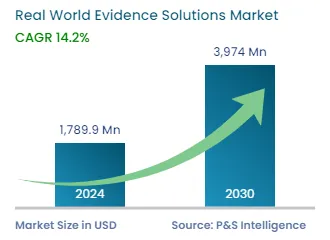
The real world evidence solutions market size was USD 2.0 billion for 2025, and it will grow by 14.3% during 2026–2032, to reach USD 5.1 billion by 2032.
The market growth is primarily driven by the rising number of clinical trials globally, the shifting focus toward value-based healthcare from volume-based models, and the continuously surging R&D activities related to the development of drugs and advanced medical devices. The World Health Organization estimates that noncommunicable diseases account for approximately 74% of global deaths annually, significantly increasing the need for long-term outcome tracking and more robust evidence-based decision-making.
Moreover, RWD and RWE are used to improve protocol design, which will reduce the number of costly protocol revisions and can also be used to create synthetic control arms, which will speed up trial execution and reduce the overall cost. The National Center for Science and Engineering Statistics reported that higher-education R&D expenditure in health sciences reached USD 38.5 billion in FY 2024, reflecting sustained investment in research capabilities that support data generation and clinical evidence development. The continuous development in data variety, volume, and speed, and the need for quick delivery of insights drawn from that data are boosting the demand for enhancement of the right technologies for real-world evidence program implementation. Thus, several life sciences companies are adopting cloud technologies because of the flexibility, speed, safety, and scalability they offer.
Key Market Insights
The data sets category will have the higher CAGR, of approximately 14.6%, due to the increasing availability of structured, longitudinal health datasets for evidence generation.
The drug development and approvals category holds the largest market share, of 40%, in 2025, driven by extensive development pipelines and the need for real-world evidence on safety and effectiveness.
The pharmaceutical & medical device companies category holds the largest market share, of 60% in 2025, driven by their role as primary funders and users of real-world evidence.
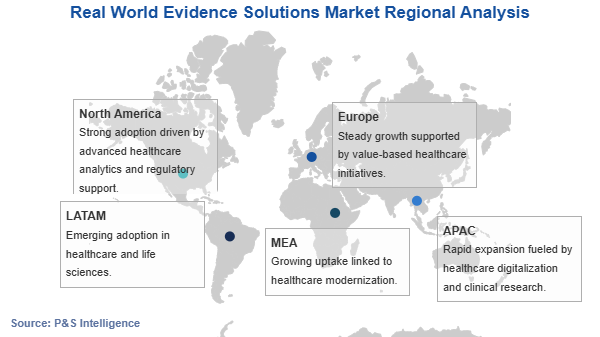
North America holds the largest market share, of 40%, in 2025, driven by its advanced healthcare data infrastructure and strong regulatory adoption of real-world evidence.
Asia-Pacific will have the highest CAGR, of approximately 15.2%, due to strong government support, rising clinical trials, and growing demand for advanced healthcare services.
Real World Evidence Solutions Market Trends and Drivers
Artificial Intelligence and Interoperable Data Infrastructure Are Key Trends
Real-world evidence generation is shifting from siloed, single-source observational studies toward integrated, interoperable data ecosystems that combine electronic health records, claims, registries, and patient-generated data within unified analytic environments. The maturation of common data models and standardized application programming interfaces is driving this transformation. These standards allow disparate healthcare systems to exchange structured clinical information without manual reconciliation. This interoperable exchange reflects the expanding data substrate available to evidence-generation platforms.
Vendors are increasingly embedding natural language processing and machine learning directly into data-curation pipelines. These pipelines automate the extraction of unstructured clinical notes into analyzable variables and compress study timelines that previously required months of manual chart abstraction. The Office of the National Coordinator for Health Information Technology reports that 70% of non-federal acute care hospitals engaged in all four domains of interoperable exchange in 2023, up from 46% in 2018. Real-world evidence platforms are moving from reactive, study-specific data pulls toward continuously refreshed, analysis-ready data assets, a structural change expected to compress evidence-generation timelines as common data models gain broader adoption through 2032.
Regulatory Recognition of Real-World Evidence Is Biggest Driver
Sustained regulatory validation of real-world evidence as a credible input to product lifecycle decisions is a primary force pushing pharmaceutical, biotechnology, and medical-device organizations toward formal evidence-generation platforms rather than ad hoc observational studies. As agencies increasingly accept real-world evidence in support of label expansions, post-market surveillance, and device clearances, sponsors face growing pressure to invest in standing data infrastructure and analytics capabilities rather than commissioning one-off studies reactively. This regulatory pull is compounded by the proliferation of AI-enabled diagnostic and monitoring technologies, which themselves generate large volumes of real-world performance data requiring systematic evidence frameworks.
The U.S. Food and Drug Administration AI-Enabled Medical Device List shows the agency has authorized over 1,400 AI-enabled medical devices since 1995. Approvals have increased in recent years, reaching record levels, as more AI-enabled and software-driven products reach the market, demand for evidence platforms capable of continuous post-market data capture is expected to accelerate. This demand is reinforcing real-world evidence's transition from a supplementary tool to a structural requirement of product lifecycle management.
Data Privacy and Fragmentation Risks Constraining Cross-Source Integration
Despite strong regulatory tailwinds, the sensitivity of health data and the fragmented nature of healthcare data ownership continue to constrain how readily real-world evidence vendors can aggregate and link data across institutions. Stricter enforcement of data-protection requirements, combined with an increasing frequency of large-scale healthcare data breaches, is pushing health systems and payers toward more conservative data-sharing postures. This shift is slowing the pace at which vendors can expand multi-source, longitudinal datasets, these breaches are intensifying scrutiny of how real-world data platforms store, transmit, and secure linked patient records.
The HHS Office for Civil Rights reports a high number of large healthcare data breaches in recent years, exposing substantial volumes of protected health information. This heightened security and compliance burden is expected to favor vendors with federated, privacy-preserving data architectures over those relying on centralized data pooling. This structural shift is likely to reshape vendor selection criteria and slow integration timelines for smaller market entrants through 2032.
Clinical Trial Representation Gaps Are Biggest Opportunity
Persistent demographic disparities between clinical trial populations and the broader patient populations who ultimately use approved products are creating a structural opportunity for real-world evidence platforms to fill representation gaps that traditional trials leave unaddressed. As regulators formalize expectations around demographic representativeness, sponsors increasingly need supplementary real-world data to characterize how products perform across patient subgroups underrepresented in pivotal trials, across race, ethnicity, age, and comorbidity dimensions.
A peer-reviewed study comparing FDA approval-trial demographics against a real-world electronic health record database covering more than 150 million U.S. patients found that none of 17 analyzed trial populations matched expected demographic proportions across all five cohorts assessed. Both over- and under-representation occurred, depending on the specific disorder studied, this gap is opening space for real-world evidence vendors to position diversity-focused data assets and post-market representativeness analyses as a distinct service line. FDA's 2024 draft guidance on diversity action plans is pushing sponsors toward systematic post-approval demographic monitoring through 2032.
Real World Evidence Solutions Market Segmentation Analysis
Component Analysis
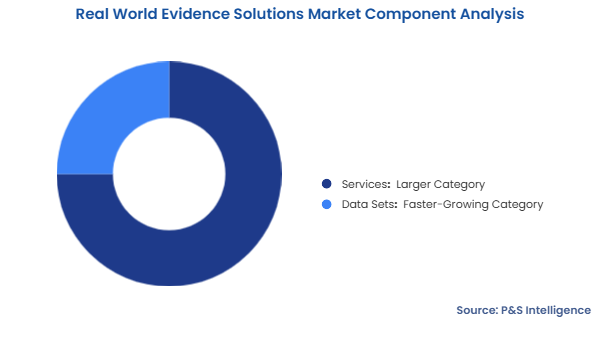
The services category holds the larger market share, of 75%, in 2025. This is ascribed to the reducing drug development delays, which is now more important than ever before, and the availability of a higher amount of healthcare information. Moreover, companies frequently adapt the necessary services as per the client's needs, which saves time and money compared to obtaining the data sets and analyzing them to generate helpful information. Also, real-world evidence program professionals communicate and work together with the subject matter professionals of medical device and pharmaceutical companies to provide services for the development of intelligent RWE plans and use their analytical abilities to offer valuable statistical insights.
The data sets category will have the higher CAGR, of approximately 14.6%, supported by the rapid expansion of structured, longitudinal health datasets available for licensing and integration into evidence-generation workflows. NIH's All of Us Research Program reports enrolling more than 850,000 participants across all 50 U.S. states as of November 2024, illustrating the accelerating scale of large, structured, research-ready datasets entering the market and reducing vendors' reliance on bespoke data-collection services.
The components analyzed in this report are:
Services (Larger Category)
Data Sets (Faster-Growing Category)
Disparate Data Sets
Clinical Settings Data
Claims Data
Pharmacy Data
Patient-Powered Data
Registry-Based Data Sets
Integrated Data Sets
Application Analysis
The drug development and approvals category holds the largest market share, of 40%, in 2025, driven by the sheer volume of active development programs requiring evidence beyond controlled trials to characterize safety, effectiveness, and comparative value across diverse patient populations. The Center for Drug Evaluation and Research approved 50 new molecular entities in calendar year 2024. Many of these entities require post-approval real-world safety and effectiveness monitoring, sustaining demand for evidence-generation platforms throughout the product lifecycle.
The market access reimbursement/coverage decision making category will have the highest CAGR, as payers and health systems are increasingly tying reimbursement to demonstrated real-world value rather than trial efficacy alone, this transition is increasing demand for outcomes-based real-world evidence to support coverage determinations, reimbursement decisions, and pricing negotiations across healthcare systems. The Centers for Medicare & Medicaid Services continues to expand value-based care and population health initiatives that shift reimbursement from volume-based service delivery toward outcomes-focused care models.
The applications analyzed in this report are:
Drug Development and Approvals (Largest Category)
Oncology
Neurology
Immunology
Cardiovascular Disease
Other Therapeutic Areas
Medical Device Development and Approvals
Post-Market Surveillance
Market Access Reimbursement/Coverage Decision Making (Fastest-Growing Category)
Clinical And Regulatory Decision-Making
End User Analysis
The pharmaceutical & medical device companies category holds the largest market share in 2025, reflecting their central role as both funders and primary consumers of real-world evidence across the product development and commercialization lifecycle. This leadership is reinforced by the scale of capital these organizations deploy toward evidence generation to support regulatory submissions, label expansions, and competitive differentiation. The Pharmaceutical Research and Manufacturers of America reported that its member companies have invested over USD 100 billion annually in research and development in recent years, underscoring the financial capacity driving sustained demand for real-world evidence platforms and services across the pharmaceutical and medical-device industry.
The healthcare payers category will have the highest CAGR, of approximately 14.8%, driven by the expansion of value-based contracting among payers and managed-care arrangements that depend on real-world outcomes data to assess treatment value and negotiate risk-sharing terms. MedPAC data shows that approximately 78% of the 61.0 million Medicare beneficiaries with Part A and Part B coverage were enrolled in Medicare managed care arrangements in 2024. This enrollment reflects payers' growing influence over care delivery and their corresponding need for real-world evidence to support coverage and network decisions.
The end users analyzed in this report are:
Pharmaceutical & Medical Device Companies (Largest Category)
Healthcare Providers
Healthcare Payers (Fastest-Growing Category)
Drive strategic growth with comprehensive market analysis
Real World Evidence Solutions Market Geographical Analysis
North America Real World Evidence Solutions Market Size
North America holds the largest market share, of 40%, in 2025, driven by the United States and Canada's mature healthcare data ecosystems. The U.S. Food and Drug Administration formalized its real-world evidence program following the 21st Century Cures Act, subsequent reauthorization of the Prescription Drug User Fee Act required annual public reporting on real-world evidence used in drug approvals.
The region's dense network of electronic health records, insurance claims repositories, and disease registries, combined with concentrated pharmaceutical and biotechnology R&D activity, gives sponsors ready access to large, longitudinal patient populations. A peer-reviewed analysis indexed in PubMed Central reveals that real-world evidence appeared in FDA documentation for 23.3%, 27.7%, and 23.7% of drug labeling-expansion approvals in 2022, 2023, and 2024, respectively. Oncology submissions most frequently incorporated such evidence.
U.S. Real World Evidence Solutions Market Size
The U.S. represented the largest individual country market for real-world evidence solutions within North America in 2025, driven by an outsized concentration of pharmaceutical, biotechnology, and medical-device manufacturers headquartered domestically underpins this position. The Center for Devices and Radiological Health has progressively incorporated structured real-world evidence into device review pathways, reducing reliance on lengthy randomized trials for select product categories.
A peer-reviewed review of FDA approval documents published in Expert Review of Medical Devices reveals that 117 medical devices incorporated real-world evidence in their submissions between January 2020 and July 2024. Of these, 74 devices (63.25%) used such evidence to directly support approval, the U.S. Food and Drug Administration continues to advance guidance on the use of real-world evidence for medical devices, supporting the standardization of data quality. This guidance is reinforcing the U.S. position as a mature evidence-generation market.
Asia-Pacific Real World Evidence Solutions Market Size
Asia-Pacific will have the highest CAGR, of approximately 15.2%, due to the rising government support for the adoption of RWE studies, the surging number of clinical trials, the increasing prevalence of chronic diseases, the presence of many contract research organizations, the mounting demand for advanced healthcare services, and the growing geriatric population in the region. Moreover, some regional countries work to completely embrace real-world evidence. For instance, Japan has developed platforms such as MID-NET, supported by the Pharmaceuticals and Medical Devices Agency, to promote the use of real-world data and evidence in healthcare decision-making.
Moreover, in India, the healthcare sector is rapidly growing and understanding the laws of health economics and research outcomes, thereby demonstrating the value of real-world insight into healthcare decisions. India has taken a step toward RWE by creating a framework to help healthcare providers optimize RWD for clinical, economic, and humanistic results. The Government of India launched the Ayushman Bharat Digital Mission to create a nationwide digital health ecosystem, enabling the integration of electronic health records and strengthening the foundation for real-world data generation and evidence-based decision-making. In Japan, pharma companies have an opportunity to obtain value from real-world evidence using advanced analytics and to better ensure patient outcomes. The Pharmaceuticals and Medical Devices Agency has expanded the regulatory framework for real-world data utilization, including guidance on the use of registry and medical database data for drug approvals and post-marketing evaluations, strengthening the adoption of RWE in Japan.
China Real World Evidence Solutions Market Size
China held the largest national market for real world evidence solutions within Asia Pacific in 2025, supported by its scale of hospital-based electronic health records and an increasingly structured regulatory pathway for incorporating real-world data into drug review. The demand for such solutions is expected to rise because many centers are doing research in the country. For instance, the Shanghai Clinical Center for Endocrine and Metabolic Diseases has completed many studies on non-communicable diseases and the risk factors of non-communicable diseases.
Moreover, a study indexed in PubMed Central reported that, among 101 medicines authorized for use in the Hainan Boao Lecheng International Medical Tourism Pilot Zone, 10 were included in the Clinical Real-World Data Application Pilot, and four subsequently received marketing authorization from the National Medical Products Administration based on the real-world data generated. Furthermore, the National Medical Products Administration has issued guidelines supporting the use of real-world data and evidence in drug development, evaluation, and regulatory decision-making, accelerating the adoption of RWE across China.
The regions and countries analysed in this report are:
North America (Largest Regional Market)
U.S. (Larger Country)
Canada (Faster-Growing Country)
Europe
Germany (Largest Country)
U.K. (Fastest-Growing Country)
France
Italy
Spain
Rest of Europe
Asia-Pacific (Fastest-Growing Regional Market)
China (Largest Country)
India (Fastest-Growing Country)
Japan
South Korea
Australia
Rest of APAC
Latin America
Brazil (Largest Country)
Mexico (Fastest-Growing Country)
Rest of LATAM
Middle East and Africa
Saudi Arabia (Largest Country)
South Africa
U.A.E. (Fastest-Growing Country)
Rest of MEA
Real World Evidence Solutions Market Competitive Landscape
The market is fragmented, characterized by a mix of a few large, diversified data and service providers and a wide range of specialized analytics firms and CRO-affiliated vendors, none of which holds a dominant market share. This fragmentation arises from the breadth of capabilities required to compete, proprietary healthcare data access, regulatory-grade analytics expertise, and clinical-trial infrastructure are rarely held together at scale by a single organization. The modular nature of RWE services, spanning data licensing, analytics, and study design, allows multiple vendors to operate within distinct niches. Although capital-intensive data acquisition and long sales cycles create moderate entry barriers, they do not prevent specialized firms from competing in targeted segments. The market continues to support a diverse and competitive vendor landscape despite ongoing consolidation among leading players.
Leading Companies in the Real World Evidence Solutions Market:
IQVIA Holdings Inc.
Optum, Inc.
ICON plc
Parexel International Corporation
Oracle Corporation
SAS Institute Inc.
Syneos Health, Inc.
Flatiron Health, Inc.
TriNetX, LLC
Aetion, Inc.
HealthVerity, Inc.
Datavant, Inc.
Real World Evidence Solutions Market News
In December 2025, Thermo Fisher Scientific Inc., launched the PPD CorEvitas Alzheimer's Disease Registry, enrolling its first patient in an international, multi-country initiative generating harmonized real-world data on Alzheimer's therapy safety, effectiveness, and treatment patterns to support regulators and clinicians.
In July 2025, Datavant, Inc. completed its acquisition of Aetion, Inc., strengthening its real-world evidence capabilities by combining Datavant's health data connectivity infrastructure with Aetion's real-world analytics and causal inference platform to support evidence generation across the product lifecycle.
In July 2025, Flatiron Health, Inc., announced that its international oncology research network tripled in size across the U.K., Germany, and Japan over the prior year, expanding multinational real-world data access to support global cancer treatment-pattern and outcomes research.
In June 2025, SAS Institute Inc., launched SAS Health Cost of Care Analytics on its cloud-native SAS Viya platform, enabling payers and providers to apply AI-driven cost and utilization analytics to real-world claims and clinical data for population health management.
In January 2025, IQVIA Holdings Inc., partnered with NVIDIA Corporation to develop AI agents automating literature synthesis, clinical data review, and trial-matching tasks, extending IQVIA's real-world data and analytics capabilities through generative AI across the drug development lifecycle.
Frequently Asked Questions About This Report
What are the key growth drivers of the real-world evidence solutions market?+
The market is driven by increasing demand for cost-effective drug development, growing adoption of value-based healthcare, rising availability of real-world data from EHRs and wearables, and strong regulatory support from agencies like the FDA for RWE use in approvals.
How is AI impacting real-world evidence solutions?+
AI and machine learning enhance data processing, predictive analytics, and pattern recognition in large healthcare datasets.
What role does RWE play in drug development?+
RWE supports clinical trial design, patient recruitment, and regulatory submissions. It helps in label expansion, reduces trial costs, and provides insights into real-world treatment effectiveness beyond controlled environments.
What are the key challenges in RWE adoption?+
Major challenges include data privacy concerns, lack of data standardization, integration issues across sources, and potential bias in real-world data, which can impact the reliability of outcomes.
How does RWE complement randomized controlled trials (RCTs)?+
RWE complements RCTs by providing insights from real-world patient populations, validating trial outcomes, and offering long-term safety and effectiveness data that may not be captured in controlled clinical environments.
Want a report tailored exactly to your business need?
Leading companies across industries trust us to deliver data-driven insights and innovative solutions for their most critical decisions. From data-driven strategies to actionable insights, we empower the decision-makers who shape industries and define the future. From Fortune 500 companies to innovative startups, we are proud to partner with organisations that drive progress in their industries.
Client Testimonials
Working with P&S Intelligence and their team was an absolute pleasure – their awareness of timelines and commitment to value greatly contributed to our project's success. Eagerly anticipating future collaborations.
McKinsey & Company
India
Unmatched Standards
Our insights into the minutest levels of the markets, including the latest trends and competitive landscape, give you all the answers you need to take your business to new heights
Complete Data Security
We take a cautious approach to protecting your personal and confidential information. Trust is the strongest bond that connects us and our clients, and trust we build by complying with all international and domestic data protection and privacy laws