Quantum Key Distribution Market Size & Share Analysis - Trends, Drivers, Competitive Landscape, and Forecasts (2026 - 2032)
This Report Provides In-Depth Analysis of the Quantum Key Distribution Market Report Prepared by P&S Intelligence, Segmented by Offering (Solutions, Services), Protocol Type (BB84 Protocol, E91 Protocol), Application (Secure Communication, Network Security, Cryptographic Key Distribution), End-User (Government and Defence, Banking, Financial Services, and Insurance, Healthcare, IT and Telecommunications, Energy and Utilities), Deployment Type (Fiber-Based QKD, Satellite-Based QKD, Free-Space QKD), and Geographical Outlook for the Period of 2021 to 2032
Explore the market potential with our data-driven report
Quantum Key Distribution Market Future Outlook
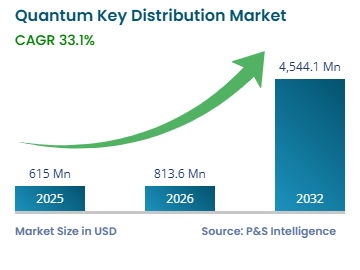
The quantum key distribution market size was USD 615.0 million in 2025, and it will grow by 33.1% during 2026-2032, to reach USD 4,544.1 million by 2032.
The market is expanding due to growing concerns about the security of sensitive information and the long-term risks that quantum computing could pose to conventional public-key encryption methods. Organizations across telecommunications, banking, financial services, government, defense, and critical infrastructure sectors are evaluating quantum-safe communication technologies to strengthen protection of confidential data. Quantum key distribution is gaining attention because it enables cryptographic key exchange using quantum principles, reducing exposure to future decryption risks associated with advances in quantum computing. Additionally, increasing digitalization, cross-border data transfers, cloud connectivity, and reliance on interconnected communication networks are creating demand for security architectures capable of protecting high-value information throughout its transmission lifecycle.
Regulatory developments are further supporting the adoption of advanced communication security technologies. According to the International Telecommunication Union Global Cybersecurity Index 2024, 177 countries have at least one regulation on either personal data protection, privacy protection, or breach notification in force or in progress. This reflects the growing importance of protecting personal, financial, and operational data within national cybersecurity frameworks. Furthermore, organizations operating across multiple jurisdictions must comply with expanding privacy and security requirements while maintaining secure information exchange between distributed locations. Similarly, government agencies and regulated industries are strengthening investments in secure network infrastructure to address emerging cybersecurity challenges. Moreover, broader deployment of quantum-secure communication frameworks is encouraging investment in quantum networking equipment, encryption platforms, and secure fiber-based communication systems, supporting commercial activity across the quantum key distribution ecosystem.
Key Market Insights
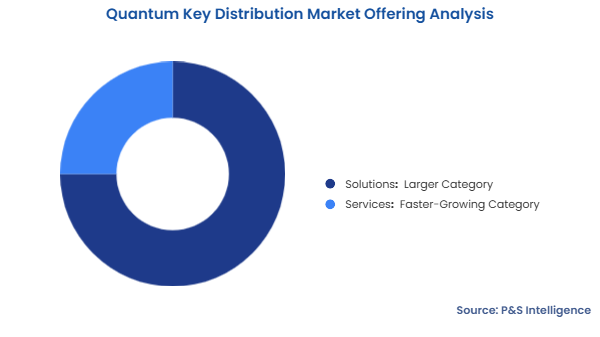
Solutions are the larger offering, holding a market share of 75%, due to preference for integrated quantum-secure communication systems across critical infrastructure networks.
Services are the faster-growing offering, registering a CAGR of approximately 33.4%, driven by the increasing need for deployment support and specialised maintenance expertise for QKD systems.
BB84 protocol is the largest type, holding a market share of 60%, due to widespread real-world implementation and compatibility with existing fibre-based communication infrastructure.
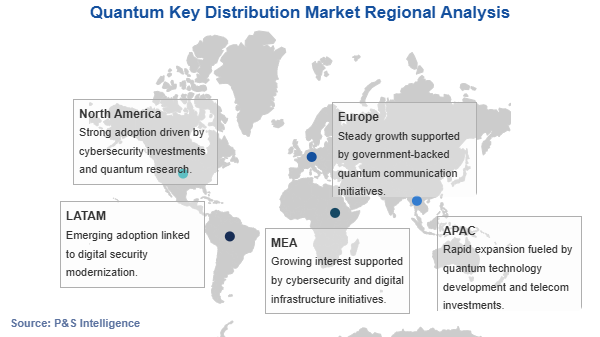
North America holds the largest share of 40%, due to established quantum research ecosystems and early deployment across telecom and defence communication networks.
Asia-Pacific is the fastest-growing region, registering a CAGR of approximately 34.0%, driven by large-scale government-led quantum network infrastructure projects and the rapid expansion of secure communication systems.
Quantum Key Distribution Market Trends and Drivers
Shift toward Hybrid Quantum-Secured Networks Is Major Trend
The market is shifting toward hybrid quantum key distribution deployment models that integrate with existing communication infrastructure rather than replacing conventional encryption systems entirely. Telecommunications operators, network providers, and technology vendors are pursuing this approach to reduce deployment complexity while maintaining compatibility with established fiber-optic and satellite communication networks. According to the International Telecommunication Union, 5G networks covered 55% of the global population in 2025, while the Organisation for Economic Co-operation and Development reported that international patent families in quantum technologies expanded sevenfold between 2005 and 2024.
These developments indicate that both communication infrastructure and quantum innovation capabilities are advancing simultaneously. Furthermore, broader network coverage enables secure quantum communication trials across larger geographic areas, while increased patent activity reflects accelerating investment in quantum networking components, photon transmission technologies, and encryption platforms. This environment is encouraging vendors to commercialize scalable QKD solutions that can be integrated into operational telecommunications networks serving government, enterprise, and critical infrastructure users.
Rising Fear of Future Quantum Attacks on Encryption Drives Market
The market is driven by concerns that future quantum computers could weaken widely used encryption algorithms protecting sensitive information across financial institutions, defense organizations, government agencies, and critical infrastructure operators. Organizations are increasingly evaluating long-term security strategies that can protect confidential communications against future decryption capabilities while maintaining regulatory and operational requirements. According to the United Nations International Computing Centre, malicious cyber activities targeting data and infrastructure increased by 35% in 2024, while the International Telecommunication Union reported a global cybersecurity commitment score of 65.7 in 2024.
These indicators highlight both the growing sophistication of cyber threats and expanding efforts to strengthen national cybersecurity frameworks. Additionally, organizations are increasing investment in quantum-safe communication architectures to reduce future security exposure. Moreover, demand for QKD systems is supporting procurement of quantum networking equipment, secure key management platforms, and dedicated communication links designed for high-security environments handling sensitive operational and strategic data.
High Cost and Complex Infrastructure Requirements Limit Adoption
The market faces a significant restraint due to the high cost and operational complexity associated with deploying quantum key distribution infrastructure. Implementation requires specialised hardware, dedicated fibre networks, or satellite links, which increases capital and maintenance expenditure for operators. According to the United Nations Educational, Scientific and Cultural Organisation, over 150 countries lacked national quantum strategies in 2024. This institutional gap reflects limited ecosystem readiness, skilled workforce availability, and policy alignment required for large-scale deployment. Additionally, fragmented infrastructure and the absence of standardisation slow integration with existing networks, restricting adoption primarily to government-led or high-investment pilot projects rather than broad commercial deployment across industries globally.
Expansion of National Quantum Communication Projects Opens New Growth Scope
The market presents strong growth opportunities as governments invest in national quantum communication networks to secure critical data infrastructure. Public sector initiatives aim to connect cities, defence systems, and essential services using quantum-safe communication technologies. According to the Organisation for Economic Co-operation and Development, more than 30 countries had established national quantum strategies in 2025. This policy-level commitment is accelerating cross-border collaborations and public–private partnerships focused on secure data exchange frameworks. Furthermore, expanding national programmes are creating demand for equipment manufacturing, system integration, and managed services, enabling vendors to scale beyond pilot deployments and establish long-term commercial presence in global quantum communication ecosystems.
Quantum Key Distribution Market Segmentation Analysis
Offering Analysis
Solutions are the larger category, holding a market share of 75%, as organizations prefer integrated QKD systems that combine hardware, software, encryption control, and deployment support within one secure communication framework. This demand is closely linked with fiber-based QKD adoption, where telecom and government networks require complete systems that can be integrated into existing optical infrastructure. According to the International Telecommunication Union, 104 countries had critical infrastructure protection regulations in 2024. This regulatory pressure is strengthening demand for standardized, scalable, and secure QKD solutions across defense, telecommunications, finance, and public-sector networks. Comprehensive solutions also reduce integration risks for users who need high-assurance key distribution across sensitive communication channels.
Services are the faster-growing category, registering a CAGR of approximately 33.4%, because QKD deployment requires specialized expertise in quantum network design, system calibration, fiber integration, satellite connectivity, and long-term performance management. This growth is connected with the expansion of E91 protocol testing, satellite-based QKD, and broader network security use cases, as organizations often lack internal teams capable of managing complex quantum communication environments. Service providers support feasibility studies, installation, maintenance, interoperability testing, and upgrades for telecom operators, banks, government agencies, and critical infrastructure users. As QKD moves from pilots to real deployments, demand for consulting, managed services, and technical support is increasing across both new and existing secure communication projects.
The offerings analysed in this report are:
Solutions (Larger Category)
Services (Faster-Growing Category)
Protocol Type Analysis
BB84 Protocol is the largest category, holding a market share of 60%, as it remains the most widely tested and commercially deployed QKD protocol across fiber-based secure communication networks. Its dominance is connected with the strong position of fiber-based QKD, since BB84 can be implemented through established optical communication infrastructure with proven reliability. Telecom operators, government networks, and financial institutions prefer this protocol because it supports practical key exchange without requiring highly complex entanglement-based systems. Its use in pilot projects, commercial trials, and metropolitan secure network deployments has built confidence among early adopters. This makes BB84 a preferred protocol for organizations seeking stable QKD implementation across existing high-capacity communication systems.
E91 Protocol is the fastest-growing category, registering a CAGR of approximately 33.8%, because it provides entanglement-based security capabilities designed for advanced quantum communication environments. Research institutions, government programs, and technology developers are increasingly evaluating this protocol due to its ability to detect interception attempts and strengthen secure key exchange across complex network architectures. According to the European Patent Office Technology Dashboard 2025, patent applications in the quantum technologies sub-field increased by 37.9% in 2025. This growth reflects rising investment in quantum networking, secure communications, and next-generation cryptographic technologies. Furthermore, increased research activity is accelerating the development of practical entanglement-based systems, supporting commercialization efforts and broader testing in operational environments. These advances are helping E91 move beyond laboratory research toward scalable deployment across high-security government, defense, and enterprise communication networks.
The protocol types analysed in this report are:
BB84 Protocol (Largest Category)
E91 Protocol (Fastest-Growing Category)
Others
Application Analysis
Secure Communication is the largest category, as QKD is mainly deployed to protect sensitive data transmission across government, defense, telecom, and financial communication networks. This application is strongly connected with solutions, the BB84 protocol, and fiber-based QKD, as organizations usually begin adoption through controlled secure links between high-value locations. Governments and defense agencies use QKD to protect classified information, while telecom operators apply it to strengthen secure data channels for enterprise and public-sector clients. According to the International Telecommunication Union, national computer incident response teams were active in 139 countries in 2024. This expansion of cybersecurity infrastructure highlights rising institutional focus on secure communication systems, increasing demand for QKD in national and enterprise-level data protection frameworks.
Network Security is the fastest-growing category, because organizations are expanding QKD use beyond single secure links into wider protection of nodes, routes, and interconnected communication systems. This shift is linked with growing adoption of services, E91 protocol research, and satellite-based QKD, as users need support for larger and more complex network architectures. Enterprises, telecom providers, and public agencies are moving toward network-level quantum security to protect distributed data flows across cloud, data center, and critical infrastructure environments. As communication networks become more connected, QKD is being evaluated as part of broader cybersecurity architectures that combine secure key exchange, encryption management, and resilient network operations.
The applications analysed in this report are:
Secure Communication (Largest Category)
Network Security (Fastest-Growing Category)
Cryptographic Key Distribution
End-User Analysis
Government and Defense is the largest category, holding a market share of 35%, as these users handle classified intelligence, national security communication, diplomatic data, and critical infrastructure information that require high-assurance protection. Their leadership is connected with secure communication applications, integrated solutions, and early fiber-based QKD deployments across controlled networks. Government agencies also support pilot projects, testbeds, and funding programs that help move QKD from research into operational use. Defense networks require secure key exchange for sensitive communication channels where future quantum computing risks could weaken traditional encryption. This makes government and defense users key early adopters, especially for national quantum communication infrastructure and mission-critical secure networking programs.
Banking, Financial Services, and Insurance is the fastest-growing category, as financial institutions require stronger protection for payment systems, transaction data, customer information, and interbank communication networks. This growth is linked with network security applications, service-based deployment support, and fiber-based QKD integration across high-speed financial infrastructure. According to ACI Worldwide and GlobalData, real-time payments reached 266.2 billion transactions globally in 2023. The rapid expansion of instant payment systems is increasing exposure to cyber risks, fraud attempts, and data interception concerns. BFSI organizations are therefore evaluating QKD to secure high-value transaction flows, protect sensitive customer data, and strengthen quantum-safe encryption strategies across digital banking and payment networks.
The end-users analysed in this report are:
Government and Defence (Largest Category)
Banking, Financial Services, and Insurance (BFSI) (Fastest-Growing Category)
Healthcare
IT and Telecommunications
Energy and Utilities
Others
Deployment Type Analysis
Fiber-Based QKD is the largest category, as it utilizes existing fiber-optic infrastructure for practical and cost-efficient deployment of quantum-secure communications. Telecommunications operators can integrate QKD systems into established terrestrial and long-haul network assets without requiring entirely new communication frameworks, making deployment more commercially viable. According to TeleGeography's Submarine Cable Map 2024, a cable investment cycle between 2023 and 2025 was expected to bring 78 submarine cable systems online, representing more than 300,000 kilometers of cable length. This continued expansion of global fiber infrastructure strengthens the foundation for secure data transmission across international and regional networks. Furthermore, broader fiber connectivity increases opportunities for integrating quantum key distribution into high-capacity communication corridors, supporting adoption among telecommunications providers, government agencies, financial institutions, and other organizations managing sensitive information flows.
Satellite-Based QKD is the fastest-growing category, registering a CAGR of approximately 33.6%, because it enables long-distance and cross-border secure communication beyond the reach of terrestrial fiber networks. Its growth is connected with E91 protocol development and network security applications, as entanglement-based communication and space-based links are being explored for wider quantum-secure connectivity. Satellite-based systems are important for remote regions, international data exchange, defense communication, and future global quantum networks where fiber deployment is limited or commercially difficult. Governments, space agencies, telecom operators, and research institutions are increasing collaboration to test satellite-enabled quantum key exchange. This is expanding QKD deployment possibilities from metropolitan fiber routes to broader national and international secure communication networks.
The deployment types analysed in this report are:
Fiber-Based QKD (Largest Category)
Satellite-Based QKD (Fastest-Growing Category)
Free-Space QKD
Drive strategic growth with comprehensive market analysis
Quantum Key Distribution Market Geographical Analysis
North America Quantum Key Distribution Market Analysis
North America holds the largest share of 40% due to early investment in quantum communication research, strong defense-sector demand, and the presence of leading quantum technology developers. The region benefits from extensive collaboration among federal agencies, national laboratories, universities, telecommunications providers, and private technology companies focused on advancing quantum-secure communications. Additionally, government programs supporting cybersecurity modernization and critical infrastructure protection are encouraging adoption of quantum-resistant security technologies. Furthermore, telecom operators are evaluating the integration of QKD capabilities within existing fiber-optic networks to support secure transmission of sensitive information. Similarly, financial institutions, defense organizations, and critical infrastructure operators are exploring quantum-secure communication frameworks to address future risks associated with quantum computing. Moreover, continuous investment in quantum networking testbeds, commercial pilot deployments, and advanced photonic technologies is strengthening the region’s position as a leading market for quantum key distribution solutions.
U.S. Quantum Key Distribution Market Analysis
U.S. leads the market due to strong involvement from defense agencies, federal research institutions, and national laboratories in advancing secure quantum communication technologies. Government organizations and telecommunications providers are actively evaluating quantum key distribution to protect classified information and critical infrastructure networks. According to Quantum.gov, the United States has 14 major National Quantum Initiative research centers and affiliated centers supporting quantum information science research and technology development. These centers connect universities, national laboratories, industry participants, and government agencies, helping accelerate innovation in quantum networking, secure communications, and quantum-safe security technologies.
Canada Quantum Key Distribution Market Analysis
Canada is growing steadily due to a research-driven ecosystem supported by universities and government-backed quantum programmes. Collaboration between academic institutions and technology firms is accelerating the development of secure communication solutions and testing frameworks. According to the Government of Canada, CAD 334.3 million was committed in 2025 to strengthen the national quantum industry. This funding is enabling the integration of research outcomes into telecom networks, supporting the commercialisation of QKD and positioning domestic firms within emerging quantum communication supply chains.
Asia-Pacific Quantum Key Distribution Market Analysis
Asia-Pacific has the highest CAGR of approximately 34.0% because governments across the region are investing heavily in large-scale quantum communication infrastructure rather than limited laboratory demonstrations. Countries including China, Japan, South Korea, and Singapore are supporting the deployment of metropolitan quantum networks, intercity fiber-based links, and satellite-enabled quantum communication systems. Additionally, national quantum technology programs are providing substantial funding for commercialization and network expansion projects. Furthermore, telecommunications operators are working alongside research institutes and technology developers to integrate QKD into existing communication infrastructure for secure data transmission. Similarly, the region is pursuing long-distance quantum communication capabilities to secure government, defense, financial, and critical infrastructure networks. Moreover, several deployments are progressing beyond pilot testing into operational environments, creating stronger demand for quantum communication hardware, encryption platforms, and network management solutions. This combination of infrastructure investment and practical deployment is accelerating market expansion across Asia-Pacific.
China Quantum Key Distribution Market Analysis
China is advancing rapidly due to large-scale government-backed initiatives focused on building a secure national communication infrastructure. Strong coordination between telecom operators and research institutions is enabling the deployment of long-distance quantum networks across major regions. China achieved quantum-secured communication across more than 12,900 kilometres between China and South Africa in 2025. This milestone demonstrates the country’s capability in implementing wide-area quantum communication systems, supporting expansion of fibre and satellite-based QKD networks and reinforcing its leadership in long-distance quantum-secure infrastructure development.
India Quantum Key Distribution Market Analysis
India is developing steadily in the market due to increasing focus on secure communication systems for government and defence applications. National programmes prioritise indigenous quantum capabilities and early-stage testing of communication networks across academic and public institutions. According to the Parliament of India, four Thematic Hubs were established in 2024 to advance quantum communication and computing research. This institutional framework is supporting pilot deployments and enabling the development of inter-city and satellite-based QKD networks, strengthening India’s long-term capability in quantum-secured communication infrastructure.
Europe Quantum Key Distribution Market Analysis
Europe is witnessing steady growth in the quantum key distribution market due to its strong emphasis on sovereign digital infrastructure, secure cross-border communications, and long-term quantum security preparedness. The region is advancing deployment through initiatives such as the European Quantum Communication Infrastructure, which aims to establish a secure quantum communication network across member states. Additionally, national governments, research organizations, and telecommunications operators are collaborating on fiber-based quantum communication corridors connecting major cities and public institutions. Furthermore, increasing regulatory focus on data protection, critical infrastructure resilience, and post-quantum cybersecurity is encouraging investment in quantum-secure networking technologies. Similarly, Europe is promoting interoperability and common technical standards to support seamless communication between national quantum networks. Moreover, financial institutions, defense agencies, and government bodies are evaluating QKD for protecting highly sensitive information transmitted across interconnected digital environments, supporting broader adoption across the region.
The regions and countries analysed in this report are:
North America (Largest Regional Market)
U.S. (Larger Country)
Canada (Faster-Growing Country)
Europe
Germany (Largest Country)
U.K. (Fastest-Growing Country)
France
Italy
Spain
Rest of Europe
Asia-Pacific (Fastest-Growing Regional Market)
China (Largest Country)
India (Fastest-Growing Country)
Japan
South Korea
Australia
Rest of APAC
Latin America
Brazil (Largest Country)
Mexico (Fastest-Growing Country)
Rest of LATAM
Middle East and Africa
Saudi Arabia (Largest Country)
U.A.E. (Fastest-Growing Country)
South Africa
Rest of MEA
Quantum Key Distribution Market Share Analysis
The market is fragmented, with participation from quantum technology developers, optical networking providers, telecommunications operators, and cybersecurity vendors across different stages of the quantum key distribution value chain. Companies are focusing on areas such as quantum key generation systems, single-photon detectors, encryption integration platforms, and secure fiber-based communication networks rather than offering complete end-to-end solutions. Additionally, several vendors are collaborating with telecom operators and research institutions to expand metropolitan and intercity quantum communication networks. Furthermore, pilot deployments and commercial trials continue to create opportunities for emerging technology firms to establish regional positions. Similarly, government-backed quantum communication programs are supporting new market entrants and technology commercialization. Moreover, ongoing advances in satellite-based quantum key distribution and long-distance secure transmission are intensifying competition among established and emerging participants, creating a diverse market landscape with multiple active players.
Key Players in the Quantum Key Distribution Market:
Toshiba Corporation
ID Quantique Societe Anonyme
QuintessenceLabs Proprietary Limited
MagiQ Technologies Incorporated
QuantumCTek Company Limited
Qubitekk Incorporated
Quantum Xchange Incorporated
NEC Corporation
Huawei Technologies Company Limited
Nokia Corporation
SK Telecom Company Limited
QNu Labs Private Limited
LuxQuanta Technologies Limited
PacketLight Networks Limited
International Business Machines Corporation
Quantum Key Distribution Market News
In February 2026, IonQ launched Romania’s national quantum communication infrastructure using its commercially available systems. The network was operational at the time of deployment and supported secure communication across multiple sectors, including government, healthcare, research, education, and data centre environments.
In June 2025, Orange Business, in partnership with Toshiba Europe, launched Orange Quantum Defender, the first commercial quantum-safe networking service in France, deployed in the greater Paris area. The service is delivered over Orange’s existing fibre network and combines quantum key distribution (QKD) with post-quantum cryptography (PQC) to provide multi-layered security for enterprise communications.
Frequently Asked Questions About This Report
What is driving demand for Quantum Key Distribution solutions today?+
Demand is increasing because critical communications need stronger key exchange, long-term data protection, cyber-resilience, and security against future quantum-enabled attacks.
Why are governments investing in Quantum Key Distribution network security?+
Governments invest in QKD to protect defense, diplomatic, public infrastructure, and confidential communications where long-term secrecy and trusted key exchange are important.
How does QKD protect sensitive communications from future quantum threats?+
QKD helps create secure encryption keys using quantum properties, making unauthorized interception detectable before sensitive data communication is trusted.
Which sectors are adopting Quantum Key Distribution technology most actively?+
Telecommunications, defense, banking, government, research networks, and critical infrastructure sectors are adopting QKD to secure high-value communications and sensitive data transfers.
What challenges slow adoption of Quantum Key Distribution systems globally?+
Adoption is slowed by specialized hardware needs, distance limitations, integration complexity, authentication requirements, deployment costs, and limited interoperability across existing security systems.
Want a report tailored exactly to your business need?
Leading companies across industries trust us to deliver data-driven insights and innovative solutions for their most critical decisions. From data-driven strategies to actionable insights, we empower the decision-makers who shape industries and define the future. From Fortune 500 companies to innovative startups, we are proud to partner with organisations that drive progress in their industries.
Client Testimonials
Working with P&S Intelligence and their team was an absolute pleasure – their awareness of timelines and commitment to value greatly contributed to our project's success. Eagerly anticipating future collaborations.
McKinsey & Company
India
Unmatched Standards
Our insights into the minutest levels of the markets, including the latest trends and competitive landscape, give you all the answers you need to take your business to new heights
Complete Data Security
We take a cautious approach to protecting your personal and confidential information. Trust is the strongest bond that connects us and our clients, and trust we build by complying with all international and domestic data protection and privacy laws