Quantum AI Market Size & Share Analysis - Trends, Drivers, Competitive Landscape, and Forecasts (2026 - 2032)
This Report Provides In-Depth Analysis of the Quantum AI Market Report Prepared by P&S Intelligence, Segmented by Component (Hardware, Software, Services), Deployment Model (On-Premises, Cloud-Based), Enterprise Size (Large Enterprises, Small & Medium Enterprises), Application (Machine Learning & Optimization, Quantum Security & Cryptography, Simulation & Modeling), Industry (BFSI, Healthcare & Life Sciences, Defense & Security, Automotive & Aerospace, Energy), and Geographical Outlook for the Period of 2021 to 2032
Explore the market potential with our data-driven report
Quantum AI Market Key Insights
The hardware category accounted for the largest share, of 65%, in 2025.
The cloud-based deployment is the faster-growing category over 2026–2032, with 35.7% CAGR.
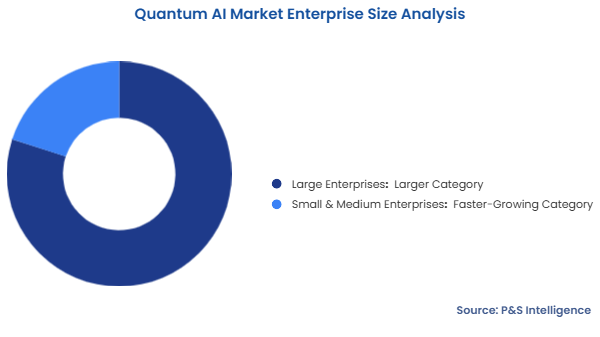
Large enterprises accounted for the larger share in 2025, of 80%.
The quantum security & cryptography category is the fastest-growing over 2026–2032, with 35.8% CAGR.
The BFSI category accounted for the largest share in 2025, of 35%.
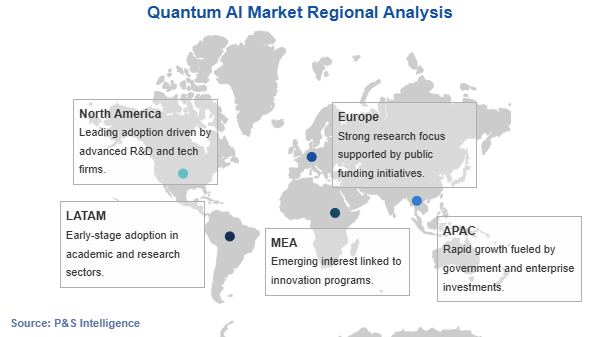
North America has the largest share, of 40%, while Asia-Pacific has the highest CAGR, of 40.5%.
Quantum AI Market Overview
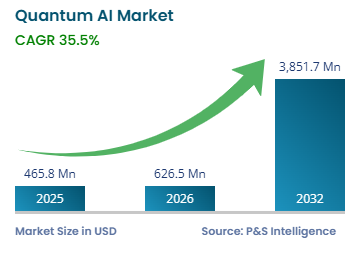
The global quantum AI market size stood at USD 465.8 million in 2025, and it is projected to reach USD 3851.7 million by 2032, expanding at a compound annual growth rate of 35.5% over 2026–2032.
Quantum-enhanced AI is establishing itself as a foundational layer for next-generation enterprise intelligence across high-complexity computational domains. The convergence of maturing qubit architectures and a rising computational ceiling is driving this formation. Superconducting, trapped-ion, and photonic qubit systems have reached a level of architectural stability that makes them viable substrates for production-oriented quantum-AI workloads, while large-scale AI model training, drug discovery pipelines, and financial risk simulation are collectively exhausting the ceiling of classical compute.
Drug discovery, cryptography, financial modeling, and logistics optimization are the primary application domains generating enterprise demand. Each presents problem classes where quantum-enhanced computation offers throughput advantages over classical methods. Quantum hardware development and the expansion of cloud-based quantum computing services are the supply-side drivers of adoption.
Hybrid quantum-classical algorithms are extending the addressable market further by enabling enterprise integration without requiring fault-tolerant quantum systems. Government support for quantum research is reinforcing this trajectory at the institutional level. Qubit stability and error correction remain the primary technical constraints on near-term deployment scale, though startups and technology incumbents are investing in solutions that combine quantum computing with AI capabilities to address previously intractable problems.
Quantum AI Market Trends & Drivers
Hybrid Quantum–Classical Integration Is Major Market Trend
The biggest trend in the quantum AI market is the transition from purely experimental quantum architectures toward hybrid quantum–classical systems that integrate quantum processing units with conventional computing infrastructure. Current quantum hardware operates with qubit counts and error rates that preclude standalone enterprise deployment. Hybrid architectures resolve this barrier by enabling organizations to apply quantum processing selectively to the most computationally intensive sub-problems, while classical systems handle data orchestration, preprocessing, and output integration. Combinatorial optimization, molecular simulation, and matrix factorization are among the sub-problem classes where quantum processing delivers measurable throughput advantages.
Enterprises in BFSI, pharmaceuticals, and logistics can embed quantum-enhanced computation into existing AI pipelines without waiting for fault-tolerant quantum systems to mature. Cloud providers, including Amazon Web Services, Microsoft Azure, and IBM, offer quantum-as-a-service (QaaS) platforms that abstract hardware complexity, enabling software-layer integration without on-premises quantum hardware investment. Each platform targets a distinct enterprise buyer profile, giving quantum-AI capabilities layered distribution across regulated industries, research-intensive verticals, and cloud-native organizations. Qubit coherence times are improving, and error mitigation algorithms are advancing. The performance ceiling of hybrid architectures is rising steadily as a result, extending the commercial relevance of this model well into the 2030s.
Rising Government Investment in Quantum R&D Fueling Market Expansion
Sustained public-sector investment is the primary structural driver accelerating commercialization timelines and reducing technology risk across the global quantum AI market. Governments are offering direct R&D funding to advance hardware and algorithm development and procurement commitments that validate commercial readiness and create the demand for quantum AI solutions. The National Quantum Initiative and the U.S. Department of Energy (DOE) have announced a USD 625 million renewal of the first five National Quantum Information Science Research Centers. This sustains a research-to-commercialization pipeline that benefits IBM, Google, IonQ, and a constellation of quantum software firms. Funding began at USD 125 million in fiscal year 2025 under this commitment.
Globally, public commitment surpassed USD 1.8 billion in 2024, a threshold already exceeded in 2025. India's National Quantum Mission allocates INR 6,003.65 crore (USD 730 million) through 2030–31, targeting quantum computing, communication, and sensing. The EU’s Quantum Flagship program is committing EUR 1 billion over 10 years. This coordinated multi-government investment is compressing the timeline between laboratory breakthrough and enterprise deployment. The market will expand as public funding transitions from research to commercialization and quantum AI finds enterprise adoption.
Regulatory and policy developments around post-quantum cryptography are generating a distinct and fast-maturing demand vector within the quantum AI market, particularly for organizations in BFSI, defense, government, and critical infrastructure. The U.S. National Institute of Standards and Technology (NIST) finalized its first set of post-quantum cryptography standards in 2024, initiating a transition process that compels federal agencies and their technology vendors to adopt quantum-resistant encryption frameworks. This mandate creates direct procurement demand for quantum AI security solutions.
Cryptographic algorithm optimization and quantum key distribution systems represent the primary procurement categories, with threat detection enhanced by quantum machine learning emerging as a third application layer. Financial regulators across the U.S., EU, and Asia-Pacific are signaling alignment with NIST frameworks, and an expanding compliance perimeter is driving enterprise procurement beyond the federal systems tier. Organizations managing sensitive long-duration data face intensifying urgency from "harvest now, decrypt later" cyberattack strategies, accelerating compliance timelines ahead of regulatory deadlines.
Qubit Instability and High Operational Costs Constrain Market Advance
The quantum AI market faces a material structural constraint in qubit decoherence, error rates, and the operational costs associated with maintaining quantum hardware at cryogenic temperatures. Current superconducting qubit systems require cooling to near absolute zero at 15 millikelvin, generating energy, infrastructure, and maintenance expenditure that restricts deployment to large research institutions, national laboratories, and large enterprises. Achieving one logical qubit of sufficient quality currently requires hundreds to thousands of physical qubits, dramatically inflating hardware requirements relative to computational output.
The International Telecommunication Union (ITU) noted that fewer than 20.3% of ICT facilities in Africa and Southeast Asia met the infrastructure prerequisites for advanced quantum AI deployment in 2023. Adoption rates among small and medium enterprises and in emerging markets are moderating as a result. Progress in error mitigation and topological qubit architectures is expected to progressively ease these constraints. Photonic quantum computing, which operates at room temperature and eliminates cryogenic infrastructure requirements entirely, represents the most structurally accessible path toward broader market participation, though the infrastructure barrier will remain a meaningful friction factor for the next five to seven years.
Quantum AI Market Segmentation Analysis
Component Analysis
The hardware category accounted for the largest share, of 65%, in 2025. Physical quantum infrastructure occupies a foundational position in the ecosystem, as all downstream software and service applications depend on the availability and performance of quantum processors, qubits, cryogenic cooling systems, control electronics, and photonic components. Quantum hardware also represents the highest investment threshold in the market. Organizations seeking on-premises quantum AI capabilities must invest in specialized fabrication environments and cryogenic infrastructure that classical computing does not require. The sustained R&D investment by IBM Corporation, Google LLC, and Intel Corporation in superconducting and silicon spin qubit architectures further drives this category.
Software is the fastest-growing category over 2026–2032. Quantum development frameworks and algorithm optimization tools are proliferating rapidly as cloud-based access extends the developer base beyond specialized research institutions. Quantum machine learning libraries are maturing in parallel, giving enterprise adopters a practical on-ramp to quantum-enhanced AI workloads without requiring on-premises hardware. The U.S. National Science Foundation (NSF) has invested up to USD 100 million to establish a nationwide network of open-access quantum research facilities. This network supports algorithm research and workforce development, directly expanding the pipeline of software-capable quantum practitioners available to enterprise and government adopters.
The market segments into the following components:
Hardware (Largest Category)
Software (Fastest-Growing Category)
Services
Deployment Model Analysis
The on-premises category accounted for the larger share, of 85%, in 2025. This is because for defense, BFSI, and government organizations, which are the major users in this market, data sovereignty and infrastructure oversight are non-negotiable. On-premises quantum AI systems allow organizations to manage quantum hardware directly and implement customized security protocols. Latency and data transfer risks associated with cloud-based quantum access are eliminated under this model, a consideration that carries weight for workloads involving classified data or regulated financial infrastructure.
The cloud-based category is the faster-growing category over 2026–2032, as QaaS platforms are extending quantum AI access to enterprise adopters without on-premises hardware investment. Each platform serves a distinct buyer profile, giving cloud-based quantum AI layered distribution across research-intensive verticals, regulated industries, and cloud-native organizations. The open-access quantum facility network of the U.S. NSF is specifically designed to support cloud-accessible quantum computing for research institutions and commercial entities
The market segments into the following deployment models:
On-Premises (Larger Category)
Cloud-Based (Faster-Growing Category)
Enterprise Size Analysis
Large enterprises accounted for the larger share of the global quantum AI market in 2025, of 80%. The capital-intensive nature of quantum AI adoption structurally concentrates early participation among organizations with substantial technology budgets and long-horizon innovation mandates. Entry into the quantum AI ecosystem requires sustained investment across multiple procurement pathways. On-premises hardware procurement demands specialized fabrication environments and cryogenic infrastructure. Dedicated R&D partnerships with quantum vendors require internal teams capable of co-developing and validating quantum algorithms.
Enterprise-grade QaaS subscriptions, while lower in upfront cost, require the integration expertise and data governance frameworks that only mature technology organizations currently maintain at scale. Large BFSI, defense, and pharmaceuticals enterprises lead adoption through internal quantum research teams and participation in programs such as the IBM Quantum Network and Google Quantum AI partnerships. The World Economic Forum (WEF) identifies large enterprise quantum readiness as a critical factor in national economic competitiveness. Technology incumbents with existing AI and cloud infrastructure are best positioned to integrate quantum AI capabilities into operational workflows, as WEF analysis confirms.
Small and medium enterprises are the faster-growing category over 2026–2032, due to the expanding availability of QaaS platforms. AWS Braket, Azure Quantum, and IBM Quantum on Cloud reduce the cost and complexity of quantum AI access, allowing SMEs to use them without dedicated quantum hardware investment. Each platform offers a distinct entry point, giving SMEs structured access to quantum-enhanced computation across optimization, simulation, and machine learning workloads.
The Organisation for Economic Co-operation and Development (OECD) has highlighted the role of cloud-based quantum access in broadening SME participation in advanced computing ecosystems. Reducing infrastructure barriers is central to equitable technology diffusion across enterprise segments, the OECD notes, and the commercial expansion of QaaS platforms is the primary mechanism through which this diffusion is occurring.
The market segments into the following enterprise sizes:
Large Enterprises (Larger Category)
Small & Medium Enterprises (Faster-Growing Category)
Application Analysis
The machine learning & optimization category accounted for the largest share, of 45%, in 2025. Quantum-enhanced ML carries immediate commercial applicability across several high-value enterprise problem classes. Portfolio optimization in financial services and drug candidate screening in pharmaceuticals are highly capital-intensive application areas, where quantum speedup over classical methods translates directly into measurable cost and time reductions.
Logistics routing in supply chain management and fraud detection in banking extend the addressable scope further, covering verticals where combinatorial problem complexity has historically constrained classical AI performance. The National Aeronautics and Space Administration (NASA) has allocated USD 36 million for FY 2026 and USD 100 million over five years toward quantum optimization research under the National Quantum Initiative. Aerospace scheduling and materials discovery are the primary application targets, with sensor data processing identified as an additional near-term development priority.
The quantum security & cryptography category is the fastest-growing over 2026–2032. The NIST post-quantum cryptography standardization mandate and expanding government procurement of quantum-safe communications infrastructure are the structural drivers of this growth. This regulatory action has established a compliance foundation requiring federal agencies and financial institutions to adopt quantum-resistant encryption frameworks at scale.
The market segments into the following applications:
The BFSI category accounted for the largest share of the global quantum AI market in 2025, of 35%. The sector's demand for quantum-enhanced computational capabilities is structurally acute across multiple high-stakes problem classes. Portfolio optimization and risk modeling represent the most capital-intensive application areas, where quantum processing offers measurable throughput advantages over classical methods in handling the variable interdependencies that characterize large financial portfolios and systemic stress scenarios.
Fraud detection and high-frequency trading algorithm development extend the addressable scope further, covering workloads where decision latency and pattern recognition at scale determine competitive and compliance outcomes. The Bank for International Settlements (BIS) has documented the growing adoption of advanced computational methods in financial risk management. Central banks and financial institutions are increasingly evaluating quantum computing for systemic risk modeling and stress-testing applications, BIS findings confirm.
The healthcare & life sciences category is the fastest-growing over 2026–2032, due to the convergence of quantum simulation capabilities with computationally intensive biological research domains. Drug discovery is the key application, where quantum simulation of molecular interactions reduces the time and cost of candidate screening relative to classical computational chemistry methods. Genomic data analysis and protein folding modeling follow as near-term development priorities, with both domains presenting combinatorial complexity that quantum processing is architecturally suited to address. The National Institutes of Health (NIH) has identified quantum biology and quantum simulation as priority research domains. Funding has been directed toward quantum-enhanced molecular modeling for therapeutic discovery and precision medicine applications.
The market segments into the following industries:
BFSI (Largest Category)
Healthcare & Life Sciences (Fastest-Growing Category)
Defense & Security
Automotive & Aerospace
Energy
Others
Drive strategic growth with comprehensive market analysis
Quantum AI Market Regional Outlook
North America Quantum AI Market Outlook
North America accounted for the largest share, of 40%, in 2025, due to its established R&D infrastructure, ample quantum-specialized talent, and sustained legislative commitment to quantum computing. The U.S.’s National Quantum Initiative Act coordinates quantum research and development across more than 25 federal agencies. Canada reinforces the region's competitive posture through its National Quantum Strategy and a CAD 630-million commitment in 2024 toward R&D in advanced networks, AI, and quantum technologies.
The White House National Quantum Coordination Office (NQCO) confirmed that U.S. government investment in quantum roughly doubled to USD 1 billion annually. This funding concentration is accelerating the transition from laboratory demonstrations to enterprise-grade deployments. IBM, Google, IonQ, and SandboxAQ are the primary commercial vehicles through which this transition is occurring.
U.S. Quantum AI Market Analysis
The U.S. leads the global quantum AI market with its dense ecosystem of pure-play quantum companies, hyperscale technology incumbents, and government-funded research laboratories operating in close coordination. Federal agencies, including DARPA, DOE, NSF, NIST, and NASA, have regularly allocated millions of dollars for quantum computing R&D. Private venture capital contributed USD 2.6 billion to quantum startups globally in 2024, a 58% increase from the prior year. U.S. companies captured the largest share of this capital, reinforcing the domestic commercialization pipeline.
The U.S. DOE’s Quantum Leadership Act of 2025 proposes USD 2.5 billion in quantum funding across fiscal years 2026–2030, targeting quantum information science research, instrumentation, national centers, and network infrastructure. Expanding QaaS offerings from AWS, Microsoft Azure Quantum, and IBM Quantum Network are broadening access beyond research institutions to large enterprise and government end-users.
Europe Quantum AI Market Trends
Public and private investment in quantum research, cross-border collaborations, and strategic national initiatives are the major drivers of the European quantum AI market. Industries seeking to solve complex optimization problems in healthcare, financial services, manufacturing, and logistics are the primary demand source, as classical computing faces inherent limitations in these problem classes. Europe's focus on data privacy and ethical AI is directing development toward secure quantum-enhanced machine learning solutions. Collaborative ecosystems involving research institutions, startups, and multinational corporations are bridging theoretical advances with practical applications. Scaling hardware and developing effective algorithms remain the region's principal technical challenges.
Germany leads within the region, anchored by deep industrial manufacturing and engineering ecosystems that are accelerating quantum AI adoption in automotive, chemicals, and logistics optimization. The UK's National Quantum Strategy has committed GBP 2.5 billion over 10 years to quantum research and innovation. Europe's quantum AI market is expected to strengthen as cross-border Quantum Valley clusters emerge and national programs in France, Germany, and Spain accelerate hardware and algorithm development pipelines.
Asia-Pacific Quantum AI Market Growth
Asia-Pacific is the fastest-growing region in the global quantum AI market, registering a CAGR of 40.5% over 2026–2032, driven by government support, national quantum strategies, and rapid digital transformation. BFSI, telecommunications, logistics, and pharmaceuticals firms are pursuing quantum-enhanced computation for optimization, simulation, and secure communications where classical methods face inherent limitations. The region's large enterprise base and established focus on AI and big data analytics are accelerating the integration of quantum-enhanced algorithms into existing computational infrastructure. Public–private partnerships and increasing investment in quantum startups, R&D centers, and talent development are strengthening the ecosystem's commercialization capacity. Scaling hardware and advancing commercialization timelines remain the principal technical and structural challenges.
The Chinese government has channeled an estimated USD 15 billion into quantum technology research and development, establishing centralized state funding as the primary supply-side driver of the region's trajectory. Japan's government committed the equivalent of USD 7.4 billion in quantum computing investment, targeting fault-tolerant computing and quantum networking. Asia-Pacific nations represented the largest share of growth in public quantum funding within this total. India is the fastest-growing country market within Asia-Pacific.
The regions and countries analyzed in this report include:
North America (Largest Region)
U.S. (Largest Country Market)
Canada (Fastest-Growing Country Market)
Europe
Germany (Largest Country Market)
U.K. (Fastest-Growing Country Market)
France
Italy
Spain
Rest of Europe
Asia-Pacific (Fastest-Growing Region)
China (Largest Country Market)
India (Fastest-Growing Country Market)
Japan
South Korea
Australia
Rest of APAC
Latin America
Brazil (Largest Country Market)
Mexico (Fastest-Growing Country Market)
Rest of LATAM
Middle East & Africa
Saudi Arabia (Largest Country Market)
South Africa
U.A.E. (Fastest-Growing Country Market)
Rest of MEA
Quantum AI Market Share Analysis
The global quantum AI market exhibits a moderately consolidated competitive structure. A few technologies majors command substantial resources while a growing cohort of pure-play quantum specialists competes on hardware architecture, algorithmic depth, and cloud platform reach. The capital intensity and scientific specialization inherent to quantum computing development create the structural conditions for this configuration. Sustained R&D investment and access to cryogenic engineering expertise establish the first tier of barriers.
The ability to operate proprietary quantum hardware at scale adds a second, preventing rapid competitive proliferation among new entrants. IBM Corporation, Google LLC, and Microsoft Corporation have committed multi-year quantum roadmaps, operate proprietary hardware, and have embedded quantum AI capabilities into broader enterprise cloud ecosystems. These distribution advantages confer a structural position that pure-play competitors cannot replicate through hardware performance alone.
Leading Companies in the Quantum AI Market:
IBM Corporation
Alphabet Inc.
Microsoft Corporation
Amazon Web Services Inc.
Intel Corporation
IonQ Inc.
D-Wave Quantum Inc.
Rigetti & Co. LLC
Quantinuum Ltd.
Xanadu Quantum Technologies Inc.
SandboxAQ
Fujitsu Limited
Quantum AI Market News
In May 2025, IonQ Inc. completed its acquisition of a controlling stake in ID Quantique SA, a Geneva-based global provider of quantum-safe networking and sensing. The transaction integrated 300 quantum networking patents into IonQ's portfolio, bringing its total granted and pending patents to nearly 900 worldwide. ID Quantique's capabilities strengthen IonQ's end-to-end quantum solutions across computing, networking, and secure communications.
In February 2025, Microsoft Corporation introduced its Majorana 1 quantum computing chip, built on a topological qubit architecture using a novel class of superconducting materials called topoconductors. The chip targets a roadmap to scale to one million qubits on a single chip. Its inherent error suppression properties aim to reduce the physical qubit overhead required for quantum error correction. This reduction in overhead has the potential to accelerate the timeline to fault-tolerant quantum AI systems capable of solving commercially significant problems.
In February 2025, Amazon Web Services Inc. unveiled Ocelot, its first proprietary quantum computing chip. The chip was developed at the AWS Center for Quantum Computing at the California Institute of Technology and utilizes a cat qubit architecture that reduces quantum error correction overhead by up to 90% compared to conventional approaches.
In December 2024, Alphabet Inc. introduced the Willow quantum chip, featuring 105 high-quality superconducting qubits. The chip demonstrated exponential error rate reduction as the qubit count scales. In a separate benchmark, Willow completed a computational task in under five minutes that would require a classical supercomputer 10 septillion years. The Willow milestone validated quantum error correction below threshold.
In November 2024, D-Wave Quantum Inc. announced the successful calibration and benchmarking of its sixth-generation Advantage2 processor, featuring over 4,400 qubits, a new Zephyr topology with 20-way qubit connectivity, and doubled qubit coherence time relative to its predecessor. The processor is designed to deliver up to 25,000× speedups for materials science optimization tasks.
In November 2024, IBM Corporation deployed its first Quantum System One at Yonsei University in South Korea, marking the expansion of the IBM Quantum Network into the Republic of Korea. This deployment extends IBM's quantum AI infrastructure footprint across the Asia-Pacific region.
Frequently Asked Questions About This Report
What will be the quantum AI market 2032 size?+
In 2032, the market for quantum AI will value USD 3851.7 million.
Which component leads the quantum AI industry?+
Hardware dominates the quantum AI industry with 65% revenue.
Which is the largest region in the quantum AI market?+
North America is the largest market for quantum AI, with 40% share.
What are the key quantum AI industry drivers?+
The global quantum AI industry is driven by growing demand for advanced computing for complex optimization, simulation, and machine learning problems, increasing government and private R&D investment, and expanding cloud-based quantum platforms across industries.
What is the quantum AI market nature?+
The market for quantum AI is moderately consolidated.
Want a report tailored exactly to your business need?
Leading companies across industries trust us to deliver data-driven insights and innovative solutions for their most critical decisions. From data-driven strategies to actionable insights, we empower the decision-makers who shape industries and define the future. From Fortune 500 companies to innovative startups, we are proud to partner with organisations that drive progress in their industries.
Client Testimonials
Working with P&S Intelligence and their team was an absolute pleasure – their awareness of timelines and commitment to value greatly contributed to our project's success. Eagerly anticipating future collaborations.
McKinsey & Company
India
Unmatched Standards
Our insights into the minutest levels of the markets, including the latest trends and competitive landscape, give you all the answers you need to take your business to new heights
Complete Data Security
We take a cautious approach to protecting your personal and confidential information. Trust is the strongest bond that connects us and our clients, and trust we build by complying with all international and domestic data protection and privacy laws