This Report Provides In-Depth Analysis of the Product Engineering Services Market Report Prepared by P&S Intelligence, Segmented by Service Type (Product Design & Development, Process Engineering, Implementation & Integration, Support & Maintenance), Organization Size (Large Enterprises, Small & Medium-Sized Enterprises (SMEs)), Application (Customer Enterprise Products, Customer Mobile Products), Vertical (Industrial Manufacturing, Automotive, Healthcare, IT & Telecom, Aerospace & Defense, Banking, Financial Services, & Insurance (BFSI), Energy & Utilities), and Geographical Outlook for the Period of 2019 to 2032
Explore the market potential with our data-driven report
Product Engineering Services Market Overview
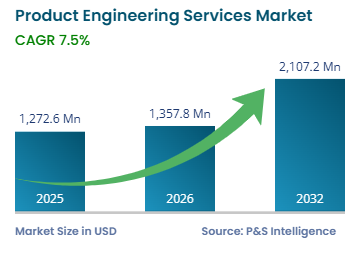
The product engineering services market size will be an estimated USD 1272.6 million for 2025, and it will grow by 7.5% during 2026–2032, to reach USD 2107.2 million by 2032.
The major factors responsible for the growth of the market include accelerating demand for faster time-to-market solutions, increasing complexity in product design requiring specialized expertise, and growing adoption of digital transformation initiatives across industries.
The accelerating technological advancements and heightened competition are prompting organizations to rely on external engineering expertise to maintain their competitive edge. This digital revolution is fundamentally transforming how products are conceived, designed, developed, and maintained throughout their lifecycle. The convergence of emerging technologies such as artificial intelligence, Internet of Things (IoT), cloud computing, and edge computing is creating unprecedented opportunities for product engineering service providers to deliver innovative solutions that meet evolving customer expectations.
Furthermore, the growing emphasis on customer experience and the need for continuous product innovation are driving enterprises to adopt more agile and flexible engineering approaches. This urgency to accelerate product development cycles while maintaining quality standards is creating substantial demand for specialized product engineering services that can provide end-to-end support from ideation to market launch.
Product Engineering Services Market Dynamics
Growing Adoption of AI-Powered Engineering and Automation Is Key Trend
The integration of artificial intelligence (AI) and automation technologies into product engineering processes represents a transformative trend reshaping the entire industry landscape.
This technological evolution is fundamentally changing how products are conceived, designed, tested, and maintained, creating unprecedented opportunities for efficiency gains and innovation acceleration.
Leading engineering service providers are increasingly leveraging generative AI for multiple applications across the product development lifecycle.
In September 2024, Tata Consultancy Services reported that its deployment of generative AI for code generation, automated testing, and documentation reduced product development timelines by 20%.
AI-driven generative design can generate thousands of design iterations from defined parameters, significantly speeding up ideation and concept development.
Additionally, AI-driven predictive analytics are enabling proactive identification of potential design flaws, performance issues, and maintenance requirements before products reach the market, significantly reducing the cost of post-launch modifications.
The automation trend extends beyond design to encompass testing, validation, and deployment processes.
Machine learning algorithms are being deployed to automate repetitive testing procedures, analyze vast amounts of test data, and identify patterns that indicate potential failures or optimization opportunities.
The digital twin technology, combining AI with real-time data analytics, allows engineers to simulate product performance under various conditions without physical prototypes.
This also helps reduce development costs by up to 30% and accelerate iteration cycles.
Furthermore, AI-powered project management tools are optimizing resource allocation, predicting project bottlenecks, and enabling more accurate timeline estimates.
As these technologies mature, engineering service providers that successfully integrate AI and automation into their service offerings are gaining significant competitive advantages.
Now, they can deliver faster, more innovative, and cost-effective solutions to their clients across all industry verticals.
Furthermore, 61% of the C-suite executives identify digital transformation as a top organizational priority.
This creates a sustained demand for engineering partners who can navigate the complexity of modern technology stacks while ensuring seamless integration with legacy systems and compliance with evolving regulatory requirements.
According to NITI Aayog, the accelerating AI adoption could contribute an additional USD 500 to USD 600 billion to India's GDP by 2035, with significant impacts expected in the financial services and manufacturing sectors.
Growing Demand for Connected Products Is Biggest Driver
The exponential growth in consumer demand for smart homes, connected electronics, and in-vehicle networking systems is emerging as a powerful product engineering services market driver.
The complexity is driving organizations to partner with specialized engineering service providers who possess the multidisciplinary expertise required to navigate the intricate landscape of standards, protocols, and platform requirements.
The automotive sector represents another critical dimension of this trend, with in-vehicle networking systems and connected car technologies fundamentally transforming the industry.
Global electric car sales reached close to 17 million units in 2024, representing over 20% of new car sales, with these vehicles incorporating sophisticated networking systems for everything from infotainment to autonomous driving capabilities.
The Indian government aims to boost the EV market share to 30% by 2030.
These developments are driving the demand for specialized product engineering services to support the design, development, and maintenance of connected products across various sectors.
Modern vehicles are essentially becoming rolling data centers, with some estimates suggesting that autonomous vehicles will generate up to 4 terabytes of data per day.
The engineering requirements for these systems are extraordinarily complex, involving real-time data processing, vehicle-to-vehicle (V2V) communication, vehicle-to-infrastructure (V2I) integration, over-the-air (OTA) update capabilities, and stringent safety and security requirements.
The product design & development category holds the largest market share, of 45%, in 2025, due to the increasing complexity of modern products and the critical need for innovation in competitive markets. Organizations are investing heavily in design and development services to create differentiated products that meet evolving customer expectations while incorporating advanced technologies such as AI, IoT, and sustainable materials.
The support & maintenance category will have the highest CAGR, of 7.6%. This rapid growth is driven by the increasing focus on product longevity, operational efficiency, and customer satisfaction. As products become more sophisticated and software-defined, the need for continuous updates, bug fixes, and performance optimization has intensified. Support and maintenance services are vital for ensuring user satisfaction and retention, especially for companies focused on delivering superior customer experiences. The shift towards subscription-based business models and the emphasis on total cost of ownership are further accelerating demand for comprehensive support and maintenance services.
The service types analyzed in this report are:
Product Design & Development (Largest Category)
Process Engineering
Implementation & Integration
Support & Maintenance (Fastest-Growing Category)
Organization Size Analysis
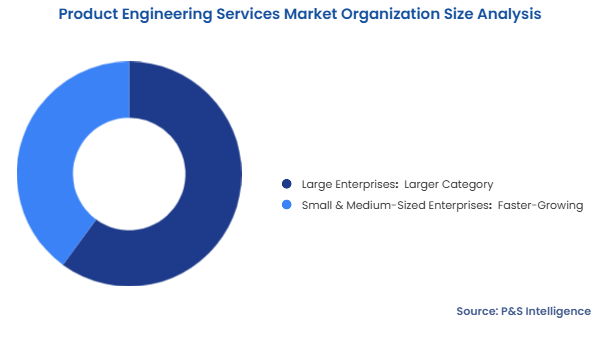
The large enterprises category holds the larger market share, of 60%, in 2025, driven by their substantial investments in advanced product engineering initiatives and complex product portfolios. These organizations require comprehensive engineering solutions to manage global product development cycles, ensure regulatory compliance across multiple markets, and integrate emerging technologies into their existing product lines. Large enterprises typically engage with engineering service providers for strategic initiatives such as digital transformation, platform modernization, and next-generation product development.
The SMEs category will have the higher CAGR, of 7.8%, because SMEs often specialize in specific domains or niche markets, allowing them to use unique product engineering services tailored to their needs. This helps them attract clients looking for highly focused and customized solutions. SMEs are recognized for their adaptability and quickness in responding to shifting market demands. In the quick-paced world of product engineering, their smaller size facilitates quicker decision-making and more efficient processes, which might be beneficial. SMEs are able to quickly modify their offerings to meet changing client needs and technology developments. Also, they use cost-effective product engineering services, to minimize their spending.
The organization sizes analyzed in this report are:
Large Enterprises (Larger Category)
Small & Medium-Sized Enterprises (SMEs) (Faster-Growing Category)
Application Analysis
The customer enterprise products category holds the larger market share, of 55%, in 2025, because a thorough examination of the customer's requirements forms the basis of product engineering services. When analyzing customer enterprise items, it is important to recognize the issues, workflows, and business procedures of a company. Product engineers work directly with enterprise stakeholders to establish the product's scope and collect requirements.
CRM, ERP, and analytics platforms appear in many customer enterprise solutions. These software applications are developed using product engineering services, which also cover coding, testing, integration, and deployment. The complexity of enterprise requirements, need for seamless integration with existing systems, and demand for scalable architectures drive significant investment in engineering services for this segment.
The customer mobile products category will have the higher CAGR, of 7.7%, because this product or app is designed exclusively for mobile devices like smartphones and tablets. In order to design, develop, and optimize these mobile devices to satisfy client demands and expectations, product engineering services are essential. These services include coding, programming, and software development in the process of actually creating the mobile product.
The proliferation of 5G networks is enabling new use cases for mobile products, including augmented reality (AR) applications, real-time streaming services, and IoT-enabled mobile solutions. Engineering service providers are investing in mobile-first development approaches, cross-platform frameworks, and user experience design capabilities to capitalize on this growth opportunity. By 2030, studies forecast the AR & VR market revenue to cross USD 200,868.5 million and 5G service market size to reach at least USD 782.2 billion.
The applications analyzed in this report are:
Customer Enterprise Products (Larger Category)
Customer Mobile Products (Faster-Growing Category)
Vertical Analysis
The healthcare category holds the largest market share of 30% in 2025, and it will have the highest CAGR during the forecast period, because product engineering services help in monitoring personal health, accessing one's medical records, self-monitoring of diagnostic data, active data collecting and documentation, and others in the healthcare industry. The industry continues to undergo a technological revolution, with better outcomes, diagnosis, and prevention as a result.
All kinds of medical equipment now use powerful processors, specialized software, a variety of algorithms, and network connectivity to carry out their functions. With innovations that lower healthcare costs, promote patient involvement, enhance population health, and, eventually, make healthcare more accessible and transparent at all levels, product engineering and IoT are improving the healthcare landscape.
The verticals analyzed in this report are:
Industrial Manufacturing
Automotive
Healthcare (Largest and Fastest-Growing Category)
IT & Telecom
Aerospace & Defense
Banking, Financial Services, & Insurance (BFSI)
Energy & Utilities
Others
Drive strategic growth with comprehensive market analysis
North America Product Engineering Services Market Size
North America holds the largest market share, of 35%, in 2025. This dominance is primarily attributed to the region's mature technology ecosystem, substantial investments in research and development, and the presence of leading technology companies driving innovation across industries. In March 2025, GE Aerospace committed USD 1 billion to expand engineering operations across the US, focusing on additive manufacturing, advanced component design, and rapid prototyping, underscoring the region's continued commitment to advanced engineering capabilities.
The region benefits from a highly skilled workforce, robust intellectual property protection frameworks, and strong collaboration between industry and academia. The presence of major automotive manufacturers, aerospace companies, and technology giants creates consistent demand for sophisticated product engineering services. Additionally, the region's emphasis on innovation-led growth and early adoption of emerging technologies such as AI, 5G, and quantum computing positions it at the forefront of next-generation product development.
U.S. Product Engineering Services Market Size
The U.S. market specifically benefits from supportive government policies, including initiatives to strengthen domestic manufacturing capabilities and investments in critical technologies. The growing focus on reshoring and nearshoring of manufacturing activities is creating new opportunities for product engineering service providers to establish local delivery centers and innovation labs. Furthermore, the thriving startup ecosystem in technology hubs such as Silicon Valley, Seattle, and Austin drives demand for agile engineering services that can help bring innovative products to market quickly.
Asia-Pacific will have the highest CAGR during the forecast period, driven by the rising investments in technology infrastructure and growing demand for innovative products and solutions. Many countries in the region have established themselves as global manufacturing powerhouses. These nations are recognized for their skills in electronics, automotive, telecommunications, and other industries, and they place a significant emphasis on research and development (R&D). To support the creation and enhancement of new goods, this manufacturing strength generates a high demand for product engineering services.
To remain competitive in the market, several companies in the Asia-Pacific area are implementing digital transformation efforts. The adoption of modern technologies, software, and digital platforms is part of this shift. By creating software applications, improving user experiences, and integrating new technologies into existing systems, product engineering services are essential in assisting these digital transformation initiatives.
India, Vietnam, and Malaysia are emerging as outsourcing powerhouses, attracting global engineering investments due to their robust STEM talent pools and favorable business ecosystems. India, in particular, has established itself as a global hub for product engineering services, with over 1,700 Global Capability Centers serving international clients. The region is also witnessing the emergence of new engineering hubs in countries such as Vietnam, Thailand, and the Philippines, which offer competitive cost structures and growing technical capabilities.
These countries are attracting investments from global companies seeking to diversify their engineering delivery locations and tap into new talent pools. The increasing focus on sustainability and green technologies in countries such as Japan and South Korea is driving demand for specialized engineering services in areas such as renewable energy, electric vehicles, and smart city solutions.
China Product Engineering Services Market Size
China's continued focus on technological self-reliance and innovation is driving substantial investments in product engineering capabilities. The country's Made in China 2025 initiative and emphasis on developing indigenous technology solutions are creating opportunities for both domestic and international engineering service providers. According to IEA, in China, the number of new electric car registrations reached 8.1 million in 2023, increasing by 35% relative to 2022, demonstrating the scale of engineering requirements in just one industry vertical.
The geographical breakdown of the market is as follows:
North America (Largest Regional Market)
U.S. (Larger Country)
Canada (Faster-Growing Country)
Europe
Germany (Largest Country)
U.K.
France (Fastest-Growing Country)
Italy
Spain
Rest of Europe
Asia-Pacific (Fastest-Growing Regional Market)
China (Largest Country)
India (Fastest-Growing Country)
Japan
South Korea
Australia
Rest of APAC
Latin America
Brazil (Largest and Fastest-Growing Country)
Mexico
Rest of LATAM
Middle East and Africa
Saudi Arabia (Fastest-Growing Country)
South Africa
U.A.E. (Largest Country)
Rest of MEA
Product Engineering Services Market Share
The market is fragmented with numerous small and specialized firms operating across industries such as automotive, healthcare, IT, aerospace, and industrial manufacturing. This fragmentation is driven by the diverse and complex requirements of product development, where companies often need tailored, industry-specific solutions. As a result, no single company dominates the market, and a large number of regional and niche players coexist, competing on expertise, innovation, and customized services to meet the varied demands of global clients.
Key Product Engineering Services Companies:
Alten Group
AVL Group
HCL Tech
Akka technologies
IBM Corporation
Capgemini SE
TATA Consultancy Services Limited
Wipro Limited
Accenture plc
Cognizant Technology Solutions Corporation
Infosys Limited
Tech Mahindra Limited
Product Engineering Services Market News
In June 2025, AB Volvo selected Tata Technologies Limited as a strategic engineering supplier, tasking the firm with embedded software and system development to accelerate the carmaker's electric and software-defined vehicle programs.
In March 2025, Wipro Limited announced a major business restructuring to improve its cloud and AI capabilities, with the restructuring effective from April 1, 2025, focusing on aligning services to meet growing demand for advanced technologies, including AI, cloud computing, and automation.
In May 2024, Quest Global Engineering Services Private Limited acquired a majority stake in People Tech Group Inc., bolstering its digital transformation capabilities in North America and enhancing expertise in Software Defined Vehicles, ADAS testing, and Hi-Tech solutions.
In March 2024, Google LLC launched its Asia Pacific Cybersecurity Engineering Center in Tokyo, reinforcing the region's growing importance as a hub for high-value engineering functions and highlighting the intersection of product engineering with cybersecurity requirements.
Want a report tailored exactly to your business need?
Leading companies across industries trust us to deliver data-driven insights and innovative solutions for their most critical decisions. From data-driven strategies to actionable insights, we empower the decision-makers who shape industries and define the future. From Fortune 500 companies to innovative startups, we are proud to partner with organisations that drive progress in their industries.
Client Testimonials
Working with P&S Intelligence and their team was an absolute pleasure – their awareness of timelines and commitment to value greatly contributed to our project's success. Eagerly anticipating future collaborations.
McKinsey & Company
India
Unmatched Standards
Our insights into the minutest levels of the markets, including the latest trends and competitive landscape, give you all the answers you need to take your business to new heights
Complete Data Security
We take a cautious approach to protecting your personal and confidential information. Trust is the strongest bond that connects us and our clients, and trust we build by complying with all international and domestic data protection and privacy laws