This Report Provides In-Depth Analysis of the Private 5G Core Hardware Market Report Prepared by P&S Intelligence, Segmented by Network Architecture (Standalone, Non-Standalone), Deployment Mode (On-premise / private cloud, Public cloud, Hybrid), Organization Size (Large enterprises, Small and medium enterprises), End-Use Industry (Manufacturing, Energy and Utilities, Logistics and Transportation, Healthcare, Mining, Government and Defense), and Geographical Outlook for the Period of 2021 to 2032
Explore the market potential with our data-driven report
Private 5G Core Hardware Market Overview
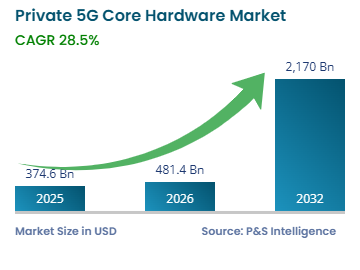
The private 5G core hardware market was valued at USD 374.60 million in 2025. It is estimated at USD 481.40 million in 2026. Annual spending is on course to hit USD 2.17 billion by 2032, rising at a 28.5% CAGR over 2026-2032. Factories, ports, and utilities are buying dedicated core appliances so production and safety data stay on site instead of crossing a public carrier's network. For suppliers, that shift turns plant and site managers into direct hardware customers.
Growth follows a broader shift toward enterprise-owned spectrum and equipment. The Global mobile Suppliers Association counted 1,846 organizations running a private mobile network across 80 countries by August 2025, up from 1,714 a year earlier. That increase shows buyers moving past pilot projects and into repeat hardware purchases. Each new site typically needs its own core appliance, spreading private 5G core hardware demand across many buyers and favoring vendors that ship compact, single-site systems over large carrier-grade platforms.
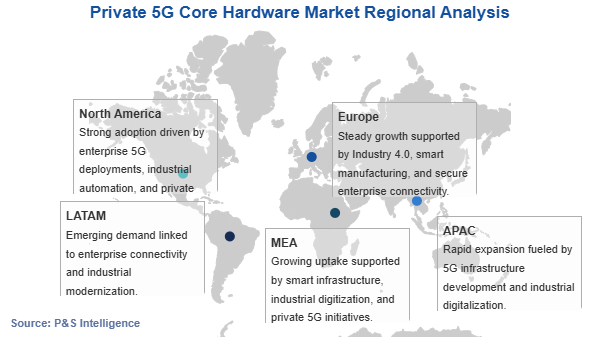
North America contributed 31% of 2025 revenue, anchored by early enterprise deployments across the U.S. and Canada. Established manufacturers and logistics operators there had the budgets and vendor ties to fund a dedicated core per site. Asia-Pacific leads on growth, with revenue set to expand at a 38.0% CAGR over 2026-2032. Manufacturers in China, Japan, and South Korea are equipping new factories with dedicated core infrastructure instead of retrofitting older, carrier-dependent lines. That buildout is pulling orders toward the region faster than in mature markets, where upgrades now drive most purchases.
Key Market Insights
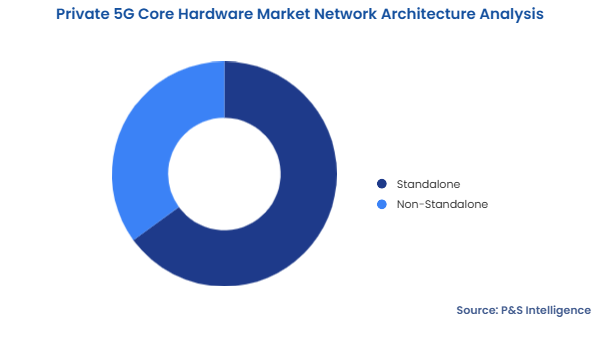
By network architecture, standalone led demand in 2025, and it is on track to also post the fastest gains through 2026-2032.
By deployment mode, on-premise and private-cloud deployment accounted for 52% of the market in 2025, while public cloud is set to grow fastest, at a 30.4% CAGR through 2026-2032.
By organization size, large enterprises made up the biggest share of the market in 2025, while small and medium enterprises are set to expand at the quickest pace through 2026-2032.
By end-use industry, manufacturing led adoption in 2025, while energy and utilities is expected to be the fastest-growing end-use vertical through 2026-2032.
By geography, North America generated 31% of revenue in 2025, while Asia-Pacific is on course for the steepest climb, a 38.0% CAGR over 2026-2032.
Private 5G Core Hardware Market Trends and Growth Drivers
Enterprise Spectrum Access Is Accelerating Core Hardware Purchases
Regulators in a growing number of countries now let enterprises license spectrum directly instead of leasing it from a mobile carrier. That shift pulls core hardware purchases forward. A factory or hospital holding its own spectrum needs its own core appliance on site, since no carrier network function exists for it to attach to. A policy change becomes a direct equipment order.
Japan's Ministry of Internal Affairs and Communications issued 153 local 5G licenses in the 4.7 GHz band and 25 in the 28 GHz band by December 2024. The program also covers municipalities and hospitals, not just factories. Each licensee generally buys or leases a core appliance to activate its license, tying hardware demand to license issuance instead of IT budget cycles. Licensing activity of this kind turns a regulatory calendar into a demand forecast. Hardware vendors that track license filings by region can time production and staffing to match issuance, rather than waiting for a completed sale to confirm demand.
Standalone Core Adoption Is Redefining Hardware Requirements
Enterprises building new private networks increasingly skip non-standalone designs and go straight to standalone cores. Automation and robotics need deterministic latency that only a full 5G core delivers. This changes what vendors put on the shelf. Standalone deployments call for dedicated core appliances instead of boxes that share functions with a carrier's 4G network.
Standards work is reinforcing the shift. The 3GPP's Release 18, the first release under the 5G-Advanced label, moved from specification into vendor implementation during 2025. It adds features that let standalone cores run on smaller, cheaper edge servers. Vendors shipping Release 18-compliant appliances can enter new standalone projects sooner. Suppliers still limited to non-standalone hardware risk exclusion from new enterprise tenders. For buyers, the practical effect is a shorter list of vendors ready for new standalone tenders. Suppliers with Release 18-ready hardware are likely to reach those shortlists first.
Direct Licensing Rules Are Opening a New Buyer Segment
Governments that once required enterprises to reach spectrum through a mobile operator are now issuing separate licenses for company-owned networks. This opens direct sales relationships in markets that lacked them before. Removing the carrier as an intermediary lets hardware vendors sell core appliances straight to the mine, port, or factory operator, often on shorter sales cycles.
India's Department of Telecommunications released draft Authorisation for Captive Telecommunication Services Rules in September 2025 for public consultation. The draft extends an earlier captive non-public network framework that lets enterprises obtain 5G spectrum directly. If finalized, the rules widen a buyer base that previously had to negotiate network access through India's mobile operators. That gives core hardware vendors a new addressable set of manufacturers and utilities to sell into directly. Vendors that already have local sales and support staff in India stand to benefit first, since a newly licensed enterprise typically wants installation help alongside the hardware order.
Cybersecurity Compliance Requirements Are Limiting Small-Buyer Entry
Operating a private 5G core now carries security obligations that used to sit with a licensed carrier. Meeting them raises the cost of entry for smaller enterprises. A buyer that runs its own core must isolate signaling, data, and management traffic, patch network functions, and pass its own security audits.
The National Institute of Standards and Technology's National Cybersecurity Center of Excellence completed a series of 5G cybersecurity guidance documents in 2025. The guidance sets out network security design principles for commercial and private 5G operators. Meeting them usually requires specialized staff or a managed-security add-on. That cost can push mid-size manufacturers and logistics operators away from a direct hardware purchase and toward hosted options. Vendors that bundle compliance support with the appliance gain an opening, since a buyer without a security team will often pay more for a pre-hardened system.
Standalone architecture led the market in 2025. A standalone core runs its own signaling and user-plane functions instead of anchoring to a public 4G network. This gives factories and hospitals the deterministic, low-latency performance that automation and robotics equipment need. Enterprises that own their spectrum have little reason to keep a design that still depends on a carrier's control functions.
Standalone designs are also set to add revenue faster than any other architecture over 2026-2032. Operators are phasing out older 4G-anchored designs and replacing them with standalone cores at each hardware refresh cycle, while new greenfield sites skip non-standalone entirely. Falling prices for edge servers capable of running a full standalone core add a second push, letting smaller sites justify a dedicated on-site core. Buyers planning a new deployment increasingly choose standalone hardware from the outset instead of budgeting for a later upgrade.
Deployment Mode
On-premise and private-cloud setups accounted for 52% of 2025 revenue. Enterprises in regulated or safety-critical settings, including manufacturing plants and utilities, keep core hardware on their own premises so operational data never leaves the site. This satisfies data-residency and uptime requirements that a shared cloud instance cannot guarantee. Owning the hardware outright also lets a plant operator tune the core to its own production schedule instead of a shared service's maintenance window.
Public cloud is the quickest-rising deployment mode, with revenue set to climb at a 30.4% CAGR between 2026 and 2032. Cloud-hosted core software lowers the upfront hardware bill for smaller enterprises that cannot justify a dedicated server room. Vendors increasingly package core functions to run on off-the-shelf compute instead of proprietary appliances. Latency-sensitive functions still need on-site edge hardware, so this shift trims the size of each hardware order without eliminating it. Enterprises weighing this option still compare total cost against keeping data fully on-site, particularly in industries where uptime guarantees matter more than upfront hardware savings.
Organization Size
Large enterprises accounted for the largest share in 2025. Multi-site manufacturers, port operators, and utilities have the capital budgets to fund a dedicated core appliance per facility. They also have the in-house IT staff to operate it, an advantage smaller firms typically lack. Large organizations also run the highest-value automation and robotics use cases, which justify the added hardware cost of a private core over shared Wi-Fi or public cellular. This budget advantage also lets large enterprises negotiate multi-year service contracts that smaller buyers rarely have the volume to secure.
Small and medium enterprises are expected to grow fastest through 2026-2032. Falling prices for compact, single-box core appliances and simpler, cloud-managed setup are bringing dedicated core hardware within reach of smaller manufacturers and logistics operators. Vendors are also packaging pre-configured hardware bundles aimed specifically at SME budgets and IT staffing levels. This bundling turns what used to be a multi-vendor project into a single purchase order that a smaller buyer's finance team can approve quickly.
End-Use Industry
Manufacturing was the largest end-use vertical in 2025. Factories have the largest installed base of on-premise core deployments. Robotics, automated guided vehicles, and quality-inspection cameras all need the deterministic latency and site-level data control that a dedicated core provides. Manufacturers were also among the earliest private 5G adopters, giving the vertical a multi-year head start over other industries.
Energy and utilities buyers are set to raise spending faster than any other industry over 2026-2032. Utilities are equipping substations, pipelines, and grid-monitoring sites with dedicated cores to support remote sensing and protection systems that cannot tolerate a public network outage. Grid-modernization spending is extending core hardware to sites that previously relied on legacy radio or wired SCADA links, widening the buyer base beyond the vertical's traditional early adopters. Vendors with ruggedized hardware built for outdoor substations are better positioned here than suppliers focused only on indoor factory floors.
The complete segmentation hierarchy is as follows.
Network Architecture
Standalone
Non-Standalone
Deployment Mode
On-premise / private cloud
Public cloud
Hybrid
Organization Size
Large enterprises
Small and medium enterprises
End-Use Industry
Manufacturing
Energy and Utilities
Logistics and Transportation
Healthcare
Mining
Government and Defense
Drive strategic growth with comprehensive market analysis
North America Private 5G Core Hardware Market Outlook
North American buyers generated 31% of global private 5G core hardware revenue in 2025, more than any other region. Enterprises across the U.S. and Canada were among the first to license spectrum for their own networks. Mature manufacturing and logistics operations already have the capital budgets to fund dedicated core appliances instead of sharing carrier infrastructure. Established relationships between enterprises and network-equipment vendors also shorten the time between a spectrum grant and a hardware order.
The U.S., the region's largest market, hosts most of this installed base. The OnGo Alliance reports that more than 420,000 Citizens Broadband Radio Service devices had been deployed across the U.S. by 2025. That scale shows how widely enterprises there have adopted the shared mid-band spectrum that many private 5G cores run on. It gives North American hardware vendors a large replacement and upgrade market even as new licensing activity slows.
Demand in the region is shifting from first-time deployments toward hardware refresh and capacity expansion at existing sites. Enterprises that deployed early-generation core appliances are now replacing them with standalone-capable hardware, keeping North America's share elevated even as growth in newer regions outpaces it. Vendors with strong service networks stand to gain the most from this refresh cycle, since swapping a core appliance without disrupting production favors suppliers already on site.
Asia-Pacific spending on core hardware is set to rise at a 38.0% CAGR over 2026-2032, the quickest pace worldwide. Governments across China, Japan, South Korea, and India have opened dedicated spectrum bands for enterprise use over the past five years. Manufacturers in the region are equipping new factories with private cores instead of retrofitting older facilities with carrier-dependent connectivity. Falling hardware costs are also widening the pool of factories that can afford a dedicated core.
China is building out private core hardware at factory scale. China's Ministry of Industry and Information Technology reported that the country had built 1,260 "5G factories" under its national 5G-plus-Industrial-Internet program by the end of 2025. Each factory requires its own on-site core infrastructure to run production-line automation, giving regional hardware vendors a defined, government-tracked pipeline of new deployment sites.
Demand should keep accelerating as China's program targets 10,000 5G factories by 2027. Similar industrial-digitization plans are advancing in Japan and South Korea, giving Asia-Pacific a multi-year runway ahead of other regions. Hardware vendors that localize manufacturing and support in the region are better placed to win this volume than suppliers shipping in from elsewhere.
Europe contributes a steady share of global demand, trailing North America and Asia-Pacific but expanding as more manufacturers commission campus networks. National regulators across Germany, the United Kingdom, and France have created dedicated licensing classes for enterprise-owned networks, separating them from the spectrum auctions used by mobile carriers. Manufacturers in Germany's automotive and industrial machinery sectors are expected to keep anchoring regional demand. The United Kingdom and France are likely to follow at a smaller scale as their own enterprise licensing regimes mature. Suppliers with a multi-country European sales presence hold an edge over single-market entrants.
Germany illustrates the pattern. Its telecommunications regulator, the Bundesnetzagentur, had granted 465 frequency allocations for private 5G campus networks by April 2025, most going to manufacturers and logistics operators building dedicated on-site infrastructure. Not every allocation converts into an operating network immediately, which keeps Europe's hardware order pipeline more gradual than the licensing count alone suggests.
Latin America accounts for a modest share of global demand, concentrated in Brazil's mining and industrial sectors. Mining companies in remote areas often sit outside reliable carrier coverage, making a self-owned core the only practical way to connect autonomous haul trucks and remote-sensing equipment. Brazil's telecommunications regulator, Anatel, issues restricted-use radiofrequency licenses that let industrial and mining operators run networks separate from the spectrum auctions used by public mobile carriers. This licensing route gives large resource companies a direct path to their own core infrastructure and has made Brazil the region's clearest source of hardware orders.
Mexico's export-manufacturing sector represents a second, smaller pocket of demand as assembly plants near the U.S. border pursue similar automation projects. Automotive and electronics plants there face the same uptime pressure that pushes Brazilian miners toward dedicated cores. Suppliers already serving Brazil's mining accounts have the clearest path to expanding into this adjacent buyer base.
The Middle East and Africa contribute a smaller share of global demand, led by energy and petrochemical operators in Saudi Arabia. Oil and gas producers run some of the largest and most safety-critical facilities in the world, and their sites are too large for Wi-Fi coverage alone to span. Their operators also treat network downtime as a safety risk.
Saudi Arabia's Communications, Space and Technology Commission has built a spectrum framework for dedicated and campus private 5G networks. Aramco Digital was awarded spectrum in the 450 MHz band in 2024 to build a nationwide industrial communications network separate from the public mobile operators. A network of that reach needs core hardware at many sites to serve connected sensors and vehicles. South Africa's mining sector is a smaller but growing source of demand as operators there pursue similar remote-site automation. Vendors already qualified in Saudi Arabia's energy sector have a template for entering this second resource-driven buyer base.
The regions and countries covered in this report are listed below.
The Private 5G Core Hardware Market is moderately fragmented, and no single company holds a dominant share. Building a core network function largely as software that runs on standard servers keeps capital requirements for new entrants low. Scale still matters for customers that want multi-site support and long-term firmware maintenance.
Most private 5G deployments are one-off enterprise contracts instead of nationwide carrier tenders. That keeps any single vendor from amassing the scale advantages that concentrate public 5G core supply among two or three carrier-focused players. This fragmentation gives enterprise buyers real vendor choice at the table. It also means switching suppliers late in a project carries less risk than in a concentrated market.
Large network-equipment vendors, including Ericsson, Nokia, Huawei, Cisco, and HPE, compete on multi-site support, global logistics, and the ability to bundle core hardware with radio equipment and long-term service contracts. Dedicated private-network specialists such as Celona, Mavenir, and Druid Software compete instead on lower-cost, purpose-built appliances and faster installation. These vendors target single-site enterprise buyers that do not need a global carrier-grade platform. This structure has held steady as new specialists enter alongside the established vendors instead of replacing them.
Open-interface specifications published by the O-RAN Alliance are lowering switching costs between vendors. Enterprises can mix core, radio, and management software from different suppliers instead of buying a single vendor's full stack. This works against consolidation, since a customer can now swap a core hardware supplier without replacing an entire network, keeping competitive intensity high across both vendor clusters.
Leading Companies in the Private 5G Core Hardware Market:
Telefonaktiebolaget LM Ericsson
Nokia Corporation
Huawei Technologies Co. Ltd.
ZTE Corporation
Cisco Systems Inc.
Hewlett Packard Enterprise Company
Samsung Electronics Co. Ltd.
NEC Corporation
Oracle Corporation
Mavenir Systems Inc.
Ciena Corporation
Celona Inc.
Parallel Wireless Inc.
Affirmed Networks Inc.
Casa Systems Inc.
Druid Software Limited
Cumucore Oy
IPLOOK Technologies Co. Ltd.
Metaswitch Networks Ltd.
Private 5G Core Hardware Market Developments
In September 2026, Nokia Corporation opened its Mobile Core Early Access program, covering 5G Core, automation, analytics, and network exposure features, to the wider industry after an initial run with 30 companies. The move gives enterprise and private-network integrators earlier access to core software Nokia is preparing to sell separately from its radio business.
In July 2026, Druid Software Limited acquired Node-H, a Munich-based radio access network specialist, to expand its engineering capacity for private 4G and 5G core deployments. The acquisition lets Druid pair its core software with in-house radio integration for enterprise, industrial, and public-safety customers.
Frequently Asked Questions About This Report
What is the dominant network architecture in the private 5G core hardware market?+
Standalone led demand in 2025, and it is on track to also post the fastest gains through 2026-2032.
Which deployment mode is most common for private 5G core hardware?+
On-premise and private-cloud deployment accounted for 52% of the market in 2025, while public cloud is set to grow fastest, at a 30.4% CAGR through 2026-2032.
Which organization size segment is driving the fastest growth?+
Large enterprises made up the biggest share of the market in 2025, while small and medium enterprises are set to expand at the quickest pace through 2026-2032.
Which industries are the largest markets for private 5G core hardware?+
Manufacturing led adoption in 2025, while energy and utilities is expected to be the fastest-growing end-use vertical through 2026-2032.
Why are enterprises investing in private 5G core hardware?+
Factories, ports, and utilities are buying dedicated core appliances so production and safety data stay on site instead of crossing a public carrier's network.
How are utilities using private 5G core hardware?+
Utilities are equipping substations, pipelines, and grid-monitoring sites with dedicated cores to support remote sensing and protection systems that cannot tolerate a public network outage.
What are the barriers to entry for vendors in this market?+
Building a core network function largely as software that runs on standard servers keeps capital requirements for new entrants low.
What do enterprises with their own spectrum need?+
A factory or hospital holding its own spectrum needs its own core appliance on site, since no carrier network function exists for it to attach to.
Want a report tailored exactly to your business need?
Leading companies across industries trust us to deliver data-driven insights and innovative solutions for their most critical decisions. From data-driven strategies to actionable insights, we empower the decision-makers who shape industries and define the future. From Fortune 500 companies to innovative startups, we are proud to partner with organisations that drive progress in their industries.
Client Testimonials
Working with P&S Intelligence and their team was an absolute pleasure – their awareness of timelines and commitment to value greatly contributed to our project's success. Eagerly anticipating future collaborations.
McKinsey & Company
India
Unmatched Standards
Our insights into the minutest levels of the markets, including the latest trends and competitive landscape, give you all the answers you need to take your business to new heights
Complete Data Security
We take a cautious approach to protecting your personal and confidential information. Trust is the strongest bond that connects us and our clients, and trust we build by complying with all international and domestic data protection and privacy laws