This Report Provides In-Depth Analysis of the Privacy Management Software Market Report Prepared by P&S Intelligence, Segmented by Component (Software, Services), Application (Regulatory Compliance, Data Discovery and Mapping, Data Subject Access Request, Consent and Preference Management, Privacy Impact Assessment, Incident and Breach Management, Vendor Risk Management, Reporting and Analytics), Deployment Mode (Cloud, On-premises), Organization Size (Large Enterprises, Small and Medium Enterprises), End User (Banking, financial services and insurance, Healthcare, IT and Telecommunications, Retail and E-commerce, Government, Manufacturing, Energy and Utilities, Education), and Geographical Outlook for the Period of 2021 to 2032
Explore the market potential with our data-driven report
Privacy Management Software Market Overview
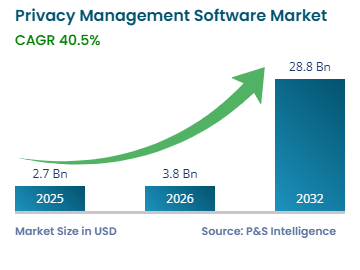
The privacy management software market size was USD 2.7 billion in 2025, and it will grow by 40.5% during 2026-2032 to reach USD 28.8 billion by 2032.
The privacy management software market is expanding as organisations manage growing volumes of personal and sensitive information across cloud platforms, digital applications, connected devices, and enterprise ecosystems. As business operations become increasingly data-driven, organisations are required to manage customer information, employee records, and operational data while maintaining appropriate privacy controls. Privacy requirements are also becoming more complex as businesses operate across multiple jurisdictions with different regulatory obligations. According to the International Telecommunication Union, approximately 6 billion people, representing 74% of the global population, used the Internet in 2025. This expanding digital user base is increasing the volume of personal information collected, processed, stored, and shared across enterprise systems and digital platforms.
The market is also benefiting from the growing need to strengthen privacy governance and reduce reliance on manual compliance processes. Organisations are increasingly adopting software platforms that automate consent management, data inventories, privacy assessments, data mapping, and regulatory reporting. Privacy management capabilities are also being integrated with broader cybersecurity, data governance, governance, risk, and compliance programmes to provide greater visibility into information assets across distributed environments. The growing adoption of cloud computing, artificial intelligence, remote work models, and digital business services is creating increasingly complex data flows that require continuous visibility and control. This is increasing demand for automated data discovery, privacy risk monitoring, and governance tools that help organisations manage privacy obligations more efficiently, improve accountability in data-handling practices, and maintain greater control over sensitive information across business operations.
Key Market Insights
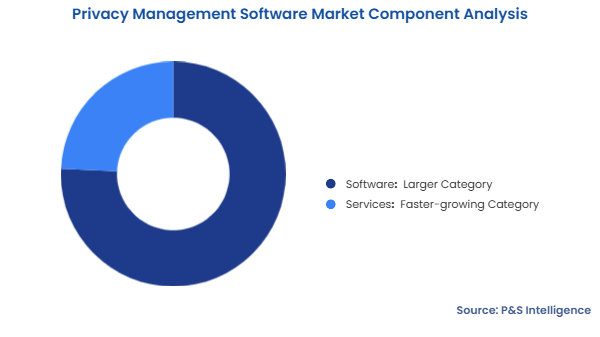
Software is the larger category, holding a market share of 75.5%, due to increasing demand for automated privacy governance, consent management, and regulatory compliance activities.
Data Discovery and Mapping is the fastest-growing category, registering a CAGR of 41.6%, driven by increasing demand for visibility into personal data across enterprise environments.
Cloud is the larger and faster-growing category, holding a market share of 85.0% and registering a CAGR of 41.1%, due to growing preference for scalable deployment models supporting evolving compliance requirements.
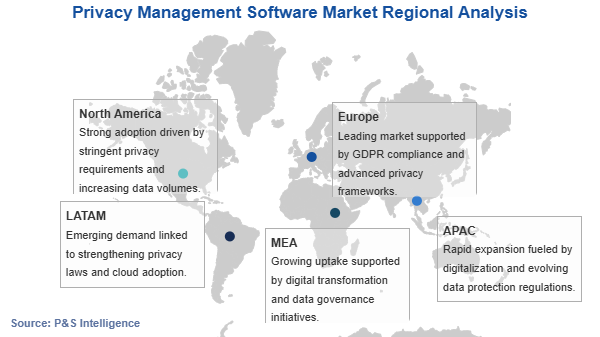
North America holds the largest share of 45.0%, due to extensive enterprise data processing activities and management of complex privacy regulations.
Asia-Pacific is the fastest-growing region, registering a CAGR of 42.0%, driven by extensive online activity and increasing emphasis on data governance across enterprises.
Privacy Management Software Market Trends and Drivers
AI-Powered Privacy Automation and Governance Platforms Are a Major Trend
Privacy management software is increasingly evolving from traditional compliance-focused tools into automated governance platforms that help organisations manage privacy requirements across increasingly complex data and AI environments. The rapid adoption of artificial intelligence, generative AI, and agentic systems is creating new data-processing activities that require organisations to understand how personal information is collected, accessed, processed, and shared. As AI systems increasingly perform automated tasks and interact with enterprise data, privacy teams are placing greater emphasis on AI governance, risk assessment, data mapping, consent management, and continuous monitoring. According to Forrester, AI governance and risk management were among the top priorities for privacy teams globally in 2025, while privacy management software is increasingly being used to support AI governance and risk-management activities.
The growing complexity of AI-driven data processing is also increasing the need for privacy controls that operate continuously rather than through periodic manual assessments. Traditional privacy programmes often rely on policies, documentation, and human-led reviews, but the growing use of AI models, automated systems, and autonomous agents is making it more difficult to maintain visibility over data usage through these approaches alone. The International Association of Privacy Professionals noted in 2026 that AI-driven data processing is placing increasing pressure on traditional document-based privacy programmes, while autonomous AI agents can independently retrieve information, use tools, and perform multiple actions with limited human oversight.
Expanding Global Data Privacy Regulations Drives Market
The increasing adoption and evolution of data privacy regulations across countries is a major driver of the privacy management software market. Organisations are required to comply with regulations governing the collection, processing, storage, sharing, and transfer of personal information while also addressing requirements related to consent, data subject rights, breach notifications, and cross-border data transfers. As businesses increasingly operate across multiple jurisdictions, differences in regulatory requirements are making privacy compliance more complex and increasing the need for centralised systems that can manage privacy obligations across business operations. According to the United Nations Trade and Development (UNCTAD), 79% of countries worldwide have legislation covering data protection and privacy. The widespread adoption of privacy legislation is increasing the need for organisations to establish structured privacy programmes and maintain greater visibility over how personal information is handled across their operations.
The growing regulatory focus is also increasing the operational burden associated with manual privacy management. Organisations need to maintain records of processing activities, conduct privacy assessments, manage consent and preferences, respond to data subject requests, monitor third-party data processing, and demonstrate compliance during audits or regulatory reviews. These activities can become increasingly difficult to manage through spreadsheets, disconnected systems, and manual workflows as data volumes and regulatory obligations expand. Privacy management software addresses these challenges by centralising privacy processes, automating repetitive compliance activities, and providing greater visibility into personal data and associated privacy obligations.
Complex Integration and Operational Implementation Challenges Restrain Market Growth
The complexity of integrating privacy management software with existing enterprise technology environments is a major restraint for market growth. Organisations often operate across legacy applications, multiple cloud platforms, databases, business systems, and third-party applications, making it difficult to establish a unified view of personal information and privacy obligations. Integrating privacy management platforms with these existing systems may require extensive configuration, data mapping, API integration, and coordination between IT, security, legal, compliance, and business teams. These requirements can increase implementation time and operational complexity, particularly for organisations with fragmented technology infrastructures.
The challenge becomes more significant when organisations need to identify and map personal information across multiple systems and maintain accurate records of how data is collected, processed, stored, and shared. Privacy management software often needs access to information from different applications and databases to automate activities such as data discovery, consent management, data subject requests, and privacy assessments. Differences in data formats, system architectures, access controls, and data ownership can make integration more difficult and require additional technical resources.
Expansion of Privacy Programs Among Small and Mid-Sized Organisations Creates Market Opportunity
The expansion of privacy programmes among small and medium-sized organisations is creating a significant opportunity for the privacy management software market. Smaller organisations are increasingly collecting and processing customer, employee, and business information through cloud applications, e-commerce platforms, digital payment systems, and other online services. As their digital operations expand, these organisations are facing greater requirements to establish structured processes for managing personal information, responding to data subject requests, maintaining consent records, and demonstrating compliance with applicable privacy regulations. According to the International Finance Corporation, micro, small, and medium-sized enterprises account for more than 90% of firms worldwide, highlighting the large potential customer base available for privacy management software providers.
Many small and medium-sized organisations have limited internal privacy and compliance resources compared with large enterprises. Managing privacy obligations through manual processes can therefore require significant time and coordination, particularly as businesses operate across multiple digital platforms and regulatory environments. This is creating demand for software solutions that simplify privacy management through automated workflows, centralised data visibility, compliance monitoring, and standardised privacy processes. Cloud-based delivery models are particularly suited to smaller organisations because they can reduce the need for extensive infrastructure and specialised technical resources while allowing businesses to deploy privacy capabilities more efficiently.
Software is the larger category, holding a market share of 75.5%, due to its central role in automating privacy governance, consent management, data discovery, and compliance workflows across cloud-based privacy environments. Organisations increasingly prefer software platforms that provide continuous monitoring, workflow automation, and centralised oversight of privacy operations. According to the International Association of Privacy Professionals, over 80% of privacy professionals had taken on at least one additional responsibility beyond their core privacy role in 2024. Growing operational demands are increasing reliance on software that consolidates governance, compliance, and risk management activities within a single platform while improving efficiency across enterprise privacy programmes.
Services are the faster-growing category, registering a CAGR of 40.9%, as organizations increasingly require external expertise to implement, customise, integrate, and manage privacy management platforms. Many enterprises face challenges related to evolving regulations, changing operational requirements, and limited in-house privacy resources. As a result, demand for professional consulting, deployment support, compliance advisory, and managed privacy services continues to expand. Service providers are also helping organisations align privacy initiatives with broader governance, cybersecurity, and risk management strategies, contributing to stronger growth within this segment.
The components analysed in this report are:
Software (Larger Category)
Services (Faster-growing Category)
Professional Services
Managed Services
Application Analysis
Regulatory Compliance is the largest category, holding a market share of 25.5%, as organisations increasingly require structured systems to manage privacy obligations across multiple jurisdictions and regulatory frameworks. Privacy regulations require businesses to maintain appropriate records, manage consent and data subject rights, conduct privacy assessments, monitor compliance activities, and demonstrate accountability for the handling of personal information.
Data Discovery and Mapping is the fastest-growing category, registering a CAGR of 41.6%, driven by the increasing complexity of enterprise data environments and the need for greater visibility into personal information. Organisations increasingly store and process data across cloud platforms, enterprise applications, databases, connected systems, and third-party services, making it difficult to identify where personal information is located and how it moves across business environments. According to Microsoft, 21% of decision-makers identified the lack of consolidated visibility across disparate tools as their biggest data security challenge in 2024.
The applications analysed in this report are:
Regulatory Compliance (Largest Category)
Data Discovery and Mapping (Fastest-growing Category)
Data Subject Access Request
Consent and Preference Management
Privacy Impact Assessment
Incident and Breach Management
Vendor Risk Management
Reporting and Analytics
Others
Deployment Mode Analysis
Cloud is the larger and faster-growing category, holding a market share of 85.0% and registering a CAGR of 41.1%, as organisations increasingly prefer scalable deployment models that support privacy governance, data discovery, and compliance management across distributed operations. Cloud-based platforms enable faster implementation, centralised policy administration, and easier integration with modern enterprise applications. In 2025, 52.74% of European Union enterprises used paid cloud computing services. Growing enterprise adoption of cloud services is strengthening demand for cloud-delivered privacy management platforms that provide greater accessibility, simplified updates, and consistent governance across multiple business locations.
The deployment modes analysed in this report are:
Cloud (Larger and Faster-growing Category)
On-premises
Organisation Size Analysis
Large Enterprises are the larger category, holding a market share of 80.0%, as these organisations manage substantial volumes of personal and sensitive information across complex business operations, multiple systems, and regulatory jurisdictions. Large organisations typically have extensive customer and employee databases, distributed IT infrastructures, and operations across multiple markets, increasing the need for structured privacy governance and centralised management of privacy obligations.
Small and Medium Enterprises are the faster-growing category, registering a CAGR of 41.9%, as increasing digitalisation and the expansion of privacy regulations are encouraging smaller organisations to establish more structured privacy management practices. SMEs increasingly use cloud applications, digital payment platforms, e-commerce services, and other online technologies that involve the collection and processing of personal information.
The organizations size analysed in this report are:
Large Enterprises (Larger Category)
Small and Medium Enterprises (Faster-growing Category)
End User Analysis
Banking, Financial Services and Insurance is the largest category, holding a market share of 25.5%, as organisations in this sector manage large volumes of highly sensitive financial and personal information across complex and highly regulated operating environments. The sector also operates under multiple regulatory and reporting requirements, increasing the need to manage consent, data subject requests, privacy assessments, data inventories, and compliance documentation efficiently. According to the International Monetary Fund, financial firms accounted for nearly one-fifth of reported cyber incidents in 2024.
Healthcare is the fastest-growing category, registering a CAGR of 41.5%, as healthcare organisations are rapidly increasing their use of digital systems to collect, process, store, and exchange sensitive patient information. Electronic health records, telemedicine, connected medical devices, digital health platforms, and cloud-based healthcare applications are creating increasingly complex data environments that require stronger privacy controls and visibility. Healthcare organisations also manage highly sensitive information that requires careful control over access, processing, sharing, and retention.
The end users analysed in this report are:
Banking, financial services and insurance (Largest Category)
Healthcare (Fastest-growing Category)
IT and Telecommunications
Retail and E-commerce
Government
Manufacturing
Energy and Utilities
Education
Others
Drive strategic growth with comprehensive market analysis
North America Privacy Management Software Market Analysis
North America holds the largest share, of 45.0%, The region's leadership is supported by its mature digital economy, extensive enterprise data processing activities, and well-established privacy and data protection requirements. According to the International Telecommunication Union, 88.1% of individuals in the Americas used the Internet in 2025, compared with 73.6% globally, reflecting the region's high level of digital connectivity. Organisations across North America manage substantial volumes of customer, employee, financial, and operational information through cloud platforms, digital applications, enterprise systems, and connected technologies. As businesses increasingly process personal information across multiple systems and jurisdictions, the need for structured privacy governance, data discovery, consent management, privacy assessments, and regulatory compliance is increasing. Canada supports market expansion through a growing emphasis on digital trust, responsible data management, and modernisation of privacy frameworks.
U.S. Privacy Management Software Market Analysis
The United States represents the largest country market due to extensive enterprise data processing activities, widespread cloud adoption, and a complex privacy regulatory environment spanning multiple state-level and sector-specific requirements. Organisations are increasingly investing in platforms that centralise privacy operations, automate compliance workflows, and strengthen oversight of personal information across business functions. The Federal Trade Commission’s Consumer Sentinel Network recorded 1.1 million identity theft reports in 2024. The scale of identity-related risks is increasing the need for stronger privacy governance, data handling controls, and compliance monitoring capabilities. This is encouraging organisations to adopt privacy management software that improves accountability, operational visibility, and privacy risk management across large enterprise environments.
Canada is experiencing notable growth as organisations place greater emphasis on digital trust, privacy accountability, and responsible data stewardship. Businesses are strengthening privacy programmes to improve transparency in data handling practices while addressing evolving compliance requirements. Demand is also increasing for solutions that integrate privacy governance with broader cybersecurity and risk management initiatives. Approximately 20 million individual Canadian accounts were affected by breach reports under the Personal Information Protection and Electronic Documents Act during 2024–2025. The volume of affected accounts is encouraging organisations to improve privacy oversight, strengthen governance frameworks, and implement software that supports consent management, privacy assessments, and more structured control over sensitive information.
Asia-Pacific has the highest CAGR, of 42.0%, in the privacy management software market, driven by rapid digitalisation, expanding online services, increasing data generation, and the development of privacy and data protection frameworks across the region. Organisations across Asia-Pacific are increasingly using cloud platforms, e-commerce applications, digital financial services, telecommunications networks, and mobile applications that involve the collection and processing of large volumes of personal information. According to the International Telecommunication Union, 77.1% of the population in Asia and the Pacific used the Internet in 2025, reflecting the region's extensive and expanding digital user base. The growing scale of digital activity is increasing the volume of personal information handled by businesses and creating greater demand for structured privacy governance and data management capabilities.
China Privacy Management Software Market Analysis
China leads the Asia-Pacific market due to the scale of its digital economy, extensive online activity, and growing emphasis on data governance across enterprise and public-sector environments. Organisations manage substantial volumes of consumer, commercial, and operational information, creating strong demand for privacy oversight and compliance technologies. China had more than 1.12 billion internet users in 2025. The scale of digital participation is increasing the volume of personal information moving across applications, platforms, and business systems. This is driving demand for privacy management software that improves visibility into data flows, supports governance requirements, and helps organisations maintain stronger control over information assets across complex digital environments.
Australia Privacy Management Software Market Analysis
Australia is emerging as a fast-growing market as organisations increasingly prioritise privacy risk management and stronger governance of personal information. Businesses are adopting privacy management software to improve compliance processes, strengthen oversight of sensitive data, and support responsible information handling practices. The growing use of cloud services and digital business models is also increasing demand for greater visibility into data collection and processing activities. Australian businesses and government agencies reported 1,113 notifiable data breach notifications in 2024. The frequency of breach notifications is encouraging organisations to strengthen privacy governance programmes, improve breach-response preparedness, and adopt software that supports privacy assessments, monitoring activities, and more consistent management of privacy-related risks.
Europe Privacy Management Software Market Analysis
Europe represents a significant market for privacy management software, supported by its mature data protection environment, strong regulatory framework, and increasing focus on responsible management of personal information. The region's privacy landscape is strongly influenced by the General Data Protection Regulation (GDPR), which establishes requirements for the collection, processing, storage, and transfer of personal data. Organisations across Europe are therefore required to maintain structured privacy processes, manage data subject rights, monitor data processing activities, and demonstrate compliance with applicable requirements. According to Eurostat, 76.9% of internet users in the European Union took steps to manage access to their personal data in 2025, up from 73.2% in 2023, indicating growing awareness and active management of personal data among European users.
The regions and countries analysed in this report are:
North America (Largest Regional Market)
U.S. (Larger Country)
Canada (Faster-Growing Country)
Europe
Germany (Largest Country)
U.K. (Fastest-Growing Country)
France
Italy
Spain
Rest of Europe
Asia-Pacific (Fastest-Growing Regional Market)
China (Largest Country)
India
Japan
South Korea
Australia (Fastest-Growing Country)
Rest of APAC
Latin America
Brazil (Largest Country)
Mexico (Fastest-Growing Country)
Rest of LATAM
Middle East and Africa
Saudi Arabia (Fastest-Growing Country)
U.A.E. (Largest Country)
South Africa
Rest of MEA
Privacy Management Software Market Share Analysis
The privacy management software market is fragmented, characterised by the presence of numerous specialised privacy technology providers alongside established cybersecurity, governance, and enterprise software vendors. The market continues to attract new participants as regulatory requirements evolve and organisations seek solutions tailored to specific privacy, compliance, and data governance needs. Competition is driven by platform functionality, automation capabilities, regulatory coverage, integration flexibility, and the ability to support diverse industry requirements. Vendors are differentiating themselves through innovations in consent management, data discovery, privacy assessments, AI governance, and automated compliance workflows. Strategic partnerships, product enhancements, and targeted acquisitions remain common approaches for expanding capabilities and strengthening market positioning in an increasingly competitive environment.
Leading Companies in the Privacy Management Software Market:
OneTrust LLC
TrustArc Inc.
Securiti Inc.
BigID Inc.
SAP SE
Spirion LLC
DataGrail Inc.
Collibra NV
IBM Corporation
DataGuard GmbH
Exterro Inc.
Privacera Inc.
Privacy Management Software Market Developments
In April 2026, OneTrust announced a collaboration with Snowflake to embed OneTrust consent signals into Snowflake Data Clean Rooms. The integration enables organisations to enforce consent within multi-party data collaboration environments, ensuring that data access, queries, and activation activities reflect users' privacy preferences.
In March 2026, DataGrail, Inc. launched Vera AI Agent for privacy operations. Embedded within the DataGrail platform, the solution helps privacy teams automate assessments, consent management, risk analysis, and compliance workflows through human-governed AI.
In March 2026, Privacera launched Trust3 AI, a unified data and AI governance platform that combines data governance, AI governance, compliance, and automated policy enforcement. The platform provides data discovery, policy creation, real-time controls, and governance across data and AI environments while supporting compliance with regulations including GDPR, HIPAA, and the EU AI Act.
In October 2025, IBM introduced Guardium Data Protection 12.2 with enhanced capabilities for continuous compliance and unified visibility across enterprise data environments. The update helps organisations discover and classify sensitive data, monitor data activity, apply policies, and simplify compliance with regulations including GDPR and CPRA.
In April 2025, BigID launched AI Privacy Risk Posture Management, a solution designed to help organisations identify and manage privacy risks across the AI lifecycle. The solution provides visibility into AI-related data processing, automated privacy assessments, and privacy controls to support compliance with evolving AI and data protection requirements.
Frequently Asked Questions About This Report
What does the privacy management software market include for organizations?+
It includes tools that manage data inventories, consent, rights requests, privacy assessments, policies, risk workflows, and compliance evidence.
What factors are driving demand in the privacy management software market?+
Demand is driven by privacy laws, consumer trust expectations, data sharing, cloud adoption, and need for accountable data practices.
Why are organizations adopting privacy management software solutions across operations?+
Organizations adopt privacy software to track personal data, manage requests, document controls, and coordinate privacy work across teams.
How do privacy management software solutions improve decision making and efficiency?+
These solutions improve operations by automating assessments, mapping data flows, managing consent, and creating audit ready privacy records.
What challenges affect adoption of privacy management software solutions today?+
Adoption is affected by incomplete data maps, changing regulations, system integration, unclear ownership, and difficulty aligning legal and technical teams.
Want a report tailored exactly to your business need?
Leading companies across industries trust us to deliver data-driven insights and innovative solutions for their most critical decisions. From data-driven strategies to actionable insights, we empower the decision-makers who shape industries and define the future. From Fortune 500 companies to innovative startups, we are proud to partner with organisations that drive progress in their industries.
Client Testimonials
Working with P&S Intelligence and their team was an absolute pleasure – their awareness of timelines and commitment to value greatly contributed to our project's success. Eagerly anticipating future collaborations.
McKinsey & Company
India
Unmatched Standards
Our insights into the minutest levels of the markets, including the latest trends and competitive landscape, give you all the answers you need to take your business to new heights
Complete Data Security
We take a cautious approach to protecting your personal and confidential information. Trust is the strongest bond that connects us and our clients, and trust we build by complying with all international and domestic data protection and privacy laws